|
시장보고서
상품코드
1708213
소프트 그리퍼 시장 기회, 성장 촉진요인, 산업 동향 분석, 예측(2025-2034년)Soft Gripper Market Opportunity, Growth Drivers, Industry Trend Analysis, and Forecast 2025 - 2034 |
||||||

소프트 그리퍼 세계 시장은 2024년 6억 7,800만 달러 규모로 2025년부터 2034년까지 35.1%의 연평균 성장률(CAGR)을 기록할 것으로 예상됩니다. 이러한 급격한 성장은 소프트 로봇 공학의 지속적인 발전과 식음료, 헬스케어, 물류 등 산업 전반의 자동화 수요 증가로 인해 촉진되고 있습니다. 업무 효율성 향상과 안전성을 보장하기 위해 자동화에 대한 의존도가 높아지면서 소프트 그리퍼의 채택은 큰 견인차 역할을 하고 있습니다. 소프트 그리퍼는 인간의 손재주와 적응력을 모방하여 섬세하고 불규칙한 모양의 물체를 정확하게 다룰 수 있는 고유한 이점을 제공합니다. 그 용도는 식품 취급 및 포장부터 첨단 의료 및 의족에 이르기까지 다양한 산업 분야에 적용되고 있습니다.
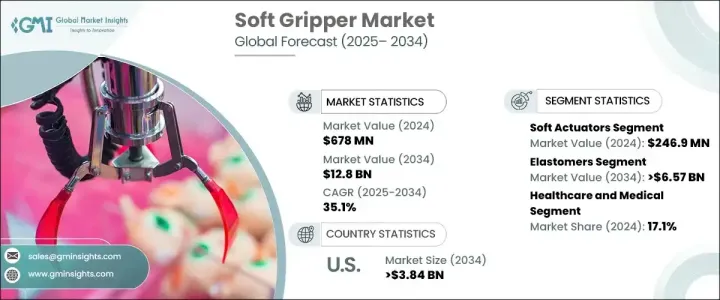
재료 과학 분야의 빠른 기술 혁신 속도는 소프트 그리퍼의 내구성과 성능을 향상시키는 자가 복구, 식품 안전, 재활용 가능한 재료의 개발을 가능하게 하여 시장을 더욱 촉진하고 있습니다. 공동 작업 공간에서 인간과 로봇의 상호 작용을 수반하는 협동 로봇의 부상은 보다 안전하고 적응력이 높은 솔루션을 제공하는 소프트 그리퍼에 대한 수요를 촉진하고 있습니다. 또한, 정부의 로봇 연구에 대한 자금 지원 증가와 다양한 분야의 자동화에 대한 투자 증가는 소프트 그리퍼 기술의 발전과 채택을 가속화하고 있습니다.
| 시장 범위 | |
|---|---|
| 시작 연도 | 2024년 |
| 예측 연도 | 2025-2034년 |
| 시작 금액 | 6억 7,800만 달러 |
| 예상 금액 | 128억 달러 |
| CAGR | 35.1% |
시장은 소프트 센서, 제어 시스템, 전원 공급 장치, 소프트 액추에이터, 기타 등 다양한 구성요소로 분류됩니다. 소프트 액추에이터는 로봇 시스템에서 안전하고 적응력 있는 움직임을 제공하는 데 필수적이며, 2024년에는 2억 4,690만 달러를 차지했습니다. 이러한 액추에이터는 인간과 로봇의 상호 작용에서 정확성과 안전성이 중요한 협동 로봇 시스템에서 특히 가치가 높습니다. 협동 작업용 로봇의 채택이 증가함에 따라 소프트 액추에이터에 대한 수요가 확대되어 전체 시장 확대를 견인할 것으로 예상됩니다.
재료 적용 측면에서 소프트 그리퍼 시장에는 엘라스토머, 젤, 직물 및 기타 재료가 포함됩니다. 높은 탄성과 기계적 반발력으로 유명한 엘라스토머는 2034년까지 65억 7,000만 달러 규모의 시장을 창출할 것으로 예측되는 지배적인 부문입니다. 엘라스토머 복합재료는 로봇공학, 가전제품, 자동화 등의 분야에서 그 효용성을 높이고 있습니다. 이러한 기술 혁신은 소프트 그리퍼가 더 복잡하고 까다로운 작업을 수행할 수 있도록 하는 등 보급을 촉진하고 있습니다.
소프트 그리퍼는 물류 및 창고, 헬스케어 및 의료, 식음료, 농업, 전자, 자동차 및 기타 산업으로 확대되고 있으며, 2024년 17.1%의 점유율을 차지한 헬스케어 및 의료 분야는 외과 수술에 소프트 로봇의 통합으로 인해 혁신적인 성장세를 보일 것으로 예상됩니다. 소프트 그리퍼는 인체에 원활하게 적응하는 유연한 기구를 제공함으로써 최소침습 수술을 용이하게 하고, 정확도를 높이며, 회복 시간을 단축합니다. 또한, 인공 보조기 및 외골격의 기능성을 향상시켜 환자의 이동성 및 재활치료의 성과를 높이고 있습니다.
미국 소프트 그리퍼 시장은 헬스케어, 제조 및 방위 산업에서 로봇 공학 및 자동화에 대한 투자가 증가함에 따라 2034년까지 38억 4,000만 달러에 달할 것으로 예상됩니다. 로봇 공학 연구를 지원하는 정부 지원 프로그램은 소프트 로봇 공학의 지속적인 발전에 기여하고 있으며, 여러 산업 분야에서 소프트 그리퍼 기술의 채택을 더욱 촉진하고 있습니다.
목차
제1장 조사 방법과 조사 범위
제2장 주요 요약
제3장 업계 인사이트
- 산업 생태계 분석
- 업계에 대한 영향요인
- 성장 촉진요인
- 제조·물류의 자동화 상승
- 헬스케어와 의약품의 채용 증가
- E-Commerce와 창고 자동화 확대
- 코봇(협동 로봇) 수요 증가
- 가전제품 제조에서의 사용 급증
- 업계의 잠재적 리스크·과제
- 기존 로봇과의 통합 과제
- 한정된 부하 용량과 강도 제약
- 성장 촉진요인
- 잠재 성장력 분석
- 규제 상황
- 기술 동향
- 향후 시장 동향
- 격차 분석
- Porters 분석
- PESTEL 분석
제4장 경쟁 구도
- 소개
- 기업 시장 점유율 분석
- 주요 시장 기업 경쟁 분석
- 경쟁 포지셔닝 매트릭스
- 전략 대시보드
- 시장 추정과 예측 : 구성요소별, 2021-2034년(백만 달러·유닛)
- 소프트 액추에이터
- 소프트 센서
- 제어 시스템
- 전원
- 기타
- 시장 추정과 예측 : 재료별, 2021-2034년(백만 달러·유닛)
- 엘라스토머
- 겔
- 패브릭
- 기타
- 시장 추정과 예측 : 용도별, 2021-2034년(백만 달러·유닛)
- 헬스케어·의료
- 식품 및 음료
- 물류·창고
- 자동차
- 농업
- 일렉트로닉스
- 기타
제5장 시장 추정과 예측 : 지역별, 2021-2034년
- 주요 동향
- 북미
- 미국
- 캐나다
- 유럽
- 독일
- 영국
- 프랑스
- 스페인
- 이탈리아
- 네덜란드
- 아시아태평양
- 중국
- 인도
- 일본
- 호주
- 한국
- 라틴아메리카
- 브라질
- 멕시코
- 아르헨티나
- 중동 및 아프리카
- 사우디아라비아
- 남아프리카공화국
- 아랍에미리트
제6장 기업 개요
- Applied Robotics(Effecto)
- ATI Industrial Automation
- Destaco
- Festo AG
- Gimatic
- KUKA Robotics
- OnRobot A/S
- PRONAL
- Robotiq Inc
- Rochu Robotics
- Schmalz
- SCHUNK SE &Co. KG
- SMC Corporation
- Soft Robot Technology Co., Ltd.
- SoftGripping GmbH
- TESOLLO INC
- Weiss Robotics
- Yaskawa Electric Corporation
- Zimmer Group
The Global Soft Gripper Market generated USD 678 million in 2024 and is anticipated to grow at a remarkable CAGR of 35.1% between 2025 and 2034. This exponential growth is fueled by ongoing advancements in soft robotics and the rising demand for automation across industries such as food and beverage, healthcare, and logistics. As industries increasingly rely on automation to enhance operational efficiency and ensure safety, the adoption of soft grippers has gained significant traction. Soft grippers offer a unique advantage by mimicking the dexterity and adaptability of human hands, allowing them to handle delicate and irregularly shaped objects with precision. Their application spans across multiple industries, from food handling and packaging to advanced medical procedures and prosthetics.
The rapid pace of innovation in materials science has further propelled the market by enabling the development of self-healing, food-safe, and recyclable materials that enhance the durability and performance of soft grippers. The rise of collaborative robotics, which involves human-robot interaction in shared workspaces, is driving the demand for soft grippers that offer safer and more adaptive solutions. Furthermore, increased government funding for robotics research and growing investments in automation across diverse sectors are accelerating the evolution and adoption of soft gripper technology.
| Market Scope | |
|---|---|
| Start Year | 2024 |
| Forecast Year | 2025-2034 |
| Start Value | $678 Million |
| Forecast Value | $12.8 Billion |
| CAGR | 35.1% |
The market is segmented by various components, including soft sensors, control systems, power sources, soft actuators, and others. Soft actuators, essential for providing safe and adaptive motion in robotic systems, accounted for USD 246.9 million in 2024. These actuators are particularly valuable in collaborative robotic systems where precision and safety in human-robot interaction are critical. As the adoption of collaborative robots continues to rise, the demand for soft actuators is expected to grow, driving overall market expansion.
In terms of material usage, the soft gripper market includes elastomers, gels, fabrics, and other materials. Elastomers, known for their high elasticity and mechanical resilience, are the dominant segment and are projected to generate USD 6.57 billion by 2034. Ongoing advancements in elastomer composites are enhancing their effectiveness in applications across robotics, consumer electronics, and automation. These innovations are driving widespread adoption and enabling soft grippers to perform more complex and demanding tasks.
The application landscape of soft grippers spans across logistics and warehousing, healthcare and medical, food and beverage, agriculture, electronics, automotive, and other industries. The healthcare and medical segment, which held a 17.1% share in 2024, is witnessing transformative growth due to the integration of soft robotics in surgical procedures. Soft grippers facilitate minimally invasive surgeries by offering flexible instruments that adapt seamlessly to the human body, enhancing precision and reducing recovery times. Additionally, they are improving the functionality of prosthetics and exoskeletons, thereby enhancing mobility and rehabilitation outcomes for patients.
The U.S. soft gripper market is expected to generate USD 3.84 billion by 2034, driven by increased investments in robotics and automation across healthcare, manufacturing, and defense sectors. Government-funded programs supporting robotics research are contributing to continuous advancements in soft robotics, further boosting the adoption of soft gripper technology across multiple industries.
Table of Contents
Chapter 1 Methodology and Scope
- 1.1 Market scope and definitions
- 1.2 Research design
- 1.2.1 Research approach
- 1.2.2 Data collection methods
- 1.3 Base estimates and calculations
- 1.3.1 Base year calculation
- 1.3.2 Key trends for market estimation
- 1.4 Forecast model
- 1.5 Primary research and validation
- 1.5.1 Primary sources
- 1.5.2 Data mining sources
Chapter 2 Executive Summary
- 2.1 Industry 360° synopsis
Chapter 3 Industry Insights
- 3.1 Industry ecosystem analysis
- 3.2 Industry impact forces
- 3.2.1 Growth drivers
- 3.2.1.1 Rising automation in manufacturing & logistics
- 3.2.1.2 Increasing adoption in healthcare & pharmaceuticals
- 3.2.1.3 Expanding E-commerce & warehouse automation
- 3.2.1.4 Rising demand for cobots (collaborative robots)
- 3.2.1.5 Surge in use in consumer electronics manufacturing
- 3.2.2 Industry pitfalls and challenges
- 3.2.2.1 Integration challenges associated with existing robotics
- 3.2.2.2 Limited Load Capacity & Strength Constraints
- 3.2.1 Growth drivers
- 3.3 Growth potential analysis
- 3.4 Regulatory landscape
- 3.5 Technology landscape
- 3.6 Future market trends
- 3.7 Gap analysis
- 3.8 Porter's analysis
- 3.9 PESTEL analysis
Chapter 4 Competitive Landscape, 2024
- 4.1 Introduction
- 4.2 Company market share analysis
- 4.3 Competitive analysis of major market players
- 4.4 Competitive positioning matrix
- 4.5 Strategy dashboard
- 4.6 Market Estimates & Forecast, By Component, 2021 – 2034 (USD Million and Units)
- 4.7 Soft actuators
- 4.8 Soft sensors
- 4.9 Control systems
- 4.10 Power sources
- 4.11 Others
- 4.12 Market estimates & forecast, By Material, 2021 – 2034 (USD Million and Units)
- 4.13 Elastomers
- 4.14 Gels
- 4.15 Fabrics
- 4.16 Others
- 4.17 Market estimates & forecast, By Application, 2021 – 2034 (USD Million and Units)
- 4.18 Healthcare and medical
- 4.19 Food and beverage
- 4.20 Logistics and warehousing
- 4.21 Automotive
- 4.22 Agriculture
- 4.23 Electronics
- 4.24 Others
Chapter 5 Market Estimates and Forecast, By Region, 2021 – 2034 (USD Million and Units)
- 5.1 Key trends
- 5.2 North America
- 5.2.1 U.S.
- 5.2.2 Canada
- 5.3 Europe
- 5.3.1 Germany
- 5.3.2 UK
- 5.3.3 France
- 5.3.4 Spain
- 5.3.5 Italy
- 5.3.6 Netherlands
- 5.4 Asia Pacific
- 5.4.1 China
- 5.4.2 India
- 5.4.3 Japan
- 5.4.4 Australia
- 5.4.5 South Korea
- 5.5 Latin America
- 5.5.1 Brazil
- 5.5.2 Mexico
- 5.5.3 Argentina
- 5.6 Middle East and Africa
- 5.6.1 Saudi Arabia
- 5.6.2 South Africa
- 5.6.3 UAE
Chapter 6 Company Profiles
- 6.1 Applied Robotics (Effecto)
- 6.2 ATI Industrial Automation
- 6.3 Destaco
- 6.4 Festo AG
- 6.5 Gimatic
- 6.6 KUKA Robotics
- 6.7 OnRobot A/S
- 6.8 PRONAL
- 6.9 Robotiq Inc
- 6.10 Rochu Robotics
- 6.11 Schmalz
- 6.12 SCHUNK SE & Co. KG
- 6.13 SMC Corporation
- 6.14 Soft Robot Technology Co., Ltd.
- 6.15 SoftGripping GmbH
- 6.16 TESOLLO INC
- 6.17 Weiss Robotics
- 6.18 Yaskawa Electric Corporation
- 6.19 Zimmer Group