

|
시장보고서
상품코드
1721458
재사용 가능 제로 웨이스트 포장 시장 기회, 성장 촉진요인, 산업 동향 분석 및 예측(2025-2034년)Reusable Zero Waste Packaging Market Opportunity, Growth Drivers, Industry Trend Analysis, and Forecast 2025 - 2034 |
||||||

세계의 재사용 가능 제로 웨이스트 포장 시장은 2024년에 4억 2,210만 달러로 평가되었고, CAGR 10.1%를 나타내 2034년까지는 11억 달러에 이를 것으로 예측됩니다.
이 성장의 원동력이 되고 있는 것은 환경에 대한 관심 증가, 규제의 강화, 지속가능성 목표에 대한 기업의 책임감 증가 등입니다. 머티리얼 리사이클 및 클리닝 기술의 첨단은 재사용 가능 포장을 보다 경제적이고 효율적으로 만들고 환경과 수익 모두에 이익을 제공하는 솔루션을 제공합니다. 게다가 기후 변화를 둘러싼 사회적 의식의 고조와 폐기물 삭감에 대한 관심 증가가 식품 및 음료, 화장품, E-Commerce 등의 주요 부문에서 순환형 포장 모델에 대한 수요를 뒷받침하고 있습니다.
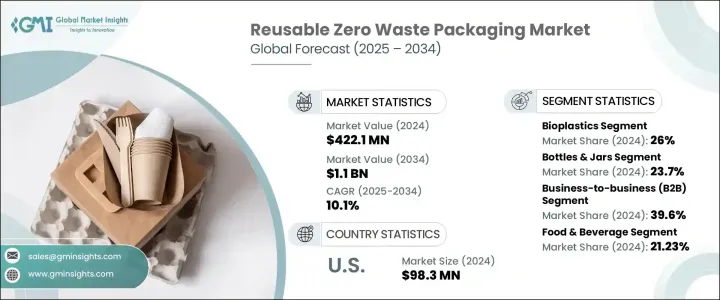
이 변화의 원동력이 되는 재료도 변화하고 있습니다. 특히 바이오플라스틱은 시장의 리더로서 대두해, 2024년에는 26%의 점유율을 차지하고, 2034년까지의 CAGR은 12.3%를 나타낼 것으로 예측되고 있습니다. 바이오플라스틱과 함께 유리, 실리콘, 대나무, 천 등의 재료도 그 내구성과 재활용성에서 인기를 끌고 있습니다.
| 시장 범위 | |
|---|---|
| 시작 연도 | 2024년 |
| 예측 연도 | 2025-2034년 |
| 시작 금액 | 4억 2,210만 달러 |
| 예측 금액 | 11억 달러 |
| CAGR | 10.1% |
포장 분야에서는 병과 자가 2024년에 1억 10만 달러를 차지했고 2034년까지 연평균 복합 성장률(CAGR) 10.7%를 나타낼 것으로 추정됩니다. 폐기물을 줄이고 브랜드 충성도를 높이는 동시에 제품의 지속가능성 발자국을 넓히고 있습니다.
미국의 재사용 가능 제로 웨이스트 포장 시장은 2024년에 9,830만 달러를 창출했고 2034년까지 11.8%의 연평균 복합 성장률(CAGR)을 나타내 강력하게 성장할 것으로 예측되고 있습니다. 이러한 노력은 환경 목표를 지원할뿐만 아니라 장기적인 비용 절감과 물류 강화로 이어질 것입니다.
세계의 재사용 가능 제로 웨이스트 포장 시장 주요 기업은 WestRock, Amcor, Mondi, Crown Holdings, ORBIS Corporation, NEFAB GROUP, Ball Corporation, Smurfit Kappa, Tetra Pak 등이 있습니다. 지위를 강화하기 위해 이러한 기업은 반품 물류 최적화, 내구성 있는 포장 솔루션에 대한 투자, 폐쇄 루프 생태계를 구축하기 위한 B2B 파트너십 육성에 주력하고 있습니다. 라이프사이클을 감시하기 위해 디지털 추적 시스템을 통합하여 보다 나은 재고 관리를 위해 스마트 라벨링을 도입하고 있습니다.
목차
제1장 조사 방법과 범위
제2장 주요 요약
제3장 업계 인사이트
- 업계 생태계 분석
- 공급업체 매트릭스
- 이익률 분석
- 기술 및 혁신 환경
- 특허 분석
- 주요 뉴스와 대처
- 업계에 미치는 영향요인
- 성장 촉진요인
- 정부 규제 강화
- 소비자의 환경 의식의 고조
- 기업의 지속가능성에 대한 노력
- 순환형 경제의 도입
- 지구환경의 과제
- 업계의 잠재적 리스크 및 과제
- 높은 재료비
- 불충분한 재활용 인프라
- 성장 촉진요인
- 성장 가능성 분석
- Porter's Five Forces 분석
- PESTEL 분석
- 장래 시장 동향
- 규제 상황
제4장 시장 추계·예측 : 재료 유형별(2021-2034년)
- 주요 동향
- 금속
- 유리
- 실리콘
- 섬유
- 목재 및 대나무
- 바이오플라스틱
제5장 시장 추계·예측 : 포장 형태별(2025-2034년)
- 주요 동향
- 병 및 자
- 박스 및 용기
- 파우치 및 가방
- 컵 및 텀블러
- 랩 및 필름
- 상자 및 팔레트
제6장 시장 추계·예측 : 유통 모델별(2021-2034년)
- 주요 동향
- 기업 간 거래(B2B)
- 기업 간 소비자(B2C)
- 리필 및 구독
제7장 시장 추계·예측 : 최종 용도별(2021-2034년)
- 주요 동향
- 산업
- 자동차
- 식품 및 음료
- 헬스케어
- 전자상거래
- 소비재
- 운송
- 기타
제8장 시장 추계·예측 : 지역별(2021-2034년)
- 주요 동향
- 북미
- 미국
- 캐나다
- 유럽
- 독일
- 영국
- 프랑스
- 스페인
- 이탈리아
- 기타 유럽
- 아시아태평양
- 일본
- 중국
- 인도
- 한국
- 호주 및 뉴질랜드
- 기타 아시아태평양
- 라틴아메리카
- 브라질
- 멕시코
- 기타 라틴아메리카
- 중동 및 아프리카
- 남아프리카
- 아랍에미리트(UAE)
- 사우디아라비아
- 기타 중동 및 아프리카
제9장 기업 프로파일
- Tetra Pak
- Ball Corporation
- Amcor
- WestRock
- Smurfit Kappa
- Crown Holdings
- Mondi
- ORBIS Corporation
- NEFAB GROUP
- PPS Midlands Limited
- Tri-pack Packaging Systems Ltd.
- Amatech, Inc.
- Schoeller Allibert
- Pragmatic Semiconductor
- TIPA Compostable Packaging
- Vytal
- Enviu
- hey circle
- Algramo
The Global Reusable Zero Waste Packaging Market was valued at USD 422.1 million in 2024 and is estimated to grow at a CAGR of 10.1% to reach USD 1.1 billion by 2034. This growth is driven by a combination of rising environmental concerns, stricter regulations, and increasing corporate responsibility toward sustainability goals. As businesses strive to meet eco-conscious consumer expectations, there's a significant push to move away from single-use packaging in favor of more sustainable solutions. This market shift is not only driven by environmental concerns but also by growing corporate accountability. Advances in material recycling and cleaning technologies are making reusable packaging more affordable and efficient, offering a solution that benefits both the environment and the bottom line. Furthermore, the increasing public awareness around climate change and the growing focus on waste reduction are fueling demand for circular packaging models across key sectors like food & beverage, cosmetics, and e-commerce.
The materials driving this change are shifting as well. In particular, bioplastics have emerged as a market leader, commanding a 26% share in 2024 and projected to grow at a CAGR of 12.3% through 2034. As a renewable and compostable alternative to traditional plastics, bioplastics are helping to replace petroleum-based packaging solutions. Alongside bioplastics, materials such as glass, silicone, bamboo, and fabric are becoming popular for their durability and recyclability. This shift is not just about adopting eco-friendly materials but also about fostering innovation in next-generation packaging that supports lifecycle usage and end-of-life recovery, a key tenet of zero-waste principles.
| Market Scope | |
|---|---|
| Start Year | 2024 |
| Forecast Year | 2025-2034 |
| Start Value | $422.1 Million |
| Forecast Value | $1.1 Billion |
| CAGR | 10.1% |
In the packaging segment, bottles and jars accounted for USD 100.1 million in 2024, growing at a CAGR of 10.7% through 2034. This growth is largely due to the adoption of these containers in high-end product lines within cosmetics and beverages. Brands are increasingly using closed-loop programs that encourage customers to return used packaging for reuse, reducing waste and boosting brand loyalty while extending the sustainability footprint of their products.
The U.S. Reusable Zero Waste Packaging Market generated USD 98.3 million in 2024 and is anticipated to grow at a strong CAGR of 11.8% through 2034. Numerous large-scale retailers and e-commerce platforms have launched pilot programs that feature refillable and returnable packaging systems, which have shown promising results in reducing packaging waste. These initiatives not only support environmental goals but also lead to long-term cost savings and enhanced logistics. The growth in the U.S. market is further fueled by public support and favorable regulatory policies.
Leading players in the Global Reusable Zero Waste Packaging Market include WestRock, Amcor, Mondi, Crown Holdings, ORBIS Corporation, NEFAB GROUP, Ball Corporation, Smurfit Kappa, and Tetra Pak. To strengthen their positions, these companies are focusing on optimizing return logistics, investing in durable packaging solutions, and fostering B2B partnerships to create closed-loop ecosystems. Many are also integrating digital tracking systems to monitor the lifecycle of reusable assets and introducing smart labeling for better inventory management. By partnering with sustainability-focused retailers and scaling circular packaging programs, they are poised to lead the market toward a more sustainable future.
Table of Contents
Chapter 1 Methodology & Scope
- 1.1 Market scope & definitions
- 1.2 Research design
- 1.2.1 Research approach
- 1.2.2 Data collection methods
- 1.3 Base estimates & calculations
- 1.3.1 Base year calculation
- 1.3.2 Key trends for market estimation
- 1.4 Forecast model
- 1.5 Primary research and validation
- 1.5.1 Primary sources
- 1.5.2 Data mining sources
Chapter 2 Executive Summary
- 2.1 Industry 3600 synopsis
Chapter 3 Industry Insights
- 3.1 Industry ecosystem analysis
- 3.2 Vendor matrix
- 3.3 Profit margin analysis
- 3.4 Technology & innovation landscape
- 3.5 Patent analysis
- 3.6 Key news and initiatives
- 3.7 Industry impact forces
- 3.7.1 Growth drivers
- 3.7.1.1 Increasing governmental regulation
- 3.7.1.2 Growing consumer eco awareness
- 3.7.1.3 Corporate sustainability commitments
- 3.7.1.4 Circular economy adoption
- 3.7.1.5 Global environmental challenges
- 3.7.2 Industry pitfalls & challenges
- 3.7.2.1 High material costs
- 3.7.2.2 Inadequate recycling infrastructure
- 3.7.1 Growth drivers
- 3.8 Growth potential analysis
- 3.9 Porter’s analysis
- 3.10 PESTEL analysis
- 3.11 Future market trends
- 3.12 Regulatory landscape
Chapter 4 Market Estimates and Forecast, By Material Type, 2021 - 2034 (USD Million & thousand units)
- 4.1 Key trends
- 4.2 Metal
- 4.3 Glass
- 4.4 Silicone
- 4.5 Fabric
- 4.6 Wood & bamboo
- 4.7 Bioplastics
Chapter 5 Market Estimates and Forecast, By Packaging Type, 2025 - 2034 (USD Million & thousand units)
- 5.1 Key trends
- 5.2 Bottles & jars
- 5.3 Boxes & containers
- 5.4 Pouches & bags
- 5.5 Cups & tumblers
- 5.6 Wraps & films
- 5.7 Crates & pallets
Chapter 6 Market Estimates and Forecast, By Distribution Model, 2021 - 2034 (USD Million & thousand units)
- 6.1 Key trends
- 6.2 Business-to-Business (B2B)
- 6.3 Business-to-Consumer (B2C)
- 6.4 Refill & Subscription-Based
Chapter 7 Market Estimates and Forecast, By End Use, 2021 - 2034 (USD Million & thousand units)
- 7.1 Key trends
- 7.2 Industrial
- 7.3 Automotive
- 7.4 Food & beverage
- 7.5 Healthcare
- 7.6 E-commerce
- 7.7 Consumer goods
- 7.8 Transportation
- 7.9 Others
Chapter 8 Market Estimates and Forecast, By Region, 2021 - 2034 (USD Million & thousand units)
- 8.1 Key trends
- 8.2 North America
- 8.2.1 U.S.
- 8.2.2 Canada
- 8.3 Europe
- 8.3.1 Germany
- 8.3.2 UK
- 8.3.3 France
- 8.3.4 Spain
- 8.3.5 Italy
- 8.3.6 Rest of Europe
- 8.4 Asia Pacific
- 8.4.1 Japan
- 8.4.2 China
- 8.4.3 India
- 8.4.4 South Korea
- 8.4.5 ANZ
- 8.4.6 Rest of Asia Pacific
- 8.5 Latin America
- 8.5.1 Brazil
- 8.5.2 Mexico
- 8.5.3 Rest of Latin America
- 8.6 Middle East and Africa
- 8.6.1 South Africa
- 8.6.2 UAE
- 8.6.3 Saudi Arabia
- 8.6.4 Rest of Middle East and Africa
Chapter 9 Company Profiles
- 9.1 Tetra Pak
- 9.2 Ball Corporation
- 9.3 Amcor
- 9.4 WestRock
- 9.5 Smurfit Kappa
- 9.6 Crown Holdings
- 9.7 Mondi
- 9.8 ORBIS Corporation
- 9.9 NEFAB GROUP
- 9.10 PPS Midlands Limited
- 9.11 Tri-pack Packaging Systems Ltd.
- 9.12 Amatech, Inc.
- 9.13 Schoeller Allibert
- 9.14 Pragmatic Semiconductor
- 9.15 TIPA Compostable Packaging
- 9.16 Vytal
- 9.17 Enviu
- 9.18 hey circle
- 9.19 Algramo


