|
시장보고서
상품코드
1740997
대형 가스 터빈 시장 : 시장 기회, 성장 촉진요인, 산업 동향 분석 및 예측(2025-2034년)Heavy Duty Gas Turbine Market Opportunity, Growth Drivers, Industry Trend Analysis, and Forecast 2025 - 2034 |
||||||

세계의 대형 가스 터빈 시장 규모는 2024년에는 115억 달러로 평가되었고, CAGR 5.2%로 성장할 전망이며, 2034년에는 194억 달러에 이를 것으로 추정되고 있습니다.
이 성장은 환경 지속가능성에 대한 노력, 보다 깨끗한 대체 에너지에 대한 세계의 뒷받침, 신뢰성있는 전력 솔루션에 대한 수요의 고조가 맞물려 초래되고 있습니다. 세계 각국이 석탄에 대한 의존을 줄이고 신재생 에너지로의 이행을 추진하는 가운데, 가스 모닥불 터빈은 이 이행에 불가결한 중간 기술이 되고 있습니다. 이러한 터빈은 전력 공급의 신뢰성을 해치지 않으면서 에너지 전환을 지원하는 유연하고 저배출 가스 솔루션을 제공합니다. 세계 전력 소비의 증가와 터빈 설계의 대폭적인 기술 진보가 시장의 수요를 더욱 끌어올리고 있습니다. 또한 안정적인 출력을 유지하면서 기존 에너지 인프라와 원활하게 통합할 수 있는 가스 터빈의 적응성으로 가스 터빈은 국가 및 지역 에너지 전략의 중요한 구성 요소로 자리 잡고 있습니다.

대형 가스 터빈 시장은 천연가스에 대한 의존도가 높아지고 있어 가스 탐사와 관련 인프라 개발에 대한 투자가 증가하고 있습니다. 이 동향은 특히 마이크로그리드와 원격지 에너지 네트워크 등 분산형 전력 시스템 등 다양한 분야에서 터빈 수요를 가속화하고 있습니다. 이러한 시스템은 본격적인 화력 발전소를 필요로 하지 않고 비용 대비 효과가 높고 효율적인 에너지 공급을 목표로 하는 지역에서 더욱 요구되고 있습니다. 공기를 압축해 연료와 조합해 고압가스를 발생시키는 원리로 작동하는 가스 터빈은 뛰어난 열효율로 효율적인 에너지 출력을 만들어냅니다. 다양한 지리적 및 경제적 조건 하에서 작동하는 범용성과 능력으로 가스 터빈은 세계 에너지 수요를 충족시키는 중요한 솔루션이 되고 있습니다.
| 시장 범위 | |
|---|---|
| 시작 연도 | 2024년 |
| 예측 연도 | 2025-2034년 |
| 시작 금액 | 115억 달러 |
| 예측 금액 | 194억 달러 |
| CAGR | 5.2% |
정격 출력 50kW 미만의 터빈은 2034년까지 CAGR 5.5%로 큰 성장을 이룰 전망입니다. 이들 소형 터빈은 신뢰성과 효율이 가장 중요한 소규모 산업 셋업과 분산형 에너지 시스템으로 인기가 높아지고 있습니다. 송전망에 대한 의존을 최소화하면서 안정적인 전력을 국지적으로 공급할 수 있기 때문에 원격지나 비전화 지역에서 특히 유용합니다. 게다가 피크 수요시나 정전시에 신뢰할 수 있는 전력을 확보하는 백업 솔루션으로서 중요 인프라에서 널리 이용되고 있습니다.
오픈 사이클 가스 터빈 분야도 시장 성장에 크게 공헌할 것으로 예상되며, 2034년 시장 규모는 25억 달러로 추정되고 있습니다. 설계와 연소 기술의 진보로 연료 효율의 향상 및 배출량의 저감이 실현되어 이산화탄소 배출량의 삭감을 목표로 하는 전력회사나 산업계에 있어서, 이러한 터빈은 보다 매력적인 것이 되고 있습니다. 오픈사이클 가스 터빈은 피커 플랜트나 계통 변동의 균형을 맞추기 위한 고속응답 에너지 시스템 등 신속한 기동시간과 운용의 유연성이 요구되는 용도로 특히 유익합니다.
미국에서 대형 가스 터빈 시장은 2024년에 27억 달러에 이른 것으로 평가되고 있습니다. 이러한 성장은 보다 깨끗한 발전을 추진하고 산업계의 이산화탄소 배출량 삭감을 추진하는 엄격한 규제 틀에 기인합니다. 따라서 전력회사와 산업계에서는 성능 기준을 충족시킬 뿐만 아니라 진화하는 배출 규제에도 적합한 차세대 터빈 기술의 채택이 진행되고 있습니다.
이 시장의 주요 기업으로는 Siemens Energy, GE Vernova, Capstone Green Energy, Solar Turbines, Rolls Royce, Vericor, Flex Energy Solutions, Mitsubishi Heavy Industries, Destinus Energy, MAN Energy Solutions, Ansaldo Energia, Kawasaki Heavy Industries, Harbin Electric, Doosan, Bharat Heavy Electricals, Nanjing Turbine and Electric Machinery, 및 Baker Hughes 등이 있습니다. 경쟁력을 유지하기 위해 이러한 기업은 터빈 효율, 하이브리드 시스템 통합, 저출력 기술 혁신에 주력하고 있습니다. 또한 예지보전을 위한 디지털 플랫폼도 인기를 끌고 있어 다운타임 단축과 기기 수명 연장에 도움이 되고 있습니다. 전략적 파트너십, 신흥 시장 진출, 연료 플렉시블 터빈 개발은 이 신흥국 시장의 성장을 촉진하는 주요 전략입니다.
목차
제1장 조사 방법 및 범위
제2장 주요 요약
제3장 업계 인사이트
- 생태계 분석
- 트럼프 정권의 관세 분석
- 무역에 미치는 영향
- 무역량의 혼란
- 보복 조치
- 업계에 미치는 영향
- 공급측의 영향(원재료)
- 주요 원재료의 가격 변동
- 공급망 재구성
- 생산 비용에 미치는 영향
- 수요측의 영향(판매가격)
- 최종 시장에 대한 가격 전달
- 시장 점유율 동향
- 소비자의 반응 패턴
- 공급측의 영향(원재료)
- 영향을 받는 주요 기업
- 전략적인 업계 대응
- 공급망 재구성
- 가격 설정 및 제품 전략
- 정책관여
- 전망 및 향후 검토 사항
- 무역에 미치는 영향
- 규제 상황
- 업계에 미치는 영향요인
- 성장 촉진요인
- 업계의 잠재적 위험 및 과제
- 성장 가능성 분석
- Porter's Five Forces 분석
- PESTEL 분석
제4장 경쟁 구도
- 서문
- 전략적 전망
- 혁신 및 지속가능성의 정세
제5장 시장 규모 및 예측 : 용량별(2021-2034년)
- 주요 동향
- 50kW 미만
- 50kW-500kW 이상
- 500kW-1MW
- 1MW-30MW 이상
- 30MW-70MW 이상
- 70MW-200MW 이상
- 200MW 이상
제6장 시장 규모 및 예측 : 기술별(2021-2034년)
- 주요 동향
- 오픈 사이클
- 복합 사이클
제7장 시장 규모 및 예측 : 용도별(2021-2034년)
- 주요 동향
- 발전소
- 석유 및 가스
- 프로세스 플랜트
- 항공
- 해양
- 기타
제8장 시장 규모 및 예측 : 지역별(2021-2034년)
- 주요 동향
- 북미
- 미국
- 캐나다
- 멕시코
- 유럽
- 영국
- 프랑스
- 독일
- 러시아
- 이탈리아
- 네덜란드
- 핀란드
- 그리스
- 폴란드
- 스웨덴
- 아시아태평양
- 중국
- 호주
- 일본
- 한국
- 인도네시아
- 태국
- 말레이시아
- 중동 및 아프리카
- 사우디아라비아
- 아랍에미리트(UAE)
- 카타르
- 쿠웨이트
- 오만
- 이집트
- 튀르키예
- 바레인
- 이라크
- 요르단
- 남아프리카
- 나이지리아
- 알제리
- 라틴아메리카
- 브라질
- 아르헨티나
- 페루
- 칠레
제9장 기업 프로파일
- Ansaldo Energia
- Baker Hughes
- Bharat Heavy Electricals
- Capstone Green Energy
- Doosan
- Flex Energy Solutions
- GE Vernova
- Harbin Electric
- Kawasaki Heavy Industries
- MAN Energy Solutions
- Mitsubishi Heavy Industries
- Nanjing Turbine and Electric Machinery
- Destinus Energy
- Rolls Royce
- Siemens Energy
- Solar Turbines
- Vericor
- Wartsila
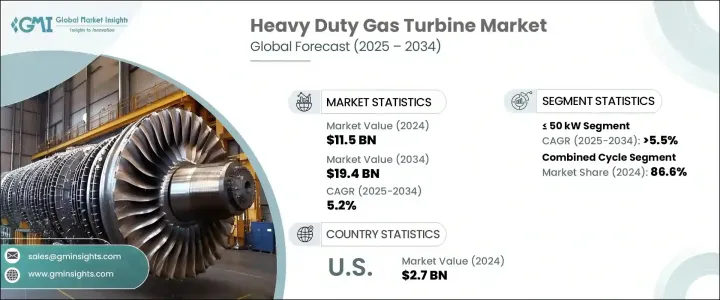
The Global Heavy Duty Gas Turbine Market was valued at USD 11.5 billion in 2024 and is estimated to grow at a CAGR of 5.2% to reach USD 19.4 billion by 2034. This growth is being driven by a combination of environmental sustainability initiatives, the global push for cleaner energy alternatives, and the increasing demand for reliable power solutions. As nations worldwide reduce their dependency on coal and transition toward renewable energy, gas-fired turbines are becoming an essential intermediate technology in this shift. These turbines offer a flexible, low-emission solution that supports the energy transition without compromising the reliability of the power supply. The growing global consumption of electricity, paired with significant technological advancements in turbine design, is further driving market demand. Additionally, the adaptability of gas turbines to integrate seamlessly with existing energy infrastructures while maintaining stable power output positions them as a key component in national and regional energy strategies.
The heavy-duty gas turbine market is also benefiting from the growing reliance on natural gas, spurred by increasing investments in gas exploration and the development of related infrastructure. This trend is accelerating demand for turbines across various sectors, particularly in decentralized power systems such as microgrids and remote energy networks. These systems are increasingly sought after in regions aiming for cost-effective and efficient energy delivery without the need for full-scale thermal plants. By operating on the principle of compressing air and combining it with fuel to create high-pressure gas, gas turbines generate efficient energy output with impressive thermal efficiency. Their versatility and ability to perform in diverse geographical and economic conditions make them a critical solution in meeting global energy needs.
| Market Scope | |
|---|---|
| Start Year | 2024 |
| Forecast Year | 2025-2034 |
| Start Value | $11.5 Billion |
| Forecast Value | $19.4 Billion |
| CAGR | 5.2% |
Turbines rated at <= 50 kW are set to experience significant growth, with a CAGR of 5.5% through 2034. These smaller turbines are becoming increasingly popular in small-scale industrial setups and decentralized energy systems, where reliability and efficiency are paramount. Their ability to provide stable, localized power while minimizing grid dependency makes them especially valuable in remote or off-grid regions. In addition, they are widely used in critical infrastructure as backup solutions, ensuring reliable power during peak demand or outages.
The open-cycle gas turbine segment is also expected to contribute significantly to market growth, with an estimated market value of USD 2.5 billion by 2034. Advances in design and combustion technology have led to increased fuel efficiency and lower emissions, making these turbines more attractive to utilities and industries seeking to reduce their carbon footprint. Open-cycle gas turbines are particularly beneficial in applications that require quick startup times and operational flexibility, such as peaker plants and fast-response energy systems that help balance grid variability.
In the United States, the heavy-duty gas turbine market is expected to reach USD 2.7 billion in 2024. This growth is largely driven by stringent regulatory frameworks that promote cleaner power generation and push for a reduction in industrial carbon emissions. As such, utilities and industries are increasingly adopting next-generation turbine technologies that not only meet performance standards but also comply with evolving emissions regulations.
Key players in the market include Siemens Energy, GE Vernova, Capstone Green Energy, Solar Turbines, Rolls Royce, Vericor, Flex Energy Solutions, Mitsubishi Heavy Industries, Destinus Energy, MAN Energy Solutions, Ansaldo Energia, Kawasaki Heavy Industries, Harbin Electric, Doosan, Bharat Heavy Electricals, Nanjing Turbine and Electric Machinery, and Baker Hughes. To stay competitive, these companies are focusing on innovations in turbine efficiency, hybrid system integration, and low-emission technologies. Digital platforms for predictive maintenance are also gaining traction, helping to reduce downtime and extend equipment life. Strategic partnerships, expansion into emerging markets, and the development of fuel-flexible turbines are key strategies for fostering growth in this evolving industry.
Table of Contents
Chapter 1 Methodology & Scope
- 1.1 Research design
- 1.2 Market estimates & forecast parameters
- 1.3 Forecast calculation
- 1.4 Data sources
- 1.4.1 Primary
- 1.4.2 Secondary
- 1.4.2.1 Paid
- 1.4.2.2 Public
- 1.5 Market definitions
Chapter 2 Executive Summary
- 2.1 Industry synopsis, 2021 - 2034
Chapter 3 Industry Insights
- 3.1 Industry ecosystem analysis
- 3.2 Trump administration tariffs analysis
- 3.2.1 Impact on trade
- 3.2.1.1 Trade volume disruptions
- 3.2.1.2 Retaliatory measures
- 3.2.2 Impact on the industry
- 3.2.2.1 Supply-side impact (raw materials)
- 3.2.2.1.1 Price volatility in key materials
- 3.2.2.1.2 Supply chain restructuring
- 3.2.2.1.3 Production cost implications
- 3.2.2.2 Demand-side impact (selling price)
- 3.2.2.2.1 Price transmission to end markets
- 3.2.2.2.2 Market share dynamics
- 3.2.2.2.3 Consumer response patterns
- 3.2.2.1 Supply-side impact (raw materials)
- 3.2.3 Key companies impacted
- 3.2.4 Strategic industry responses
- 3.2.4.1 Supply chain reconfiguration
- 3.2.4.2 Pricing and product strategies
- 3.2.4.3 Policy engagement
- 3.2.5 Outlook and future considerations
- 3.2.1 Impact on trade
- 3.3 Regulatory landscape
- 3.4 Industry impact forces
- 3.4.1 Growth drivers
- 3.4.2 Industry pitfalls & challenges
- 3.5 Growth potential analysis
- 3.6 Porter's analysis
- 3.6.1 Bargaining power of suppliers
- 3.6.2 Bargaining power of buyers
- 3.6.3 Threat of new entrants
- 3.6.4 Threat of substitutes
- 3.7 PESTEL analysis
Chapter 4 Competitive Landscape, 2025
- 4.1 Introduction
- 4.2 Strategic outlook
- 4.3 Innovation & sustainability landscape
Chapter 5 Market Size and Forecast, By Capacity, 2021 - 2034 (USD Million & MW)
- 5.1 Key trends
- 5.2 ≤ 50 kW
- 5.3 > 50 kW to 500 kW
- 5.4 > 500 kW to 1 MW
- 5.5 > 1 MW to 30 MW
- 5.6 > 30 MW to 70 MW
- 5.7 > 70 MW to 200 MW
- 5.8 > 200 MW
Chapter 6 Market Size and Forecast, By Technology, 2021 - 2034 (USD Million & MW)
- 6.1 Key trends
- 6.2 Open cycle
- 6.3 Combined cycle
Chapter 7 Market Size and Forecast, By Application, 2021 - 2034 (USD Million & MW)
- 7.1 Key trends
- 7.2 Power plants
- 7.3 Oil & gas
- 7.4 Process plants
- 7.5 Aviation
- 7.6 Marine
- 7.7 Others
Chapter 8 Market Size and Forecast, By Region, 2021 - 2034 (USD Million & MW)
- 8.1 Key trends
- 8.2 North America
- 8.2.1 U.S.
- 8.2.2 Canada
- 8.2.3 Mexico
- 8.3 Europe
- 8.3.1 UK
- 8.3.2 France
- 8.3.3 Germany
- 8.3.4 Russia
- 8.3.5 Italy
- 8.3.6 Netherlands
- 8.3.7 Finland
- 8.3.8 Greece
- 8.3.9 Poland
- 8.3.10 Sweden
- 8.4 Asia Pacific
- 8.4.1 China
- 8.4.2 Australia
- 8.4.3 Japan
- 8.4.4 South Korea
- 8.4.5 Indonesia
- 8.4.6 Thailand
- 8.4.7 Malaysia
- 8.5 Middle East & Africa
- 8.5.1 Saudi Arabia
- 8.5.2 UAE
- 8.5.3 Qatar
- 8.5.4 Kuwait
- 8.5.5 Oman
- 8.5.6 Egypt
- 8.5.7 Turkey
- 8.5.8 Bahrain
- 8.5.9 Iraq
- 8.5.10 Jordan
- 8.5.11 South Africa
- 8.5.12 Nigeria
- 8.5.13 Algeria
- 8.6 Latin America
- 8.6.1 Brazil
- 8.6.2 Argentina
- 8.6.3 Peru
- 8.6.4 Chile
Chapter 9 Company Profiles
- 9.1 Ansaldo Energia
- 9.2 Baker Hughes
- 9.3 Bharat Heavy Electricals
- 9.4 Capstone Green Energy
- 9.5 Doosan
- 9.6 Flex Energy Solutions
- 9.7 GE Vernova
- 9.8 Harbin Electric
- 9.9 Kawasaki Heavy Industries
- 9.10 MAN Energy Solutions
- 9.11 Mitsubishi Heavy Industries
- 9.12 Nanjing Turbine and Electric Machinery
- 9.13 Destinus Energy
- 9.14 Rolls Royce
- 9.15 Siemens Energy
- 9.16 Solar Turbines
- 9.17 Vericor
- 9.18 Wartsila