

|
시장보고서
상품코드
1750283
발전소용 대형 가스 터빈 시장 : 기회, 성장 촉진요인, 산업 동향 분석, 예측(2025-2034년)Power Plants Heavy Duty Gas Turbine Market Opportunity, Growth Drivers, Industry Trend Analysis, and Forecast 2025 - 2034 |
||||||

세계의 발전소용 대형 가스 터빈 시장 규모는 2024년 47억 달러로 평가되었으며, CAGR 5.4%로 성장하여 2034년까지 80억 달러에 이를 것으로 추정됩니다.
신뢰할 수 있는 온디맨드 에너지원으로의 전환이 진행됨에 따라 대기업과 공공기관은 가스 기반 발전에 대한 투자를 늘리고 있습니다. 에너지 안전 보장에 대한 관심 증가는 천연가스 탐사와 무역활동의 활성화와 함께 시장을 더욱 형성하고 있습니다. 또한, 각국이 에너지 인프라의 효율 향상을 목표로 하는 가운데, 디지털 기술과 스마트 그리드 솔루션의 통합이 채용을 가속하고 있습니다.
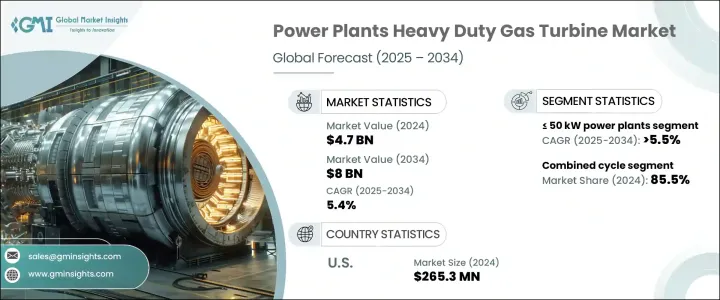
대형 가스 터빈은 운전의 유연성과 환경 컴플라이언스를 유지하면서 고출력을 생산하는 능력으로 지지되고 있습니다. 터빈 블레이드를 맹렬한 속도로 회전시켜 놀라운 발전 성능을 발휘합니다.
| 시장 범위 | |
|---|---|
| 시작 연도 | 2024년 |
| 예측 연도 | 2025-2034년 |
| 시작 금액 | 47억 달러 |
| 예측 금액 | 80억 달러 |
| CAGR | 5.4% |
50kW 미만 발전소용 대형 가스 터빈 분야는 분산 에너지 시스템에서의 채용 증가로 2034년까지 연평균 복합 성장률(CAGR) 5.5% 이상으로 성장할 것으로 예측됩니다. 이러한 컴팩트한 유닛은 신뢰할 수 있는 자가 발전이 필요한 산업과 원격지의 시설에 필수적인 것으로 입증되었습니다. 산업 시설이 이산화탄소 배출량을 최소화하면서 중단 없는 전력을 확보하는 비용 효율적인 방법을 모색하는 동안 이러한 저용량 터빈의 매력은 점점 강해지고 있습니다.
기술 측면에서 가스 터빈과 증기 터빈을 이용하여 동일한 연료원으로부터 최대한의 에너지를 끌어내는 콤바인드 사이클 시스템의 뛰어난 효율성이 원동력이 되어 콤바인드 사이클 부문의 2024년 점유율은 85.5%에 이르렀습니다.
미국의 대형 가스 터빈 시장의 2024년 시장 규모는 2억 6,530만 달러로, 신뢰성이 높고 깨끗한 전력에 대한 동국 수요 가속을 반영하고 있습니다. 석탄에서 천연가스로의 광범위한 전환이 이러한 성장의 주요 요인입니다.
시장의 주요 기업으로는 Wartsila, Siemens Energy, GE Vernova, Vericor, MAN Energy Solutions, Flex Energy Solutions, Nanjing Steam Turbine Motor(Group), Solar Turbines, 가와사키 중공업, Capstone Green Energy Holdings, Baker Hughes, 미쓰비시 중공업 Royce, Bharat Heavy Electricals, Destinus Energy, Ansaldo Energia, Harbin Electric 등이 있습니다. 시장에서의 존재감을 높이기 위해 기업은 몇 가지 전략에 주력하고 있습니다. 포트폴리오 확장이 포함되어 있으며, 각 기업은 공공시설 및 산업 시설에 유연하게 도입할 수 있도록 모듈형 터빈 설계에 투자하고 있습니다.
목차
제1장 조사 방법과 범위
제2장 주요 요약
제3장 업계 인사이트
- 생태계 분석
- 규제 상황
- 업계에 미치는 영향요인
- 성장 촉진요인
- 업계의 잠재적 위험 및 과제
- 성장 가능성 분석
- Porter's Five Forces 분석
- PESTEL 분석
제4장 경쟁 구도
- 소개
- 전략적 대시보드
- 전략적 노력
- 기업의 시장 점유율 분석
- 경쟁 벤치마킹
- 혁신과 지속가능성의 정세
제5장 시장 규모와 예측 : 용량별, 2021-2034년
- 주요 동향
- 50kW 미만
- 50-500kW 이상
- 500kW-1MW
- 1-30MW 이상
- 30-70MW 이상
- 70-200MW 이상
- 200MW 이상
제6장 시장 규모와 예측 : 기술별, 2021-2034년
- 주요 동향
- 오픈 사이클
- 복합 사이클
제7장 시장 규모와 예측 : 지역별, 2021-2034년
- 주요 동향
- 북미
- 미국
- 캐나다
- 멕시코
- 유럽
- 영국
- 프랑스
- 독일
- 러시아
- 이탈리아
- 네덜란드
- 핀란드
- 그리스
- 덴마크
- 루마니아
- 폴란드
- 스웨덴
- 아시아태평양
- 중국
- 호주
- 일본
- 한국
- 인도네시아
- 태국
- 말레이시아
- 방글라데시
- 중동 및 아프리카
- 사우디아라비아
- 아랍에미리트(UAE)
- 카타르
- 쿠웨이트
- 오만
- 이집트
- 튀르키예
- 바레인
- 이라크
- 요르단
- 남아프리카
- 나이지리아
- 알제리
- 케냐
- 가나
- 라틴아메리카
- 브라질
- 아르헨티나
- 페루
- 칠레
제8장 기업 프로파일
- Ansaldo Energia
- Baker Hughes
- Bharat Heavy Electricals
- Capstone Green Energy Holdings
- Destinus Energy
- Doosan Enerbility
- Flex Energy Solutions
- GE Vernova
- Harbin Electric
- Kawasaki Heavy Industries
- MAN Energy Solutions
- Mitsubishi Heavy Industries
- Nanjing Steam Turbine Motor(Group)
- Rolls Royce
- Siemens Energy
- Solar Turbines
- Vericor
- Wartsila
The Global Power Plants Heavy Duty Gas Turbine Market was valued at USD 4.7 billion in 2024 and is estimated to grow at a CAGR of 5.4% to reach USD 8 billion by 2034, driven by the ongoing shift toward reliable, on-demand energy sources is prompting major utilities and public sector bodies to increase investments in gas-based power generation. This market is gaining momentum with the rising demand for peak-load and base-load energy solutions, driven by rapid industrialization and global energy needs. The growing focus on energy security, combined with increasing natural gas exploration and trade activity, is further shaping the market. Additionally, as countries look to enhance the efficiency of their energy infrastructure, integrating digital technologies and smart grid solutions is accelerating adoption. The push for lower emissions and reduced capital expenditure on large-scale plants supports the transition toward gas turbine-based generation.
Heavy-duty gas turbines are favored for their ability to produce high power outputs while maintaining operational flexibility and environmental compliance. These turbines function through an advanced process of air compression, fuel mixing, and ignition, resulting in high-pressure gases that spin turbine blades at intense speeds, delivering remarkable power generation performance. The industry has faced some headwinds, particularly due to trade tariffs introduced recently, which raised the cost of key input materials such as aluminum, steel, and specialized alloys.
| Market Scope | |
|---|---|
| Start Year | 2024 |
| Forecast Year | 2025-2034 |
| Start Value | $4.7 Billion |
| Forecast Value | $8 Billion |
| CAGR | 5.4% |
The <= 50 kW power plants heavy-duty gas turbine segment is forecasted to grow at a CAGR of over 5.5% through 2034, driven by its increasing adoption in decentralized energy systems. These compact units are proving vital for industries and remote facilities that require reliable, on-site power generation. Their flexibility, operational efficiency, and compact footprint make them ideal for distributed power networks where grid connectivity is limited or inconsistent. As industrial facilities seek cost-effective ways to ensure uninterrupted power while minimizing carbon output, the appeal of these lower-capacity turbines continues to strengthen.
On the technology front, the combined cycle segment held 85.5% share in 2024, driven by the superior efficiency of combined cycle systems, which utilize gas and steam turbines to extract maximum energy from the same fuel source. These systems significantly cut emissions and optimize fuel usage, aligning with environmental goals and stringent regulatory standards. The shift toward clean energy generation prompts utilities and independent power producers to phase out conventional coal plants and adopt combined cycle solutions as a more sustainable alternative.
United States Heavy Duty Gas Turbine Market was valued at USD 265.3 million in 2024, reflecting the country's accelerating demand for reliable and clean electricity. Rapid industrialization, the rise of energy-intensive sectors like artificial intelligence data centers, and the widespread transition from coal to natural gas are key contributors to this growth. The increasing availability of shale gas has further strengthened the U.S. position as a natural gas powerhouse, enabling stable supply chains for gas turbine operations.
Leading companies in the market include Wartsila, Siemens Energy, GE Vernova, Vericor, MAN Energy Solutions, Flex Energy Solutions, Nanjing Steam Turbine Motor (Group), Solar Turbines, Kawasaki Heavy Industries, Capstone Green Energy Holdings, Baker Hughes, Mitsubishi Heavy Industries, Doosan Enerbility, Rolls Royce, Bharat Heavy Electricals, Destinus Energy, Ansaldo Energia, Harbin Electric, and others. To enhance market presence, companies are focusing on several strategies. These include expanding their service portfolios through digital upgrades and remote monitoring solutions, which optimize turbine performance and reduce operational downtime. Firms invest in modular turbine designs for flexible deployment across utility and industrial sites. Strategic collaborations with energy providers and long-term supply agreements are helping solidify market positions.
Table of Contents
Chapter 1 Methodology & Scope
- 1.1 Research design
- 1.2 Market estimates & forecast parameters
- 1.3 Forecast calculation
- 1.4 Data sources
- 1.4.1 Primary
- 1.4.2 Secondary
- 1.4.2.1 Paid
- 1.4.2.2 Public
- 1.5 Market definitions
Chapter 2 Executive Summary
- 2.1 Industry synopsis, 2021 - 2034
Chapter 3 Industry Insights
- 3.1 Industry ecosystem analysis
- 3.2 Regulatory landscape
- 3.3 Industry impact forces
- 3.3.1 Growth drivers
- 3.3.2 Industry pitfalls & challenges
- 3.4 Growth potential analysis
- 3.5 Porter's analysis
- 3.5.1 Bargaining power of suppliers
- 3.5.2 Bargaining power of buyers
- 3.5.3 Threat of new entrants
- 3.5.4 Threat of substitutes
- 3.6 PESTEL analysis
Chapter 4 Competitive Landscape, 2025
- 4.1 Introduction
- 4.2 Strategic dashboard
- 4.3 Strategic initiatives
- 4.4 Company market share analysis, 2024
- 4.5 Competitive benchmarking
- 4.6 Innovation & sustainability landscape
Chapter 5 Market Size and Forecast, By Capacity, 2021 - 2034 (USD Million & MW)
- 5.1 Key trends
- 5.2 ≤ 50 kW
- 5.3 > 50 kW to 500 kW
- 5.4 > 500 kW to 1 MW
- 5.5 > 1 MW to 30 MW
- 5.6 > 30 MW to 70 MW
- 5.7 > 70 MW to 200 MW
- 5.8 > 200 MW
Chapter 6 Market Size and Forecast, By Technology, 2021 - 2034 (USD Million & MW)
- 6.1 Key trends
- 6.2 Open cycle
- 6.3 Combined cycle
Chapter 7 Market Size and Forecast, By Region, 2021 - 2034 (USD Million & MW)
- 7.1 Key trends
- 7.2 North America
- 7.2.1 U.S.
- 7.2.2 Canada
- 7.2.3 Mexico
- 7.3 Europe
- 7.3.1 UK
- 7.3.2 France
- 7.3.3 Germany
- 7.3.4 Russia
- 7.3.5 Italy
- 7.3.6 Netherlands
- 7.3.7 Finland
- 7.3.8 Greece
- 7.3.9 Denmark
- 7.3.10 Romania
- 7.3.11 Poland
- 7.3.12 Sweden
- 7.4 Asia Pacific
- 7.4.1 China
- 7.4.2 Australia
- 7.4.3 Japan
- 7.4.4 South Korea
- 7.4.5 Indonesia
- 7.4.6 Thailand
- 7.4.7 Malaysia
- 7.4.8 Bangladesh
- 7.5 Middle East & Africa
- 7.5.1 Saudi Arabia
- 7.5.2 UAE
- 7.5.3 Qatar
- 7.5.4 Kuwait
- 7.5.5 Oman
- 7.5.6 Egypt
- 7.5.7 Turkey
- 7.5.8 Bahrain
- 7.5.9 Iraq
- 7.5.10 Jordan
- 7.5.11 South Africa
- 7.5.12 Nigeria
- 7.5.13 Algeria
- 7.5.14 Kenya
- 7.5.15 Ghana
- 7.6 Latin America
- 7.6.1 Brazil
- 7.6.2 Argentina
- 7.6.3 Peru
- 7.6.4 Chile
Chapter 8 Company Profiles
- 8.1 Ansaldo Energia
- 8.2 Baker Hughes
- 8.3 Bharat Heavy Electricals
- 8.4 Capstone Green Energy Holdings
- 8.5 Destinus Energy
- 8.6 Doosan Enerbility
- 8.7 Flex Energy Solutions
- 8.8 GE Vernova
- 8.9 Harbin Electric
- 8.10 Kawasaki Heavy Industries
- 8.11 MAN Energy Solutions
- 8.12 Mitsubishi Heavy Industries
- 8.13 Nanjing Steam Turbine Motor (Group)
- 8.14 Rolls Royce
- 8.15 Siemens Energy
- 8.16 Solar Turbines
- 8.17 Vericor
- 8.18 Wartsilä


