

|
시장보고서
상품코드
1741009
에이프런 버스 시장 : 시장 기회, 촉진요인, 업계 동향 분석 및 예측(2025-2034년)Apron Buses Market Opportunity, Growth Drivers, Industry Trend Analysis, and Forecast 2025 - 2034 |
||||||

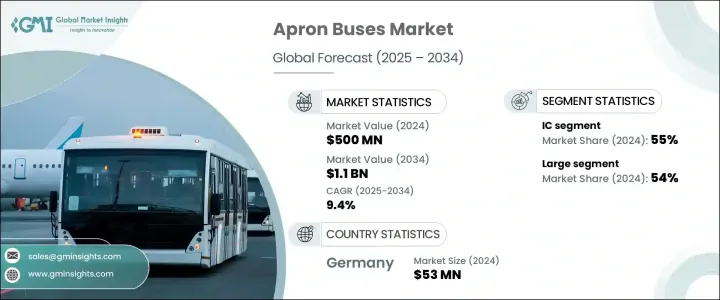
세계의 에이프런 버스 시장은 2024년에 5억 달러로 평가되었고, CAGR 9.4%로 성장할 전망이며, 2034년에는 11억 달러에 이를 것으로 추정됩니다.
성장의 주요 원동력은 터미널과 항공기 간의 효율적인 여객 수송에 대한 수요가 높아지고, 진행 중인 공항 인프라의 근대화, 지속 가능한 항공 관행을 목표로 하는 세계의 움직임입니다. 공항이 계속 확장되어 여객수의 증가에 대응함에 따라, 에이프런 버스는 지상 업무의 합리화, 턴 어라운드 타임의 강화, 공항 전체의 효율 개선에 불가결한 것이 되고 있습니다. 선진국 시장, 신흥국 시장을 막론하고 공항은 항공 교통량 급증에 대응하기 위해 새로운 항공기에 투자하고 있으며, 스마트하고 지속 가능한 커넥티드 모빌리티 솔루션에 대한 관심이 높아지고 있습니다. 이산화탄소 배출량 삭감에 대한 공항 압력의 고조는 보다 환경 친화적인 수송 시스템을 추진하는 정부의 이니셔티브와 맞물려 지상 지원 업무의 형태를 바꾸고 있습니다. 전기 및 하이브리드 기술, 실시간 운행 관리 시스템, 승객 중심의 혁신 통합은 에이프런 버스의 전망을 재형성하고 향후 10년간 강력한 성장을 위해 자리매김하고 있습니다.
공항의 지상 교통기관에서는 환경규제 강화 및 탄소중립의 야심적인 목표를 달성하기 위해 보다 깨끗한 모빌리티 솔루션을 우선하는 사업자가 늘어나고 있으며, 전동화가 중요한 전환기를 맞이하고 있습니다. 전동대체기는 배출 삭감에 공헌하며 공항 전체의 이산화탄소 배출량 감소에 기여합니다. 그 채용은, 제로 에미션의 지상 차량에 대한 정부 보조금 및 장려금, 종래의 IC버스를 장기적으로 운용하는데 있어서 비교적 비싸지는 연료비 상승 등의 정책적 지원에 의해서 뒷받침되고 있습니다. 또, 전동 에이프런 버스는, 가동 부품이 적은 것에 의한 유지 보수 비용의 대폭적인 저감, 유성 부품 미사용, 회생 기술에 의한 브레이크 마모 저감 등, 환경에 대한 영향에 머무르지 않는 운용상의 메리트도 제공합니다.
| 시장 범위 | |
|---|---|
| 시작 연도 | 2024년 |
| 예측 연도 | 2025-2034년 |
| 시작 금액 | 5억 달러 |
| 예측 금액 | 11억 달러 |
| CAGR | 9.4% |
2024년 시장 세분화(에이프런 버스) 시장에서는 내연(IC) 엔진 구동 분야가 55%의 점유율을 차지했습니다. 이 버스들은 비용 대비 효과, 강력한 성능, 다양한 운영 환경에 대한 적응성, 특히 전기 인프라가 아직 발달하지 않았거나 이용할 수 없는 곳이기 때문에 많은 공항에서 여전히 선호되는 선택지가 되고 있습니다. 다운 타임을 최소화하면서 공항의 대형 운용에 대응할 수 있는 것으로부터, 선진국 시장에서도 신흥국 시장에서도, 지상 지원 차량에 빼놓을 수 없는 존재가 되고 있습니다. IC 엔진을 탑재한 에이프런 버스는 대규모 인프라 변경을 수반하지 않고 여객 수송량 증가에 대응하기 위해 급속한 차량 증비를 필요로 하는 지역에서 널리 사용되고 있습니다.
운송 능력에서는 대형 에이프런 버스 부문이 2024년에 54%의 점유율을 차지했습니다. 이 대용량 버스는 1회의 이동으로 100명 이상의 승객을 운송하기 때문에 여객 운송량이 많은 국제 공항이나 원격지의 항공기 승강장에 최적입니다. 저상, 넓은 문, 충분한 입식 공간과 같은 설계상의 특징은 신속한 승하차를 지원하고 턴어라운드 시간을 단축하며 터미널 전체의 물류를 개선합니다. 공항에서는 피크 시 운행을 합리화하고 연료비와 인건비를 최소화하면서 차량 크기를 최적화하기 위해 대형 버스에 대한 투자가 늘고 있습니다.
독일의 에이프런 버스 시장은 28%의 점유율을 차지했으며, 2024년에는 5,300만 달러의 매출을 계상했습니다. 세계 정상급 OEM과 최첨단 차량 기술에 힘입어 독일은 고성능, 저배출 가스 에이프런 버스 개발과 수출에서 앞서고 있습니다. EU 그린딜에 대한 약속과 기후 뉴트럴 공항의 비전은 세계 에이프런 버스 시장의 중요한 혁신 허브로서의 지위를 강화하고 있습니다.
세계 에이프런 버스 산업의 주요 기업으로는 Xiamen King Long, Ashok Leyland, BYD Company, AB Volvo, Nandan GSE, Neoplan, Proterra, COBUS Industries, Xinfa 등이 있습니다. 각 회사는 환경 규제를 충족하고 운행 비용을 줄이기 위해 전기자동차와 하이브리드 자동차를 적극적으로 개발, 도입하고 있습니다. 각 회사는, 운행 효율과 승객 체험을 향상시키기 위해서, GPS 추적, 실시간 승객 정보 시스템, 자율 주행 기능을 도입하고 있습니다. 또한 공항 당국 및 기타 이해 관계자와 제휴를 맺고 에이프런 버스 배치를 촉진하여 시장을 확대하고 있습니다.
목차
제1장 조사 방법 및 범위
제2장 주요 요약
제3장 업계 인사이트
- 생태계 분석
- 공급자의 상황
- 부품 공급자
- 원재료 공급자
- 제조업체
- 서비스 제공업체
- 도매업체
- 최종 용도
- 트럼프 정권에 의한 관세에 대한 영향
- 무역에 미치는 영향
- 무역량의 혼란
- 보복 조치
- 업계에 미치는 영향
- 공급측의 영향(원재료)
- 주요 원재료의 가격 변동
- 공급망 재구성
- 생산 비용에 미치는 영향
- 수요측의 영향(판매가격)
- 최종 시장에 대한 가격 전달
- 시장 점유율 동향
- 소비자의 반응 패턴
- 공급측의 영향(원재료)
- 전략적인 업계 대응
- 공급망 재구성
- 가격 설정 및 제품 전략
- 무역에 미치는 영향
- 이익률 분석
- 기술 및 혁신의 상황
- 특허 분석
- 주요 뉴스 및 대처
- 규제 상황
- 영향요인
- 성장 촉진요인
- 세계 항공 여행 증가
- 환경의 지속가능성에 대한 관심 증가
- 공항 인프라 투자 증가
- 스마트 및 커넥티드 기술의 통합
- 업계의 잠재적 위험 및 과제
- 높은 유지 보수 비용
- 공급망의 혼란
- 성장 촉진요인
- 성장 가능성 분석
- Porter's Five Forces 분석
- PESTEL 분석
제4장 경쟁 구도
- 서문
- 기업의 시장 점유율 분석
- 경쟁 포지셔닝 매트릭스
- 전략적 전망 매트릭스
제5장 시장 추계 및 예측 : 추진력별(2021-2034년)
- 주요 동향
- IC
- 디젤
- CNG
- 전기
- 하이브리드
제6장 시장 추계 및 예측 : 용량별(2021-2034년)
- 주요 동향
- 대
- 중
- 소
제7장 시장 추계 및 예측 : 최종 용도별(2021-2034년)
- 주요 동향
- 공항
- 항공사
- 정부 및 방위
제8장 시장 추계 및 예측 : 지역별(2021-2034년)
- 주요 동향
- 북미
- 미국
- 캐나다
- 유럽
- 영국
- 독일
- 프랑스
- 이탈리아
- 스페인
- 러시아
- 북유럽 국가
- 아시아태평양
- 중국
- 인도
- 일본
- 한국
- 호주 및 뉴질랜드
- 동남아시아
- 라틴아메리카
- 브라질
- 멕시코
- 아르헨티나
- 중동 및 아프리카
- 아랍에미리트(UAE)
- 사우디아라비아
- 남아프리카
제9장 기업 프로파일
- AB Volvo
- AMSS GSE
- Ashok Leyland
- BYD Company
- China Leyuan Airspace Investment Manufacturing
- COBUS Industries
- KIITOKORI OY
- MCV Group
- Nandan GSE
- Neoplan
- Panus Assembly
- Proterra
- Shenzhen Wuzhoulong Motors
- Sutlej Motors
- TAM-EUROPE
- Tarmac Aerosave
- Weihai Guangtai Airport Equipment
- Xiamen King Long United Automotive Industry
- Xinfa Airport Equipment
- Zhengzhou Yutong Bus
The Global Apron Buses Market was valued at USD 500 million in 2024 and is estimated to grow at a CAGR of 9.4%, reaching USD 1.1 billion by 2034. Growth is largely driven by rising demand for efficient passenger transport between terminals and aircraft, the ongoing modernization of airport infrastructure, and the global movement toward sustainable aviation practices. As airports continue to expand and adapt to handle higher passenger volumes, apron buses are becoming essential in streamlining ground operations, enhancing turnaround times, and improving overall airport efficiency. Airports across developed and emerging markets are investing in new fleets to support the surge in air traffic, with a growing focus on smart, sustainable, and connected mobility solutions. The increasing pressure on airports to reduce carbon emissions, combined with government initiatives promoting greener transport systems, is reshaping ground support operations. The integration of electric and hybrid technologies, real-time fleet management systems, and passenger-centric innovations is reshaping the apron bus landscape and positioning it for robust growth over the next decade.
The growing preference for electric apron buses marks a significant transition in airport ground transportation as operators prioritize cleaner mobility solutions to meet tightening environmental regulations and ambitious carbon neutrality goals. Electric alternatives contribute to emissions reduction and help airports lower their overall carbon footprint-an increasingly critical benchmark in global aviation sustainability standards. Their adoption is fueled by policy support, including government subsidies and incentives for zero-emission ground vehicles and rising fuel costs that make traditional IC buses more expensive to operate long term. Electric apron buses also offer operational benefits beyond environmental impact, including significantly lower maintenance costs due to fewer moving parts, the absence of oil-based components, and reduced brake wear through regenerative technologies.
| Market Scope | |
|---|---|
| Start Year | 2024 |
| Forecast Year | 2025-2034 |
| Start Value | $500 Million |
| Forecast Value | $1.1 Billion |
| CAGR | 9.4% |
The internal combustion (IC) engine-powered segment held a 55% share in the apron buses market in 2024. These buses remain a preferred option across many airports because of their cost-effectiveness, strong performance, and adaptability to varied operational environments-especially where electric infrastructure is still underdeveloped or unavailable. Their ability to handle heavy-duty airport operations with minimal downtime has kept them an integral component of ground support fleets in both developed and emerging markets. IC-powered apron buses are widely used in regions requiring rapid fleet expansion to meet rising passenger traffic without extensive infrastructure changes.
In terms of capacity, the large-sized apron buses segment accounted for a 54% share in 2024. These high-capacity buses transport over 100 passengers in a single trip, making them ideal for international airports with heavy passenger traffic and remote aircraft stands. Their design features-such as low floors, wide doors, and ample standing space-support faster boarding and unloading, reduce turnaround times, and improve overall terminal logistics. Airports are increasingly investing in larger buses to streamline operations during peak travel hours and optimize fleet size while minimizing fuel and labor costs.
Germany's Apron Bus Market held a 28% share and generated USD 53 million in 2024, driven by its advanced automotive manufacturing base, strong focus on electric mobility, and government policies promoting green airport operations. Backed by world-class OEMs and access to cutting-edge vehicle technologies, Germany leads in the development and export of high-performance, low-emission apron buses. The country's commitment to the EU Green Deal and vision for climate-neutral airports strengthens its position as a key innovation hub within the global apron bus market.
Key players in the global apron bus industry include Xiamen King Long, Ashok Leyland, BYD Company, AB Volvo, Nandan GSE, Neoplan, Proterra, COBUS Industries, and Xinfa. Companies are actively developing and introducing electric and hybrid apron buses to meet environmental regulations and reduce operational costs. They are incorporating GPS tracking, real-time passenger information systems, and autonomous driving features to enhance operational efficiency and passenger experience. Organizations are also forming alliances with airport authorities and other stakeholders to facilitate apron bus deployment and expand market reach.
Table of Contents
Chapter 1 Methodology & Scope
- 1.1 Research design
- 1.1.1 Research approach
- 1.1.2 Data collection methods
- 1.2 Base estimates and calculations
- 1.2.1 Base year calculation
- 1.2.2 Key trends for market estimates
- 1.3 Forecast model
- 1.4 Primary research & validation
- 1.4.1 Primary sources
- 1.4.2 Data mining sources
- 1.5 Market definitions
Chapter 2 Executive Summary
- 2.1 Industry 3600 synopsis, 2021 - 2034
Chapter 3 Industry Insights
- 3.1 Industry ecosystem analysis
- 3.2 Supplier landscape
- 3.2.1 Component supplier
- 3.2.2 Raw material supplier
- 3.2.3 Manufacturer
- 3.2.4 Service provider
- 3.2.5 Distributor
- 3.2.6 End use
- 3.3 Impact of Trump administration tariffs
- 3.3.1 Impact on trade
- 3.3.1.1 Trade volume disruptions
- 3.3.1.2 Retaliatory measures
- 3.3.2 Impact on industry
- 3.3.2.1 Supply-side impact (raw materials)
- 3.3.2.1.1 Price volatility in key materials
- 3.3.2.1.2 Supply chain restructuring
- 3.3.2.1.3 Production cost implications
- 3.3.2.2 Demand-side impact (selling price)
- 3.3.2.2.1 Price transmission to end markets
- 3.3.2.2.2 Market share dynamics
- 3.3.2.2.3 Consumer response patterns
- 3.3.2.1 Supply-side impact (raw materials)
- 3.3.3 Strategic industry responses
- 3.3.3.1 Supply chain reconfiguration
- 3.3.3.2 Pricing and product strategies
- 3.3.1 Impact on trade
- 3.4 Profit margin analysis
- 3.5 Technology & innovation landscape
- 3.6 Patent analysis
- 3.7 Key news & initiatives
- 3.8 Regulatory landscape
- 3.9 Impact forces
- 3.9.1 Growth drivers
- 3.9.1.1 Increasing air travel globally
- 3.9.1.2 Growing focus on environmental sustainability
- 3.9.1.3 Rising investment in airport infrastructure
- 3.9.1.4 Integration of smart & connected technologies
- 3.9.2 Industry pitfalls & challenges
- 3.9.2.1 High maintenance cost
- 3.9.2.2 Supply chain disruption
- 3.9.1 Growth drivers
- 3.10 Growth potential analysis
- 3.11 Porter's analysis
- 3.12 PESTEL analysis
Chapter 4 Competitive Landscape, 2024
- 4.1 Introduction
- 4.2 Company market share analysis
- 4.3 Competitive positioning matrix
- 4.4 Strategic outlook matrix
Chapter 5 Market Estimates & Forecast, By Propulsion, 2021 - 2034 ($Bn, Units)
- 5.1 Key trends
- 5.2 IC
- 5.2.1 Diesel
- 5.2.2 CNG
- 5.3 Electric
- 5.4 Hybrid
Chapter 6 Market Estimates & Forecast, By Capacity, 2021 - 2034 ($Bn, Units)
- 6.1 Key trends
- 6.2 Large
- 6.3 Medium
- 6.4 Small
Chapter 7 Market Estimates & Forecast, By End Use, 2021 - 2034 ($Bn, Units)
- 7.1 Key trends
- 7.2 Airports
- 7.3 Airlines
- 7.4 Government & Defense
Chapter 8 Market Estimates & Forecast, By Region, 2021 - 2034 ($Bn, Units)
- 8.1 Key trends
- 8.2 North America
- 8.2.1 U.S.
- 8.2.2 Canada
- 8.3 Europe
- 8.3.1 UK
- 8.3.2 Germany
- 8.3.3 France
- 8.3.4 Italy
- 8.3.5 Spain
- 8.3.6 Russia
- 8.3.7 Nordics
- 8.4 Asia Pacific
- 8.4.1 China
- 8.4.2 India
- 8.4.3 Japan
- 8.4.4 South Korea
- 8.4.5 ANZ
- 8.4.6 Southeast Asia
- 8.5 Latin America
- 8.5.1 Brazil
- 8.5.2 Mexico
- 8.5.3 Argentina
- 8.6 MEA
- 8.6.1 UAE
- 8.6.2 Saudi Arabia
- 8.6.3 South Africa
Chapter 9 Company Profiles
- 9.1 AB Volvo
- 9.2 AMSS GSE
- 9.3 Ashok Leyland
- 9.4 BYD Company
- 9.5 China Leyuan Airspace Investment Manufacturing
- 9.6 COBUS Industries
- 9.7 KIITOKORI OY
- 9.8 MCV Group
- 9.9 Nandan GSE
- 9.10 Neoplan
- 9.11 Panus Assembly
- 9.12 Proterra
- 9.13 Shenzhen Wuzhoulong Motors
- 9.14 Sutlej Motors
- 9.15 TAM - EUROPE
- 9.16 Tarmac Aerosave
- 9.17 Weihai Guangtai Airport Equipment
- 9.18 Xiamen King Long United Automotive Industry
- 9.19 Xinfa Airport Equipment
- 9.20 Zhengzhou Yutong Bus


