|
시장보고서
상품코드
1750291
열간 압연 및 냉간 마무리 합금 막대강 시장 : 기회, 성장 촉진요인, 산업 동향 분석, 예측(2025-2034년)Hot-Rolled or Cold-Finished Alloy Steel Bars Market Opportunity, Growth Drivers, Industry Trend Analysis, and Forecast 2025 - 2034 |
||||||

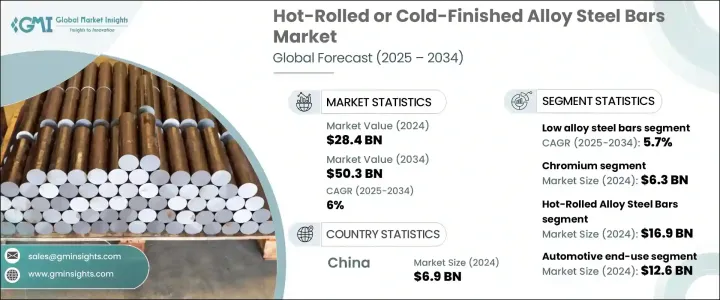
세계의 열간 압연 및 냉간 마무리 합금 막대강 시장 규모는 2024년 284억 달러로, 산업화의 진전과 제조업 확대에 견인되어 CAGR 6%로 성장하여 2034년에는 503억 달러에 이를 것으로 추정되고 있습니다.
산업이 성장함에 따라 합금 막대강과 같은 내구성이 뛰어난 고성능 재료에 대한 수요가 지속적으로 높아지고 있습니다.
이러한 강봉은 다양한 산업에서 매우 중요한 역할을 하고 있으며, 탁월한 강도, 내구성, 가공의 용이성을 제공합니다. 그 범용성은 또한 높은 인장 강도와 내마모성을 필요로 하는 부품의 제조에 이용되는 중기 생산에 또한, 산업계가 우수한 성능과 비용 효율을 제공하는 재료를 요구하는 경향이 강해지고 있기 때문에 강봉 수요는 계속 성장하고 있어 다양한 제조 공정에서 필수적인 부품이 되고 있습니다.
| 시장 범위 | |
|---|---|
| 시작 연도 | 2024년 |
| 예측 연도 | 2025-2034년 |
| 시작 금액 | 284억 달러 |
| 예측 금액 | 503억 달러 |
| CAGR | 6% |
2024년에 106억 달러로 평가된 저합금 막대강 부문은 2025년부터 2034년까지 연평균 복합 성장률(CAGR) 5.7%로 확대할 전망입니다. 저합금 막대강 및 중합금 막대강은 저렴한 가격과 내구성에 의해 자동차, 건설, 중기계 등의 산업에서 널리 사용되고 있습니다.
자동차 부문은 126억 달러를 차지하며 2024년 점유율은 24%로 2034년까지 연평균 복합 성장률(CAGR) 6.1%를 보일 것으로 예측됩니다. 합금 막대강은 특히 강도와 내구성이 중요한 서스펜션 유닛과 연료 시스템 등 자동차 부품의 제조에 필수적입니다. 막대강 수요는 증가하는 경향이 있으며, 자동차 산업이 보다 정교한 연료 시스템과 고성능 서스펜션 유닛으로 전환함에 따라 이러한 재료에 대한 요구가 계속 증가하고 있다고 생각됩니다.
중국의 열간 압연 및 냉간 마감 합금 막대강 2024년 시장 규모는 69억 달러로, 2025년부터 2034년까지 CAGR 5.9%를 보일 것으로 예측됩니다. 최대의 철강 생산 및 수출국의 하나인 중국은 세계의 철강 시장에 있어서 중요한 역할을 하고 있습니다.
세계의 열간 압연 및 냉간 마무리 합금 막대강 업계의 주요 기업으로는 Tata Steel, ArcelorMittal, United States Steel Corporation (U.S. Steel), JFE Steel Corporation, Nippon Steel Corp 등이 포함되어 있습니다. 이러한 기업은 수요에 대응하기 위한 이노베이션에 주력하고 있습니다.
목차
제1장 조사 방법과 범위
제2장 주요 요약
제3장 업계 인사이트
- 생태계 분석
- 밸류체인에 영향을 주는 요인
- 이익률 분석
- 혁신
- 장래의 전망
- 제조업자
- 리셀러
- 트럼프 정권에 의한 관세에 대한 영향
- 무역에 미치는 영향
- 무역량의 혼란
- 보복 조치
- 업계에 미치는 영향
- 공급측의 영향(원재료)
- 주요 원재료의 가격 변동
- 공급망 재구성
- 생산 비용에 미치는 영향
- 수요측의 영향(판매가격)
- 최종 시장에의 가격 전달
- 시장 점유율 동향
- 소비자의 반응 패턴
- 공급측의 영향(원재료)
- 영향을 받는 주요 기업
- 전략적인 업계 대응
- 공급망 재구성
- 가격 설정 및 제품 전략
- 정책관여
- 전망과 향후 검토 사항
- 무역에 미치는 영향
- 무역 통계(HS코드)
- 주요 수출국
- 주요 수입국
- 이익률 분석
- 주요 뉴스와 대처
- 규제 상황
- 영향요인
- 성장 촉진요인
- 자동차 경량화의 급증에 의해 고성능 합금 강봉 수요가 높아지고 있습니다.
- 인프라 확장 프로젝트에 의해 열간 압연 강봉의 사용이 세계적으로 증가하고 있습니다.
- 항공우주 산업의 성장에 의해 정밀 등급의 냉간 마무리 합금봉 수요가 높아지고 있습니다.
- 신재생에너지 프로젝트에 대한 투자 증가가 철근 소비를 지원하고 있습니다.
- 업계의 잠재적 위험 및 과제
- 원재료 가격 변동이 생산 안정성과 이익률에 영향을 미치고 있습니다.
- 주요 산업에 있어서의 복합재나 대체 경량 소재에 대한 대체가 확대되고 있습니다.
- 성장 촉진요인
- 성장 가능성 분석
- Porter's Five Forces 분석
- PESTEL 분석
제4장 경쟁 구도
- 소개
- 기업의 시장 점유율 분석
- 경쟁 포지셔닝 매트릭스
- 전략적 전망 매트릭스
제5장 시장 추계 및 예측 : 구성별, 2021-2034년
- 주요 동향
- 저합금 막대강
- 중합금 막대강
- 고합금 막대강
- 스테인리스 강봉
- 기타
제6장 시장 추계 및 예측 : 합금 원소별, 2021-2034년
- 주요 동향
- 니켈
- 크롬
- 몰리브덴
- 바나듐
- 망간
- 실리콘
- 다원소 합금
- 기타
제7장 시장 추계 및 예측 : 가공 방법별, 2021-2034년
- 주요 동향
- 열간 압연 합금 막대강
- 둥근 막대강
- 사각 막대강
- 육각형 막대강
- 플랫 막대강
- 기타 형상
- 냉간 마무리 합금 막대강
- 냉간 인발봉
- 냉간 압연봉
- 선삭 및 연마된 막대강
- 연마된 막대강
제8장 시장 추계 및 예측 : 최종 용도별, 2021-2034년
- 주요 동향
- 자동차산업
- 파워트레인 부품
- 섀시 부품
- 서스펜션 시스템
- 스티어링 부품
- 변속기 부품
- 항공우주 및 방어
- 항공기 구조 부품
- 착륙 장치 부품
- 엔진 부품
- 방위 장비
- 건설 및 인프라
- 구조 부품
- 보강 용도
- 다리 건설
- 기계설비
- 산업기계
- 농업기계
- 채굴 설비
- 자재관리 기기
- 석유 및 가스 산업
- 드릴링 장비
- 탐사 컴포넌트
- 정제장치
- 발전
- 기존 발전소
- 원자력 발전소
- 재생에너지 기기
- 철도와 교통
- 레일 부품
- 차량
- 중공업
- 조선
- 중장비 제조
- 공구 및 금형 제조
- 절삭 공구
- 금형
- 기타 용도
- 의료기기
- 소비재
- 스포츠 용품
제9장 시장 추계 및 예측 : 지역별, 2021-2034년
- 주요 동향
- 북미
- 미국
- 캐나다
- 유럽
- 영국
- 독일
- 프랑스
- 이탈리아
- 스페인
- 아시아태평양
- 중국
- 인도
- 일본
- 한국
- 호주
- 라틴아메리카
- 브라질
- 멕시코
- 아르헨티나
- 중동 및 아프리카
- 남아프리카
- 사우디아라비아
- 아랍에미리트(UAE)
제10장 기업 프로파일
- ArcelorMittal
- Tata Steel
- Nippon Steel
- JFE Steel
- US Steel
- POSCO
- Steel Dynamics
- Hyundai Steel
- Baosteel
- Thyssenkrupp
- Nucor Corporation
- Sumitomo Metal Industries
- Voestalpine
- China Steel Corporation
- Schmolz Bickenbach
- KOBE Steel
- AK Steel
- Outokumpu
- Severstal
The Global Hot-Rolled or Cold-Finished Alloy Steel Bars Market was valued at USD 28.4 billion in 2024 and is estimated to grow at a CAGR of 6% to reach USD 50.3 billion by 2034, driven by the increasing industrialization and expansion of manufacturing sectors. As industries grow, the demand for durable, high-performance materials like alloy steel bars has consistently risen.
These bars play a pivotal role across various industries, offering exceptional strength, durability, and ease of machinability. In the automotive sector, they are used to produce essential vehicle components, such as suspension parts, engine blocks, and structural elements, where their ability to withstand stress and provide longevity is critical. Similarly, in the construction and infrastructure sectors, these bars are fundamental in reinforcing concrete structures and creating durable frameworks for buildings, bridges, and roads. Their versatility also extends to heavy machinery production utilized in manufacturing components that require high tensile strength and resistance to wear and tear. The demand for these bars continues to grow as industries increasingly seek materials that offer superior performance and cost efficiency, making them an essential component in various manufacturing processes.
| Market Scope | |
|---|---|
| Start Year | 2024 |
| Forecast Year | 2025-2034 |
| Start Value | $28.4 Billion |
| Forecast Value | $50.3 Billion |
| CAGR | 6% |
The low-alloy steel bars segment, valued at USD 10.6 billion in 2024, is expected to expand at a CAGR of 5.7% between 2025 and 2034. Low and medium-alloy steel bars are widely used in industries such as automotive, construction, and heavy machinery, due to their affordability and durability. These alloys are highly valued for their strength, versatility, and cost-effectiveness, making them an attractive option for manufacturers seeking materials that balance performance and price.
The automotive sector accounted for USD 12.6 billion, with a share of 24% in 2024 and is anticipated to grow at a CAGR of 6.1% through 2034. Alloy steel bars are integral to producing vehicle components, particularly in suspension units and fuel systems, where strength and durability are critical. With the global automotive production on the rise, the demand for high-quality steel bars is set to increase. The need for these materials will also continue to grow as the automotive industry moves towards more advanced fuel systems and better-performing suspension units.
China Hot-Rolled or Cold-Finished Alloy Steel Bars Market was valued at USD 6.9 billion in 2024 and is projected to grow at a 5.9% CAGR from 2025 to 2034. As one of the largest producers and exporters of steel, China plays a crucial role in the global steel market. The country's ability to produce and export massive quantities of steel is reshaping global supply chains, although the overproduction of steel has led to challenges in domestic markets, particularly real estate, while shifting focus toward international markets.
The leading players in the Global Hot-Rolled or Cold-Finished Alloy Steel Bars Industry include Tata Steel, ArcelorMittal, United States Steel Corporation (U.S. Steel), JFE Steel Corporation, and Nippon Steel Corp. These companies are focusing on innovations to enhance steel production processes, improve product quality, and meet the evolving demands of industries such as automotive, construction, and heavy machinery. To strengthen their market positions, companies like Tata Steel and ArcelorMittal are focusing on expanding their production capabilities and diversifying their product offerings. By investing in advanced manufacturing technologies, they aim to increase production efficiency and meet the rising demand for alloy steel bars.
Table of Contents
Chapter 1 Methodology & Scope
- 1.1 Market scope & definitions
- 1.2 Base estimates & calculations
- 1.3 Forecast calculations
- 1.4 Data sources
- 1.4.1 Primary
- 1.4.2 Secondary
- 1.4.2.1 Paid sources
- 1.4.2.2 Public sources
Chapter 2 Executive Summary
- 2.1 Industry synopsis, 2021-2034
Chapter 3 Industry Insights
- 3.1 Industry ecosystem analysis
- 3.1.1 Factor affecting the value chain
- 3.1.2 Profit margin analysis
- 3.1.3 Disruptions
- 3.1.4 Future outlook
- 3.1.5 Manufacturers
- 3.1.6 Distributors
- 3.2 Trump administration tariffs
- 3.2.1 Impact on trade
- 3.2.1.1 Trade volume disruptions
- 3.2.1.2 Retaliatory measures
- 3.2.2 Impact on the industry
- 3.2.2.1 Supply-side impact (raw materials)
- 3.2.2.1.1 Price volatility in key materials
- 3.2.2.1.2 Supply chain restructuring
- 3.2.2.1.3 Production cost implications
- 3.2.2.2 Demand-side impact (selling price)
- 3.2.2.2.1 Price transmission to end markets
- 3.2.2.2.2 Market share dynamics
- 3.2.2.2.3 Consumer response patterns
- 3.2.2.1 Supply-side impact (raw materials)
- 3.2.3 Key companies impacted
- 3.2.4 Strategic industry responses
- 3.2.4.1 Supply chain reconfiguration
- 3.2.4.2 Pricing and product strategies
- 3.2.4.3 Policy engagement
- 3.2.5 Outlook and future considerations
- 3.2.1 Impact on trade
- 3.3 Trade statistics (hs code)
- 3.3.1 Major exporting countries
- 3.3.2 Major importing countries
- 3.4 Profit margin analysis
- 3.5 Key news & initiatives
- 3.6 Regulatory landscape
- 3.7 Impact forces
- 3.7.1 Growth drivers
- 3.7.1.1 Surge in automotive lightweighting boosting demand for high-performance alloy steel bars.
- 3.7.1.2 Infrastructure expansion projects globally increasing usage of hot-rolled steel bars.
- 3.7.1.3 Aerospace industry's growth fueling need for precision-grade cold-finished alloy bars.
- 3.7.1.4 Rising investments in renewable energy projects supporting steel bar consumption.
- 3.7.2 Industry pitfalls & challenges
- 3.7.2.1 Volatile raw material prices impacting production stability and profit margins.
- 3.7.2.2 Growing substitution by composite and alternative lightweight materials in key industries.
- 3.7.1 Growth drivers
- 3.8 Growth potential analysis
- 3.9 Porter's analysis
- 3.10 PESTEL analysis
Chapter 4 Competitive Landscape, 2024
- 4.1 Introduction
- 4.2 Company market share analysis
- 4.3 Competitive positioning matrix
- 4.4 Strategic outlook matrix
Chapter 5 Market Estimates & Forecast, By Composition, 2021-2034 (USD Billion) (Kilo Tons)
- 5.1 Key trends
- 5.2 Low alloy steel bars
- 5.3 Medium alloy steel bars
- 5.4 High alloy steel bars
- 5.5 Stainless steel bars
- 5.6 Others
Chapter 6 Market Estimates & Forecast, By Alloying Elements, 2021-2034 (USD Billion) (Kilo Tons)
- 6.1 Key trends
- 6.2 Nickel
- 6.3 Chromium
- 6.4 Molybdenum
- 6.5 Vanadium
- 6.6 Manganese
- 6.7 Silicon
- 6.8 Multi-element alloys
- 6.9 Others
Chapter 7 Market Estimates & Forecast, By Processing Method, 2021-2034 (USD Billion) (Kilo Tons)
- 7.1 Key trends
- 7.2 Hot-rolled alloy steel bars
- 7.2.1 Round bars
- 7.2.2 Square bars
- 7.2.3 Hexagonal bars
- 7.2.4 Flat bars
- 7.2.5 Other shapes
- 7.3 Cold-finished alloy steel bars
- 7.3.1 Cold-drawn bars
- 7.3.2 Cold-rolled bars
- 7.3.3 Turned and polished bars
- 7.3.4 Ground and polished bars
Chapter 8 Market Estimates & Forecast, By End Use, 2021-2034 (USD Billion) (Kilo Tons)
- 8.1 Key trends
- 8.2 Automotive industry
- 8.2.1 Powertrain components
- 8.2.2 Chassis components
- 8.2.3 Suspension systems
- 8.2.4 Steering components
- 8.2.5 Transmission components
- 8.3 Aerospace and defense
- 8.3.1 Aircraft structural components
- 8.3.2 Landing gear components
- 8.3.3 Engine components
- 8.3.4 Defense equipment
- 8.4 Construction and infrastructure
- 8.4.1 Structural components
- 8.4.2 Reinforcement applications
- 8.4.3 Bridge construction
- 8.5 Machinery and equipment
- 8.5.1 Industrial machinery
- 8.5.2 Agricultural equipment
- 8.5.3 Mining equipment
- 8.5.4 Material handling equipment
- 8.6 Oil and gas industry
- 8.6.1 Drilling equipment
- 8.6.2 Exploration components
- 8.6.3 Refining equipment
- 8.7 Power generation
- 8.7.1 Conventional power plants
- 8.7.2 Nuclear power plants
- 8.7.3 Renewable energy equipment
- 8.8 Railway and transportation
- 8.8.1 Rail components
- 8.8.2 Rolling stock
- 8.9 Heavy engineering
- 8.9.1 Shipbuilding
- 8.9.2 Heavy equipment manufacturing
- 8.10 Tool and die manufacturing
- 8.10.1 Cutting tools
- 8.10.2 Dies and molds
- 8.11 Other applications
- 8.11.1 Medical equipment
- 8.11.2 Consumer goods
- 8.11.3 Sports equipment
Chapter 9 Market Estimates & Forecast, By Region, 2021-2034 (USD Billion) (Kilo Tons)
- 9.1 Key trends
- 9.2 North America
- 9.2.1 U.S.
- 9.2.2 Canada
- 9.3 Europe
- 9.3.1 UK
- 9.3.2 Germany
- 9.3.3 France
- 9.3.4 Italy
- 9.3.5 Spain
- 9.4 Asia Pacific
- 9.4.1 China
- 9.4.2 India
- 9.4.3 Japan
- 9.4.4 South Korea
- 9.4.5 Australia
- 9.5 Latin America
- 9.5.1 Brazil
- 9.5.2 Mexico
- 9.5.3 Argentina
- 9.6 MEA
- 9.6.1 South Africa
- 9.6.2 Saudi Arabia
- 9.6.3 UAE
Chapter 10 Company Profiles
- 10.1 ArcelorMittal
- 10.2 Tata Steel
- 10.3 Nippon Steel
- 10.4 JFE Steel
- 10.5 U.S. Steel
- 10.6 POSCO
- 10.7 Steel Dynamics
- 10.8 Hyundai Steel
- 10.9 Baosteel
- 10.10 Thyssenkrupp
- 10.11 Nucor Corporation
- 10.12 Sumitomo Metal Industries
- 10.13 Voestalpine
- 10.14 China Steel Corporation
- 10.15 Schmolz + Bickenbach
- 10.16 KOBE Steel
- 10.17 AK Steel
- 10.18 Outokumpu
- 10.19 Severstal