|
시장보고서
상품코드
1750438
7075-T6 알루미늄 시장 기회, 성장 촉진요인, 산업 동향 분석 및 예측(2025-2034년)7075-T6 Aluminum Market Opportunity, Growth Drivers, Industry Trend Analysis, and Forecast 2025 - 2034 |
||||||

세계의 7075-T6 알루미늄 시장은 2024년에는 111억 달러로 평가되었으며 CAGR 6.5%를 나타내 2034년까지는 205억 달러에 이를 것으로 예측됩니다.
고강도 알루미늄 합금은 주로 아연으로 구성되어 있으며, 탁월한 강도 대 중량비로 유명하며 항공우주, 방위, 고성능 자동차 분야의 요구가 까다로운 용도에 이상적입니다.
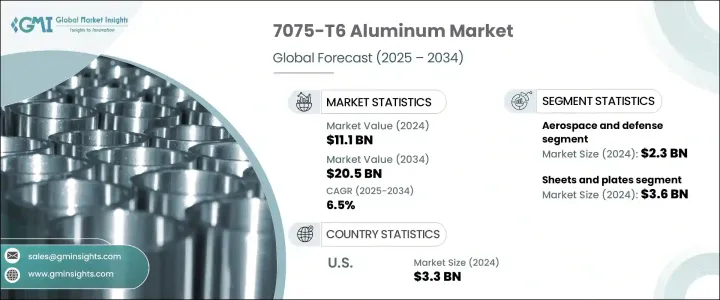
7075-T6 알루미늄 수요는 항공기의 날개나 군용 차량의 부품 등 중요한 구조 부품에 사용되는 항공우주 및 방위 분야에서 현저하게 강합니다. 방위 외에도 7075-T6 알루미늄은 스포츠 및 레크리에이션 공구의 제조에도 널리 사용되고 있습니다.
| 시장 범위 | |
|---|---|
| 시작 연도 | 2024년 |
| 예측 연도 | 2025-2034년 |
| 시작 금액 | 111억 달러 |
| 예측 금액 | 205억 달러 |
| CAGR | 6.5% |
제품 형태별로는 시트 플레이트 분야가 시장을 선도하고 2024년 시장 규모는 36억 달러였으며, 2034년 CAGR 성장률은 7.2%를 나타낼 것으로 예상됩니다. 날개 구조, 군용 차량 장갑의 생산에 이용되고 있습니다. 이 중요한 분야에서의 고성능 재료 수요는 중요한 인프라의 안전성, 내구성, 성능의 유지에 있어서의 7075-T6 알루미늄의 중요성을 강조하고 있습니다.
7075-T6 알루미늄 시장의 항공우주 및 방위 분야 2024년 시장 규모는 23억 달러였고, 2025년부터 2034년까지의 CAGR은 8.3%를 나타낼 것으로 예측되고 있습니다. 가장 선호되는 합금 중 하나로 수년간 정평이 있어 엄격한 성능 요건과 안전 요건에 매우 적합합니다.
북미의 7075-T6 알루미늄 시장은 항공우주 및 방위산업이 확립하고 있는 것 외에 자동차 분야에서의 선진 알루미늄 합금의 채용이 증가하고 있는 것이 요인이 되어 2024년에 41.7%의 점유율을 차지했습니다. 대기업의 존재와 최첨단 기술과 기술 혁신에 대한 지속적인 투자가 북미 시장의 성장을 뒷받침하는 주요 요인이 되고 있습니다.
7075-T6 알루미늄 시장 주요 기업은 Alcoa Corporation, Kaiser Aluminum, Novelis Inc.(Hindalco Industries), Constellium NV, Emirates Global Aluminium(EGA) 등이 있습니다. 이들 기업은 생산능력 강화, 합금특성 향상을 위한 연구개발에 투자, 다양한 산업에서 수요 증가에 대응하기 위한 세계적 프레즌스의 확대에 주력하고 있습니다.
목차
제1장 조사 방법과 범위
제2장 주요 요약
제3장 업계 인사이트
- 시장 정의와 진화
- 밸류체인 분석
- 가격 분석과 비용 구조
- 제품 유형별 가격 분석
- 지역별 가격 분석
- 가격 동향(2020-2025년)
- 가격 예측(2025-2033년)
- 가격에 영향을 미치는 요인
- 원재료비
- 제조의 복잡성
- 코팅 기술
- 품질 요건
- 비용 구조 분석
- 원재료비
- 인건비
- 제조 간접비
- 연구개발비
- 유통·마케팅 비용
- 이익률 분석
- 트럼프 정권의 관세 영향 - 구조화된 개요
- 무역에 미치는 영향
- 무역량의 혼란
- 보복 조치
- 업계에 미치는 영향
- 공급측의 영향(원재료)
- 주요 원재료의 가격 변동
- 공급망 재구성
- 생산 비용에 미치는 영향
- 수요측의 영향(판매가격)
- 최종 시장에의 가격 전달
- 시장 점유율 동향
- 소비자의 반응 패턴
- 영향을 받는 주요 기업
- 전략적인 업계 대응
- 공급망 재구성
- 가격 설정 및 제품 전략
- 정책관여
- 전망과 향후 검토 사항
- 무역에 미치는 영향
- 무역 통계(HS코드)
- 주요 수출국
- 국가 1
- 국가 2
- 국가 3
- 주요 수입국
- 국가 1
- 국가 2
- 국가 3
- 주요 수출국
참고 : 위의 무역 통계는 주요 국가에 대해서만 제공됩니다.
- 이익률 분석
- 주요 뉴스와 대처
- 규제 상황
- 시장 역학
- 주요 성장 요인
- 항공우주 및 방위 분야에서 수요 증가
- 고성능 자동차 부품에서의 사용이 증가
- 스포츠·레크리에이션 기기 업계의 성장
- 다양한 용도에 있어서의 경량 소재 수요 증가
- 시장 성장 억제요인 및 과제
- 원재료 가격 변동
- 에너지 비용의 변동
- 대체 재료와의 경쟁
- 높은 생산 비용
- 환경 컴플라이언스 비용
- 처리에 있어서의 기술적인 과제
- 시장 기회
- 항공우주산업의 성장
- 자동차의 경량화의 동향
- 방위 근대화 프로그램
- 스포츠 용품 시장의 확대
- 신흥 애플리케이션 개발
- 적층 조형의 가능성
- 주요 성장 요인
- PESTEL 분석
- Porter's Five Forces 분석
- 업계 동향과 최종 사용자의 기호
- 경량 소재로의 이행
- 항공우주 경량화의 대처
- 자동차의 경량화의 동향
- 7075-T6 알루미늄 수요에 미치는 영향
- 항공우주산업의 동향
- 민간 항공기의 생산 동향
- 국방비의 패턴
- 우주 탐사의 대처
- 재료 선택 기준
- 자동차 업계 동향
- 경량 소재로의 이행
- 전기자동차의 영향
- 고성능 자동차 부문
- 연비 요건
- 재료 선택 기준
- 스포츠 용품 업계 동향
- 고성능 기기 수요
- 레크리에이션 스포츠의 성장
- 재료 선택 기준
- 산업기기의 동향
- 기계 제조의 동향
- 금형 제작의 동향
- 재료 선택 기준
- 최종 용도 용도에 있어서의 기술 진보
- 첨단 제조 기술
- 설계 최적화 방식
- 재료 통합 전략
- 지역별 최종 사용자의 기호의 차이
- OEM 사양의 동향
- 재료 선택 기준
- 성능 요건
- 비용 고려
- 스포츠 용품 업계 동향
- 지속가능성과 환경에 미치는 영향
- 7075-T6 알루미늄 생산 환경 발자국
- 탄소 발자국 분석
- 에너지 소비 평가
- 물의 사용과 관리
- 폐기물의 발생과 관리
- 알루미늄 업계의 지속가능성에 대한 노력
- 탄소 삭감 전략
- 에너지 효율 대책
- 순환형 경제의 접근
- 재활용 및 재료 회수
- 스크랩 이용률
- 수명 종료 고려 사항
- 폐쇄 루프 제조
- 7075 합금 재활용의 과제
- 그린 알루미늄 생산 기술
- 저탄소 제련 공정
- 신재생에너지 통합
- 지속가능성을 위한 공정 최적화
- 지속가능성에 대한 규제압력
- 탄소 가격 설정 메커니즘
- 배출량 거래 제도
- 환경 컴플라이언스 요건
- 업계의 지속가능성에 대한 노력
- 수명 주기 평가(LCA) 분석
- 지속 가능한 관행의 비용 편익 분석
- 7075-T6 알루미늄 생산 환경 발자국
- 공급망과 원재료 분석
- 원재료 조달 분석
- 보크사이트 채굴
- 알루미나 생산
- 1차 알루미늄 생산
- 합금 원소의 조달
- 아연
- 마그네슘
- 구리
- 크롬
- 7075-T6 알루미늄 생산 공정 분석
- 합금 및 주조
- 압연 및 압출 프로세스
- 열처리 공정
- 품질관리조치
- 유통 채널 분석
- OEM에 직접 판매
- 금속 서비스 센터
- 유통업체 및 도매업체
- 전자상거래 플랫폼
- 공급망의 과제
- 원재료 가격 변동
- 에너지 비용의 변동
- 물류와 수송의 과제
- 공급망의 혼란
- 공급망 최적화 전략
- 지속 가능한 공급망의 실천
- 공급 체인의 기술 통합
- 원재료 조달 분석
- 가격 분석과 비용 구조
- 제품 형태별 가격 분석
- 시트 및 플레이트 가격
- 로드 및 바 가격
- 튜브 및 파이프의 가격
- 단조 가격
- 압출 가격
- 가격 동향 분석(2021-2025년)
- 가격 예측(2026-2034년)
- 가격에 영향을 미치는 요인
- 원재료비
- 에너지 비용
- 인건비
- 생산 비용
- 수송비
- 시장 경쟁
- 무역정책과 관세
- 지역별 가격 차이
- 주요 기업의 가격 전략
- 비용 구조 분석
- 원재료비
- 에너지 비용
- 인건비
- 제조 비용
- 유통 비용
- 마케팅 및 판매 비용
- 수익성 분석 : 제품 부문별
- 부가가치 서비스의 가격에 미치는 영향
- 제품 형태별 가격 분석
- 기술의 진보와 혁신
- 최근 기술 개발
- 고급 알루미늄 합금 기술
- 합금 설계의 혁신
- 미세 구조 제어 기술
- 치료의 진보
- 제조 공정의 혁신
- 주조 기술의 진보
- 압연과 압출의 혁신
- 가공 기술 개선
- 적층 조형 용도
- 표면 치료와 마무리의 혁신
- 양극산화 처리의 진보
- 코팅 기술
- 부식 방지 혁신
- 품질 관리 및 시험 혁신
- 비파괴 검사의 진보
- 자동 검사 시스템
- 재료 특성 평가 기술
- 알루미늄 생산의 디지털 통합
- 인더스트리 4.0의 구현
- 인공지능 용도
- 예지보전시스템
- 디지털 트윈 기술
- 지속가능한 생산기술
- 에너지 효율의 혁신
- 배출 감축 기술
- 폐기물 삭감과 재활용
- 특허 분석과 연구개발 동향
- 미래의 기술 로드맵
- 규제 프레임워크과 기준
- 세계의 알루미늄 산업 규제
- 알루미늄 합금의 국제 규격
- ASTM 규격
- AMS 규격
- ISO 규격
- EN 규격
- JIS 규격
- 지역 규제 틀
- 북미의 규제
- 유럽의 규제
- 아시아태평양의 규제
- 무역정책과 관세
- 수출입 규제
- 반덤핑 조치
- 상쇄 관세
- 세이프 가드 조치
- 품질인증 요건
- 재료 인증
- 프로세스 인증
- 품질 관리 시스템
- 환경규제
- 배출 기준
- 폐기물 관리 규제
- 에너지 효율 요건
- 항공우주 및 방위산업의 사양
- 군사 사양(밀 스펙)
- 항공우주재료 사양(AMS)
- Nadcap 인증 요건
- 규제의 영향 분석
- 비용
- 시장 진입 장벽에 대한 영향
- 가격 전략에 미치는 영향
제4장 경쟁 구도
- 주요 기업의 시장 점유율 분석
- 경쟁 포지셔닝 매트릭스
- 채용하고 있는 경쟁 전략 : 주요 기업별
- 제품의 혁신과 개발
- 합병 및 인수
- 파트너십 및 협업
- 확대 전략
- 투자분석과 시장의 매력
- 현재 투자 시나리오
- 부문별 투자 기회
- 지역별 투자 기회
- ROI 분석
- 벤처 캐피탈과 프라이빗 에퀴티의 상황
- M&A 활동 분석
- 미래 투자 전망
제5장 시장 추계·예측 : 형태별(2021-2034년)
- 주요 동향
- 시트 및 플레이트
- 표준 치수
- 두께 범위
- 표면 마감
- 막대 및 바
- 원형 바
- 직사각형 막대
- 육각 막대
- 기타 프로파일
- 튜브 및 파이프
- 이음매없는 튜브
- 압출 튜브
- 표준 치수
- 단조품
- 오픈 다이 단조
- 닫힌 다이 단조
- 맞춤형 단조
- 압출
- 표준 프로파일
- 맞춤 프로파일
- 기타 형식
제6장 시장 추계·예측 : 용도별(2021-2034년)
- 주요 동향
- 항공우주 및 방위
- 항공기 구조 부품
- 군사 장비
- 미사일 부품
- 우주
- 자동차 및 운송
- 고성능 차량 부품
- 서스펜션 부품
- 구조 부품
- 파워트레인 부품
- 스포츠 및 레크리에이션
- 자전거 부품
- 등산 장비
- 스키 및 스노보드용구
- 골프 클럽 부품
- 기타 스포츠 용품
- 산업기기
- 기계 부품
- 공구 및 금형
- 유압부품
- 해양용도
- 보트 및 선박 부품
- 해외 장비
- 전자 및 통신
- 전자 하우징
- 방열판
- 구조 부품
- 기타 용도
제7장 시장 추계·예측 : 지역별(2021-2034년)
- 주요 동향
- 북미
- 미국
- 캐나다
- 유럽
- 독일
- 영국
- 프랑스
- 스페인
- 이탈리아
- 기타 유럽
- 아시아태평양
- 중국
- 인도
- 일본
- 호주
- 한국
- 기타 아시아태평양
- 라틴아메리카
- 브라질
- 멕시코
- 아르헨티나
- 기타 라틴아메리카
- 중동 및 아프리카
- 사우디아라비아
- 남아프리카
- 아랍에미리트(UAE)
- 기타 중동 및 아프리카
제8장 기업 프로파일
- Alcoa Corporation
- Aleris Corporation
- Aluminum Corporation of China(Chalco)
- Arconic Inc.
- China Hongqiao Group
- Constellium NV
- ElvalHalcor SA
- Emirates Global Aluminium(EGA)
- Granges AB
- Hindalco Industries Limited
- JW Aluminum
- Kaiser Aluminum
- Norsk Hydro ASA
- Novelis Inc.(Hindalco Industries)
- UACJ Corporation
The Global 7075-T6 Aluminum Market was valued at USD 11.1 billion in 2024 and is estimated to grow at a CAGR of 6.5% to reach USD 20.5 billion by 2034, driven by high-strength aluminum alloy, primarily composed of zinc, and is renowned for its exceptional strength-to-weight ratio, making it ideal for demanding applications in aerospace, defense, and high-performance automotive sectors. Its lightweight and robust properties contribute to fuel efficiency and structural integrity, driving its adoption across various industries.
The demand for 7075-T6 aluminum is notably strong in the aerospace and defense sectors, where it is utilized in critical structural components such as aircraft wings and military vehicle parts. The automotive industry also increasingly incorporates this alloy into performance-oriented vehicle powertrains, suspension systems, and structural elements to meet consumer expectations for improved fuel efficiency and environmental compliance. In addition to aerospace and defense, 7075-T6 aluminum is also widely used in the production of sports and recreational equipment. Its combination of strength and lightweight properties makes it ideal for applications in bicycle frames, climbing gear, golf club components, and more. The alloy's resilience and ability to withstand high stress levels while maintaining lightness are crucial for enhancing the performance and durability of these products.
| Market Scope | |
|---|---|
| Start Year | 2024 |
| Forecast Year | 2025-2034 |
| Start Value | $11.1 Billion |
| Forecast Value | $20.5 Billion |
| CAGR | 6.5% |
Based on product forms, the sheets and plates segment led the market, valued at USD 3.6 billion in 2024, with an expected growth rate of 7.2% CAGR during 2034. These forms are important in aerospace and defense applications, where they are utilized in producing aircraft fuselage panels, wing structures, and military vehicle armor. The demand for high-performance materials in these critical sectors emphasizes the importance of 7075-T6 aluminum in maintaining the safety, durability, and performance of essential infrastructures.
The aerospace and defense segment in the 7075-T6 aluminum market was valued at USD 2.3 billion in 2024 and is expected to grow at a CAGR of 8.3% from 2025 to 2034. 7075 aluminum has a long-established reputation as one of the most preferred alloys in this sector due to its remarkable combination of strength, lightness, and resistance to corrosion, making it highly suitable for demanding performance and safety requirements. Its application in military aircraft, satellite components, and other defense systems continues to drive the sustained demand for this alloy, as it plays a pivotal role in ensuring operational efficiency and reliability in extreme conditions.
North America 7075-T6 Aluminum Market held 41.7% share in 2024, driven by a well-established aerospace and defense industry, along with an increasing adoption of advanced aluminum alloys in the automotive sector. The presence of major players and continuous investments in cutting-edge technology and innovation are key factors propelling the growth of the market in North America. This region remains a significant hub for research, development, and production of high-performance aluminum materials.
Key players in the 7075-T6 aluminum market include Alcoa Corporation, Kaiser Aluminum, Novelis Inc. (Hindalco Industries), Constellium N.V., and Emirates Global Aluminium (EGA). These companies focus on enhancing production capabilities, investing in research and development to improve alloy properties, and expanding their global presence to meet the growing demand across various industries. To strengthen their market position, companies in the 7075-T6 aluminum industry are adopting several strategies. They invest in advanced manufacturing technologies to enhance production efficiency and reduce costs.
Table of Contents
Chapter 1 Methodology & Scope
- 1.1 Market scope & definition
- 1.2 Base estimates & calculations
- 1.3 Forecast calculation
- 1.4 Data sources
- 1.4.1 Primary
- 1.4.2 Secondary
- 1.4.2.1 Paid sources
- 1.4.2.2 Public sources
- 1.5 Primary research and validation
- 1.5.1 Primary sources
- 1.5.2 Data mining sources
Chapter 2 Executive Summary
- 2.1 Industry synopsis, 2021-2034
Chapter 3 Industry Insights
- 3.1 Market definition and evolution
- 3.2 Value chain analysis
- 3.3 Pricing analysis and cost structure
- 3.3.1 Price point analysis by product type
- 3.3.2 Price point analysis by region
- 3.3.3 Price trends (2020-2025)
- 3.3.4 Price forecast (2025-2033)
- 3.3.5 Factors affecting pricing
- 3.3.5.1 Raw material costs
- 3.3.5.2 Manufacturing complexity
- 3.3.5.3 Coating technology
- 3.3.5.4 Quality requirements
- 3.3.6 Cost structure analysis
- 3.3.6.1 Raw material cost
- 3.3.6.2 Labor cost
- 3.3.6.3 Manufacturing overhead
- 3.3.6.4 R&D expenses
- 3.3.6.5 Distribution and marketing costs
- 3.3.7 Profit margin analysis
- 3.4 Impact of Trump administration tariffs - structured overview
- 3.4.1 Impact on trade
- 3.4.1.1 Trade volume disruptions
- 3.4.1.2 Retaliatory measures
- 3.4.2 Impact on the industry
- 3.4.2.1.1 Supply-side impact (raw materials)
- 3.4.2.1.2 Price volatility in key materials
- 3.4.2.1.3 Supply chain restructuring
- 3.4.2.1.4 Production cost implications
- 3.4.2.2 Demand-side impact (selling price)
- 3.4.2.2.1 Price transmission to end markets
- 3.4.2.2.2 Market share dynamics
- 3.4.2.2.3 Consumer response patterns
- 3.4.3 Key companies impacted
- 3.4.4 Strategic industry responses
- 3.4.4.1 Supply chain reconfiguration
- 3.4.4.2 Pricing and product strategies
- 3.4.4.3 Policy engagement
- 3.4.5 Outlook and future considerations
- 3.4.1 Impact on trade
- 3.5 Trade statistics (hs code)
- 3.5.1 Major exporting countries
- 3.5.1.1 Country 1
- 3.5.1.2 Country 2
- 3.5.1.3 Country 3
- 3.5.2 Major importing countries
- 3.5.2.1 Country 1
- 3.5.2.2 Country 2
- 3.5.2.3 Country 3
- 3.5.1 Major exporting countries
Note: the above trade statistics will be provided for key countries only.
- 3.6 Profit margin analysis
- 3.7 Key news & initiatives
- 3.8 Regulatory landscape
- 3.9 Market dynamics
- 3.9.1 Primary growth drivers
- 3.9.1.1 Rising demand in the aerospace and defense sector.
- 3.9.1.2 Increasing use in high-performance automotive components.
- 3.9.1.3 Growth in sports and recreational equipment industry.
- 3.9.1.4 Rising demand for lightweight materials in various applications
- 3.9.2 Market restraints and challenges
- 3.9.2.1 Raw material price volatility
- 3.9.2.2 Energy cost fluctuations
- 3.9.2.3 Competition from alternative materials
- 3.9.2.4 High production costs
- 3.9.2.5 Environmental compliance costs
- 3.9.2.6 Technical challenges in processing
- 3.9.3 Market opportunities
- 3.9.3.1 Aerospace industry growth
- 3.9.3.2 Automotive lightweighting trends
- 3.9.3.3 Defense modernization programs
- 3.9.3.4 Sporting goods market expansion
- 3.9.3.5 Emerging applications development
- 3.9.3.6 Additive manufacturing potential
- 3.9.1 Primary growth drivers
- 3.10 PESTLE analysis
- 3.11 Porter's five forces analysis
- 3.12 Industry trends and end-user preferences
- 3.12.1 Shift towards lightweight materials
- 3.12.1.1 Aerospace lightweighting initiatives
- 3.12.1.2 Automotive weight reduction trends
- 3.12.1.3 Impact on 7075-t6 aluminum demand
- 3.12.2 Aerospace industry trends
- 3.12.2.1 Commercial aircraft production trends
- 3.12.2.2 Defense spending patterns
- 3.12.2.3 Space exploration initiatives
- 3.12.2.4 Material selection criteria
- 3.12.3 Automotive industry trends
- 3.12.1 Shift towards lightweight materials
- 3.13 Electric vehicle impact
- 3.14 High-performance vehicle segment
- 3.15 Fuel efficiency requirements
- 3.16 Material selection criteria
- 3.16.1 Sporting goods industry trends
- 3.16.1.1 High-performance equipment demand
- 3.16.1.2 Recreational sports growth
- 3.16.1.3 Material selection criteria
- 3.16.2 Industrial equipment trends
- 3.16.2.1 Machinery manufacturing trends
- 3.16.2.2 Tooling and mold making trends
- 3.16.2.3 Material selection criteria
- 3.16.3 Technological advancements in end-use applications
- 3.16.3.1 Advanced manufacturing techniques
- 3.16.3.2 Design optimization approaches
- 3.16.3.3 Material integration strategies
- 3.16.4 Regional end-user preference variations
- 3.16.5 Oem specification trends
- 3.16.5.1 Material selection criteria
- 3.16.5.2 Performance requirements
- 3.16.5.3 Cost considerations
- 3.16.1 Sporting goods industry trends
- 3.17 Sustainability and environmental impact
- 3.17.1 Environmental footprint of 7075-t6 aluminum production
- 3.17.1.1 Carbon footprint analysis
- 3.17.1.2 Energy consumption assessment
- 3.17.1.3 Water usage and management
- 3.17.1.4 Waste generation and management
- 3.17.2 Sustainability initiatives in the aluminum industry
- 3.17.2.1 Carbon reduction strategies
- 3.17.2.2 Energy efficiency measures
- 3.17.2.3 Circular economy approaches
- 3.17.3 Recycling and material recovery
- 3.17.3.1 Scrap utilization rates
- 3.17.3.2 End-of-life considerations
- 3.17.3.3 Closed-loop manufacturing
- 3.17.3.4 Challenges in 7075 alloy recycling
- 3.17.4 Green aluminum production technologies
- 3.17.4.1 Low-carbon smelting processes
- 3.17.4.2 Renewable energy integration
- 3.17.4.3 Process optimization for sustainability
- 3.17.5 Regulatory pressures for sustainability
- 3.17.5.1 Carbon pricing mechanisms
- 3.17.5.2 Emissions trading systems
- 3.17.5.3 Environmental compliance requirements
- 3.17.6 Industry sustainability commitments
- 3.17.7 Lifecycle assessment (lca) analysis
- 3.17.8 Cost-benefit analysis of sustainable practices
- 3.17.1 Environmental footprint of 7075-t6 aluminum production
- 3.18 Supply chain and raw material analysis
- 3.18.1 Raw material sourcing analysis
- 3.18.1.1 Bauxite mining
- 3.18.1.2 Alumina production
- 3.18.1.3 Primary aluminum production
- 3.18.1.4 Alloying elements sourcing
- 3.18.1.4.1 Zinc
- 3.18.1.4.2 Magnesium
- 3.18.1.4.3 Copper
- 3.18.1.4.4 Chromium
- 3.18.2 7075-t6 aluminum production process analysis
- 3.18.2.1 Alloying and casting
- 3.18.2.2 Rolling and extrusion processes
- 3.18.2.3 Heat treatment processes
- 3.18.2.4 Quality control measures
- 3.18.3 Distribution channel analysis
- 3.18.3.1 Direct sales to oems
- 3.18.3.2 Metal service centers
- 3.18.3.3 Distributors and wholesalers
- 3.18.3.4 E-commerce platforms
- 3.18.4 Supply chain challenges
- 3.18.4.1 Raw material price volatility
- 3.18.4.2 Energy cost fluctuations
- 3.18.4.3 Logistics and transportation challenges
- 3.18.4.4 Supply chain disruptions
- 3.18.5 Supply chain optimization strategies
- 3.18.6 Sustainable supply chain practices
- 3.18.7 Technology integration in supply chain
- 3.18.1 Raw material sourcing analysis
- 3.19 Pricing analysis and cost structure
- 3.19.1 Price point analysis by product form
- 3.19.1.1 Sheets and plates pricing
- 3.19.1.2 Rods and bars pricing
- 3.19.1.3 Tubes and pipes pricing
- 3.19.1.4 Forgings pricing
- 3.19.1.5 Extrusions pricing
- 3.19.2 Price trend analysis (2021-2025)
- 3.19.3 Price forecast (2026-2034)
- 3.19.4 Factors affecting pricing
- 3.19.4.1 Raw material costs
- 3.19.4.2 Energy costs
- 3.19.4.3 Labor costs
- 3.19.4.4 Production costs
- 3.19.4.5 Transportation costs
- 3.19.4.6 Market competition
- 3.19.4.7 Trade policies and tariffs
- 3.19.5 Regional price variations
- 3.19.6 Pricing strategies of key players
- 3.19.7 Cost structure analysis
- 3.19.7.1 Raw material costs
- 3.19.7.2 Energy costs
- 3.19.7.3 Labor costs
- 3.19.7.4 Manufacturing costs
- 3.19.7.5 Distribution costs
- 3.19.7.6 Marketing and sales costs
- 3.19.8 Profitability analysis by product segment
- 3.19.9 Value-added services impact on pricing
- 3.19.1 Price point analysis by product form
- 3.20 Technological advancement and innovations
- 3.20.1 Recent technological developments
- 3.20.2 Advanced aluminum alloy technologies
- 3.20.2.1 Alloy design innovations
- 3.20.2.2 Microstructure control techniques
- 3.20.2.3 Heat treatment advancements
- 3.20.3 Manufacturing process innovations
- 3.20.3.1 Casting technology advancements
- 3.20.3.2 Rolling and extrusion innovations
- 3.20.3.3 Machining technology improvements
- 3.20.3.4 Additive manufacturing applications
- 3.20.4 Surface treatment and finishing innovations
- 3.20.4.1 Anodizing advancements
- 3.20.4.2 Coating technologies
- 3.20.4.3 Corrosion protection innovations
- 3.20.5 Quality control and testing innovations
- 3.20.5.1 Non-destructive testing advancements
- 3.20.5.2 Automated inspection systems
- 3.20.5.3 Material characterization technologies
- 3.20.6 Digital integration in aluminum production
- 3.20.6.1 Industry 4.0 implementation
- 3.20.6.2 Artificial intelligence applications
- 3.20.6.3 Predictive maintenance systems
- 3.20.6.4 Digital twin technology
- 3.20.7 Sustainable production technologies
- 3.20.7.1 Energy efficiency innovations
- 3.20.7.2 Emissions reduction technologies
- 3.20.7.3 Waste reduction and recycling
- 3.20.8 Patent analysis and R&D trends
- 3.20.9 Future technology roadmap
- 3.21 Regulatory framework and standards
- 3.21.1 Global aluminum industry regulations
- 3.21.2 International standards for aluminum alloys
- 3.21.2.1 ASTM standards
- 3.21.2.2 AMS standards
- 3.21.2.3 ISO standards
- 3.21.2.4 EN standards
- 3.21.2.5 JIS standards
- 3.21.3 Regional regulatory frameworks
- 3.21.3.1 North american regulations
- 3.21.3.2 European regulations
- 3.21.3.3 Asia-pacific regulations
- 3.21.4 Trade policies and tariffs
- 3.21.4.1 Import/export regulations
- 3.21.4.2 Anti-dumping measures
- 3.21.4.3 Countervailing duties
- 3.21.4.4 Safeguard measures
- 3.21.5 Quality certification requirements
- 3.21.5.1 Material certification
- 3.21.5.2 Process certification
- 3.21.5.3 Quality management systems
- 3.21.6 Environmental regulations
- 3.21.6.1 Emissions standards
- 3.21.6.2 Waste management regulations
- 3.21.6.3 Energy efficiency requirements
- 3.21.7 Aerospace and defense industry specifications
- 3.21.7.1 Military specifications (mil-spec)
- 3.21.7.2 Aerospace material specifications (ams)
- 3.21.7.3 Nadcap certification requirements
- 3.21.8 Regulatory impact analysis
- 3.21.8.1 Costs
- 3.21.8.2 Impact on market entry barriers
- 3.21.8.3 Impact on pricing strategies
Chapter 4 Competitive Landscape, 2024
- 4.1 Market share analysis of key players
- 4.2 Competitive positioning matrix
- 4.3 Competitive strategies adopted by key players
- 4.3.1 Product innovation and development
- 4.3.2 Mergers and acquisitions
- 4.3.3 Partnerships and collaborations
- 4.3.4 Expansion strategies
- 4.4 Investment analysis and market attractiveness
- 4.4.1 Current investment scenario
- 4.4.2 Investment opportunities by segment
- 4.4.3 Investment opportunities by region
- 4.4.4 ROI analysis
- 4.4.5 Venture capital and private equity landscape
- 4.4.6 M&A activity analysis
- 4.4.7 Future investment outlook
Chapter 5 Market Estimates and Forecast, By Form, 2021 - 2034 (USD Billion) (Kilo Tons)
- 5.1 Key trends
- 5.2 Sheets and plates
- 5.2.1 Standard dimensions
- 5.2.2 Thickness ranges
- 5.2.3 Surface finishes
- 5.3 Rods and bars
- 5.3.1 Round bars
- 5.3.2 Rectangular bars
- 5.3.3 Hexagonal bars
- 5.3.4 Other profiles
- 5.4 Tubes and pipes
- 5.4.1 Seamless tubes
- 5.4.2 Extruded tubes
- 5.4.3 Standard dimensions
- 5.5 Forgings
- 5.5.1 Open die forgings
- 5.5.2 Closed die forgings
- 5.5.3 Custom forgings
- 5.6 Extrusions
- 5.6.1 Standard profiles
- 5.6.2 Custom profiles
- 5.7 Other forms
Chapter 6 Market Estimates and Forecast, By Application, 2021 - 2034 (USD Billion) (Kilo Tons)
- 6.1 Key trends
- 6.2 Aerospace and defense
- 6.2.1 Aircraft structural components
- 6.2.2 Military equipment
- 6.2.3 Missile components
- 6.2.4 Space applications
- 6.3 Automotive and transportation
- 6.3.1 High-performance vehicle components
- 6.3.2 Suspension components
- 6.3.3 Structural components
- 6.3.4 Powertrain components
- 6.4 Sports and recreation
- 6.4.1 Bicycle components
- 6.4.2 Climbing equipment
- 6.4.3 Ski and snowboard equipment
- 6.4.4 Golf club components
- 6.4.5 Other sporting goods
- 6.5 Industrial equipment
- 6.5.1 Machinery components
- 6.5.2 Tooling and molds
- 6.5.3 Hydraulic components
- 6.6 Marine applications
- 6.6.1 Boat and ship components
- 6.6.2 Offshore equipment
- 6.7 Electronics and telecommunications
- 6.7.1 Electronic housings
- 6.7.2 Heat sinks
- 6.7.3 Structural components
- 6.8 Other applications
Chapter 7 Market Estimates and Forecast, By Region, 2021 - 2034 (USD Billion) (Kilo Tons)
- 7.1 Key trends
- 7.2 North America
- 7.2.1 U.S.
- 7.2.2 Canada
- 7.3 Europe
- 7.3.1 Germany
- 7.3.2 UK
- 7.3.3 France
- 7.3.4 Spain
- 7.3.5 Italy
- 7.3.6 Rest of Europe
- 7.4 Asia Pacific
- 7.4.1 China
- 7.4.2 India
- 7.4.3 Japan
- 7.4.4 Australia
- 7.4.5 South Korea
- 7.4.6 Rest of Asia Pacific
- 7.5 Latin America
- 7.5.1 Brazil
- 7.5.2 Mexico
- 7.5.3 Argentina
- 7.5.4 Rest of Latin America
- 7.6 Middle East and Africa
- 7.6.1 Saudi Arabia
- 7.6.2 South Africa
- 7.6.3 UAE
- 7.6.4 Rest of Middle East and Africa
Chapter 8 Company Profiles
- 8.1 Alcoa Corporation
- 8.2 Aleris Corporation
- 8.3 Aluminum Corporation of China (Chalco)
- 8.4 Arconic Inc.
- 8.5 China Hongqiao Group
- 8.6 Constellium N.V.
- 8.7 ElvalHalcor S.A.
- 8.8 Emirates Global Aluminium (EGA)
- 8.9 Granges AB
- 8.10 Hindalco Industries Limited
- 8.11 JW Aluminum
- 8.12 Kaiser Aluminum
- 8.13 Norsk Hydro ASA
- 8.14 Novelis Inc. (Hindalco Industries)
- 8.15 UACJ Corporation