

|
시장보고서
상품코드
1750475
태양열 시장 : 기회, 성장 촉진요인, 산업 동향 분석 및 예측(2025-2034년)Solar Thermal Market Opportunity, Growth Drivers, Industry Trend Analysis, and Forecast 2025 - 2034 |
||||||

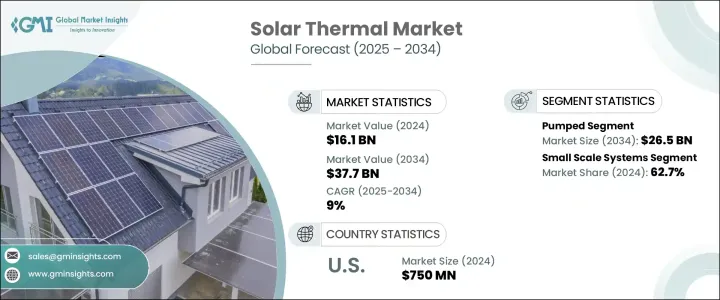
세계의 태양열 시장 규모는 2024년 161억 달러로 평가되었고 환경 의식이 높아지고 이산화탄소 배출량 감축을 목적으로 한 정부 정책, 태양광 발전 인센티브 도입 등에 촉진되어 2034년에는 377억 달러에 달할 것으로 예측되며, CAGR 9%로 성장할 전망입니다.
전 세계 정부는 탈탄소화와 재생 에너지 전환을 최우선 과제로 삼으며, 태양열 기술의 확장에 유리한 환경을 조성하고 있습니다. 또한 지속 가능한 건축 기준로의 전환은 주거 및 상업 부문에서 태양열 시스템 채택을 촉진하고 있습니다. 전통적인 난방 원천에 대한 의존도를 줄이고 에너지 효율성을 높이기 위한 지속적인 노력은 시장 성장을 더욱 지원할 것입니다. 태양열 솔루션을 지역 난방 시스템에 통합하는 것, 하이브리드 및 전기-열 저장 기술의 발전도 시장 성장을 가속화할 것입니다.
그러나 이전 정부의 관세 정책은 태양열 열전환 산업에 영향을 미쳐 태양광 셀 및 모듈과 같은 핵심 재료의 비용을 상승시켰습니다. 이러한 관세는 제조업체가 구매 비용 증가와 부품 공급 부족으로 인해 공급망 지연과 혼란을 겪게 했습니다. 그럼에도 불구하고 저배출 및 에너지 효율적인 시스템에 대한 수요 증가로 인해 시장은 여전히 탄력성을 유지하고 있습니다.
| 시장 범위 | |
|---|---|
| 시작 연도 | 2024년 |
| 예측 연도 | 2025-2034년 |
| 시작 금액 | 161억 달러 |
| 예측 금액 | 377억 달러 |
| CAGR | 9% |
열 사이펀 태양열 난방 시스템 부문은 2025년부터 2034년까지 연평균 7.5%의 성장률을 보일 것으로 예상됩니다. 이 시스템은 설치가 간편하고 유지보수 비용이 낮아 주거용 응용 분야에 특히 유리합니다. 열순환 시스템은 펌프 없이 작동하기 때문에 에너지 접근이 어려운 오프그리드 및 농촌 지역에서 완벽한 솔루션입니다. 중앙 전력 공급원이 필요 없이 작동할 수 있는 이 시스템은 분산형, 저렴한 재생 에너지 접근을 위한 이상적인 솔루션으로, 특히 전통적인 전력망 연결이 불가능하거나 비용이 너무 높은 지역에서 에너지 독립성을 실현하는 데 큰 기회를 제공합니다.
2024년에 62.7%의 점유율을 차지한 소규모 태양열 시스템 부문은 소형 열 저장 솔루션에 대한 수요가 증가함에 따라 계속 성장하고 있습니다. 주거용으로 최적화된 이 시스템은 효율적인 공간 활용과 비용 효율성으로 인해 점점 인기를 얻고 있습니다. 또한, 가정용으로 설계된 플러그 앤 플레이 태양열 키트의 설치가 증가하면서 이 부문의 확장이 가속화되고 있습니다.
유럽의 태양열 시장은 2025년부터 2034년까지 10%의 견고한 성장률을 보일 것으로 예상되며, 이는 이 지역의 기후 중립 목표에 대한 강조와 재생 가능한 지역 난방 시스템에 대한 강력한 추진에 의해 촉진될 것입니다. 유럽의 여러 국가들은 도시 인프라에 열 에너지 저장 시스템을 통합하는 데 선도적인 역할을 하고 있으며, 에너지 효율적인 건축 규정과 규제는 태양열 기술 채택을 추가로 지원하고 있습니다. 정부가 재생 에너지 사용을 장려하고 지원 정책을 시행함에 따라 태양열 시스템에 대한 수요가 증가할 것으로 예상되며, 이는 지역 내 시장 성장 추세를 더욱 강화할 것입니다.
세계의 태양열 시장의 주요 기업으로는 CONA Solar, G2 Energy, GREENoneTEC Solarindustrie, Inventive Power 등의 기업이 포함되어 있습니다. 이들 기업은 고효율 시스템 개발, 비용 효율적인 솔루션 제공, 신흥 시장 진출 확대를 통해 시장 점유율을 확대하기 위해 적극적으로 혁신하고 있습니다. 전략 측면에서 Modulo Solar와 Linuo Ritter는 주거용 및 상업용 수요를 충족시키기 위해 고급 열 저장 솔루션에 투자하고 있습니다. Next Source와 Ormat Technologies와 같은 다른 기업들은 지역 난방 네트워크와의 시스템 통합을 강화하고 도시 환경에서의 태양열 응용 효율성을 높이는 데 집중하고 있습니다.
목차
제1장 조사 방법과 범위
제2장 주요 요약
제3장 업계 인사이트
- 업계 에코시스템
- 트럼프 정권의 관세 분석
- 무역에 미치는 영향
- 무역량의 혼란
- 보복 조치
- 업계에 미치는 영향
- 공급측의 영향(원재료)
- 주요 원재료의 가격 변동
- 공급망 재구성
- 생산 비용에 미치는 영향
- 수요측의 영향(판매가격)
- 최종 시장에의 가격 전달
- 시장 점유율 동향
- 소비자의 반응 패턴
- 공급측의 영향(원재료)
- 영향을 받는 주요 기업
- 전략적인 업계 대응
- 공급망 재구성
- 가격 설정 및 제품 전략
- 정책관여
- 전망과 향후 검토 사항
- 무역에 미치는 영향
- 규제 상황
- 업계에 미치는 영향요인
- 성장 촉진요인
- 업계의 잠재적 위험 및 과제
- 성장 가능성 분석
- Porter's Five Forces 분석
- PESTEL 분석
제4장 경쟁 구도
- 소개
- 기업의 시장 점유율
- 전략적 대시보드
- 전략적 노력
- 경쟁 벤치마킹
- 혁신과 지속가능성의 정세
제5장 시장 규모와 예측 : 집열기별(2024-2034년)
- 주요 동향
- 진공관 집열기
- 평판 집열기
- 무유약 물 집열기
- 공기 집열기
제6장 시장 규모와 예측 : 유형별(2024-2034년)
- 주요 동향
- 열 사이펀
- 펌프
제7장 시장 규모와 예측 : 시스템별(2024-2034년)
- 주요 동향
- 소규모 시스템
- 대규모 시스템
제8장 시장 규모와 예측 : 용도별(2024-2034년)
- 주요 동향
- 소규모 온수 시스템
- 대규모 온수 시스템
- 수영장 난방
- 태양열 복합 시스템
- 기타
제9장 시장 규모와 예측 : 최종용도별(2024-2034년)
- 주요 동향
- 식품 및 음료
- 섬유
- 화학약품
- 금속가공
- 광업
- 농업
- 기계 및 자동차
- 기타
제10장 시장 규모와 예측 : 지역별(2024-2034년)
- 주요 동향
- 북미
- 미국
- 캐나다
- 유럽
- 독일
- 프랑스
- 스페인
- 오스트리아
- 벨기에
- 아시아태평양
- 중국
- 인도
- 태국
- 호주
- 베트남
- 중동 및 아프리카
- 남아프리카
- 사우디아라비아
- 오만
- 튀르키예
- 라틴아메리카
- 브라질
- 멕시코
- 칠레
제11장 기업 프로파일
- CONA Solar
- G2 Energy
- GREENoneTEC Solarindustrie
- Inventive Power
- Linuo Ritter
- Modulo Solar
- Next Source
- Ormat Technologies
- Photon Energy Systems Limited
- Ritter XL Solar
- Solareast Group
- Shandong Linuo New Energy
- Sunoptimo
- TE SOLAR
- Vicot
The Global Solar Thermal Market was valued at USD 16.1 billion in 2024 and is estimated to grow at a CAGR of 9% to reach USD 37.7 billion by 2034, driven by increasing environmental awareness, government policies aimed at reducing carbon footprints, and the adoption of solar incentives. Governments around the world are prioritizing decarbonization and renewable energy, creating favorable conditions for the expansion of solar thermal technologies. Additionally, the transition toward more sustainable building codes is fueling the adoption of solar thermal systems in both residential and commercial sectors. The ongoing push to reduce reliance on conventional heating sources and increase energy efficiency will further support the market. Integration of solar thermal solutions into district heating systems, along with advancements in hybrid and electro-thermal storage technologies, will also accelerate the market's growth.
Tariff policies from previous administrations, however, have affected the solar thermal sector by raising the costs of critical materials, such as photovoltaic cells and modules. These tariffs have resulted in delays and disruptions in supply chains, as manufacturers face increased procurement costs and limited component availability. Despite these challenges, the market remains resilient due to rising demand for low-emission, energy-efficient systems.
| Market Scope | |
|---|---|
| Start Year | 2024 |
| Forecast Year | 2025-2034 |
| Start Value | $16.1 Billion |
| Forecast Value | $37.7 Billion |
| CAGR | 9% |
The thermosiphon solar heating systems segment is anticipated to grow at a CAGR of 7.5% from 2025 to 2034. These systems are particularly beneficial for residential applications, thanks to their easy installation and low maintenance needs. As thermosiphon systems do not rely on pumps for operation, they are perfect for off-grid and rural locations where energy access can be challenging. Their ability to function without the need for a central power source makes them an ideal solution for decentralized, affordable renewable energy access, offering significant opportunities for energy independence, especially in areas where conventional grid connections are either unavailable or too costly.
The small-scale solar thermal systems segment, which held a share of 62.7% in 2024, continues to experience growth due to the rising demand for compact thermal storage solutions. These systems, optimized for residential use, have become increasingly popular because of their efficient space usage and cost-effective nature. Additionally, the increasing installation of plug-and-play solar thermal kits designed for homes is fueling this segment's expansion.
Europe Solar Thermal Market is projected to experience a robust growth rate of 10% from 2025 to 2034, driven by the region's emphasis on climate neutrality goals and a strong push towards renewable district heating systems. Several European nations are leading the way in integrating thermal energy storage into urban infrastructures, while energy-efficient building codes and regulations provide additional support for the adoption of solar thermal technologies. As governments continue to incentivize the use of renewable energy sources and implement supportive policies, the demand for solar thermal systems is expected to rise, further reinforcing the market's growth trajectory across the region.
Key players in the Global Solar Thermal Market include companies such as CONA Solar, G2 Energy, GREENoneTEC Solarindustrie, and Inventive Power. These players are actively innovating and expanding their product offerings to capture a larger market share. By focusing on developing high-efficiency systems, cost-effective solutions, and expanding their presence in emerging markets, these companies are strengthening their position in the growing solar thermal industry. In terms of strategies, companies like Modulo Solar and Linuo Ritter are investing in advanced thermal storage solutions to cater to both residential and commercial needs. Other players, such as Next Source and Ormat Technologies, are focusing on enhancing system integration with district heating networks and boosting the efficiency of solar thermal applications in urban settings.
Table of Contents
Chapter 1 Methodology & Scope
- 1.1 Research design
- 1.2 Base estimates & calculations
- 1.3 Forecast calculation
- 1.4 Primary research & validation
- 1.4.1 Primary sources
- 1.4.2 Data mining sources
- 1.5 Market definitions
Chapter 2 Executive Summary
- 2.1 Industry synopsis, 2021 - 2034
Chapter 3 Industry Insights
- 3.1 Industry ecosystem
- 3.2 Trump administration tariff analysis
- 3.2.1 Impact on trade
- 3.2.1.1 Trade volume disruptions
- 3.2.1.2 Retaliatory measures
- 3.2.2 Impact on the industry
- 3.2.2.1 Supply-side impact (raw materials)
- 3.2.2.1.1 Price volatility in key materials
- 3.2.2.1.2 Supply chain restructuring
- 3.2.2.1.3 Production cost implications
- 3.2.2.2 Demand-side impact (selling price)
- 3.2.2.2.1 Price transmission to end markets
- 3.2.2.2.2 Market share dynamics
- 3.2.2.2.3 Consumer response patterns
- 3.2.2.1 Supply-side impact (raw materials)
- 3.2.3 Key companies impacted
- 3.2.4 Strategic industry responses
- 3.2.4.1 Supply chain reconfiguration
- 3.2.4.2 Pricing and product strategies
- 3.2.4.3 Policy engagement
- 3.2.5 Outlook and future considerations
- 3.2.1 Impact on trade
- 3.3 Regulatory landscape
- 3.4 Industry impact forces
- 3.4.1 Growth drivers
- 3.4.2 Industry pitfalls & challenges
- 3.5 Growth potential analysis
- 3.6 Porter's analysis
- 3.6.1 Bargaining power of suppliers
- 3.6.2 Bargaining power of buyers
- 3.6.3 Threat of new entrants
- 3.6.4 Threat of substitutes
- 3.7 PESTEL analysis
Chapter 4 Competitive landscape, 2024
- 4.1 Introduction
- 4.2 Company market share
- 4.3 Strategic dashboard
- 4.4 Strategic Initiatives
- 4.5 Competitive benchmarking
- 4.6 Innovation & sustainability landscape
Chapter 5 Market Size and Forecast, By Collector, 2021 - 2034 (USD Billion & GW)
- 5.1 Key trends
- 5.2 Evacuated tube collector
- 5.3 Flat plate collector
- 5.4 Unglazed water collector
- 5.5 Air collector
Chapter 6 Market Size and Forecast, By Type, 2021 - 2034 (USD Billion & GW)
- 6.1 Key trends
- 6.2 Thermosiphon
- 6.3 Pumped
Chapter 7 Market Size and Forecast, By System, 2021 - 2034 (USD Billion & GW)
- 7.1 Key trends
- 7.2 Small scale systems
- 7.3 Large scale systems
Chapter 8 Market Size and Forecast, By Application, 2021 - 2034 (USD Billion & GW)
- 8.1 Key trends
- 8.2 Small scale DHW systems
- 8.3 Large scale DHW systems
- 8.4 Swimming pool heating
- 8.5 Solar combi systems
- 8.6 Others
Chapter 9 Market Size and Forecast, By End Use, 2021 - 2034 (USD Billion & GW)
- 9.1 Key trends
- 9.2 Food & beverage
- 9.3 Textile
- 9.4 Chemical
- 9.5 Metal processing
- 9.6 Mining
- 9.7 Agriculture
- 9.8 Machinery and automotive
- 9.9 Others
Chapter 10 Market Size and Forecast, By Region, 2021 - 2034 (USD Billion & MW)
- 10.1 Key trends
- 10.2 North America
- 10.2.1 U.S.
- 10.2.2 Canada
- 10.3 Europe
- 10.3.1 Germany
- 10.3.2 France
- 10.3.3 Spain
- 10.3.4 Austria
- 10.3.5 Belgium
- 10.4 Asia Pacific
- 10.4.1 China
- 10.4.2 India
- 10.4.3 Thailand
- 10.4.4 Australia
- 10.4.5 Vietnam
- 10.5 Middle East & Africa
- 10.5.1 South Africa
- 10.5.2 Saudi Arabia
- 10.5.3 Oman
- 10.5.4 Turkey
- 10.6 Latin America
- 10.6.1 Brazil
- 10.6.2 Mexico
- 10.6.3 Chile
Chapter 11 Company Profiles
- 11.1 CONA Solar
- 11.2 G2 Energy
- 11.3 GREENoneTEC Solarindustrie
- 11.4 Inventive Power
- 11.5 Linuo Ritter
- 11.6 Modulo Solar
- 11.7 Next Source
- 11.8 Ormat Technologies
- 11.9 Photon Energy Systems Limited
- 11.10 Ritter XL Solar
- 11.11 Solareast Group
- 11.12 Shandong Linuo New Energy
- 11.13 Sunoptimo
- 11.14 T.E SOLAR
- 11.15 Vicot


