|
시장보고서
상품코드
1750512
스테인리스 스틸 바 및 바 크기 모양 시장 기회와 성장 촉진요인, 산업 동향 분석 및 예측(2025-2034년)Stainless Steel Bars and Bar-Size Shapes Market Opportunity, Growth Drivers, Industry Trend Analysis, and Forecast 2025 - 2034 |
||||||

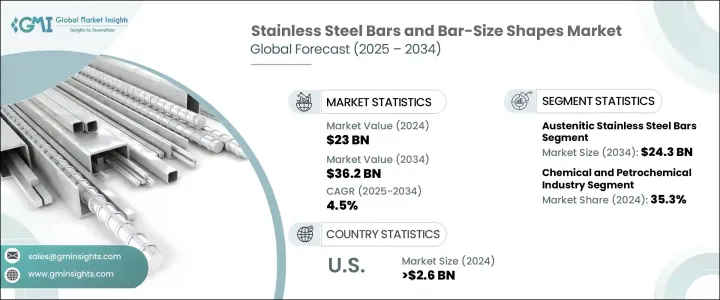
세계의 스테인리스 스틸 바 및 바 크기 모양 시장은 2024년에 230억 달러로 평가되었고 건설, 자동차, 에너지, 제조업 등 산업에서의 스테인리스 스틸 수요의 급속한 성장을 배경으로 CAGR 4.5%를 나타내 2034년에는 362억 달러에 이를 것으로 추정되고 있습니다.
스테인레스 스틸의 독특한 특성 - 강도, 내식성, 재활용성 - 그것은 현대 산업 응용 분야에 필수적인 재료로 되어 있습니다.
스테인레스 스틸 바는 그 응력과 부식에 견딜 수 있는 능력에 따라 다양한 분야에서 중요한 역할을 담당하고 있습니다. 고압이나 가혹한 조건 하에서의 내구성을 위해 스테인리스가 사용되고 있습니다. 스테인리스는 높은 위생 기준이 요구되는 의료 및 식품 가공 산업에도 불가결합니다.
| 시장 범위 | |
|---|---|
| 시작 연도 | 2024년 |
| 예측 연도 | 2025-2034년 |
| 시작 금액 | 230억 달러 |
| 예측 금액 | 362억 달러 |
| CAGR | 4.5% |
오스테나이트계 스테인레스 스틸 바 강 부문은 2024년에 158억 달러를 차지했고 2034년까지 243억 달러로 성장할 것으로 예측됩니다. 부식, 고온에 대한 뛰어난 내성으로 진중하고, 건설, 화학 처리, 의료 분야 등의 용도에 필수적입니다.
화학 및 석유화학 산업은 스테인리스 스틸 바 및 바 크기 모양 시장에서 중요한 역할을 하고 있으며, 2024년에는 35.3%의 점유율을 차지했습니다. 온도, 극단적인 압력이라는 엄격한 조건을 견뎌야 합니다. 이 분야에서는 부식성 물질과 휘발성 화합물에 항상 노출되어도 구조적 무결성을 유지하는 재료가 필요하며 스테인레스 스틸은 중요한 작업에서 신뢰성과 안전성을 보장하기 위한 이상적인 선택입니다.
2024년 미국의 스테인리스 스틸 바 및 바 크기 모양 시장 규모는 26억 달러에 달했으며 활발한 제조업과 건설업, 진행중인 인프라 개발 프로젝트에 견인되어 2034년까지 연평균 복합 성장률(CAGR) 4.5%를 나타내 안정된 페이스로 성장을 계속할 것으로 예측됩니다. 스테인리스 스틸 부품은 기계, 수송, 건축자재 등 다양한 분야에서 널리 사용되고 있으며, 가혹한 환경에도 견딜 수 있는 내구성과 범용성이 높은 소재에 대한 수요를 뒷받침하고 있습니다.
세계의 스테인리스 스틸 바 및 바 크기 모양 시장 주요 기업은 Outokumpu, 신일본 제철, Acerinox, POSCO, Jindal Stainless 등이 있습니다. 이러한 기업은 제품의 다양화, 생산 능력의 강화, 지속가능성의 중시 등 전략을 채용하여 시장에서의 지위를 강화하고 있습니다.
목차
제1장 조사 방법과 범위
제2장 주요 요약
제3장 업계 인사이트
- 요약
- 시장의 하이라이트와 주요 조사 결과
- 시장 규모와 성장 예측
- 주요 시장 성장 촉진요인과 제약
- 경쟁 구도의 개요
- 전략적 권장사항의 스냅샷
- 트럼프 정권에 의한 관세에 대한 영향
- 무역에 미치는 영향
- 무역량의 혼란
- 보복 조치
- 업계에 미치는 영향
- 공급측의 영향(원재료)
- 주요 원재료의 가격 변동
- 공급망 재구성
- 생산 비용에 미치는 영향
- 수요측의 영향(판매가격)
- 최종 시장에의 가격 전달
- 시장 점유율 동향
- 소비자의 반응 패턴
- 공급측의 영향(원재료)
- 영향을 받는 주요 기업
- 전략적 업계 대응
- 공급망 재구성
- 가격 설정 및 제품 전략
- 정책관여
- 전망과 향후 검토 사항
- 무역에 미치는 영향
- 무역 통계(HS코드)
- 주요 수출국(2021-2024년)
- 주요 수입국(2021-2024년)
참고 : 위의 무역 통계는 주요 국가에만 제공됩니다.
- 시장 개요 및 역학
- 시장 정의와 진화
- 밸류체인 분석
- 시장 규모와 성장 예측(2021-2034년)
- 과거 시장 가치(2021-2024년)
- 현재 시장평가(2024년)
- 시장 예측(2025-2034년)
- 시장 역학
- 주요 성장 촉진요인
- 시장 성장 억제요인 및 과제
- 시장 기회
- 시장의 힘 영향 분석
- PESTEL 분석
- Porter's Five Forces 분석
- COVID-19의 영향 평가 및 회복 분석
- 세계의 철강 업계의 개요와 스테인리스 스틸 바 시장에 대한 영향
- 규제 프레임워크과 기준
- 세계의 스테인레스 스틸 산업 규제
- 스테인리스 스틸 바의 국제규격
- ASTM 규격
- ASME 규격
- EN 규격
- JIS 규격
- ISO 규격
- 지역 규제 틀
- 북미 규제
- 유럽 규제
- 아시아태평양 규제
- 무역정책과 관세
- 수출입 규제
- 안티 덤핑 조치
- 상쇄 관세
- 세이프 가드 조치
- 품질인증 요건
- 재료 인증
- 프로세스 인증
- 품질 관리 시스템
- 환경규제
- 배출 기준
- 폐기물 관리 규제
- 에너지 효율 요건
- 노동안전규칙
- 규제의 영향 분석
- 생산 비용에 미치는 영향
- 시장 진입 장벽에 대한 영향
- 가격 전략에 미치는 영향
- 업계 동향과 최종 사용자의 기호
- 고성능 스테인리스 스틸로의 이행
- 내부식 등급
- 고강도 등급
- 내열 등급
- 자동차 업계 동향
- 차량 경량화의 대처
- 전기자동차의 영향
- 배출규제의 영향
- 안전성과 성능 요건
- 석유 및 가스 업계 동향
- 심해 탐사의 요건
- 부식성 환경 솔루션
- 고압/고온용도
- 화학 업계 동향
- 내식성 요건
- 공정 효율 개선
- 안전성과 신뢰성 요구
- 식품 및 음료 업계 동향
- 위생 및 위생 관리 요건
- 프로세스 자동화의 영향
- 규제 컴플라이언스의 요구
- 의료 업계 동향
- 생체 적합성 요건
- 정밀 제조 수요
- 멸균 적합성
- 건설 업계 동향
- 건축 용도의 성장
- 지속 가능한 건축 실천
- 내부식성 인프라
- 지역에 의한 최종 용도의 취향 차이
- OEM 사양의 동향
- 재료 선택 기준
- 성능 요건
- 비용 고려 사항
- 고성능 스테인리스 스틸로의 이행
- 공급망과 원재료 분석
- 원재료 조달 분석
- 철광석 및 스크랩
- 니켈
- 크롬
- 몰리브덴
- 기타 합금 원소
- 스테인레스 스틸 생산 공정 분석
- 제철 기술
- 합금화 프로세스
- 압연 및 마무리 공정
- 치료 프로세스
- 품질관리조치
- 유통 채널 분석
- OEM에 직접 판매
- 철강 서비스 센터
- 판매자 및 도매업체
- 전자상거래 플랫폼
- 공급망의 과제
- 원재료 가격 변동
- 에너지 비용의 변동
- 물류와 수송의 과제
- 공급망의 혼란
- 공급망 최적화 전략
- 지속 가능한 공급망의 실천
- 공급 체인의 기술 통합
- 원재료 조달 분석
- 가격 분석과 비용 구조
- 제품 유형별 가격 분석
- 오스테나이트계 스테인레스 스틸 바의 가격
- 페라이트계 스테인리스 스틸 바의 가격
- 마르텐사이트계 스테인리스 스틸 바의 가격
- 듀플렉스 스테인레스 스틸 바 가격
- PH 스테인레스 스틸 바 가격
- 가격 동향 분석(2020-2025년)
- 가격 예측(2025-2030년)
- 가격에 영향을 미치는 요인
- 원재료비
- 에너지 비용
- 인건비
- 생산 비용
- 수송비
- 시장 경쟁
- 무역정책과 관세
- 지역별 가격 차이
- 주요 기업의 가격 전략
- 비용 구조 분석
- 원재료비
- 에너지 비용
- 인건비
- 제조 비용
- 유통 비용
- 마케팅 및 판매 비용
- 제품 부문별 수익성 분석
- 부가가치 서비스의 가격에 미치는 영향
- 제품 유형별 가격 분석
- 기술의 진보와 혁신
- 최근 기술 개발
- 고급 제철 기술
- 전기 아크로의 혁신
- AOD 프로세스의 진보
- 상용 주조의 개선
- 합금 설계의 혁신
- 린 듀플렉스 스테인레스 스틸
- 고질소 스테인리스 스틸
- 고급 마르텐사이트 등급
- 특수 오스테나이트계 등급
- 처리 기술의 진보
- 열간 압연의 혁신
- 냉간 가공의 발전
- 열처리 혁신
- 표면 처리 기술
- 품질 관리 및 시험 혁신
- 비파괴 검사의 진보
- 자동 검사 시스템
- 재료 특성 평가 기술
- 스테인레스 스틸 생산의 디지털 통합
- 인더스트리 4.0의 구현
- 인공지능 용도
- 예지보전시스템
- 디지털 트윈 기술
- 지속가능한 생산기술
- 에너지 효율의 혁신
- 배출 감축 기술
- 폐기물 삭감과 재활용
- 특허 분석과 연구개발 동향
- 미래의 기술 로드맵
- 지속가능성과 환경에 미치는 영향
- 스테인레스 스틸 생산 환경 발자국
- 탄소 발자국 분석
- 에너지 소비 평가
- 물의 사용과 관리
- 폐기물의 발생과 관리
- 스테인레스 스틸 업계의 지속가능성에 대한 노력
- 탄소 삭감 전략
- 에너지 효율 대책
- 순환형 경제의 접근
- 재활용 및 재료 회수
- 스크랩 이용률
- 수명 종료 고려 사항
- 폐쇄 루프 제조
- 그린 스틸 생산 기술
- 수소계 제강
- 탄소 포집 및 저류
- 바이오매스 베이스의 삭감
- 지속가능성에 대한 규제압력
- 탄소 가격 설정 메커니즘
- 배출량 거래 제도
- 환경 컴플라이언스 요건
- 업계의 지속가능성에 대한 노력
- 수명 주기 평가(LCA) 분석
- 지속 가능한 관행의 비용 편익 분석
- 스테인레스 스틸 생산 환경 발자국
- 시장의 과제와 기회
- 주요 시장의 과제
- 원재료 가격 변동
- 에너지 비용의 변동
- 철강 업계의 과잉 생산 능력
- 무역장벽과 보호주의
- 환경 컴플라이언스 비용
- 대체 재료의 경쟁
- 시장 기회
- 고성능 합금 개발
- 신흥 시장 확대
- 인프라 개발 프로젝트
- 신재생에너지 성장
- 의료 및 의약품 용도
- 적층 조형 용도
- 거시경제 요인의 영향
- 세계경제의 성장
- 공업 생산 동향
- 건설 활동
- 석유 및 가스 산업의 동향
- 기술적 기회 평가
- 전략적 기회 매핑
- 주요 시장의 과제
- 향후 시장 전망과 예측
- 제품 유형별 시장 예측(2025-2030년)
- 오스테나이트계 스테인리스 스틸 바의 예측
- 페라이트계 스테인리스 스틸 바의 예측
- 마르텐사이트계 스테인리스 스틸 바의 예측
- 듀플렉스 스테인리스 스틸 바의 예측
- PH 스테인레스 스틸 바 예측
- 형상별 시장 예측(2025-2030년)
- 원형 바 예측
- 정사각형 및 직사각형 바 예측
- 육각형 바의 예측
- 기타 형상 예측
- 용도별 시장 예측(2025-2030년)
- 지역별 시장 예측(2025-2030년)
- 신흥 시장 동향
- 향후 성장 촉진요인
- 시장 발전 시나리오
- 낙관적 시나리오
- 현실적인 시나리오
- 비관적인 시나리오
- 투자 기회 평가
- 미래경쟁 구도 예측
- 제품 유형별 시장 예측(2025-2030년)
- 전략적 제안
- 시장 진출 전략
- 제품 개발 권장 사항
- 지역 확대의 기회
- 경쟁적 포지셔닝 전략
- 지속가능성 구현 로드맵
- 디지털 변혁 전략
- 규제 컴플라이언스 전략
- 마케팅 및 유통에 관한 권장 사항
- 리스크 경감 전략
- 투자 우선순위화 프레임워크
- 스테인리스 스틸과 다른 재료의 비교 분석
- 스테인리스 스틸과 탄소강
- 스테인레스 스틸과 알루미늄
- 스테인리스 스틸과 니켈 합금
- 퍼포먼스 벤치마크
- 비용편익분석
- 용도 적합성의 비교
- 특허 분석과 혁신의 상황
- 최근 특허출원의 분석
- 기술 혁신과 연구개발의 중점분야
- 지역 및 기업 수준의 특허 동향
제4장 경쟁 구도
- 시장 구조와 집중분석
- 시장 집중도 개요
- 시장의 세분화와 지배의 분석
- 진입 장벽과 시장 접근 평가
- 주요 기업의 시장 점유율 분석
- 주요 제조업체의 점유율
- 지역을 넘은 시장 지배
- 시장 점유율 추이의 과거 동향
- 경쟁 포지셔닝 매트릭스
- 제품 범위와 지리적 존재에 의한 주요 기업의 포지셔닝 지정
- 전략적 능력과 기술적 우위성의 비교
- 성능과 혁신을 기반으로 한 사분면 매핑
- 주요 기업의 상세한 기업 프로파일
- Outokumpu
- Acerinox
- Jindal Stainless
- Nippon Steel Corporation
- POSCO
- Sandvik Materials Technology
- Carpenter Technology Corporation
- Valbruna Stainless Inc.
- Voestalpine AG
- Tsingshan Holding Group
- 경쟁 전략 분석
- 능력 확대의 대처
- 합병 및 인수
- 파트너십 및 협업
- 제품 개발과 혁신
- 투자 및 자금조달 시나리오
- 최근 투자 동향
- 프라이빗 에퀴티와 벤처 캐피탈의 관여
- 공공 부문의 자금과 인센티브
제5장 시장 규모와 예측 : 등급별(2021-2034년)
- 주요 동향
- 오스테나이트계 스테인리스 스틸 바(300 시리즈)
- 304/304l 스테인리스 스틸
- 316/316l 스테인리스 스틸
- 321 스테인레스 스틸
- 347 스테인레스 스틸
- 기타 오스테나이트계 강종
- 페라이트계 스테인리스 스틸 바(400 시리즈)
- 430 스테인레스 스틸
- 409 스테인레스 스틸
- 446 스테인레스 스틸
- 기타 페라이트계 등급
- 마르텐사이트계 스테인리스 스틸 바(400 시리즈)
- 410 스테인레스 스틸
- 416 스테인레스 스틸
- 420 스테인레스 스틸
- 440 스테인레스 스틸
- 기타 마르텐사이트계 등급
- 듀플렉스 스테인리스 스틸 바
- 2205 듀플렉스
- 2507 슈퍼 듀플렉스
- 기타 듀플렉스 등급
- 석출 경화 스테인리스 스틸 바
- 17-4 PH 스테인리스 스틸
- 15-5 PH 스테인레스 스틸
- 기타 PH 등급
제6장 시장 규모와 예측 : 형상 및 치수별(2021-2034년)
- 주요 동향
- 원형 바
- 정사각형 바
- 육각 바
- 플랫 바
- 각도
- 채널
- 기타 바 크기 모양
제7장 시장 규모와 예측 : 가공 방법별(2021-2034년)
- 주요 동향
- 열간 압연 스테인리스 스틸 바
- 냉간 가공 스테인레스 스틸 바
- 냉간 압연 바
- 냉간 압연 바
- 연마 및 광택 바
- 연마 및 광택 바
제8장 시장 규모와 예측 : 용도별(2021-2034년)
- 주요 동향
- 자동차 및 수송
- 배기 시스템
- 구조 부품
- 패스너 및 커넥터
- 연료 시스템 부품
- 항공우주 및 방위
- 항공기 부품
- 패스너 및 커넥터
- 착륙 장치의 부품
- 방위 장비
- 건설 및 인프라
- 구조 부품
- 보강 용도
- 건축용도
- 패스너와 앵커
- 석유 및 가스 산업
- 드릴링 장비
- 탐사 구성 요소
- 정제장치
- 해외 용도
- 화학 및 석유화학 산업
- 공정 장비 부품
- 밸브 및 피팅
- 열교환부품
- 식품 및 음료 업계
- 처리 장치
- 저장 탱크 및 용기
- 컨베이어 시스템
- 의료 및 의약품
- 수술기구
- 내장형 디바이스
- 기기 구성 요소
- 발전
- 기존의 발전소
- 원자력 발전소
- 재생에너지 기기
- 해양 및 조선
- 구조 부품
- 추진 시스템
- 갑판 장비
- 기계설비 제조
- 산업기계
- 섬유 기계
- 제지 및 펄프 설비
- 기타 용도
- 소비재
- 일렉트로닉스
- 스포츠 용품
제9장 시장 규모와 예측 : 지역별(2021-2034년)
- 주요 동향
- 북미
- 미국
- 캐나다
- 유럽
- 영국
- 독일
- 프랑스
- 이탈리아
- 스페인
- 네덜란드
- 아시아태평양
- 중국
- 인도
- 일본
- 한국
- 호주
- 라틴아메리카
- 브라질
- 멕시코
- 아르헨티나
- 중동 및 아프리카
- 남아프리카
- 사우디아라비아
- 아랍에미리트(UAE)
제10장 기업 프로파일
- Outokumpu
- Acerinox
- Jindal Stainless
- Nippon Steel
- POSCO
- Sandvik Materials Technology
- Carpenter Technology
- Valbruna Stainless
- Voestalpine
- Tsingshan Holding Group
The Global Stainless Steel Bars and Bar-Size Shapes Market was valued at USD 23 billion in 2024 and is estimated to grow at a CAGR of 4.5% to reach USD 36.2 billion by 2034, driven by the rapid growth in demand for stainless steel across industries like construction, automotive, energy, and manufacturing. Stainless steel's unique properties-strength, corrosion resistance, and recyclability-make it an essential material for modern industrial applications. The material's robustness in extreme environments, along with its sustainability, positions it as a key player in global industrial growth.
Stainless steel bars are crucial in various sectors due to their ability to withstand stress and corrosion. In construction, they provide the structural integrity needed for long-lasting buildings and infrastructure. The automotive industry relies on stainless-steel bars for critical components exposed to wear and corrosion. Similarly, the energy sector, particularly oil and gas, uses stainless steel for its durability under high pressures and extreme conditions. Stainless steel is also vital in the medical and food processing industries, where high hygiene standards are required. As new applications for stainless steel emerge, the market for bars and bar-size shapes continues to expand, bolstering the demand for reliable, durable materials.
| Market Scope | |
|---|---|
| Start Year | 2024 |
| Forecast Year | 2025-2034 |
| Start Value | $23 Billion |
| Forecast Value | $36.2 Billion |
| CAGR | 4.5% |
The austenitic stainless steel bars segment accounted for USD 15.8 billion in 2024 and is expected to grow to USD 24.3 billion by 2034. Austenitic stainless steel, especially grades like 304 and 316, is prized for its excellent resistance to oxidation, corrosion, and high temperatures, making it indispensable in applications such as construction, chemical processing, and the medical field. These bars are also known for their high ductility, non-magnetic properties, and ease of fabrication, which allows them to be shaped into complex structures without compromising their strength.
The chemical and petrochemical industries play a crucial role in the stainless steel bars and bar-size shapes market, holding a 35.3% share in 2024. Stainless steel bars and shapes are indispensable in manufacturing reactors, valves, pumps, heat exchangers, and piping systems, all of which must endure the demanding conditions of aggressive chemicals, high temperatures, and extreme pressures. These sectors require materials that maintain their structural integrity even under constant exposure to corrosive substances and volatile compounds, making stainless steel an ideal choice for ensuring reliability and safety in critical operations.
U.S. Stainless Steel Bars and Bar-Size Shapes Market reached USD 2.6 billion in 2024 and is projected to continue growing at a steady pace of 4.5% CAGR through 2034, driven by the active manufacturing and construction industries, as well as ongoing infrastructure development projects. Stainless steel components are widely used in various sectors, including machinery, transportation, and building materials, fueling the demand for durable and versatile materials that can withstand harsh environments. As industrial activity in the U.S. remains robust, the market for stainless steel bars and shapes is expected to expand steadily over the coming years.
Key players in the Global Stainless Steel Bars and Bar-Size Shapes Market include Outokumpu, Nippon Steel Corporation, Acerinox, POSCO, and Jindal Stainless. These companies are adopting strategies such as diversifying product offerings, enhancing production capabilities, and focusing on sustainability to strengthen their market position. By investing in innovative production techniques and expanding into emerging markets, these players are looking to meet the increasing demand for high-quality stainless-steel products.
Table of Contents
Chapter 1 Methodology & Scope
- 1.1 Market scope & definition
- 1.2 Base estimates & calculations
- 1.3 Forecast calculation
- 1.4 Data sources
- 1.4.1 Primary
- 1.4.2 Secondary
- 1.4.2.1 Paid sources
- 1.4.2.2 Public sources
Chapter 2 Executive Summary
- 2.1 Industry synopsis, 2021-2034
Chapter 3 Industry Insights
- 3.1 Summary
- 3.1.1 Market Highlights and Key Findings
- 3.1.2 Market Size and Growth Projections
- 3.1.3 Key Market Drivers and Restraints
- 3.1.4 Competitive Landscape Overview
- 3.1.5 Strategic Recommendations Snapshot
- 3.2 Trump Administration Tariffs
- 3.2.1 Impact on Trade
- 3.2.1.1 Trade Volume Disruptions
- 3.2.1.2 Retaliatory Measures
- 3.2.2 Impact on the Industry
- 3.2.2.1 Supply-Side Impact (Raw Materials)
- 3.2.2.1.1 Price Volatility in Key Materials
- 3.2.2.1.2 Supply Chain Restructuring
- 3.2.2.1.3 Production Cost Implications
- 3.2.2.2 Demand-Side Impact (Selling Price)
- 3.2.2.2.1 Price Transmission to End Markets
- 3.2.2.2.2 Market Share Dynamics
- 3.2.2.2.3 Consumer Response Patterns
- 3.2.2.1 Supply-Side Impact (Raw Materials)
- 3.2.3 Key Companies Impacted
- 3.2.4 Strategic Industry Responses
- 3.2.4.1 Supply Chain Reconfiguration
- 3.2.4.2 Pricing and Product Strategies
- 3.2.4.3 Policy Engagement
- 3.2.5 Outlook and Future Considerations
- 3.2.1 Impact on Trade
- 3.3 Trade statistics (HS Code)
- 3.3.1 Major Exporting Countries, 2021-2024 (USD Mn)
- 3.3.2 Major Importing Countries, 2021-2024 (USD Mn)
Note: The above trade statistics will be provided for key countries only
- 3.4 Market Overview and Dynamics
- 3.4.1 Market Definition and Evolution
- 3.4.2 Value Chain Analysis
- 3.4.3 Market Size and Growth Forecast 2021–2034
- 3.4.3.1 Historical Market Value 2021–2024
- 3.4.3.2 Current Market Valuation 2024
- 3.4.3.3 Market Projections 2025–2034
- 3.4.4 Market Dynamics
- 3.4.4.1 Primary Growth Drivers
- 3.4.4.2 Market Restraints and Challenges
- 3.4.4.3 Market Opportunities
- 3.4.4.4 Impact Analysis of Market Forces
- 3.4.5 PESTLE Analysis
- 3.4.6 Porter's Five Forces Analysis
- 3.4.7 COVID-19 Impact Assessment and Recovery Analysis
- 3.4.8 Global Steel Industry Overview and Impact on Stainless Steel Bars Market
- 3.5 Regulatory Framework and Standards
- 3.5.1 Global Stainless Steel Industry Regulations
- 3.5.2 International Standards for Stainless Steel Bars
- 3.5.2.1 ASTM Standards
- 3.5.2.2 ASME Standards
- 3.5.2.3 EN Standards
- 3.5.2.4 JIS Standards
- 3.5.2.5 ISO Standards
- 3.5.3 Regional Regulatory Frameworks
- 3.5.3.1 North American Regulations
- 3.5.3.2 European Regulations
- 3.5.3.3 Asia-Pacific Regulations
- 3.5.4 Trade Policies and Tariffs
- 3.5.4.1 Import/Export Regulations
- 3.5.4.2 Anti-Dumping Measures
- 3.5.4.3 Countervailing Duties
- 3.5.4.4 Safeguard Measures
- 3.5.5 Quality Certification Requirements
- 3.5.5.1 Material Certification
- 3.5.5.2 Process Certification
- 3.5.5.3 Quality Management Systems
- 3.5.6 Environmental Regulations
- 3.5.6.1 Emissions Standards
- 3.5.6.2 Waste Management Regulations
- 3.5.6.3 Energy Efficiency Requirements
- 3.5.7 Occupational Safety Regulations
- 3.5.8 Regulatory Impact Analysis
- 3.5.8.1 Impact on Production Costs
- 3.5.8.2 Impact on Market Entry Barriers
- 3.5.8.3 Impact on Pricing Strategies
- 3.6 Industry Trends and End-User Preferences
- 3.6.1 Shift Towards High-Performance Stainless-Steel Grades
- 3.6.1.1 Corrosion-Resistant Grades
- 3.6.1.2 High-Strength Grades
- 3.6.1.3 Heat-Resistant Grades
- 3.6.2 Automotive Industry Trends
- 3.6.2.1 Vehicle Lightweighting Initiatives
- 3.6.2.2 Electric Vehicle Impact
- 3.6.2.3 Emissions Regulations Impact
- 3.6.2.4 Safety and Performance Requirements
- 3.6.3 Oil and Gas Industry Trends
- 3.6.3.1 Deepwater Exploration Requirements
- 3.6.3.2 Corrosive Environment Solutions
- 3.6.3.3 High-Pressure/High-Temperature Applications
- 3.6.4 Chemical Industry Trends
- 3.6.4.1 Corrosion Resistance Requirements
- 3.6.4.2 Process Efficiency Improvements
- 3.6.4.3 Safety and Reliability Demands
- 3.6.5 Food and Beverage Industry Trends
- 3.6.5.1 Hygiene and Sanitation Requirements
- 3.6.5.2 Process Automation Impact
- 3.6.5.3 Regulatory Compliance Needs
- 3.6.6 Medical Industry Trends
- 3.6.6.1 Biocompatibility Requirements
- 3.6.6.2 Precision Manufacturing Demands
- 3.6.6.3 Sterilization Compatibility
- 3.6.7 Construction Industry Trends
- 3.6.7.1 Architectural Applications Growth
- 3.6.7.2 Sustainable Building Practices
- 3.6.7.3 Corrosion-Resistant Infrastructure
- 3.6.8 Regional End Use Preference Variations
- 3.6.9 OEM Specification Trends
- 3.6.9.1 Material Selection Criteria
- 3.6.9.2 Performance Requirements
- 3.6.9.3 Cost Considerations
- 3.6.1 Shift Towards High-Performance Stainless-Steel Grades
- 3.7 Supply Chain and Raw Material Analysis
- 3.7.1 Raw Material Sourcing Analysis
- 3.7.1.1 Iron Ore and Scrap
- 3.7.1.2 Nickel
- 3.7.1.3 Chromium
- 3.7.1.4 Molybdenum
- 3.7.1.5 Other Alloying Elements
- 3.7.2 Stainless Steel Production Process Analysis
- 3.7.2.1 Steelmaking Technologies
- 3.7.2.2 Alloying Processes
- 3.7.2.3 Rolling and Finishing Processes
- 3.7.2.4 Heat Treatment Processes
- 3.7.2.5 Quality Control Measures
- 3.7.3 Distribution Channel Analysis
- 3.7.3.1 Direct Sales to OEMs
- 3.7.3.2 Steel Service Centers
- 3.7.3.3 Distributors and Wholesalers
- 3.7.3.4 E-commerce Platforms
- 3.7.4 Supply Chain Challenges
- 3.7.4.1 Raw Material Price Volatility
- 3.7.4.2 Energy Cost Fluctuations
- 3.7.4.3 Logistics and Transportation Challenges
- 3.7.4.4 Supply Chain Disruptions
- 3.7.5 Supply Chain Optimization Strategies
- 3.7.6 Sustainable Supply Chain Practices
- 3.7.7 Technology Integration in the Supply Chain
- 3.7.1 Raw Material Sourcing Analysis
- 3.8 Pricing Analysis and Cost Structure
- 3.8.1 Price Point Analysis by Product Type
- 3.8.1.1 Austenitic Stainless Steel Bars Pricing
- 3.8.1.2 Ferritic Stainless Steel Bars Pricing
- 3.8.1.3 Martensitic Stainless Steel Bars Pricing
- 3.8.1.4 Duplex Stainless Steel Bars Pricing
- 3.8.1.5 PH Stainless Steel Bars Pricing
- 3.8.2 Price Trend Analysis 2020-2025
- 3.8.3 Price Forecast 2025-2030
- 3.8.4 Factors Affecting Pricing
- 3.8.4.1 Raw Material Costs
- 3.8.4.2 Energy Costs
- 3.8.4.3 Labor Costs
- 3.8.4.4 Production Costs
- 3.8.4.5 Transportation Costs
- 3.8.4.6 Market Competition
- 3.8.4.7 Trade Policies and Tariffs
- 3.8.5 Regional Price Variations
- 3.8.6 Pricing Strategies for Key Players
- 3.8.7 Cost Structure Analysis
- 3.8.7.1 Raw Material Costs
- 3.8.7.2 Energy Costs
- 3.8.7.3 Labor Costs
- 3.8.7.4 Manufacturing Costs
- 3.8.7.5 Distribution Costs
- 3.8.7.6 Marketing and Sales Costs
- 3.8.8 Profitability Analysis by Product Segment
- 3.8.9 Value-Added Services Impact on Pricing
- 3.8.1 Price Point Analysis by Product Type
- 3.9 Technological Advancements and Innovations
- 3.9.1 Recent technological developments
- 3.9.2 Advanced steelmaking technologies
- 3.9.2.1 Electric arc furnace innovations
- 3.9.2.2 AOD process advancements
- 3.9.2.3 Continuous casting improvements
- 3.9.3 Alloy design innovations
- 3.9.3.1 Lean duplex stainless steel
- 3.9.3.2 High-nitrogen stainless steels
- 3.9.3.3 Advanced martensitic grades
- 3.9.3.4 Specialty austenitic grades
- 3.9.4 Processing technology advancements
- 3.9.4.1 Hot-rolling innovations
- 3.9.4.2 Cold-finishing advancements
- 3.9.4.3 Heat treatment innovations
- 3.9.4.4 Surface treatment technologies
- 3.9.5 Quality control and testing innovations
- 3.9.5.1 Non-destructive testing advancements
- 3.9.5.2 Automated inspection systems
- 3.9.5.3 Material characterization technologies
- 3.9.6 Digital integration in stainless steel production
- 3.9.6.1 Industry 4.0 implementation
- 3.9.6.2 Artificial intelligence applications
- 3.9.6.3 Predictive maintenance systems
- 3.9.6.4 Digital twin technology
- 3.9.7 Sustainable production technologies
- 3.9.7.1 Energy efficiency innovations
- 3.9.7.2 Emissions reduction technologies
- 3.9.7.3 Waste reduction and recycling
- 3.9.8 Patent analysis and R&D trends
- 3.9.9 Future technology roadmap
- 3.10 Sustainability and Environmental Impact
- 3.10.1 Environmental footprint of stainless-steel production
- 3.10.1.1 Carbon footprint analysis
- 3.10.1.2 Energy consumption assessment
- 3.10.1.3 Water usage and management
- 3.10.1.4 Waste generation and management
- 3.10.2 Sustainability initiatives in stainless steel industry
- 3.10.2.1 Carbon reduction strategies
- 3.10.2.2 Energy efficiency measures
- 3.10.2.3 Circular economy approaches
- 3.10.3 Recycling and material recovery
- 3.10.3.1 Scrap utilization rates
- 3.10.3.2 End-of-life considerations
- 3.10.3.3 Closed-loop manufacturing
- 3.10.4 Green steel production technologies
- 3.10.4.1 Hydrogen-based steelmaking
- 3.10.4.2 Carbon capture and storage
- 3.10.4.3 Biomass-based reduction
- 3.10.5 Regulatory pressures for sustainability
- 3.10.5.1 Carbon pricing mechanisms
- 3.10.5.2 Emissions trading systems
- 3.10.5.3 Environmental compliance requirements
- 3.10.6 Industry sustainability commitments
- 3.10.7 Lifecycle assessment (LCA) analysis
- 3.10.8 Cost-benefit analysis of sustainable practices
- 3.10.1 Environmental footprint of stainless-steel production
- 3.11 Market Challenges and Opportunities
- 3.11.1 Key market challenges
- 3.11.1.1 Raw material price volatility
- 3.11.1.2 Energy cost fluctuations
- 3.11.1.3 Overcapacity in the steel industry
- 3.11.1.4 Trade barriers and protectionism
- 3.11.1.5 Environmental compliance costs
- 3.11.1.6 Competition of alternative materials
- 3.11.2 Market opportunities
- 3.11.2.1 High-performance alloy development
- 3.11.2.2 Emerging markets expansion
- 3.11.2.3 Infrastructure development projects
- 3.11.2.4 Renewable energy growth
- 3.11.2.5 Medical and pharmaceutical applications
- 3.11.2.6 Additive manufacturing applications
- 3.11.3 Impact of macro-economic factors
- 3.11.3.1 Global economic growth
- 3.11.3.2 Industrial production trends
- 3.11.3.3 Construction activity
- 3.11.3.4 Oil and gas industry dynamics
- 3.11.4 Technological opportunity assessment
- 3.11.5 Strategic opportunity mapping
- 3.11.1 Key market challenges
- 3.12 Future Market Outlook and Forecast
- 3.12.1 Market forecast by product type 2025-2030
- 3.12.1.1 Austenitic stainless-steel bars forecast
- 3.12.1.2 Ferritic stainless-steel bars forecast
- 3.12.1.3 Martensitic stainless-steel bars forecast
- 3.12.1.4 Duplex stainless-steel bars forecast
- 3.12.1.5 PH stainless steel bars forecast
- 3.12.2 Market forecast by shape 2025-2030
- 3.12.2.1 Round bars forecast
- 3.12.2.2 Square and rectangular bars forecast
- 3.12.2.3 Hexagonal bars forecast
- 3.12.2.4 Other shapes forecast
- 3.12.3 Market forecast by application 2025-2030
- 3.12.4 Market forecast by region 2025-2030
- 3.12.5 Emerging market trends
- 3.12.6 Future growth drivers
- 3.12.7 Market evolution scenarios
- 3.12.7.1 Optimistic scenario
- 3.12.7.2 Realistic scenario
- 3.12.7.3 Pessimistic scenario
- 3.12.8 Investment opportunities assessment
- 3.12.9 Future competitive landscape projection
- 3.12.1 Market forecast by product type 2025-2030
- 3.13 Strategic Recommendations
- 3.13.1 Market entry strategies
- 3.13.2 Product development recommendations
- 3.13.3 Regional expansion opportunities
- 3.13.4 Competitive positioning strategies
- 3.13.5 Sustainability implementation roadmap
- 3.13.6 Digital transformation strategies
- 3.13.7 Regulatory compliance strategies
- 3.13.8 Marketing and distribution recommendations
- 3.13.9 Risk mitigation strategies
- 3.13.10 Investment prioritization framework
- 3.14 Comparative Analysis of Stainless Steel vs. Other Materials
- 3.14.1 Stainless Steel vs. Carbon Steel
- 3.14.2 Stainless Steel vs. Aluminum
- 3.14.3 Stainless Steel vs. Nickel Alloys
- 3.14.4 Performance Benchmarking
- 3.14.5 Cost-Benefit Analysis
- 3.14.6 Application Suitability Comparison
- 3.15 Patent Analysis and Innovation Landscape
- 3.15.1 Analysis of recent patent filings
- 3.15.2 Technological innovations and R&D focus areas
- 3.15.3 Regional and company-level patent trends
Chapter 4 Competitive Landscape, 2024
- 4.1 Market Structure and Concentration Analysis
- 4.1.1 Overview of market concentration levels
- 4.1.2 Analysis of market fragmentation vs. dominance
- 4.1.3 Assessment of entry barriers and market access
- 4.2 Market Share Analysis of Key Players
- 4.2.1 Percentage share of top manufacturers
- 4.2.2 Market dominance across regions
- 4.2.3 Historical trends in market share shifts
- 4.3 Competitive Positioning Matrix
- 4.3.1 Positioning of major players by product range and geographic presence
- 4.3.2 Comparison of strategic capabilities and technological edge
- 4.3.3 Quadrant mapping based on performance and innovation
- 4.4 Detailed Company Profiles of Major Players
- 4.4.1 Outokumpu
- 4.4.2 Acerinox
- 4.4.3 Jindal Stainless
- 4.4.4 Nippon Steel Corporation
- 4.4.5 POSCO
- 4.4.6 Sandvik Materials Technology
- 4.4.7 Carpenter Technology Corporation
- 4.4.8 Valbruna Stainless Inc.
- 4.4.9 Voestalpine AG
- 4.4.10 Tsingshan Holding Group
- 4.5 Competitive Strategies Analysis
- 4.5.1 Capacity Expansion Initiatives
- 4.5.2 Mergers and Acquisitions
- 4.5.3 Partnerships and Collaborations
- 4.5.4 Product Development and Innovation
- 4.6 Investment and Funding Scenario
- 4.6.1 Recent investment trends
- 4.6.2 Private equity and venture capital involvement
- 4.6.3 Public sector funding and incentives
Chapter 5 Market Size and Forecast, By Grade, 2021-2034 (USD Million) (Tons)
- 5.1 Key trends
- 5.2 Austenitic stainless-steel bars (300 series)
- 5.2.1 304/304l stainless steel
- 5.2.2 316/316l stainless steel
- 5.2.3 321 stainless steel
- 5.2.4 347 stainless steel
- 5.2.5 Other austenitic grades
- 5.3 Ferritic stainless-steel bars (400 series)
- 5.3.1 430 stainless steel
- 5.3.2 409 stainless steel
- 5.3.3 446 stainless steel
- 5.3.4 Other ferritic grades
- 5.4 Martensitic stainless-steel bars (400 series)
- 5.4.1 410 stainless steel
- 5.4.2 416 stainless steel
- 5.4.3 420 stainless steel
- 5.4.4 440 stainless steel
- 5.4.5 Other martensitic grades
- 5.5 Duplex stainless-steel bars
- 5.5.1 2205 duplex
- 5.5.2 2507 super duplex
- 5.5.3 Other duplex grades
- 5.6 Precipitation hardening stainless steel bars
- 5.6.1 17-4 PH stainless steel
- 5.6.2 15-5 PH stainless steel
- 5.6.3 Other PH Grades
Chapter 6 Market Size and Forecast, By Shape & Dimension, 2021-2034 (USD Million) (Tons)
- 6.1 Key trends
- 6.2 Round bars
- 6.3 Square bars
- 6.4 Hexagonal bars
- 6.5 Flat bars
- 6.6 Angles
- 6.7 Channels
- 6.8 Other bar-size shapes
Chapter 7 Market Size and Forecast, By Processing Method, 2021-2034 (USD Million) (Tons)
- 7.1 Key trends
- 7.2 Hot-rolled stainless-steel bars
- 7.3 Cold-finished stainless-steel bars
- 7.3.1 Cold-drawn bars
- 7.3.2 Cold-rolled bars
- 7.3.3 Turned and polished bars
- 7.3.4 Ground and polished bars
Chapter 8 Market Size and Forecast, By Application, 2021-2034 (USD Million) (Tons)
- 8.1 Key trends
- 8.2 Automotive and transportation
- 8.2.1 Exhaust systems
- 8.2.2 Structural components
- 8.2.3 Fasteners and connectors
- 8.2.4 Fuel system components
- 8.3 Aerospace and defense
- 8.3.1 Aircraft components
- 8.3.2 Fasteners and connectors
- 8.3.3 Landing gear components
- 8.3.4 Defense equipment
- 8.4 Construction and infrastructure
- 8.4.1 Structural components
- 8.4.2 Reinforcement applications
- 8.4.3 Architectural applications
- 8.4.4 Fasteners and anchors
- 8.5 Oil and gas industry
- 8.5.1 Drilling equipment
- 8.5.2 Exploration components
- 8.5.3 Refining equipment
- 8.5.4 Offshore applications
- 8.6 Chemical and petrochemical industry
- 8.6.1 Process equipment components
- 8.6.2 Valves and fittings
- 8.6.3 Heat exchange components
- 8.7 Food and beverage industry
- 8.7.1 Processing equipment
- 8.7.2 Storage tanks and vessels
- 8.7.3 Conveying systems
- 8.8 Medical and pharmaceutical
- 8.8.1 Surgical instruments
- 8.8.2 Implantable devices
- 8.8.3 Equipment components
- 8.9 Power generation
- 8.9.1 Conventional power plants
- 8.9.2 Nuclear power plants
- 8.9.3 Renewable energy equipment
- 8.10 Marine and shipbuilding
- 8.10.1 Structural components
- 8.10.2 Propulsion systems
- 8.10.3 Deck equipment
- 8.11 Machinery and equipment manufacturing
- 8.11.1 Industrial machinery
- 8.11.2 Textile machinery
- 8.11.3 Paper and pulp equipment
- 8.12 Other applications
- 8.12.1 Consumer goods
- 8.12.2 Electronics
- 8.12.3 Sporting equipment
Chapter 9 Market Size and Forecast, By Region, 2021-2034 (USD Million) (Tons)
- 9.1 Key trends
- 9.2 North America
- 9.2.1 U.S.
- 9.2.2 Canada
- 9.3 Europe
- 9.3.1 UK
- 9.3.2 Germany
- 9.3.3 France
- 9.3.4 Italy
- 9.3.5 Spain
- 9.3.6 Netherlands
- 9.4 Asia Pacific
- 9.4.1 China
- 9.4.2 India
- 9.4.3 Japan
- 9.4.4 South Korea
- 9.4.5 Australia
- 9.5 Latin America
- 9.5.1 Brazil
- 9.5.2 Mexico
- 9.5.3 Argentina
- 9.6 MEA
- 9.6.1 South Africa
- 9.6.2 Saudi Arabia
- 9.6.3 UAE
Chapter 10 Company Profiles
- 10.1 Outokumpu
- 10.2 Acerinox
- 10.3 Jindal Stainless
- 10.4 Nippon Steel
- 10.5 POSCO
- 10.6 Sandvik Materials Technology
- 10.7 Carpenter Technology
- 10.8 Valbruna Stainless
- 10.9 Voestalpine
- 10.10 Tsingshan Holding Group