|
시장보고서
상품코드
1750514
상업용 가스 연소 보일러 시장 : 시장 기회, 성장 촉진요인, 산업 동향 분석, 예측(2025-2034년)Commercial Gas Fired Boiler Market Opportunity, Growth Drivers, Industry Trend Analysis, and Forecast 2025 - 2034 |
||||||

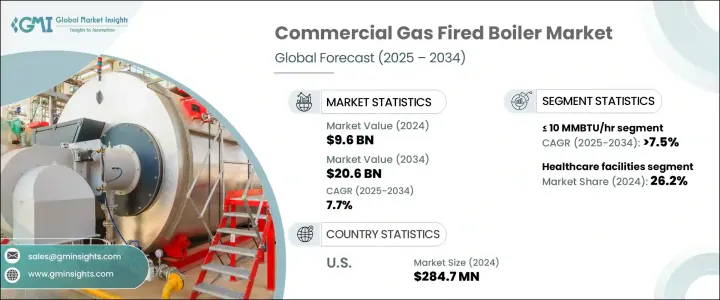
세계의 상업용 가스 연소 보일러 시장 규모는 2024년에 96억 달러로 평가되었고, 2034년에는 CAGR 7.7%로 성장할 전망이며, 206억 달러에 이를 것으로 추정됩니다.
보일러 시스템에서 사물인터넷(IoT)의 활용 확대를 통해 원격 모니터링, 실시간 성능 최적화, 예보보전이 가능하며, 다운타임 절감과 운영비용 절감을 실현합니다. 이 분야는 수소 혼합 기술 혁신의 혜택을 받고 있으며, 대기업은 역동적인 난방 수요에 대응하는 선진 모델을 설계하고 있습니다. 이러한 대처는, 성능의 신뢰성을 유지하면서, 보다 클린한 에너지 전환을 서포트하는 것을 목적으로 하고 있습니다.
모듈식 난방 시스템에 대한 수요가 증가함에 따라 대규모 캠퍼스, 기업 사무실 및 상업 시설의 에너지 사용 방식을 변화시키고 있습니다. 바이오 테크놀로지, 제약, 데이터 인프라와 같은 분야의 계속적인 확대에 의해, 신뢰성과 적응성을 제공하는 정밀한 난방 솔루션이 요구되고 있습니다. 공급망의 불확실성과 무역규제 변화에 대응하기 위해 보일러 업체들은 국내 생산에 투자해 공급 대응력을 높이고 지정학적 리스크를 줄이고 있습니다. 예를 들어, 금속에 대한 관세가 이전에 실시되어 제조업의 경제성에 큰 영향을 주었기 때문에 기업은 사업을 현지화하고 부품 조달 전략을 다양화하는 동기부여가 되었습니다.
| 시장 범위 | |
|---|---|
| 시작 연도 | 2024년 |
| 예측 연도 | 2025-2034년 |
| 시작 금액 | 96억 달러 |
| 예측 금액 | 206억 달러 |
| CAGR | 7.7% |
10 MMBTU/hr 미만의 시스템은 강력한 성장 궤도를 유지하며 2034년까지 연평균 복합 성장률(CAGR) 7.5%로 확대될 것으로 예측됩니다. 이러한 소형 고효율 솔루션은 교육 기관, 소매점, 의료 시설, 접객 건물 등 공간에 제약이 있는 환경에 적합합니다. 확장성이 있고 초기 투자 및 유지보수 비용이 낮으며, 성능이나 배출 기준을 해치지 않고 안정적인 난방을 제공할 수 있는 비용 대비 효과가 높은 방법입니다.
상업 사무부는 현대의 지속가능성 벤치마크에 따른 지능적이고 에너지 효율적인 난방 시스템에 대한 수요 증가에 힘입어 2034년까지 35억 달러에 이를 것으로 예측되고 있습니다. 기업들은 컴플라이언스 요건을 충족하기 위해서뿐만 아니라 업무 효율을 높이기 위해서도 콘덴싱 보일러와 초저NOx 기술을 채택하고 있습니다. 빌딩 자동화 시스템과의 통합이 일반화되고 있어 시설 관리자는 난방 부하를 제어해 에너지 낭비를 줄일 수 있습니다.
미국의 상업용 가스 연소 보일러 2024년 시장 규모는 2억 8,470만 달러로 평가되었고, 전국적인 인프라 근대화 노력 및 온실 효과 가스 배출 감축을 의무화하는 환경 규제의 강화가 원동력이 되고 있습니다. 상업용 건물, 특히 난방 업그레이드가 필요한 노후화된 건축물에서는 더 높은 열효율과 디지털 통합을 지원하는 고급 보일러 시스템으로의 전환이 진행되고 있습니다. 클린 에너지 도입을 장려하는 정부의 우대 조치와 지역 규제도 기존 시스템에서 고성능 가스불소 대체 시스템으로의 대체를 촉진하는 한 요인이 되고 있습니다.
BDR Thermea Group, Lochinvar, Viessmann, Ariston Holding, Bosch Industriekessel, Weil-McLain, Bradford White Corporation, AO Smith, Burnham Commercial, Daikin, Vaillant Group, FERROLI, FONDITAL, Immergas, Remeha, Hoval, Cleaver-Brooks, Babcock & Wilcox와 같은 선도적인 제조업체는 경쟁력을 유지하기 위해 중요한 전략을 채택하고 있습니다. 이 전략에는 스마트 제품 라인 확대, 수소 대응 모델의 연구 개발 강화, 고객 지원 시스템 개선, 지역 제조 허브 구축 등이 포함되어 지속가능성 목표를 달성하면서 납품 속도 향상 및 비용 절감을 도모하고 있습니다.
목차
제1장 조사 방법 및 범위
제2장 주요 요약
제3장 업계 인사이트
- 생태계 분석
- 트럼프 정권의 관세 분석
- 무역에 미치는 영향
- 무역량의 혼란
- 보복 조치
- 업계에 미치는 영향
- 공급측의 영향(원재료)
- 주요 원재료의 가격 변동
- 공급망 재구성
- 생산 비용에 미치는 영향
- 수요측의 영향(판매가격)
- 최종 시장에 대한 가격 전달
- 시장 점유율 동향
- 소비자의 반응 패턴
- 공급측의 영향(원재료)
- 영향을 받는 주요 기업
- 전략적인 업계 대응
- 공급망 재구성
- 가격 설정 및 제품 전략
- 정책관여
- 전망 및 향후 검토 사항
- 무역에 미치는 영향
- 규제 상황
- 업계에 미치는 영향요인
- 성장 촉진요인
- 업계의 잠재적 위험 및 과제
- 성장 가능성 분석
- Porter's Five Forces 분석
- PESTEL 분석
제4장 경쟁 구도
- 서문
- 전략적 대시보드
- 전략적 노력
- 기업의 시장 점유율 분석
- 경쟁 벤치마킹
- 혁신 및 지속가능성의 정세
제5장 시장 규모 및 예측 : 용량별(2021-2034년)
- 주요 동향
- 10 MMBTU/시 미만
- 10-50 MMBTU/시 이상
- 50-100 MMBTU/시 이상
- 100-250 MMBTU/시 이상
- 250 MMBTU/시 이상
제6장 시장 규모 및 예측 : 기술별(2021-2034년)
- 주요 동향
- 응축
- 불응축
제7장 시장 규모 및 예측 : 용도별(2021-2034년)
- 주요 동향
- 사무실
- 의료시설
- 교육기관
- 숙박 시설
- 소매점
- 기타
제8장 시장 규모 및 예측 : 지역별(2021-2034년)
- 주요 동향
- 북미
- 미국
- 캐나다
- 멕시코
- 유럽
- 프랑스
- 영국
- 폴란드
- 이탈리아
- 스페인
- 오스트리아
- 독일
- 스웨덴
- 러시아
- 아시아태평양
- 중국
- 인도
- 필리핀
- 일본
- 한국
- 호주
- 인도네시아
- 중동 및 아프리카
- 사우디아라비아
- 이란
- 아랍에미리트(UAE)
- 나이지리아
- 남아프리카
- 라틴아메리카
- 브라질
- 아르헨티나
- 칠레
제9장 기업 프로파일
- AO Smith
- Ariston Holding
- Babcock & Wilcox Enterprises
- BDR Thermea Group
- Bosch Industriekessel
- Bradford White Corporation
- BURNHAM COMMERCIAL BOILERS
- Cleaver-Brooks
- Daikin
- FERROLI
- FONDITAL
- Hoval
- Immergas
- Lochinvar
- Remeha
- Vaillant Group
- VIESSMANN
- Weil-McLain
The Global Commercial Gas Fired Boiler Market was valued at USD 9.6 billion in 2024 and is estimated to grow at a CAGR of 7.7% to reach USD 20.6 billion by 2034, driven by evolving heating needs across sectors and the continued push for smarter, more efficient building systems. The increasing use of Internet of Things (IoT) in boiler systems enables remote monitoring, real-time performance optimization, and predictive maintenance, reducing downtime and cutting operational costs. The sector benefits from hydrogen blending innovations, with leading manufacturers designing advanced models to accommodate dynamic heating demands. These efforts aim to support cleaner energy transitions while maintaining performance reliability.
A rise in demand for modular heating systems is transforming how large campuses, corporate offices, and commercial facilities approach energy use. The continued expansion of sectors like biotechnology, pharmaceuticals, and data infrastructure has pushed for precision heating solutions that offer reliability and adaptability. In response to supply chain uncertainties and shifting trade regulations, boiler manufacturers invest in domestic production to enhance supply responsiveness and reduce geopolitical risks. For instance, earlier tariff implementations on metals significantly impacted manufacturing economics, motivating companies to localize operations and diversify component sourcing strategies.
| Market Scope | |
|---|---|
| Start Year | 2024 |
| Forecast Year | 2025-2034 |
| Start Value | $9.6 Billion |
| Forecast Value | $20.6 Billion |
| CAGR | 7.7% |
Systems rated at <= 10 MMBTU/hr are expected to maintain a strong growth trajectory, expanding at a CAGR of 7.5% through 2034. These compact, high-efficiency solutions are well-suited for space-constrained environments such as educational institutions, retail outlets, healthcare facilities, and hospitality buildings. Their scalability and lower upfront and maintenance costs offer a cost-effective way to deliver consistent heating without compromising performance or emissions standards.
The commercial office segment is projected to reach USD 3.5 billion by 2034, fueled by increased demand for intelligent, energy-efficient heating systems in line with modern sustainability benchmarks. Organizations are adopting condensing boilers and ultra-low NOx technology not only to meet compliance requirements but also to enhance operational efficiency. Integration with building automation systems is becoming more common, allowing facility managers to control heating loads and reduce energy waste.
United States Commercial Gas Fired Boiler Market generated USD 284.7 million in 2024, driven by the nationwide infrastructure modernization efforts and stricter environmental mandates reducing greenhouse gas emissions. Commercial buildings-especially aging structures in need of heating upgrades-are switching to advanced boiler systems that support higher thermal efficiency and digital integration. Government incentives and regional regulations encouraging clean energy adoption have also contributed to the increased replacement of conventional systems with high-performance gas-fired alternatives.
Leading manufacturers such as BDR Thermea Group, Lochinvar, Viessmann, Ariston Holding, Bosch Industriekessel, Weil-McLain, Bradford White Corporation, A.O. Smith, Burnham Commercial, Daikin, Vaillant Group, FERROLI, FONDITAL, Immergas, Remeha, Hoval, Cleaver-Brooks, and Babcock & Wilcox are adopting key strategies to stay competitive. These include expanding smart product lines, boosting R&D in hydrogen-ready models, improving customer support systems, and building regional manufacturing hubs to increase delivery speed and reduce costs while meeting sustainability targets.
Table of Contents
Chapter 1 Methodology & Scope
- 1.1 Research design
- 1.2 Market estimates & forecast parameters
- 1.3 Forecast calculation
- 1.4 Data sources
- 1.4.1 Primary
- 1.4.2 Secondary
- 1.4.2.1 Paid
- 1.4.2.2 Public
- 1.5 Market definitions
Chapter 2 Executive Summary
- 2.1 Industry synopsis, 2021 - 2034
Chapter 3 Industry Insights
- 3.1 Industry ecosystem analysis
- 3.2 Trump administration tariffs analysis
- 3.2.1 Impact on trade
- 3.2.1.1 Trade volume disruptions
- 3.2.1.2 Retaliatory measures
- 3.2.2 Impact on the industry
- 3.2.2.1 Supply-side impact (raw materials)
- 3.2.2.1.1 Price volatility in key materials
- 3.2.2.1.2 Supply chain restructuring
- 3.2.2.1.3 Production cost implications
- 3.2.2.2 Demand-side impact (selling price)
- 3.2.2.2.1 Price transmission to end markets
- 3.2.2.2.2 Market share dynamics
- 3.2.2.2.3 Consumer response patterns
- 3.2.2.1 Supply-side impact (raw materials)
- 3.2.3 Key companies impacted
- 3.2.4 Strategic industry responses
- 3.2.4.1 Supply chain reconfiguration
- 3.2.4.2 Pricing and product strategies
- 3.2.4.3 Policy engagement
- 3.2.5 Outlook and future considerations
- 3.2.1 Impact on trade
- 3.3 Regulatory landscape
- 3.4 Industry impact forces
- 3.4.1 Growth drivers
- 3.4.2 Industry pitfalls & challenges
- 3.5 Growth potential analysis
- 3.6 Porter's analysis
- 3.6.1 Bargaining power of suppliers
- 3.6.2 Bargaining power of buyers
- 3.6.3 Threat of new entrants
- 3.6.4 Threat of substitutes
- 3.7 PESTEL analysis
Chapter 4 Competitive Landscape, 2025
- 4.1 Introduction
- 4.2 Strategic dashboard
- 4.3 Strategic initiatives
- 4.4 Company market share analysis, 2024
- 4.5 Competitive benchmarking
- 4.6 Innovation & sustainability landscape
Chapter 5 Market Size and Forecast, By Capacity, 2021 - 2034 (USD Million & Units)
- 5.1 Key trends
- 5.2 ≤ 10 MMBTU/hr
- 5.3 > 10 - 50 MMBTU/hr
- 5.4 > 50 - 100 MMBTU/hr
- 5.5 > 100 - 250 MMBTU/hr
- 5.6 > 250 MMBTU/hr
Chapter 6 Market Size and Forecast, By Technology, 2021 - 2034 (USD Million & Units)
- 6.1 Key trends
- 6.2 Condensing
- 6.3 Non-condensing
Chapter 7 Market Size and Forecast, By Application, 2021 - 2034 (USD Million & Units)
- 7.1 Key trends
- 7.2 Offices
- 7.3 Healthcare facilities
- 7.4 Educational institutions
- 7.5 Lodgings
- 7.6 Retail stores
- 7.7 Others
Chapter 8 Market Size and Forecast, By Region, 2021 - 2034 (USD Million & Units)
- 8.1 Key trends
- 8.2 North America
- 8.2.1 U.S.
- 8.2.2 Canada
- 8.2.3 Mexico
- 8.3 Europe
- 8.3.1 France
- 8.3.2 UK
- 8.3.3 Poland
- 8.3.4 Italy
- 8.3.5 Spain
- 8.3.6 Austria
- 8.3.7 Germany
- 8.3.8 Sweden
- 8.3.9 Russia
- 8.4 Asia Pacific
- 8.4.1 China
- 8.4.2 India
- 8.4.3 Philippines
- 8.4.4 Japan
- 8.4.5 South Korea
- 8.4.6 Australia
- 8.4.7 Indonesia
- 8.5 Middle East & Africa
- 8.5.1 Saudi Arabia
- 8.5.2 Iran
- 8.5.3 UAE
- 8.5.4 Nigeria
- 8.5.5 South Africa
- 8.6 Latin America
- 8.6.1 Brazil
- 8.6.2 Argentina
- 8.6.3 Chile
Chapter 9 Company Profiles
- 9.1 A.O. Smith
- 9.2 Ariston Holding
- 9.3 Babcock & Wilcox Enterprises
- 9.4 BDR Thermea Group
- 9.5 Bosch Industriekessel
- 9.6 Bradford White Corporation
- 9.7 BURNHAM COMMERCIAL BOILERS
- 9.8 Cleaver-Brooks
- 9.9 Daikin
- 9.10 FERROLI
- 9.11 FONDITAL
- 9.12 Hoval
- 9.13 Immergas
- 9.14 Lochinvar
- 9.15 Remeha
- 9.16 Vaillant Group
- 9.17 VIESSMANN
- 9.18 Weil-McLain