|
시장보고서
상품코드
1750597
폐암 시장 기회, 성장 촉진요인, 산업 동향 분석 및 예측(2025-2034년)Lung Cancer Market Opportunity, Growth Drivers, Industry Trend Analysis, and Forecast 2025 - 2034 |
||||||

세계의 폐암 시장 규모는 2024년에는 351억 달러로 평가되었고, 세계적인 폐암 이환율 상승과 인지도 향상, 조기 발견 촉진, 치료 접근 강화를 위한 정부의 이니셔티브이 높아짐에 따라 CAGR 10.6%를 나타내 2034년에는 951억 달러에 달할 전망입니다.
지원 프로그램과 공중 보건 이니셔티브의 확대를 통해 환자의 치료에 대한 액세스가 증가하고 있는 것도 시장 확대에 보다 유리한 환경 만들기에 기여하고 있습니다.

공공기관이나 민간기업에 의한 종양학에 대한 투자 확대가 의약품 개발이나 진단에 있어서의 기술 혁신의 파도를 일으켜 궁극적으로 시장을 밀어 올렸습니다. 이러한 기술 혁신에 의해 헬스 케어 프로바이더는 보다 효과적이고 커스터마이즈된 치료 레지멘을 제공할 수 있게 되어, 차세대의 진단·치료 솔루션에 대한 수요가 탄생하고 있습니다.
| 시장 범위 | |
|---|---|
| 시작 연도 | 2024년 |
| 예측 연도 | 2025-2034년 |
| 시작 금액 | 351억 달러 |
| 예측 금액 | 951억 달러 |
| CAGR | 10.6% |
환자와 의료 종사자가 기존의 화학요법보다 표적요법이나 면역요법을 선호하게 되었기 때문에 치료제 부문은 2024년에 187억 달러에 달했습니다. 또한 여러 치료 전략을 동시에 사용하는 병용 요법에 대한 관심도 높아지고 있으며, 치료 프로토콜의 효능이 높아지고 있습니다.
병원 분야는 기관지경 검사나 기타 최첨단 기술과 같은 고도의 진단 툴이 널리 채용되어 암 발견을 위한 병원 환경에서의 표준이 되고 있는 것으로 추진되고, 2034년에는 615억 달러에 이르는 등 크게 성장할 것으로 예측되고 있습니다. 보다 이용하기 쉽고 효율적이 됨에 따라 병원에서 실시되는 진단 처치의 수는 증가의 길을 따라 가고 있습니다.
2024년 미국의 폐암 시장 규모는 154억 달러에 달했고 진단기술의 급속한 진보와 규제당국으로부터의 강력한 지원에 지지되고 있습니다. 광범위한 자금 지원이 임상 개발과 신속한 제품 승인에 기여하고 있습니다. 이러한 요소는 혁신적인 폐암 솔루션의 채택에 유리한 상황을 만들어 북미 전역 시장 실적을 더욱 강화하고 있습니다.
세계의 폐암 시장을 형성하는 주요 기업으로는 Merck, Sun Pharmaceuticals, Pfizer, F. Hoffmann-La Roche, Bristol-Myers Squibb Company, AdvaCare Pharma, Cleveland Clinic, Weill Cornell Medicine, Rutgers Health, Biodesix, Memorial Sloan Kettering Cancer Center, Teva Pharmaceuticals, CHEPLAPHARM Group, CHEPLAPHARM 그룹, UPMC 등이 있습니다. 시장에서의 존재감을 높이기 위해 각 회사는 정밀 종양학 연구에 대한 투자, 세계 판매망의 확대, 생명 공학 기업 및 학술 기관과의 전략적 제휴를 우선하고 있습니다. 신속하게 도입하기 위해 임상시험 파이프라인을 가속화하는 기업도 많이 있습니다.
목차
제1장 조사 방법과 범위
제2장 주요 요약
제3장 업계 인사이트
- 생태계 분석
- 업계에 미치는 영향요인
- 성장 촉진요인
- 세계적인 폐암 이환율의 상승
- 진단과 스크리닝에 있어서의 기술의 진보
- 표적요법 및 면역요법의 채용 증가
- 낮은 침습 수술 수요 증가
- 업계의 잠재적 리스크 및 과제
- 고액의 치료비
- 충분한 기술과 훈련을 받은 종양 전문의와 방사선과 의사의 부족
- 성장 촉진요인
- 성장 가능성 분석
- 규제 상황
- 트럼프 정권에 의한 관세에 대한 영향
- 무역에 미치는 영향
- 무역량의 혼란
- 보복 조치
- 업계에 미치는 영향
- 공급측의 영향(원재료)
- 주요 원재료의 가격 변동
- 공급망 재구성
- 생산 비용에 미치는 영향
- 수요측의 영향(판매가격)
- 최종 시장에의 가격 전달
- 시장 점유율 동향
- 소비자의 반응 패턴
- 공급측의 영향(원재료)
- 영향을 받는 주요 기업
- 전략적인 업계 대응
- 공급망 재구성
- 가격 설정 및 제품 전략
- 정책관여
- 전망과 향후 검토 사항
- 무역에 미치는 영향
- 향후 시장 동향
- 폐암역학
- 상환 시나리오
- Porter's Five Forces 분석
- PESTEL 분석
제4장 경쟁 구도
- 서론
- 기업 매트릭스 분석
- 기업의 시장 점유율 분석
- 주요 시장 기업의 경쟁 분석
- 경쟁 포지셔닝 매트릭스
- 전략 대시보드
제5장 시장 추계·예측 : 진단 및 치료별(2021-2034년)
- 주요 동향
- 진단
- 기관지경 검사
- 분자 검사
- 이미징
- 기타
- 치료
- 비침습적 치료
- 유형별
- 화학요법
- 표적요법
- 면역요법
- 기타
- 투여 경로별
- 경구
- 비경구
- 유형별
- 최소 침습 요법
- 고주파 절제
- 마이크로파 절제
- 온열/동결요법
- 기타
- 비침습적 치료
제6장 시장 추계·예측 : 적응증별(2021-2034년)
- 주요 동향
- 비소세포 폐암
- 소세포 폐암
제7장 시장 추계·예측 : 최종 용도별(2021-2034년)
- 주요 동향
- 병원
- 진단실험실
- 전문 클리닉
- 기타
제8장 시장 추계·예측 : 지역별(2021-2034년)
- 주요 동향
- 북미
- 미국
- 캐나다
- 유럽
- 독일
- 영국
- 프랑스
- 스페인
- 이탈리아
- 네덜란드
- 아시아태평양
- 중국
- 인도
- 일본
- 호주
- 한국
- 라틴아메리카
- 브라질
- 멕시코
- 아르헨티나
- 중동 및 아프리카
- 남아프리카
- 사우디아라비아
- 아랍에미리트(UAE)
제9장 기업 프로파일
- AdvaCare Pharma
- Biodesix
- Bristol-Myers Squibb Company
- CHEPLAPHARM Group
- Cleveland Clinic
- F. Hoffmann La Roche
- Memorial Sloan Kettering Cancer Center
- Merck &Co.
- Pfizer
- Rutgers Health Sun Pharmaceutical
- Sun Pharmaceuticals
- Teva Pharmaceuticals
- UPMC
- Weill Cornell Medicine
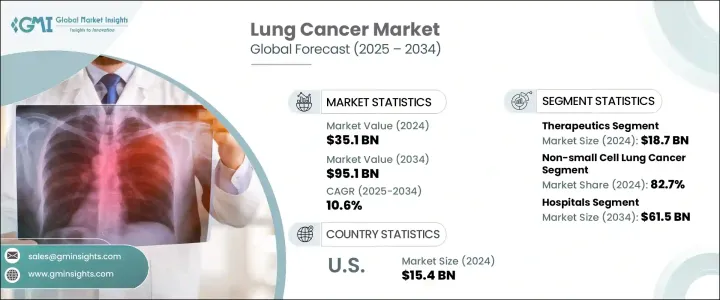
The Global Lung Cancer Market was valued at USD 35.1 billion in 2024 and is estimated to grow at a CAGR of 10.6% to reach USD 95.1 billion by 2034, driven by the rising incidence of lung cancer worldwide, as well as growing government efforts to improve awareness, promote early detection, and enhance access to treatment. Increasing patient access to care through expanding assistance programs and public health initiatives has also contributed to a more favorable environment for market expansion. As aging populations in developed countries continue to rise, so does the at-risk patient pool, particularly in nations like the United States, Germany, and Japan.
Greater investment in oncology by public institutions and private players has triggered a wave of innovation in drug development and diagnostics, ultimately pushing the market forward. Continuous research efforts are helping to uncover advanced methods of treating lung cancer, and the introduction of biomarker-driven therapies has supported the emergence of precision medicine. With these innovations, healthcare providers can offer more effective, customized treatment regimens, creating demand for next-generation diagnostic and therapeutic solutions.
| Market Scope | |
|---|---|
| Start Year | 2024 |
| Forecast Year | 2025-2034 |
| Start Value | $35.1 Billion |
| Forecast Value | $95.1 Billion |
| CAGR | 10.6% |
The therapeutics segment generated USD 18.7 billion in 2024, as patients and healthcare professionals increasingly prefer targeted therapies and immunotherapies over conventional chemotherapy. These new treatment options offer better outcomes, fewer side effects, and greater patient convenience. There is also growing interest in combination approaches-using multiple therapeutic strategies simultaneously, which has enhanced the effectiveness of treatment protocols. Advanced therapies are now often used in initial treatment stages, which is helping to redefine standards of care across various lung cancer types.
The hospital segment is projected to grow significantly, reaching an estimated USD 61.5 billion by 2034, fueled by the widespread adoption of advanced diagnostic tools such as bronchoscopy and other cutting-edge technologies, which have become standard in hospital settings for cancer detection. As these tools become more accessible and efficient, the number of diagnostic procedures performed in hospitals continues to rise. Supportive reimbursement frameworks for diagnostic equipment and surgical treatments in hospitals further encourage patients to seek care in these facilities, driving revenue growth.
United States Lung Cancer Market was valued at USD 15.4 billion in 2024, supported by rapid advancements in diagnostic technologies and strong support from regulatory authorities. The presence of leading biopharmaceutical companies and cancer research institutions, coupled with extensive funding from federal agencies, has fueled clinical development and fast-tracked product approvals. These elements have created a favorable landscape for the adoption of innovative lung cancer solutions, further strengthening market performance across North America.
Key players shaping the Global Lung Cancer Market landscape include Merck, Sun Pharmaceuticals, Pfizer, F. Hoffmann-La Roche, Bristol-Myers Squibb Company, AdvaCare Pharma, Cleveland Clinic, Weill Cornell Medicine, Rutgers Health, Biodesix, Memorial Sloan Kettering Cancer Center, Teva Pharmaceuticals, CHEPLAPHARM Group, and UPMC. To strengthen their market presence, companies prioritize investing in precision oncology research, expanding global distribution networks, and forming strategic collaborations with biotech firms and academic institutions. Many are also accelerating their clinical trial pipelines to introduce innovative therapies faster. Additionally, they are acquiring smaller firms with promising drug candidates, while optimizing drug delivery systems to improve patient outcomes.
Table of Contents
Chapter 1 Methodology and Scope
- 1.1 Market scope and definition
- 1.2 Research design
- 1.2.1 Research approach
- 1.2.2 Data collection methods
- 1.3 Base estimates and calculations
- 1.3.1 Base year calculation
- 1.3.2 Key trends for market estimation
- 1.4 Forecast model
- 1.5 Primary research and validation
- 1.5.1 Primary sources
- 1.5.2 Data mining sources
Chapter 2 Executive Summary
- 2.1 Industry 3600 synopsis
Chapter 3 Industry Insights
- 3.1 Industry ecosystem analysis
- 3.2 Industry impact forces
- 3.2.1 Growth drivers
- 3.2.1.1 Rising prevalence of lung cancer globally
- 3.2.1.2 Technology advancements in diagnostics and screening
- 3.2.1.3 Increasing adoption of targeted and immune therapies
- 3.2.1.4 Rising demand for minimally invasive procedures
- 3.2.2 Industry pitfalls and challenges
- 3.2.2.1 High cost of treatment
- 3.2.2.2 Dearth of well-skilled and trained oncologists and radiologists
- 3.2.1 Growth drivers
- 3.3 Growth potential analysis
- 3.4 Regulatory landscape
- 3.5 Trump administration tariffs
- 3.5.1 Impact on trade
- 3.5.1.1 Trade volume disruptions
- 3.5.1.2 Retaliatory measures
- 3.5.2 Impact on the Industry
- 3.5.2.1 Supply-side impact (raw materials)
- 3.5.2.1.1 Price volatility in key materials
- 3.5.2.1.2 Supply chain restructuring
- 3.5.2.1.3 Production cost implications
- 3.5.2.2 Demand-side impact (selling price)
- 3.5.2.2.1 Price transmission to end markets
- 3.5.2.2.2 Market share dynamics
- 3.5.2.2.3 Consumer response patterns
- 3.5.2.1 Supply-side impact (raw materials)
- 3.5.3 Key companies impacted
- 3.5.4 Strategic industry responses
- 3.5.4.1 Supply chain reconfiguration
- 3.5.4.2 Pricing and product strategies
- 3.5.4.3 Policy engagement
- 3.5.5 Outlook and future considerations
- 3.5.1 Impact on trade
- 3.6 Future market trends
- 3.7 Lung cancer epidemiology
- 3.8 Reimbursement scenario
- 3.9 Porter's analysis
- 3.10 PESTEL analysis
Chapter 4 Competitive Landscape, 2024
- 4.1 Introduction
- 4.2 Company matrix analysis
- 4.3 Company market share analysis
- 4.4 Competitive analysis of major market players
- 4.5 Competitive positioning matrix
- 4.6 Strategy dashboard
Chapter 5 Market Estimates and Forecast, By Diagnostics and Therapeutics, 2021 – 2034 ($ Mn)
- 5.1 Key trends
- 5.2 Diagnostics
- 5.2.1 Bronchoscopy
- 5.2.2 Molecular testing
- 5.2.3 Imaging
- 5.2.4 Other diagnostics
- 5.3 Therapeutics
- 5.3.1 Non-invasive therapy
- 5.3.1.1 By type
- 5.3.1.1.1 Chemotherapy
- 5.3.1.1.2 Targeted therapy
- 5.3.1.1.3 Immunotherapy
- 5.3.1.1.4 Other non-invasive therapies
- 5.3.1.2 By route of administration
- 5.3.1.2.1 Oral
- 5.3.1.2.2 Parenteral
- 5.3.1.1 By type
- 5.3.2 Minimally invasive therapy
- 5.3.2.1 Radiofrequency ablation
- 5.3.2.2 Microwave ablation
- 5.3.2.3 Thermal/cryoablation
- 5.3.2.4 Other minimally invasive therapies
- 5.3.1 Non-invasive therapy
Chapter 6 Market Estimates and Forecast, By Indication, 2021 – 2034 ($ Mn)
- 6.1 Key trends
- 6.2 Non-small cell lung cancer
- 6.3 Small cell lung cancer
Chapter 7 Market Estimates and Forecast, By End Use, 2021 – 2034 ($ Mn)
- 7.1 Key trends
- 7.2 Hospitals
- 7.3 Diagnostic laboratories
- 7.4 Specialty clinics
- 7.5 Other end use
Chapter 8 Market Estimates and Forecast, By Region, 2021 – 2034 ($ Mn)
- 8.1 Key trends
- 8.2 North America
- 8.2.1 U.S.
- 8.2.2 Canada
- 8.3 Europe
- 8.3.1 Germany
- 8.3.2 UK
- 8.3.3 France
- 8.3.4 Spain
- 8.3.5 Italy
- 8.3.6 Netherlands
- 8.4 Asia Pacific
- 8.4.1 China
- 8.4.2 India
- 8.4.3 Japan
- 8.4.4 Australia
- 8.4.5 South Korea
- 8.5 Latin America
- 8.5.1 Brazil
- 8.5.2 Mexico
- 8.5.3 Argentina
- 8.6 Middle East and Africa
- 8.6.1 South Africa
- 8.6.2 Saudi Arabia
- 8.6.3 UAE
Chapter 9 Company Profiles
- 9.1 AdvaCare Pharma
- 9.2 Biodesix
- 9.3 Bristol-Myers Squibb Company
- 9.4 CHEPLAPHARM Group
- 9.5 Cleveland Clinic
- 9.6 F. Hoffmann La Roche
- 9.7 Memorial Sloan Kettering Cancer Center
- 9.8 Merck & Co.
- 9.9 Pfizer
- 9.10 Rutgers Health Sun Pharmaceutical
- 9.11 Sun Pharmaceuticals
- 9.12 Teva Pharmaceuticals
- 9.13 UPMC
- 9.14 Weill Cornell Medicine