|
시장보고서
상품코드
1755241
실리콘 광전자 증배관 시장 기회 : 성장 촉진요인, 산업 동향 분석 및 예측(2025-2034년)Silicon Photomultiplier Market Opportunity, Growth Drivers, Industry Trend Analysis, and Forecast 2025 - 2034 |
||||||

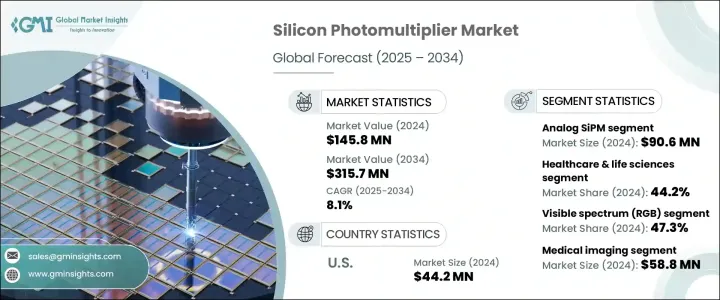
세계의 실리콘 광전자 증배관 시장은 2024년에 1억 4,580만 달러로 평가되었고 2034년까지는 3억 1,570만 달러에 달할 것으로 예측되며, CAGR 8.1%로 성장할 전망입니다.
이러한 성장은 자율주행 차량 개발에 고체 LiDAR 기술의 의존도가 높아지고, PET 및 SPECT와 같은 의료 영상 응용 분야에서의 채택이 증가함에 따라 촉진되고 있습니다. SiPM은 고급 운전자 보조 시스템과 차세대 의료 진단에 필수적인 높은 감도, 컴팩트한 크기, 빠른 응답 시간으로 인해 선호됩니다. 실시간 광자 검출에 대한 진전과 다양한 산업 분야의 수요 증가가 계속되고 있습니다.
과거에 도입된 무역 조치들은 SiPM 공급망을 크게 방해했으며, 특히 미국 기반 제조업체에 영향을 미쳤습니다. 해외 시장에서 필수 부품의 수입 비용 증가가 생산 경제성에 영향을 미쳤습니다. 수출 제한과 상호 관세는 주요 기업들의 국제 판매를 더욱 어렵게 만들었습니다. 그러나 이 혼란은 리쇼어링과 국내 역량 강화로 이어졌습니다. 미국 기업들은 외국 공급업체에 대한 의존도를 줄이고 회복력을 강화하기 위해 현지 생산과 연구개발(R&D)에 더 많은 투자를 시작했습니다. 이러한 변화는 더 자급자족적인 공급망 구축의 기반을 마련했습니다.
| 시장 범위 | |
|---|---|
| 시작 연도 | 2024년 |
| 예측 연도 | 2025-2034년 |
| 시작 금액 | 1억 4,580만 달러 |
| 예측 금액 | 3억 1,570만 달러 |
| CAGR | 8.1% |
디지털 실리콘 광전자 증배관 부문은 크게 성장하여 2034년까지 1억 6,670만 달러에 달할 것으로 예상되며, 상당한 성장을 보일 것으로 전망됩니다. 디지털 변형 제품은 통합 신호 처리, 우수한 타이밍 정밀도, 고밀도 센서 어레이 처리 능력 등 고급 기능으로 인해 인기를 얻고 있습니다. 자동차 LiDAR, 광자 계수 및 비행 시간 이미징에서 이러한 제품의 사용이 증가하는 것은 고속 및 고해상도 데이터 수집 시스템에 대한 수요에 의해 촉진되고 있습니다.
2024년에는 의료 생명과학 분야가 44.2%의 점유율을 차지했습니다. 이러한 장치는 뛰어난 이미징 정확도, 신뢰성 및 작은 폼 팩터 때문에 SiPM에 의존합니다. 암의 조기 발견, 정밀 의학 및 분자 진단에 대한 강조가 높아짐에 따라 병원 및 연구 기관의 수요가 계속해서 크게 증가하고 있습니다.
미국의 실리콘 광전자 증배관 시장은 의료 영상, 국방 응용 분야 및 첨단 연구 시설에서 미국의 강력한 입지를 바탕으로 2024년에 4,420만 달러로 평가되었습니다. Semiconductor Components Industries, LLC 및 Excelitas Technologies Corp.와 같은 주요 제조업체들이 국내 혁신을 주도하고 있습니다. 원자력 및 방사선 감지 분야에 대한 정부 투자가 증가하고 디지털 의료에 대한 관심이 높아짐에 따라 미국은 앞으로 몇 년 동안 꾸준한 성장을 유지할 것입니다.
세계의 실리콘 광전자 증배관 시장에서 활약하는 주요 기업으로는 Broadcom Inc., Hamamatsu Photonics KK, Excelitas Technologies Corp., Semiconductor Components Industries, LLC 등이 있습니다. 이 기업들은 확장 가능한 제조 시설에 투자하고, 제품 소형화를 강화하며, 차세대 디지털 SiPM 아키텍처를 개발하여 시장 지위를 강화하고 있습니다. 연구 기관 및 자동차 OEM과의 전략적 협력을 통해 응용 분야가 확대되고 있으며, 타이밍 분해능 및 광자 검출 효율을 개선하기 위한 노력이 계속되어 성능의 한계를 뛰어넘고 있습니다. 이러한 업체들 중 다수는 경쟁력 있는 가격을 유지하면서 증가하는 전 세계 수요를 충족하기 위해 자동화 및 수직 통합을 통한 비용 효율성 개선에 주력하고 있습니다.
목차
제1장 조사 방법과 범위
제2장 주요 요약
제3장 업계 인사이트
- 업계 생태계 분석
- 트럼프 정권의 관세 분석
- 무역에 미치는 영향
- 무역량의 혼란
- 보복 조치
- 업계에 미치는 영향
- 공급측의 영향
- 주요 원재료의 가격 변동
- 공급망 재구성
- 생산 비용에 미치는 영향
- 수요측의 영향(판매가격)
- 최종 시장에의 가격 전달
- 시장 점유율 동향
- 소비자의 반응 패턴
- 공급측의 영향
- 영향을 받는 주요 기업
- 전략적인 업계의 대응
- 공급망 재구성
- 가격 설정 및 제품 전략
- 정책관여
- 전망과 향후 검토 사항
- 무역에 미치는 영향
- 영향요인
- 성장 촉진요인
- 자율주행 차량에서의 고체 상태 LiDAR 채택 증가
- 의료 진단 분야에서의 PET 및 SPECT 영상 기술 성장
- 소형화 및 저전력 광학 센서 수요 증가
- 유동 세포 측정법 및 생명과학 연구의 확장
- 로봇공학 및 산업 자동화에서의 3D 이미징의 등장
- 업계의 잠재적 리스크 및 과제
- 높은 제조 비용과 가격에 민감함
- 고온 작동 시 열적 불안정성과 노이즈
- 성장 촉진요인
- 성장 가능성 분석
- 기술과 혁신의 상황
- 특허 분석
- 주요 뉴스와 대처
- 장래 시장 동향
- Porter's Five Forces 분석
- PESTEL 분석
- 규제 상황
제4장 경쟁 구도
- 소개
- 기업의 시장 점유율 분석
- 경쟁 포지셔닝 매트릭스
- 전략적 전망 매트릭스
제5장 시장 추계 및 예측 : 유형별(2021-2034년)
- 주요 동향
- 아날로그 SiPM
- 디지털 SiPM
제6장 시장 추계 및 예측 : 분광 감도별(2021-2034년)
- 주요 동향
- 근자외선(NUV)
- 가시 스펙트럼(RGB)
- 근적외선(NIR)
- 광대역 스펙트럼/다중 스펙트럼
제7장 시장 추계 및 예측 : 용도별(2021-2034년)
- LiDAR과 3D 거리 측정
- 의료 영상
- 고에너지 물리학
- 핵 및 방사선 검출
- 유동 세포 측정법
- 기타
제8장 시장 추계 및 예측 : 최종 이용 산업별(2021-2034년)
- 의료 및 생명과학
- 자동차
- 항공우주 및 방위
- 산업
- 기타
제9장 시장 추계 및 예측 : 지역별(2021-2034년)
- 주요 동향
- 북미
- 미국
- 캐나다
- 유럽
- 영국
- 독일
- 프랑스
- 이탈리아
- 스페인
- 러시아
- 아시아태평양
- 중국
- 인도
- 일본
- 한국
- 호주
- 라틴아메리카
- 브라질
- 멕시코
- 중동 및 아프리카
- 남아프리카
- 사우디아라비아
- 아랍에미리트(UAE)
제10장 기업 프로파일
- AdvanSiD
- Berkeley Nucleonics Corporation
- Berthold Technologies GmbH &Co.KG
- Broadcom
- Excelitas Technologies Corp.
- First Sensor
- Hamamatsu Photonics KK
- John Caunt Scientific ltd.
- Radiation Monitoring Devices
- Semiconductor Components Industries, LLC
- Thorlabs, Inc.
The Global Silicon Photomultiplier Market was valued at USD 145.8 million in 2024 and is estimated to grow at a CAGR of 8.1% to reach USD 315.7 million by 2034. The growth is driven by the increasing reliance on solid-state LiDAR technology in autonomous vehicle development, along with rising adoption in medical imaging applications such as PET and SPECT. SiPMs are favored for their high sensitivity, compact footprint, and fast response time essential in advanced driver-assistance systems and next-generation healthcare diagnostics. Progress and growing demand for real-time photon detection across sectors continue to grow.
Trade measures introduced in previous years significantly disrupted the SiPM supply chain, especially for US-based manufacturers. Increased import costs for essential components from overseas markets impacted production economics. Export limitations and reciprocal tariffs also made international sales more difficult for leading companies. However, this disruption created a push toward reshoring and developing domestic capabilities. U.S. players began investing more heavily in local production and R&D to strengthen resilience and reduce dependency on foreign suppliers. These shifts helped lay the foundation for a more self-sufficient supply network.
| Market Scope | |
|---|---|
| Start Year | 2024 |
| Forecast Year | 2025-2034 |
| Start Value | $145.8 Million |
| Forecast Value | $315.7 Million |
| CAGR | 8.1% |
The digital silicon photomultipliers segment is set to grow substantially, expected to reach USD 166.7 million by 2034. Digital variants are gaining popularity due to their advanced features like integrated signal processing, superior timing precision, and the ability to handle dense sensor arrays. Their increasing use in automotive LiDAR, photon counting, and time-of-flight imaging is driven by the demand for high-speed and high-resolution data acquisition systems.
In 2024, the healthcare and life sciences segment held a 44.2% share due to extensive SiPM deployment in medical diagnostic equipment like SPECT and PET scanners, as well as in applications such as flow cytometry and radiation detection. These devices depend on SiPMs for their exceptional imaging accuracy, reliability, and small form factor. Rising emphasis on early cancer detection, precision medicine, and molecular diagnostics continues to drive substantial demand from hospitals and research institutions.
United States Silicon Photomultiplier Market was valued at USD 44.2 million in 2024, supported by the country's strong position in medical imaging, national defense applications, and advanced research facilities. Key manufacturers such as Semiconductor Components Industries, LLC, and Excelitas Technologies Corp. lead innovation domestically. With increasing government investment in nuclear and radiation detection and a growing focus on digital healthcare, the U.S. will maintain steady growth in the years ahead.
Key players active in the Global Silicon Photomultiplier Market include Broadcom Inc., Hamamatsu Photonics K.K., Excelitas Technologies Corp., and Semiconductor Components Industries, LLC. These companies are strengthening their market position by investing in scalable manufacturing facilities, enhancing product miniaturization, and developing next-generation digital SiPM architectures. Strategic collaborations with research institutions and automotive OEMs are expanding application reach, while efforts to improve timing resolution and photon detection efficiency continue to push performance boundaries. Many of these players focus on improving cost efficiency through automation and vertical integration to meet increasing global demand while ensuring competitive pricing.
Table of Contents
Chapter 1 Methodology & Scope
- 1.1 Market scope & definitions
- 1.2 Base estimates & calculations
- 1.3 Forecast calculations
- 1.4 Data sources
- 1.4.1 Primary
- 1.4.2 Secondary
- 1.4.2.1 Paid sources
- 1.4.2.2 Public sources
Chapter 2 Executive Summary
- 2.1 Industry synopsis, 2021-2034
Chapter 3 Industry Insights
- 3.1 Industry ecosystem analysis
- 3.2 Trump administration tariffs analysis
- 3.2.1 Impact on trade
- 3.2.1.1 Trade volume disruptions
- 3.2.1.2 Retaliatory measures
- 3.2.2 Impact on the industry
- 3.2.2.1 Supply-side impact
- 3.2.2.1.1 Price volatility in key raw material
- 3.2.2.1.2 Supply chain restructuring
- 3.2.2.1.3 Production cost implications
- 3.2.2.2 Demand-side impact (selling price)
- 3.2.2.2.1 Price transmission to end markets
- 3.2.2.2.2 Market share dynamics
- 3.2.2.2.3 Consumer response patterns
- 3.2.2.1 Supply-side impact
- 3.2.3 key companies impacted
- 3.2.4 strategic industry responses
- 3.2.4.1 Supply chain reconfiguration
- 3.2.4.2 Pricing and product strategies
- 3.2.4.3 Policy engagement
- 3.2.5 Outlook and future considerations
- 3.2.1 Impact on trade
- 3.3 Impact forces
- 3.3.1 Growth drivers
- 3.3.1.1 Rising adoption of solid-state LiDAR in autonomous vehicles
- 3.3.1.2 Growth in PET and SPECT imaging in healthcare diagnostics
- 3.3.1.3 Increased demand for compact, low-power optical sensors
- 3.3.1.4 Expansion of flow cytometry and life science research
- 3.3.1.5 Emergence of 3D imaging in robotics and industrial automation
- 3.3.2 Industry pitfalls & challenges
- 3.3.2.1 High manufacturing cost and price sensitivity
- 3.3.2.2 Thermal instability and noise at high operating temperatures
- 3.3.1 Growth drivers
- 3.4 Growth potential analysis
- 3.5 Technological & innovation landscape
- 3.6 Patent analysis
- 3.7 Key news and initiatives
- 3.8 Future market trends
- 3.9 Porter's analysis
- 3.10 PESTEL analysis
- 3.11 Regulatory landscape
Chapter 4 Competitive Landscape, 2024
- 4.1 Introduction
- 4.2 Company market share analysis
- 4.3 Competitive positioning matrix
- 4.4 Strategic outlook matrix
Chapter 5 Market Estimates & Forecast, By Type, 2021-2034 (USD Million & Units)
- 5.1 Key trends
- 5.2 Analog SiPM
- 5.3 Digital SiPM
Chapter 6 Market Estimates & Forecast, By Spectral Sensitivity, 2021-2034 (USD Million & Units)
- 6.1 Key trends
- 6.2 Near ultraviolet (NUV)
- 6.3 Visible spectrum (RGB)
- 6.4 Near infrared (NIR)
- 6.5 Broad spectrum/multispectral
Chapter 7 Market Estimates & Forecast, By Application, 2021-2034 (USD Million & Units)
- 7.1 LiDAR & 3D ranging
- 7.2 Medical imaging
- 7.3 High-energy physics
- 7.4 Nuclear & radiation detection
- 7.5 Flow cytometry
- 7.6 Others
Chapter 8 Market Estimates & Forecast, By End Use Industry, 2021-2034 (USD Million & Units)
- 8.1 Healthcare & life sciences
- 8.2 Automotive
- 8.3 Aerospace & defense
- 8.4 Industrial
- 8.5 Others
Chapter 9 Market Estimates & Forecast, By Region, 2021-2034 (USD Million & Units)
- 9.1 Key trends
- 9.2 North America
- 9.2.1 U.S.
- 9.2.2 Canada
- 9.3 Europe
- 9.3.1 UK
- 9.3.2 Germany
- 9.3.3 France
- 9.3.4 Italy
- 9.3.5 Spain
- 9.3.6 Russia
- 9.4 Asia Pacific
- 9.4.1 China
- 9.4.2 India
- 9.4.3 Japan
- 9.4.4 South Korea
- 9.4.5 Australia
- 9.5 Latin America
- 9.5.1 Brazil
- 9.5.2 Mexico
- 9.6 MEA
- 9.6.1 South Africa
- 9.6.2 Saudi Arabia
- 9.6.3 UAE
Chapter 10 Company Profiles
- 10.1 AdvanSiD
- 10.2 Berkeley Nucleonics Corporation
- 10.3 Berthold Technologies GmbH & Co.KG
- 10.4 Broadcom
- 10.5 Excelitas Technologies Corp.
- 10.6 First Sensor
- 10.7 Hamamatsu Photonics K.K.
- 10.8 John Caunt Scientific ltd.
- 10.9 Radiation Monitoring Devices
- 10.10 Semiconductor Components Industries, LLC
- 10.11 Thorlabs, Inc.