|
시장보고서
상품코드
1773376
자동 테이프 부착 시스템 시장(2025-2034년) : 기회, 성장 촉진요인, 산업 동향 분석, 예측Automated Tape Application Systems Market Opportunity, Growth Drivers, Industry Trend Analysis, and Forecast 2025 - 2034 |
||||||

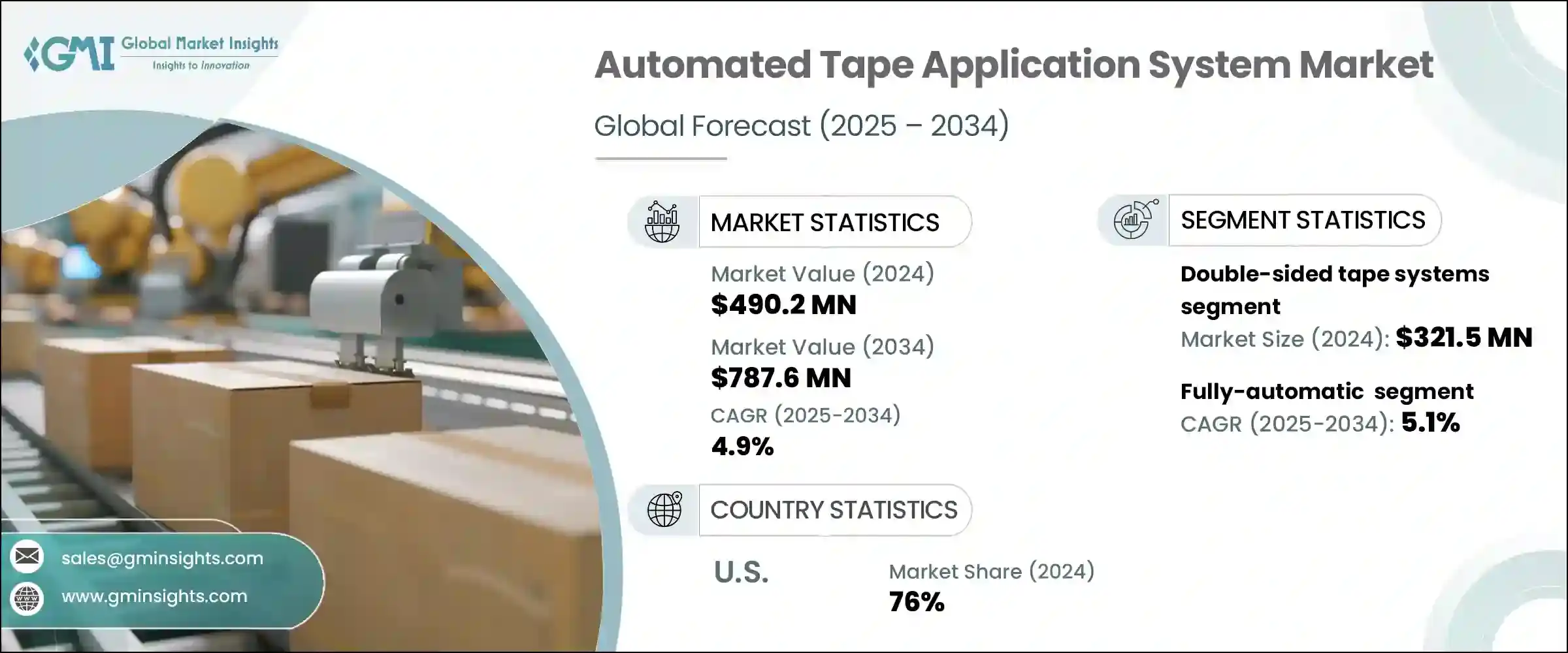
세계의 자동 테이프 부착 시스템 시장은 2024년에는 4억 9,020만 달러에 달하였고, CAGR 4.9%로 성장하여 2034년에는 7억 8,760만 달러에 이를 것으로 예측됩니다.
이 시장이 확대되고 있는 주된 이유는 전자상거래 산업의 급성장에 의한 포장 공정의 자동화 증가입니다. 자동 테이프 부착 시스템은 수작업의 필요성을 최소화하면서 신뢰성있고 일관된 접착력을 제공함으로써 포장의 합리화에 중요한 역할을 하고 있습니다. 또한, 이러한 시스템은 테이프의 낭비와 에너지 소비의 절감 등의 비용 절감에 공헌하여 생산성과 지속 가능성 모두를 향상시킵니다.

주요 전자상거래를 중심으로 완전 자동화된 풀필먼트 센터의 존재감이 높아지고 있는 것이 자동 테이프 부착 시스템의 세계적인 보급을 크게 뒷받침하고 있습니다. 자동화에 대한 수요는 급증하고 있으며, 자동 테이프 부착 시스템은 포장 작업의 합리화에 빠뜨릴 수 없는 요소가 되고 있습니다.
| 시장 범위 | |
|---|---|
| 시작연도 | 2024 |
| 예측연도 | 2025-2034 |
| 시작금액 | 4억 9,020만 달러 |
| 예측금액 | 7억 8,760만 달러 |
| CAGR | 4.9% |
2024년 양면 테이프 시스템 분야는 3억 2,150만 달러의 매출을 달성하였고, 2025-2034년의 CAGR은 5.3%를 보일 것으로 예측됩니다. 양면 테이프 시스템은 직접적이고 내구성있는 접착이 필요한 조립 응용 분야에서 눈에 띄는 테이프 라인을 없애는 이점을 제공합니다.
테이프 전자동 부착 시스템 분야는 2024년에 59%의 점유율을 차지하였고 2025년부터 2034년에 걸쳐 CAGR 5.1%를 보일 것으로 예측됩니다. 전자동 시스템은 자동차, 전자, 포장 등 높은 처리량, 정밀도, 최소한의 개입이 필요한 산업에서 특히 선호됩니다. 전자동 시스템은 컴퓨터 제어를 활용해 다운타임을 최소화하면서 일관된 품질을 확보합니다.
미국의 자동 테이프 부착 시스템 시장은 2024년에 76%의 점유율을 차지하면서 9,820만 달러를 창출했습니다. 다양한 부문에서 자동화가 채용되고 있는 것이 성장의 큰 요인이 되고 있습니다. 보다 효율적이고 빠르며 신뢰성이 높은 테이프 부착 기기에 대한 수요가 높아짐에 따라, 자동화 시스템 시장은 특히 대량 포장이나 조립 작업에 보급되고 있습니다.
자동 테이프 부착 시스템 시장의 주요 기업은 Ambica Pharma Machines, APR Solutions, Cyclop, Daap Machinery, Dongguan KEQI Automation Equipment, Global Packaging Automation, Intec Automation, Kylin Machines, Robo Tape, Robus India, Rocket Industrial, Smart Tec Autom Automation 등이 있습니다. 자동 테이프 부착 시스템 시장의 기업은 시장에서의 지위를 강화하기 위해 다양한 전략에 주력하고 있습니다. 포트폴리오를 확대하고 새로운 고객층에 접근하기 위해 제휴 및 협력 관계를 모색하고 있습니다.
목차
제1장 조사방법과 범위
제2장 주요 요약
제3장 업계 인사이트
- 생태계 분석
- 공급자의 상황
- 이익률
- 각 단계에서의 부가가치
- 밸류체인에 영향을 주는 요인
- 업계에 미치는 영향요인
- 성장 촉진요인
- 전자상거래와 포장 자동화의 성장
- 제조업과 산업자동화의 성장
- 업계의 잠재적 위험 및 과제
- 초기 투자 비용이 높음
- 통합의 복잡성
- 기회
- 성장 촉진요인
- 성장 가능성 분석
- 장래 시장 동향
- 기술과 혁신의 상황
- 현재의 기술 동향
- 신흥기술
- 가격 동향
- 지역별
- 제품별
- 규제 상황
- 표준 및 컴플라이언스 요건
- 지역 규제 프레임워크
- 인증기준
- Porter's Five Forces 분석
- PESTEL 분석
제4장 경쟁구도
- 소개
- 기업의 시장 점유율 분석
- 지역별
- 기업 매트릭스 분석
- 주요 시장기업의 경쟁 분석
- 경쟁 포지셔닝 매트릭스
- 주요 발전
- 합병과 인수
- 파트너십 및 협업
- 신제품 발매
- 확장 계획
제5장 시장 추계 및 예측 : 유형별(2021-2034년)
- 주요 동향
- 단면 테이프 시스템
- 양면 테이프 시스템
제6장 시장 추계 및 예측 : 자동화 레벨별(2021-2034년)
- 주요 동향
- 전자동
- 반자동
제7장 시장 추계 및 예측 : 포장 형태별(2021-2034년)
- 주요 동향
- 판지 상자
- 골판지 상자
- 배달용 가방
- 기타
제8장 시장 추계 및 예측 : 출력 용량별(2021-2034년)
- 주요 동향
- 1000카톤 미만/시
- 1,000카톤/시간-5,000카톤/시간
- 5,000카톤 이상/시
제9장 시장 추계 및 예측 : 최종 이용 산업별(2021-2034년)
- 주요 동향
- 전자상거래 및 풀필먼트 센터
- 소매 및 소비재
- 식음료
- 의약품 및 의료
- 물류 및 창고
- 기타(전자기기 및 가전 등)
제10장 시장 추계 및 예측 : 유통 채널별(2021-2034년)
- 주요 동향
- 직접
- 간접
제11장 시장 추계 및 예측 : 지역별(2021-2034년)
- 주요 동향
- 북미
- 미국
- 캐나다
- 유럽
- 독일
- 영국
- 프랑스
- 스페인
- 이탈리아
- 네덜란드
- 아시아태평양
- 중국
- 일본
- 인도
- 호주
- 한국
- 라틴아메리카
- 브라질
- 멕시코
- 아르헨티나
- 중동 및 아프리카
- 남아프리카
- 사우디아라비아
- 아랍에미리트(UAE)
제12장 기업 프로파일
- Ambica Pharma Machines
- APR Solutions
- Cyklop
- Daap Machinery
- Dongguan KEQI automation equipment
- Global Packaging Automation
- Intec Automation
- Kylin Machines
- Robo Tape
- Robus India
- Rocket Industrial
- Smart Tec Automation
- Straub Design Company
- Vulkan Technic
- Wayne Automation
The Global Automated Tape Application Systems Market was valued at USD 490.2 million in 2024 and is estimated to grow at a CAGR of 4.9% to reach USD 787.6 million by 2034. This market is expanding primarily due to the rise in automation in packing processes, driven by the rapid growth of the e-commerce industry. As the demand for faster, more efficient packaging solutions intensifies, businesses are increasingly turning to automated systems. Automated tape application systems play a crucial role in streamlining packaging by providing reliable, consistent adhesion while minimizing the need for manual labor. Additionally, these systems contribute to cost savings in terms of reduced tape waste and energy consumption, enhancing both productivity and sustainability.
The growing presence of fully automated fulfillment centers, particularly among major e-commerce players, is significantly boosting the global adoption of automated tape application systems. These centers, which leverage cutting-edge robotics, artificial intelligence, and machine vision, are designed to optimize every aspect of packaging and logistics. As e-commerce companies seek faster and more efficient order fulfillment, the demand for automation has skyrocketed, making automated tape application systems crucial for streamlining packing operations. In response to this surge, manufacturers of tape application systems are making significant investments in developing more advanced, faster, and more reliable solutions. These investments are not only improving system performance but also reducing operational costs and energy consumption.
| Market Scope | |
|---|---|
| Start Year | 2024 |
| Forecast Year | 2025-2034 |
| Start Value | $490.2 Million |
| Forecast Value | $787.6 Million |
| CAGR | 4.9% |
In 2024, the double-sided tape systems segment generated USD 321.5 million and is expected to grow at a CAGR of 5.3% during 2025-2034. This segment leads the market due to the demand from industries such as aerospace, construction, and consumer electronics, which require high-performance adhesion and clean finishes. Double-sided tape systems offer an advantage in assembly applications where direct, durable bonds are needed, eliminating visible tape lines. These systems continue to evolve with technological improvements, including the ability to utilize custom tape feed systems and automated quality inspections, increasing both flexibility and reliability.
The fully automatic tape application systems segment held 59% share in 2024 and is projected to grow at a CAGR of 5.1% between 2025 and 2034. Fully automated systems are particularly preferred in industries that require high throughput, precision, and minimal intervention, such as automotive, electronics, and packaging. These systems leverage integrated robotics, machine vision, and AI-based controls to ensure consistent quality while minimizing downtime. The growing adoption of Industry 4.0 technologies, including real-time monitoring and predictive maintenance, is further fueling this trend by improving productivity and reducing operational inefficiencies.
United States Automated Tape Application Systems Market held a 76% share in 2024, generating USD 98.2 million. This growth is largely driven by the widespread adoption of automated solutions across various sectors, including manufacturing, automotive, packaging, and e-commerce. As demand for more efficient, faster, and reliable tape application equipment increases, the market for automated systems continues to expand, particularly in high-volume packaging and assembly operations.
Key players in the Automated Tape Application Systems Market include Ambica Pharma Machines, APR Solutions, Cyklop, Daap Machinery, Dongguan KEQI Automation Equipment, Global Packaging Automation, Intec Automation, Kylin Machines, Robo Tape, Robus India, Rocket Industrial, Smart Tec Automation, Straub Design Company, Vulkan Technic, and Wayne Automation. Companies in the automated tape application systems market are focusing on various strategies to strengthen their market position. These include investing heavily in research and development to enhance the precision, efficiency, and versatility of their products. Companies are also exploring partnerships and collaborations to expand their product portfolios and reach new customer segments. Automation and integration of smart technologies, such as robotics, AI, and machine vision, are central to many players' strategies to improve the reliability and performance of their systems.
Table of Contents
Chapter 1 Methodology & Scope
- 1.1 Market scope and definition
- 1.2 Research design
- 1.2.1 Research approach
- 1.2.2 Data collection methods
- 1.3 Data mining sources
- 1.3.1 Global
- 1.3.2 Regional/Country
- 1.4 Base estimates and calculations
- 1.4.1 Base year calculation
- 1.4.2 Key trends for market estimation
- 1.5 Primary research and validation
- 1.5.1 Primary sources
- 1.6 Forecast model
- 1.7 Research assumptions and limitations
Chapter 2 Executive Summary
- 2.1 Industry 360° synopsis
- 2.2 Key market trends
- 2.2.1 Regional
- 2.2.2 Type
- 2.2.3 Automation Level
- 2.2.4 Packaging Type
- 2.2.5 Output Capacity
- 2.2.6 End Use Industry
- 2.2.7 Distribution Channel
- 2.3 CXO perspectives: Strategic imperatives
- 2.3.1 Key decision points for industry executives
- 2.3.2 Critical success factors for market players
- 2.4 Future Outlook and Strategic Recommendations
Chapter 3 Industry Insights
- 3.1 Industry ecosystem analysis
- 3.1.1 Supplier Landscape
- 3.1.2 Profit Margin
- 3.1.3 Value addition at each stage
- 3.1.4 Factor affecting the value chain
- 3.2 Industry impact forces
- 3.2.1 Growth drivers
- 3.2.1.1 Rise in E-commerce and Packaging Automation
- 3.2.1.2 Growth in Manufacturing and Industrial Automation
- 3.2.2 Industry pitfalls & challenges
- 3.2.2.1 High Initial Investment Costs
- 3.2.2.2 Integration Complexity
- 3.2.3 Opportunities
- 3.2.1 Growth drivers
- 3.3 Growth potential analysis
- 3.4 Future market trends
- 3.5 Technology and Innovation landscape
- 3.5.1 Current technological trends
- 3.5.2 Emerging technologies
- 3.6 Price trends
- 3.6.1 By region
- 3.6.2 By product
- 3.7 Regulatory landscape
- 3.7.1 standards and compliance requirements
- 3.7.2 Regional regulatory frameworks
- 3.7.3 Certification standards
- 3.8 Porter's analysis
- 3.9 PESTEL analysis
Chapter 4 Competitive Landscape, 2024
- 4.1 Introduction
- 4.1.1 Company market share analysis
- 4.1.2 By region
- 4.1.2.1 North America
- 4.1.2.2 Europe
- 4.1.2.3 Asia Pacific
- 4.1.2.4 Latin America
- 4.1.2.5 MEA
- 4.2 Company matrix analysis
- 4.3 Competitive analysis of major market players
- 4.4 Competitive positioning matrix
- 4.5 Key developments
- 4.5.1 Mergers & acquisitions
- 4.5.2 Partnerships & collaborations
- 4.5.3 New Product Launches
- 4.5.4 Expansion Plans
Chapter 5 Market Estimates & Forecast, By Type, 2021 - 2034 ($Million, Thousand Units)
- 5.1 Key trends
- 5.2 Single-sided tape systems
- 5.3 Double-sided tape systems
Chapter 6 Market Estimates & Forecast, By Automation Level, 2021 - 2034 ($Million, Thousand Units)
- 6.1 Key trends
- 6.2 Fully automatic
- 6.3 Semi-automatic
Chapter 7 Market Estimates & Forecast, By Packaging Type, 2021 - 2034 ($Million, Thousand Units)
- 7.1 Key trends
- 7.2 Cardboard boxes
- 7.3 Corrugated boxes
- 7.4 Delivery bags
- 7.5 Others
Chapter 8 Market Estimates & Forecast, By Output Capacity, 2021 - 2034 ($Million, Thousand Units)
- 8.1 Key trends
- 8.2 Up to 1000 cartons/hour
- 8.3 1000 cartons/hour to 5,000 cartons/hour
- 8.4 above 5,000 cartons/hour
Chapter 9 Market Estimates & Forecast, By End Use Industry, 2021 - 2034 ($Million, Thousand Units)
- 9.1 Key trends
- 9.2 E-commerce & fulfillment centers
- 9.3 Retail & consumer goods
- 9.4 Food & beverage
- 9.5 Pharmaceutical & medical
- 9.6 Logistics & warehousing
- 9.7 Others( electronics & appliances, etc.)
Chapter 10 Market Estimates & Forecast, By Distribution Channel, 2021 - 2034 ($Million, Thousand Units)
- 10.1 Key trends
- 10.2 Direct
- 10.3 Indirect
Chapter 11 Market Estimates & Forecast, By Region, 2021 - 2034 ($Million, Thousand Units)
- 11.1 Key trends
- 11.2 North America
- 11.2.1 U.S.
- 11.2.2 Canada
- 11.3 Europe
- 11.3.1 Germany
- 11.3.2 UK
- 11.3.3 France
- 11.3.4 Spain
- 11.3.5 Italy
- 11.3.6 Netherlands
- 11.4 Asia Pacific
- 11.4.1 China
- 11.4.2 Japan
- 11.4.3 India
- 11.4.4 Australia
- 11.4.5 South Korea
- 11.5 Latin America
- 11.5.1 Brazil
- 11.5.2 Mexico
- 11.5.3 Argentina
- 11.6 Middle East and Africa
- 11.6.1 South Africa
- 11.6.2 Saudi Arabia
- 11.6.3 UAE
Chapter 12 Company Profiles
- 12.1 Ambica Pharma Machines
- 12.2 APR Solutions
- 12.3 Cyklop
- 12.4 Daap Machinery
- 12.5 Dongguan KEQI automation equipment
- 12.6 Global Packaging Automation
- 12.7 Intec Automation
- 12.8 Kylin Machines
- 12.9 Robo Tape
- 12.10 Robus India
- 12.11 Rocket Industrial
- 12.12 Smart Tec Automation
- 12.13 Straub Design Company
- 12.14 Vulkan Technic
- 12.15 Wayne Automation