|
시장보고서
상품코드
1773410
위험물 포장 시장 기회, 성장 촉진요인, 산업 동향 분석 및 예측(2025-2034년)Hazmat Packaging Market Opportunity, Growth Drivers, Industry Trend Analysis, and Forecast 2025 - 2034 |
||||||

세계의 위험물 포장 시장은 2024년에는 128억 달러에 달했고, CAGR 5.9%를 나타내 2034년에는 226억 달러에 이를 것으로 추정됩니다.
이 꾸준한 성장은 화학·의약품 생산 확대, 전자상거래 및 국경을 넘어 무역의 급증에 기인하고 있습니다. 인화성, 독성 또는 부식성으로 분류되는 제품이 많아지면서 업계에서는 엄격한 보관 및 운송 요건을 충족하기 위해 특수 제작된 위험물 포장에 점점 더 의존하고 있습니다.

생물 제제와 백신을 포함한 의약품은 위험물을 취급할 수 있는 온도 제어 포장 솔루션에 대한 수요를 가져오고 있습니다. 안전한 배송을 보장하고 운송 중 위험을 최소화, 신뢰성이 높고 규제에 준거한 포장의 필요성이 높아지고 있습니다.
| 시장 범위 | |
|---|---|
| 시작 연도 | 2024년 |
| 예측 연도 | 2025-2034년 |
| 시작 금액 | 128억 달러 |
| 예측 금액 | 226억 달러 |
| CAGR | 5.9% |
드럼 캔 부문은 2024년에 41억 달러를 창출했습니다. 이 용기는 페인트, 화학제품, 오일 등의 산업용 액체의 안전한 운송과 보관에 필수적입니다. 야생에서의 헤비 듀티 용도로 선택되고 있습니다. 안전 프로토콜 증가나 정부에 의해 의무화된 기준이, 드럼 제조에 있어서의 고품위 플라스틱, 섬유 복합재료, 강화 스틸등의 적합 재료에 수요를 한층 더 촉진하고 있습니다.
플라스틱 분야는 2024년에 69억 달러를 차지했으며, 그 수요는 감속의 조짐을 보이지 않습니다. 또한 플라스틱은 IBC, 캐니스터, 젤리칸 등 다양한 용기 형식에 적응할 수 있으므로 위험물 취급에 유연성, 효율성, 안전성이 필요한 업계 전체에서 그 관련성이 계속됩니다.
2024년 미국의 위험물 포장 시장 규모는 28억 달러였습니다. 바이오테크놀로지 분야의 활황을 반영하고 있습니다. 또한, 제조업이나 헬스케어 사업에서 발생하는 대량의 유해 폐기물은 치료 시설에의 안전한 수송을 위한 적합 포장에 대한 지속적인 수요를 낳고 있습니다.
세계의 위험물 포장 시장 주요 기업은 HazmatPac, Greif, Inc. Berlin Packaging, Label Master, Craters &Freighters, Air Sea Containers, Enpac, Mauser Packaging Solutions, CL Smith, Nefab Group, Schutz GmbH & Co.KGaA, Fibre Container, Inc, Sohner Kunststofftechnik GmbH, THIELMANN US LLC 등이 있습니다. 이 기업들은 주요 위험물 포장 회사가 진화하는 규제 기준을 충족시키기 위해 제품 혁신에 주력하고 있으며 모듈식 누설 방지 드럼 시스템 및 온도 제어 용기를 개발하고 있습니다.
또한 비용 절감과 내구성 향상을 위해 경량 복합재료와 내식성 플라스틱의 채용 등 재료과학에 대한 투자도 진행하고 있습니다.
목차
제1장 조사 방법과 범위
제2장 주요 요약
제3장 업계 인사이트
- 생태계 분석
- 공급자의 상황
- 이익률
- 비용 구조
- 각 단계에서의 부가가치
- 밸류체인에 영향을 주는 요인
- 파괴적 혁신
- 업계에 미치는 영향요인
- 성장 촉진요인
- 화학·의약품 생산 증가
- 전자상거래와 국제무역 확대
- 헬스케어 및 제약 업계의 성장
- 엄격한 규제 틀
- 포장재의 기술적 진보
- 업계의 잠재적 위험 및 과제
- 특수 포장에 드는 높은 비용
- 환경문제와 지속가능성에 대한 압력
- 성장 촉진요인
- 성장 가능성 분석
- 규제 상황
- 북미
- 유럽
- 아시아태평양
- 라틴아메리카
- 중동 및 아프리카
- Porter's Five Forces 분석
- PESTEL 분석
- 기술과 혁신의 상황
- 현재의 기술 동향
- 신흥기술
- 가격 동향
- 과거의 가격 분석(2021-2024년)
- 가격 동향의 요인
- 지역별 가격 차이
- 가격 예측(2025-2034년)
- 가격 전략
- 새로운 비즈니스 모델
- 컴플라이언스 요건
- 지속가능성 대책
- 지속 가능한 재료의 평가
- 탄소발자국 분석
- 순환형 경제의 실현
- 지속가능성 인증 및 기준
- 지속가능성 ROI 분석
- 세계의 소비자 감정 분석
- 특허 분석
제4장 경쟁 구도
- 서론
- 기업의 시장 점유율 분석
- 지역별
- 북미
- 유럽
- 아시아태평양
- 시장 집중 분석
- 지역별
- 주요 기업의 경쟁 벤치마킹
- 재무실적의 비교
- 수익
- 이익률
- 연구개발
- 제품 포트폴리오 비교
- 제품 라인업의 넓이
- 기술
- 파괴적 혁신
- 지리적 존재의 비교
- 세계의 실적 분석
- 서비스 네트워크의 범위
- 지역별 시장 침투율
- 경쟁 포지셔닝 매트릭스
- 리더
- 챌린저
- 팔로워
- 틈새 기업
- 전략적 전망 매트릭스
- 재무실적의 비교
- 주요 발전(2021-2024년)
- 합병과 인수
- 파트너십 및 협업
- 기술적 진보
- 확대 및 투자 전략
- 지속가능성에 대한 노력
- 디지털 변혁의 대처
- 신흥기업/스타트업기업경쟁 구도
제5장 시장 추계·예측 : 제품 유형별(2021-2034년)
- 주요 동향
- 드럼
- 중간 벌크 컨테이너(IBC)
- 통
- 병 및 자
- 상자 및 판지
- 기타
제6장 시장 추계·예측 : 재질별(2021-2034년)
- 주요 동향
- 플라스틱
- HDPE
- LDPE
- PP
- PVC
- 기타
- 금속
- 파형
제7장 시장 추계·예측 : 최종 이용 산업별(2021-2034년)
- 주요 동향
- 화학 및 석유화학
- 제약
- 석유 및 가스
- 농업
- 기타
제8장 시장 추계·예측 : 지역별(2021-2034년)
- 주요 동향
- 북미
- 미국
- 캐나다
- 유럽
- 독일
- 영국
- 프랑스
- 스페인
- 이탈리아
- 네덜란드
- 아시아태평양
- 중국
- 인도
- 일본
- 호주
- 한국
- 라틴아메리카
- 브라질
- 멕시코
- 아르헨티나
- 중동 및 아프리카
- 사우디아라비아
- 남아프리카
- 아랍에미리트(UAE)
제9장 기업 프로파일
- Air Sea Containers
- Berlin Packaging
- CL Smith
- Craters &Freighters
- Enpac
- FibreStar
- Greif, Inc.
- HazmatPac
- Label Master
- LPS Industries
- Mauser Packaging Solutions
- MJS Packaging
- Nefab Group
- Rhino Container, Inc.
- Schutz GmbH &Co. KGaA
- Sohner Kunststofftechnik GmbH
- THIELMANN US LLC
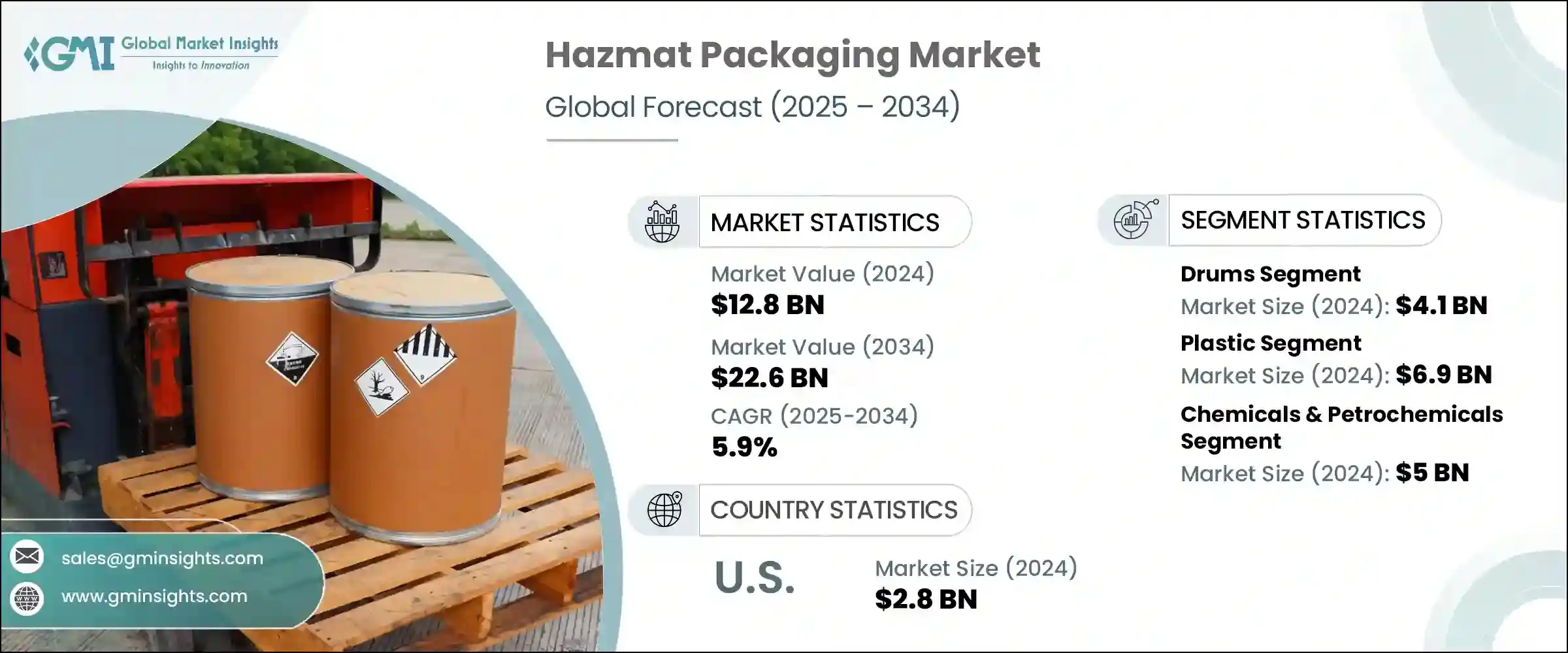
The Global Hazmat Packaging Market was valued at USD 12.8 billion in 2024 and is estimated to grow at a CAGR of 5.9% to reach USD 22.6 billion by 2034. This steady growth stems from expanding chemical and pharmaceutical production, as well as surging ecommerce and cross-border trade. With many products classified as flammable, toxic, or corrosive, industries increasingly rely on purpose-built hazmat packaging to meet stringent storage and transport requirements. Regulatory agencies such as OSHA, the EPA, and international bodies enforce rigorous standards for containment, labeling, and shipping, prompting broader market adoption.
Pharmaceuticals, including biologics and vaccines, introduce demand for temperature-controlled packaging solutions capable of handling hazardous materials. Additionally, the steady rise of digital commerce channels has introduced greater complexity in the handling and transport of hazardous goods. Online platforms now facilitate bulk and small-quantity orders of regulated items, which has intensified the need for reliable, regulation-compliant packaging that ensures safe delivery and minimizes risk during transit. This shift is pushing packaging manufacturers to prioritize both safety and logistical efficiency by designing packaging that can endure long-distance shipping, warehouse handling, and varying climate conditions, without compromising regulatory standards.
| Market Scope | |
|---|---|
| Start Year | 2024 |
| Forecast Year | 2025-2034 |
| Start Value | $12.8 Billion |
| Forecast Value | $22.6 Billion |
| CAGR | 5.9% |
The drums segment generated USD 4.1 billion in 2024. These containers remain essential for the safe transport and storage of industrial liquids such as paints, chemicals, and oils. Their durable structure, leak resistance, and ease of stacking make them the preferred choice for heavy-duty applications across several sectors. Increasing safety protocols and government-mandated standards are further driving demand for compliant materials like high-grade plastics, fiber composites, and reinforced steel in drum production.
The plastic segment accounted USD 6.9 billion in 2024, and its demand shows no signs of slowing. Its lightweight nature significantly reduces freight costs, while its chemical resistance makes it ideal for storing corrosive or sensitive substances. Moreover, the adaptability of plastic into different container formats-including IBCs, canisters, and jerricans-ensures its continued relevance across industries that require flexibility, efficiency, and safety in hazardous material handling.
U.S. Hazmat Packaging Market was valued at USD 2.8 billion in 2024. This leadership reflects strong activity in chemical and petrochemical production-in regions like the Gulf Coast-as well as a booming pharmaceutical and biotech sector needing safe packaging for specialty drugs and biologics. Additionally, the high volume of hazardous waste generated by manufacturing and healthcare operations creates sustained demand for compliant packaging for safe transport to treatment facilities.
Key players in the Global Hazmat Packaging Market include HazmatPac, Greif, Inc., Berlin Packaging, Label Master, Craters & Freighters, Air Sea Containers, Enpac, Mauser Packaging Solutions, CL Smith, Nefab Group, Schutz GmbH & Co. KGaA, FibreStar, LPS Industries, MJS Packaging, Rhino Container, Inc., Sohner Kunststofftechnik GmbH, THIELMANN US LLC. Leading hazmat packaging firms are focusing on product innovation to meet evolving regulatory standards-developing modular, leak-proof drum systems and temperature-controlled containers.
They are also investing in materials science, favoring lightweight composites and corrosion-resistant plastics to reduce costs and enhance durability. Strategic partnerships with chemical, pharmaceutical, and e-commerce companies are enabling tailored solutions and long-term contracts. Operationally, manufacturers are scaling production by expanding facilities in key regions to improve delivery speed and cost efficiency.
Table of Contents
Chapter 1 Methodology and Scope
- 1.1 Market scope and definition
- 1.2 Research design
- 1.2.1 Research approach
- 1.2.2 Data collection methods
- 1.3 Data mining sources
- 1.3.1 Global
- 1.3.2 Regional/Country
- 1.4 Base estimates and calculations
- 1.4.1 Base year calculation
- 1.4.2 Key trends for market estimation
- 1.5 Primary research and validation
- 1.5.1 Primary sources
- 1.6 Forecast model
- 1.7 Research assumptions and limitations
Chapter 2 Executive Summary
- 2.1 Industry snapshot
- 2.2 Key market trends
- 2.2.1 Business trends
- 2.2.2 Product type trends
- 2.2.3 Material type trends
- 2.2.4 End use industry trends
- 2.2.5 Regional
- 2.3 TAM Analysis, 2025-2034 (USD Billion)
- 2.4 CXO perspectives: Strategic imperatives
- 2.4.1 Executive decision points
- 2.4.2 Critical success factors
- 2.5 Future outlook and strategic recommendations
Chapter 3 Industry Insights
- 3.1 Industry ecosystem analysis
- 3.1.1 Supplier landscape
- 3.1.2 Profit margin
- 3.1.3 Cost structure
- 3.1.4 Value addition at each stage
- 3.1.5 Factor affecting the value chain
- 3.1.6 Disruptions
- 3.2 Industry impact forces
- 3.2.1 Growth drivers
- 3.2.1.1 Rising chemical & pharmaceutical production
- 3.2.1.2 E-commerce & global trade expansion
- 3.2.1.3 Growth in the healthcare & pharmaceutical sector
- 3.2.1.4 Stringent regulatory frameworks
- 3.2.1.5 Technological advancements in packaging materials
- 3.2.2 Industry pitfalls and challenges
- 3.2.2.1 High costs of specialized packaging
- 3.2.2.2 Environmental concerns & sustainability pressures
- 3.2.1 Growth drivers
- 3.3 Growth potential analysis
- 3.4 Regulatory landscape
- 3.4.1 North America
- 3.4.2 Europe
- 3.4.3 Asia Pacific
- 3.4.4 Latin America
- 3.4.5 Middle East & Africa
- 3.5 Porter's analysis
- 3.6 PESTEL analysis
- 3.7 Technology and innovation landscape
- 3.7.1 Current technological trends
- 3.7.2 Emerging technologies
- 3.8 Price trends
- 3.8.1 Historical price analysis (2021-2024)
- 3.8.2 Price trend drivers
- 3.8.3 Regional price variations
- 3.8.4 Price forecast (2025-2034)
- 3.9 Pricing strategies
- 3.10 Emerging business models
- 3.11 Compliance requirements
- 3.12 Sustainability measures
- 3.12.1 Sustainable materials assessment
- 3.12.2 Carbon footprint analysis
- 3.12.3 Circular economy implementation
- 3.12.4 Sustainability certifications and standards
- 3.12.5 Sustainability ROI analysis
- 3.13 Global consumer sentiment analysis
- 3.14 Patent analysis
Chapter 4 Competitive Landscape, 2024
- 4.1 Introduction
- 4.2 Company market share analysis
- 4.2.1 By region
- 4.2.1.1 North America
- 4.2.1.2 Europe
- 4.2.1.3 Asia Pacific
- 4.2.2 Market concentration analysis
- 4.2.1 By region
- 4.3 Competitive benchmarking of key players
- 4.3.1 Financial performance comparison
- 4.3.1.1 Revenue
- 4.3.1.2 Profit margin
- 4.3.1.3 R&D
- 4.3.2 Product portfolio comparison
- 4.3.2.1 Product range breadth
- 4.3.2.2 Technology
- 4.3.2.3 Innovation
- 4.3.3 Geographic presence comparison
- 4.3.3.1 Global footprint analysis
- 4.3.3.2 Service network coverage
- 4.3.3.3 Market penetration by region
- 4.3.4 Competitive positioning matrix
- 4.3.4.1 Leaders
- 4.3.4.2 Challengers
- 4.3.4.3 Followers
- 4.3.4.4 Niche Players
- 4.3.5 Strategic outlook matrix
- 4.3.1 Financial performance comparison
- 4.4 Key developments, 2021-2024
- 4.4.1 Mergers and acquisitions
- 4.4.2 Partnerships and collaborations
- 4.4.3 Technological advancements
- 4.4.4 Expansion and investment strategies
- 4.4.5 Sustainability initiatives
- 4.4.6 Digital transformation initiatives
- 4.5 Emerging/ startup competitors landscape
Chapter 5 Market Estimates and Forecast, By Product Type, 2021 - 2034 (USD Million & Thousand Units)
- 5.1 Key trends
- 5.2 Drums
- 5.3 Intermediate bulk containers (IBCs)
- 5.4 Pails
- 5.5 Bottles & jars
- 5.6 Boxes & cartons
- 5.7 Others
Chapter 6 Market Estimates and Forecast, By Material Type, 2021 - 2034 (USD Million & Thousand Units)
- 6.1 Key trends
- 6.2 Plastics
- 6.2.1 HDPE
- 6.2.2 LDPE
- 6.2.3 PP
- 6.2.4 PVC
- 6.2.5 Others
- 6.3 Metal
- 6.4 Corrugated
Chapter 7 Market Estimates and Forecast, By End Use Industry, 2021 - 2034 (USD Million & Thousand Units)
- 7.1 Key trends
- 7.2 Chemicals & petrochemicals
- 7.3 Pharmaceuticals
- 7.4 Oil and gas
- 7.5 Agriculture
- 7.6 Others
Chapter 8 Market Estimates and Forecast, By Region, 2021 - 2034 (USD Million & Thousand Units)
- 8.1 Key trends
- 8.2 North America
- 8.2.1 U.S.
- 8.2.2 Canada
- 8.3 Europe
- 8.3.1 Germany
- 8.3.2 UK
- 8.3.3 France
- 8.3.4 Spain
- 8.3.5 Italy
- 8.3.6 Netherlands
- 8.4 Asia Pacific
- 8.4.1 China
- 8.4.2 India
- 8.4.3 Japan
- 8.4.4 Australia
- 8.4.5 South Korea
- 8.5 Latin America
- 8.5.1 Brazil
- 8.5.2 Mexico
- 8.5.3 Argentina
- 8.6 Middle East and Africa
- 8.6.1 Saudi Arabia
- 8.6.2 South Africa
- 8.6.3 UAE
Chapter 9 Company Profiles
- 9.1 Air Sea Containers
- 9.2 Berlin Packaging
- 9.3 CL Smith
- 9.4 Craters & Freighters
- 9.5 Enpac
- 9.6 FibreStar
- 9.7 Greif, Inc.
- 9.8 HazmatPac
- 9.9 Label Master
- 9.10 LPS Industries
- 9.11 Mauser Packaging Solutions
- 9.12 MJS Packaging
- 9.13 Nefab Group
- 9.14 Rhino Container, Inc.
- 9.15 Schutz GmbH & Co. KGaA
- 9.16 Sohner Kunststofftechnik GmbH
- 9.17 THIELMANN US LLC