

|
시장보고서
상품코드
1797722
극저온 초전도체 재료 시장 기회, 성장 촉진요인, 산업 동향 분석 및 예측(2025-2034년)Cryogenic Superconductor Materials Market Opportunity, Growth Drivers, Industry Trend Analysis, and Forecast 2025 - 2034 |
||||||

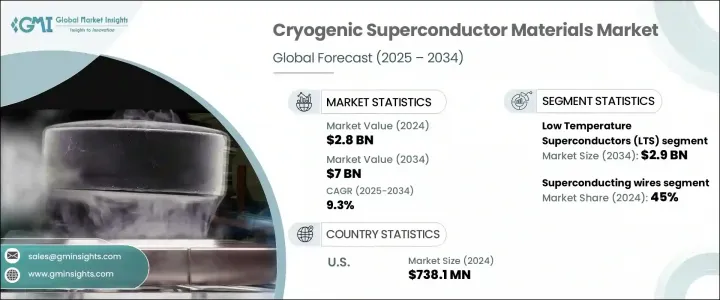
세계의 극저온 초전도체 재료 시장은 2024년에 28억 달러로 평가되었고 CAGR 9.3%를 나타내 2034년에는 70억 달러에 이를 것으로 추정되고 있습니다.
중요 산업이 첨단 기술을 채택함에 따라 극저온 초전도체에 대한 수요가 세계적으로 높아지고 있습니다. 극저온에서 저항이 0인 전기를 전도할 수 있는 이러한 재료는 청정 에너지에서 정밀한 의료 영상 처리에 이르기까지 광범위한 분야에서 필수적인 부품이 되고 있습니다. 독특한 전기적 특성은 에너지 효율적인 인프라를 가능하게 하고 차세대 전력 시스템과 과학 기술 혁신을 지원하는 열쇠로 점점 주목받고 있습니다. 세계의 에너지 효율 목표는 보다 큰 지속가능성에 대한 노력의 일환으로 초전도체 재료의 채택을 계속 추진하고 있습니다.

초전도체는 에너지 손실 없이 전기를 보낼 수 있기 때문에 특히 재생가능 에너지의 비율이 확대되는 가운데, 최신의 송전망을 업그레이드 하는데 필수적인 솔루션이 되고 있습니다. 초전도 케이블을 통합한 인프라 개발은 송전 안정화와 강화에 도움이 되며 기존 방법보다 우수한 성능을 제공할 수 있습니다. 한편, 의료 및 과학 연구 산업은 여전히 초전도 소재의 강력한 최종 사용자입니다. MRI 스캐너와 같은 의료 기술은 정밀한 체내 이미징을 위해 강력하고 안정적인 자기장을 생성하기 위해 과냉각 초전도 자석에 의존합니다. 기술의 발전과 건강 관리의 필요성이 증가함에 따라 그 용도가 확대되고 있습니다.
| 시장 범위 | |
|---|---|
| 시작 연도 | 2024년 |
| 예측 연도 | 2025-2034년 |
| 시작 금액 | 28억 달러 |
| 예측 금액 | 70억 달러 |
| CAGR | 9.3% |
저온 초전도체(LTS) 부문은 2024년에 11억 달러를 생산했고 2034년에는 29억 달러에 이를 것으로 예측됩니다. 주로 니오븀-티타늄(NbTi) 및 니오븀-주석(Nb3Sn)과 같은 화합물로 구성된 이 초전도체는 20 켈빈(약 -253℃) 이하의 온도에서 최적으로 작동합니다. 이러한 이점은 기술적 성숙도, 안정성 및 수십 년에 걸친 개발로 정교하고 비용 효율적인 제조 공정이 실현되었기 때문입니다. LTS 재료는 특히 안정적인 저온 환경을 확실하게 유지할 수 있는 용도에 있어서 그 입증된 성능으로 인해 많은 상용 시스템에 대해 실용적이고 선호되는 옵션이 되고 있습니다.
초전도 선재 부문은 2024년에 45%의 점유율을 차지했습니다. 초전도 선재는 저항 없이 전류를 전달하는 능력이 평가되어 에너지 손실 제로와 비교할 수 없는 운전 효율을 실현합니다. 또한 더 높은 전류 밀도를 처리할 수 있기 때문에 의료, 에너지 및 연구의 첨단 기술에 필수적인 더 큰 자기장 강도를 가진 컴팩트한 시스템을 실현할 수 있습니다. 컴팩트한 설치 면적과 성능의 이점은 전력 효율성과 시스템 신뢰성 향상을 요구하는 산업계 수요를 계속 끌어들이고 있습니다.
2024년 미국의 극저온 초전도체 재료 시장 규모는 7억 3,810만 달러로 평가되었고 2034년까지 연평균 복합 성장률(CAGR) 9.1%를 나타낼 것으로 예측됩니다. 미국은 헬스케어, 전력 인프라, 하이테크 산업에서 초전도 기술의 채용에 견인되어, 이 분야의 최전선으로 계속되고 있습니다. 미국에서는 MRI 시스템이 초전도체 재료의 주요 용도이며, 이미징 기술이 진화함에 따라 차세대 초전도체 재료에 대한 요구도 커지고 있습니다. 이 시스템은 극저온으로 냉각된 초전도 코일에 의해 가능한 매우 안정된 자기장을 이용합니다. 헬스케어 서비스가 확대되고 오래된 시스템의 업그레이드나 리플레이스가 진행되고 있는 가운데, 이러한 특수한 재료에 대한 수요는 항상 왕성합니다.
세계의 극저온 초전도체 재료 시장에서 사업을 전개하는 주요 기업으로는 클라이오마그네틱스, 하이퍼텍 리서치, SAMRI 어드밴스드 머티리얼, 아메리칸 슈퍼컨덕터 코퍼레이션, 웨스턴 슈퍼 콘 테크놀로지스, 브루커 에너지 & 슈퍼 콘 테크놀로지스, 슈바 Dunnschichttechnik 등이 있습니다. 극저온 초전도체 재료 분야의 기업은 재료의 성능을 높이고 생산 비용을 줄이고 확장성을 높이기 위해 최첨단 연구 개발에 많은 투자를 하고 있습니다. 대부분은 차세대 초전도 합금 개발을 가속화하기 위해 대학 및 연구 기관과의 제휴에 주력하고 있습니다. 또 다른 중요한 전략은 제조 능력을 확대하고 수직 통합을 진행하여 공급망 제어를 강화하는 것입니다. 또한 기업은 커스터마이즈를 선호하며 MRI 시스템, 송전, 양자 컴퓨팅 등의 용도에 특화된 초전도체를 제공합니다.
목차
제1장 조사 방법과 범위
제2장 주요 요약
제3장 업계 인사이트
- 생태계 분석
- 공급자의 상황
- 이익률
- 각 단계에서의 부가가치
- 밸류체인에 영향을 주는 요인
- 파괴적 혁신
- 업계에 미치는 영향요인
- 성장 촉진요인
- 업계의 잠재적 위험 및 과제
- 시장 기회
- 성장 가능성 분석
- 규제 상황
- 북미
- 유럽
- 아시아태평양
- 라틴아메리카
- 중동 및 아프리카
- Porter's Five Forces 분석
- PESTEL 분석
- 가격 동향
- 지역별
- 향후 시장 동향
- 기술과 혁신의 상황
- 현재의 기술 동향
- 신흥기술
- 특허 상황
- 무역 통계(HS코드)(참고: 무역 통계는 주요 국가에서만 제공됨)
- 주요 수입국
- 주요 수출국
- 지속가능성과 환경 측면
- 지속가능한 관행
- 폐기물 감축 전략
- 생산에 있어서의 에너지 효율
- 환경 친화적인 노력
- 탄소발자국의 고려
제4장 경쟁 구도
- 서론
- 기업의 시장 점유율 분석
- 지역별
- 북미
- 유럽
- 아시아태평양
- 라틴아메리카
- 중동 및 아프리카
- 지역별
- 기업 매트릭스 분석
- 주요 시장 기업의 경쟁 분석
- 경쟁 포지셔닝 매트릭스
- 주요 발전
- 합병과 인수
- 파트너십 및 협업
- 신제품 발매
- 확장 계획
제5장 시장 규모와 예측 : 재질별(2021-2034년)
- 주요 동향
- 저온 초전도체(LTS)
- 니오븀-티타늄(NbTi) 합금
- 니오븀-주석(Nb3Sn) 화합물
- 이붕화 마그네슘(MgB2)
- 고온 초전도체(HTS)
- YBCO(YBa2Cu3O7) 재료
- BSCCO(Bi2Sr2Ca2Cu3O10) 재료
- 철계 초전도체
- 기타 HTS 재료(TBCCO, Hg 기반)
- 신흥 초전도체 재료
- 위상 초전도체
- 유기 초전도체
- 실온 초전도체
- 하이브리드 및 복합 재료
제6장 시장 규모와 예측 : 제품 형태별(2021-2034년)
- 주요 동향
- 초전도 전선
- 원형 전선 제품
- 다중 필라멘트 전선 구조
- AC 손실 특성 및 응용
- 플랫 와이어 및 테이프 제품
- 코팅 도체 기술
- 고전류 밀도 용도
- 연선 및 케이블 도체
- 고전류 용도
- 융합 자석 및 전원 케이블 사용
- 원형 전선 제품
- 벌크 초전도체 재료
- 단결정 벌크 재료
- 트랩 필드 자석 응용
- 자기 부상 시스템
- 다결정 벌크 재료
- 비용 효율적인 벌크
- 자기 차폐 및 베어링
- 텍스처 및 방향성 재료
- 향상된 성능 특성
- 특수 고자장 용도
- 단결정 벌크 재료
- 박막 초전도체
- 에피택셜 박막
- 전자 및 센서 용도
- 양자 소자 통합
- 다층 및 이종 구조 필름
- 고급 양자 컴퓨팅 용도
- 조셉슨 접합 기술
- 에피택셜 박막
- 초전도 분말 및 전구체
- 원료 분말
- 전구체 화학 물질 및 화합물
- 특수 가공 재료
제7장 시장 규모와 예측 : 최종 용도별(2021-2034년)
- 주요 동향
- 의료 및 헬스케어 용도
- 자기 공명 영상(MRI) 시스템
- 핵자기 공명(NMR) 분광법
- 초고장 NMR 시스템(>1GHz)
- 연구 및 제약 응용 분야
- 입자 치료 및 의료용 가속기
- 양성자 및 이온 치료 시스템
- 소형 가속기 개발
- 에너지 및 전력 용도
- 전력 전송 및 분배
- 초전도 전력 케이블
- 고장 전류 제한기
- 전력 변압기 및 변전소
- 에너지 저장 시스템
- 초전도 자기 에너지 저장(SMES)
- 그리드 안정화 및 전력 품질
- 신재생에너지 통합
- 발전기 및 모터
- 풍력 터빈 발전기
- 선박 추진 모터
- 산업용 모터 용도
- 전력 전송 및 분배
- 핵융합 에너지 및 연구
- 자기 감금 핵융합로
- ITER 프로젝트 및 국제 협력
- 민간 핵융합 기업 이니셔티브
- 토로이드 및 폴로이드 필드 코일
- 고에너지 물리학 연구
- 입자 가속기 및 충돌기
- 대형 강입자 충돌기(LHC) 응용
- 미래 가속기 프로젝트
- 자기 감금 핵융합로
- 양자 컴퓨팅 및 일렉트로닉스
- 양자 컴퓨팅 시스템
- 초전도 큐비트 기술
- 양자 프로세서 개발
- 극저온 양자 컴퓨팅 인프라
- 초전도 일렉트로닉스
- 단일 광자 검출기(SSPDS)
- 스퀴드 센서 및 자력계
- 조셉슨 접합 장치
- 양자센서 및 계측
- 초고감도 자기장 감지
- 중력파 감지
- 양자 컴퓨팅 시스템
- 운송 응용
- 자기 부상(마그레브) 시스템
- 고속철도 운송
- 도시 교통 용도
- 전기항공
- 항공기 추진 모터
- 경량 전력 시스템
- 자기 부상(마그레브) 시스템
- 산업 및 과학 용도
- 재료 가공 및 제조
- 자기 분리 시스템
- 과학 연구 기기
제8장 시장 규모와 예측 : 지역별(2021-2034년)
- 주요 동향
- 북미
- 미국
- 캐나다
- 유럽
- 영국
- 독일
- 프랑스
- 이탈리아
- 스페인
- 아시아태평양
- 중국
- 인도
- 일본
- 한국
- 호주
- 라틴아메리카
- 브라질
- 멕시코
- 아르헨티나
- 중동 및 아프리카
- 남아프리카
- 사우디아라비아
- 아랍에미리트(UAE)
제9장 기업 프로파일
- American Superconductor Corporation
- SuperPower
- Sumitomo Electric Industries
- Bruker Energy & Supercon Technologies
- Hyper Tech Research
- THEVA Dunnschichttechnik
- Western Superconducting Technologies
- SAMRI Advanced Material
- Sam Dong
- Cryomagnetics
The Global Cryogenic Superconductor Materials Market was valued at USD 2.8 billion in 2024 and is estimated to grow at a CAGR of 9.3% to reach USD 7 billion by 2034. As critical industries increasingly adopt advanced technologies, demand for cryogenic superconductors is gaining traction across the globe. These materials, capable of conducting electricity with zero resistance at extremely low temperatures, are becoming essential components in sectors ranging from clean energy to high-precision medical imaging. Their unique electrical properties enable energy-efficient infrastructure and are increasingly being viewed as key to supporting next-generation power systems and scientific innovation. Energy efficiency goals worldwide continue to push the adoption of superconducting materials as part of larger sustainability efforts.
Superconductors can transmit electricity without energy loss, making them a vital solution for upgrading modern grids-especially as the share of renewable energy expands. Infrastructure development that integrates superconducting cables can help stabilize and enhance power transmission, offering superior performance over conventional methods. Meanwhile, the healthcare and scientific research industries remain strong end-users of these materials. Medical technologies such as MRI scanners depend on supercooled superconducting magnets to generate powerful, steady magnetic fields for precise internal imaging. Their usage is expanding in line with technological advancement and rising healthcare needs.
| Market Scope | |
|---|---|
| Start Year | 2024 |
| Forecast Year | 2025-2034 |
| Start Value | $2.8 Billion |
| Forecast Value | $7 Billion |
| CAGR | 9.3% |
The low temperature superconductors (LTS) segment generated USD 1.1 billion in 2024 and is expected to reach USD 2.9 billion by 2034. These superconductors, primarily composed of compounds such as niobium-titanium (NbTi) and niobium-tin (Nb3Sn), function optimally at temperatures under 20 Kelvin (around -253°C). Their dominance is due to technological maturity, stability, and decades of development that have led to refined, cost-effective manufacturing processes. LTS materials remain a practical and preferred choice for many commercial systems because of their proven performance, especially in applications where stable, low-temperature environments can be reliably maintained.
The superconducting wires segment held a 45% share in 2024. These wires are valued for their ability to transmit electric current without resistance, translating to zero energy loss and unmatched operational efficiency. Their capability to handle higher current densities also allows for compact systems with greater magnetic field strengths-essential for advanced technologies in medicine, energy, and research. Their compact footprint and performance advantages continue to attract demand from industries seeking to improve power efficiency and system reliability.
United States Cryogenic Superconductor Materials Market was valued at USD 738.1 million in 2024 and is expected to grow at a CAGR of 9.1% through 2034. The United States remains at the forefront of this sector, driven by adoption of superconducting technologies in healthcare, power infrastructure, and high-tech industries. MRI systems are the primary application for these materials in the US, and as diagnostic imaging technology continues to evolve, so does the need for next-generation superconducting materials. These systems utilize highly stable magnetic fields, made possible by superconducting coils cooled to cryogenic temperatures. As healthcare services expand, along with upgrades and replacements of older systems, the demand for these specialized materials remains consistently strong.
Leading companies operating in the Global Cryogenic Superconductor Materials Market include Cryomagnetics, Hyper Tech Research, SAMRI Advanced Material, American Superconductor Corporation, Western Superconducting Technologies, Bruker Energy & Supercon Technologies, THEVA Dunnschichttechnik, Sam Dong, SuperPower, and Sumitomo Electric Industries Companies in the cryogenic superconductor materials space are investing heavily in advanced R&D to enhance material performance, reduce production costs, and increase scalability. Many are focusing on partnerships with universities and research institutions to accelerate the development of next-generation superconducting alloys. Another key strategy is expanding their manufacturing capabilities and integrating vertical operations for better supply chain control. Firms are also prioritizing customization, offering application-specific superconductors for MRI systems, power transmission, and quantum computing.
Table of Contents
Chapter 1 Methodology & Scope
- 1.1 Market scope and definition
- 1.2 Research design
- 1.2.1 Research approach
- 1.2.2 Data collection methods
- 1.3 Data mining sources
- 1.3.1 Global
- 1.3.2 Regional/Country
- 1.4 Base estimates and calculations
- 1.4.1 Base year calculation
- 1.4.2 Key trends for market estimation
- 1.5 Primary research and validation
- 1.5.1 Primary sources
- 1.6 Forecast model
- 1.7 Research assumptions and limitations
Chapter 2 Executive Summary
- 2.1 Industry 360° synopsis
- 2.2 Key market trends
- 2.2.1 Regional
- 2.2.2 Material type
- 2.2.3 End use
- 2.3 TAM analysis, 2025-2034
- 2.4 CXO perspectives: Strategic imperatives
- 2.4.1 Executive decision points
- 2.4.2 Critical success factors
- 2.5 Outlook and strategic recommendations
Chapter 3 Industry Insights
- 3.1 Industry ecosystem analysis
- 3.1.1 Supplier landscape
- 3.1.2 Profit margin
- 3.1.3 Value addition at each stage
- 3.1.4 Factor affecting the value chain
- 3.1.5 Disruptions
- 3.2 Industry impact forces
- 3.2.1 Growth drivers
- 3.2.2 Industry pitfalls and challenges
- 3.2.3 Market opportunities
- 3.3 Growth potential analysis
- 3.4 Regulatory landscape
- 3.4.1 North America
- 3.4.2 Europe
- 3.4.3 Asia Pacific
- 3.4.4 Latin America
- 3.4.5 Middle East & Africa
- 3.5 Porter's analysis
- 3.6 PESTEL analysis
- 3.6.1 Technology and innovation landscape
- 3.6.2 Current technological trends
- 3.6.3 Emerging technologies
- 3.7 Price trends
- 3.7.1 By region
- 3.8 Future market trends
- 3.9 Technology and innovation landscape
- 3.9.1 Current technological trends
- 3.9.2 Emerging technologies
- 3.10 Patent landscape
- 3.11 Trade statistics (HS code) (Note: the trade statistics will be provided for key countries only)
- 3.11.1 Major importing countries
- 3.11.2 Major exporting countries
- 3.12 Sustainability and environmental aspects
- 3.12.1 Sustainable practices
- 3.12.2 Waste reduction strategies
- 3.12.3 Energy efficiency in production
- 3.12.4 Eco-friendly initiatives
- 3.13 Carbon footprint considerations
Chapter 4 Competitive Landscape, 2024
- 4.1 Introduction
- 4.2 Company market share analysis
- 4.2.1 By region
- 4.2.1.1 North America
- 4.2.1.2 Europe
- 4.2.1.3 Asia Pacific
- 4.2.1.4 LATAM
- 4.2.1.5 MEA
- 4.2.1 By region
- 4.3 Company matrix analysis
- 4.4 Competitive analysis of major market players
- 4.5 Competitive positioning matrix
- 4.6 Key developments
- 4.6.1 Mergers & acquisitions
- 4.6.2 Partnerships & collaborations
- 4.6.3 New product launches
- 4.6.4 Expansion plans
Chapter 5 Market Size and Forecast, By Material Type, 2021-2034 (USD Million) (Tons)
- 5.1 Key trends
- 5.2 Low temperature superconductors (LTS)
- 5.2.1 Niobium-Titanium (NbTi) alloys
- 5.2.2 Niobium-Tin (Nb3Sn) compounds
- 5.2.3 Magnesium diboride (MgB2)
- 5.3 High temperature superconductors (HTS)
- 5.3.1 YBCO (YBa2Cu3O7) materials
- 5.3.2 BSCCO (Bi2Sr2Ca2Cu3O10) materials
- 5.3.3 Iron-based superconductors
- 5.3.4 Other HTS materials (TBCCO, Hg-based)
- 5.4 Emerging superconductor materials
- 5.4.1 Topological superconductors
- 5.4.2 Organic superconductors
- 5.4.3 Room temperature superconductor
- 5.4.4 Hybrid and composite materials
Chapter 6 Market Size and Forecast, By Product Form, 2021-2034 (USD Million) (Tons)
- 6.1 Key trends
- 6.2 Superconducting wires
- 6.2.1 Round wire products
- 6.2.1.1 Multifilamentary wire construction
- 6.2.1.2 AC loss characteristics and applications
- 6.2.2 Flat wire and tape products
- 6.2.2.1 Coated conductor technology
- 6.2.2.2 High current density applications
- 6.2.3 Stranded and cabled conductors
- 6.2.3.1 High current applications
- 6.2.3.2 Fusion magnet and power cable use
- 6.2.1 Round wire products
- 6.3 Bulk superconductor materials
- 6.3.1 Single crystal bulk materials
- 6.3.1.1 Trapped field magnet applications
- 6.3.1.2 Magnetic levitation systems
- 6.3.2 Polycrystalline bulk materials
- 6.3.2.1 Cost-effective bulk applications
- 6.3.2.2 Magnetic shielding and bearings
- 6.3.3 Textured and oriented materials
- 6.3.3.1 Enhanced performance characteristics
- 6.3.3.2 Specialized high-field applications
- 6.3.1 Single crystal bulk materials
- 6.4 Thin film superconductors
- 6.4.1 Epitaxial thin films
- 6.4.1.1 Electronic and sensor applications
- 6.4.1.2 Quantum device integration
- 6.4.2 Multilayer and heterostructure films
- 6.4.2.1 Advanced quantum computing applications
- 6.4.2.2 Josephson junction technology
- 6.4.1 Epitaxial thin films
- 6.5 Superconducting powders and precursors
- 6.5.1 Raw material powders
- 6.5.2 Precursor chemicals and compounds
- 6.5.3 Specialty processing materials
Chapter 7 Market Size and Forecast, By End Use, 2021-2034 (USD Million) (Tons)
- 7.1 Key trends
- 7.2 Medical and healthcare applications
- 7.2.1 Magnetic resonance imaging (MRI) systems
- 7.2.2 Nuclear magnetic resonance (NMR) spectroscopy
- 7.2.2.1 Ultra-high field NMR systems (>1 Ghz)
- 7.2.2.2 Research and pharmaceutical applications
- 7.2.3 Particle therapy and medical accelerators
- 7.2.3.1 Proton and ion therapy systems
- 7.2.3.2 Compact accelerator development
- 7.3 Energy and power applications
- 7.3.1 Power transmission and distribution
- 7.3.1.1 Superconducting power cables
- 7.3.1.2 Fault current limiters
- 7.3.1.3 Power transformers and substations
- 7.3.2 Energy storage systems
- 7.3.2.1 Superconducting magnetic energy storage (SMES)
- 7.3.2.2 Grid stabilization and power quality
- 7.3.2.3 Renewable energy integration
- 7.3.3 Electric generators and motors
- 7.3.3.1 Wind turbine generators
- 7.3.3.2 Ship propulsion motors
- 7.3.3.3 Industrial motor applications
- 7.3.1 Power transmission and distribution
- 7.4 Fusion energy and research
- 7.4.1 Magnetic confinement fusion reactors
- 7.4.1.1 Iter project and international collaboration
- 7.4.1.2 Private fusion company initiatives
- 7.4.1.3 Toroidal and poloidal field coils
- 7.4.2 High energy physics research
- 7.4.2.1 Particle accelerators and colliders
- 7.4.2.2 Large hadron collider (LHC) applications
- 7.4.2.3 Future accelerator projects
- 7.4.1 Magnetic confinement fusion reactors
- 7.5 Quantum computing and electronics
- 7.5.1 Quantum computing systems
- 7.5.1.1 Superconducting qubit technology
- 7.5.1.2 Quantum processor development
- 7.5.1.3 Cryogenic quantum computing infrastructure
- 7.5.2 Superconducting electronics
- 7.5.2.1 Single photon detectors (SSPDS)
- 7.5.2.2 Squid sensors and magnetometers
- 7.5.2.3 Josephson junction devices
- 7.5.3 Quantum sensors and metrology
- 7.5.3.1 Ultra-sensitive magnetic field detection
- 7.5.3.2 Gravitational wave detection
- 7.5.1 Quantum computing systems
- 7.6 Transportation applications
- 7.6.1 Magnetic levitation (Maglev) systems
- 7.6.1.1 High-speed rail transportation
- 7.6.1.2 Urban transit applications
- 7.6.2 Electric aviation
- 7.6.2.1 Aircraft propulsion motors
- 7.6.2.2 Lightweight power systems
- 7.6.1 Magnetic levitation (Maglev) systems
- 7.7 Industrial and scientific applications
- 7.7.1 Materials processing and manufacturing
- 7.7.2 Magnetic separation systems
- 7.7.3 Scientific research instruments
Chapter 8 Market Size and Forecast, By Region, 2021-2034 (USD Million) (Tons)
- 8.1 Key trends
- 8.2 North America
- 8.2.1 U.S.
- 8.2.2 Canada
- 8.3 Europe
- 8.3.1 UK
- 8.3.2 Germany
- 8.3.3 France
- 8.3.4 Italy
- 8.3.5 Spain
- 8.4 Asia Pacific
- 8.4.1 China
- 8.4.2 India
- 8.4.3 Japan
- 8.4.4 South Korea
- 8.4.5 Australia
- 8.5 Latin America
- 8.5.1 Brazil
- 8.5.2 Mexico
- 8.5.3 Argentina
- 8.6 MEA
- 8.6.1 South Africa
- 8.6.2 Saudi Arabia
- 8.6.3 UAE
Chapter 9 Company Profiles
- 9.1 American Superconductor Corporation
- 9.2 SuperPower
- 9.3 Sumitomo Electric Industries
- 9.4 Bruker Energy & Supercon Technologies
- 9.5 Hyper Tech Research
- 9.6 THEVA Dunnschichttechnik
- 9.7 Western Superconducting Technologies
- 9.8 SAMRI Advanced Material
- 9.9 Sam Dong
- 9.10 Cryomagnetics


