|
시장보고서
상품코드
1797750
안티 그래피티 및 셀프 클리닝 코팅 시장 : 기회, 성장 촉진요인, 산업 동향 분석, 예측(2025-2034년)Anti-graffiti and Self-cleaning Coatings Market Opportunity, Growth Drivers, Industry Trend Analysis, and Forecast 2025 - 2034 |
||||||

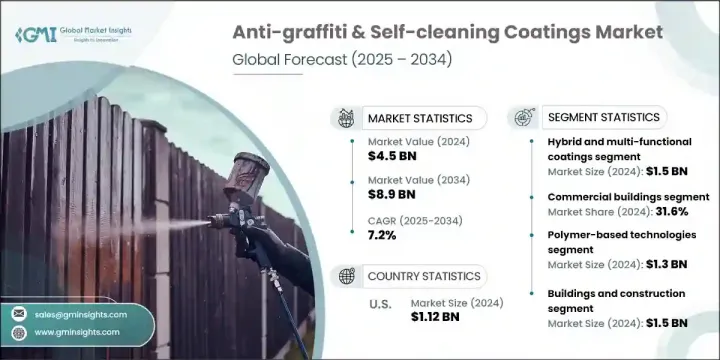
세계의 안티 그래피티 및 셀프 클리닝 코팅 시장은 2024년 45억 달러로 평가되었으며 CAGR 7.2%로 성장해 2034년까지 89억 달러에 이를 것으로 추정됩니다.
중동, 아시아태평양 등의 지역에서 인프라 정비가 진행되고, 도시화가 진행되고 있는 것이 시장의 급속한 확대로 이어지고 있습니다. 이러한 코팅은 유지 보수의 필요성을 줄이고 구조물의 내구성을 향상시키기 위해 널리 채택되었습니다. 셀프 클리닝 코팅은 신재생에너지와 같은 분야에서도 지지를 모으고 있으며, 쓰레기나 먼지의 축적을 막아 성능을 유지하는 데 도움이 됩니다. 오염된 기후와 건조한 기후의 장점은 수요를 더욱 밀어 올리고 있습니다.
최종 사용자가 기능성과 도포의 용이성을 점점 더 우선시하게 됨에 따라 업계는 안티 그래피티 특성, UV 컷 및 항균성과 같은 여러 장점을 단층으로 제공하는 코팅으로 이동하고 있습니다. 첨단 배합으로의 전환은 지속가능성에 대한 기대에 부응하면서 제조업체에 혁신을 촉구하고 있습니다. 소비자의 선호도는 인증과 환경 성능에 영향을 받으며 수성이 낮은 VOC 솔루션으로 강한 시장 변화를 촉진합니다. 이러한 선호도는 그린 빌딩 기준과 지속가능한 도시 개발에 대한 보다 광범위한 목표와 일치하며, 주택, 상업 및 공공 인프라 분야에서 채택이 진행되고 있습니다.
| 시장 범위 | |
|---|---|
| 시작 연도 | 2024년 |
| 예측 연도 | 2025-2034년 |
| 시작 금액 | 45억 달러 |
| 예측 금액 | 89억 달러 |
| CAGR | 7.2% |
하이브리드 및 다기능 코팅 분야는 2024년에 15억 달러를 창출해 2025년부터 2034년까지 CAGR 6.7%의 성장이 전망됩니다. 이 분야는 셀프 클리닝, 안티 그래피티 및 자외선 차폐를 하나의 코팅 솔루션으로 통합 할 수 있기 때문에 시장을 독점하고 있습니다. 이러한 다용도 코팅은 지속적인 보호를 제공하면서 유지보수 비용을 절감할 수 있기 때문에 인프라, 산업용지 및 상업 공간에 이상적입니다. 다양한 용도로 고성능 및 내구성이 있는 페인트가 요구되고 있기 때문에 하이브리드 배합의 사용은 증가의 일도를 따르고 있습니다.
상업시설 분야는 2024년 14억 달러에 달했고, 31.6%의 점유율을 차지해, 2034년까지 CAGR 8%로 성장할 것으로 예측됩니다. 상업 부문은 오래된 마무리와 유지 보수 비용 절감에 대한 요구가 증가함에 따라 주요 최종 사용자 범주가되었습니다. 이 페인트는 도시의 중심부와 사람의 왕래가 많은 지역에서 선호되며, 사업장, 쇼핑몰, 시설 등에서는 외형의 아름다움과 자산 가치 유지가 필수적입니다.
미국의 안티 그래피티 및 셀프 클리닝 코팅 시장 규모는 2024년에 11억 2,000만 달러로 2034년까지 연평균 복합 성장률(CAGR) 6.9%를 보일 것으로 예측됩니다. 미국은 캐나다와 함께 북미 시장을 선도하고 있지만 그 이유는 확립된 인프라와 적극적인 도시 정비에 있습니다. 이 지역의 대중 교통, 도시 시설 및 상업시설은 장기적인 유지 관리와 도시 환경의 미관 유지를 위해 이러한 코팅에 대한 의존도를 높입니다.
세계 안티 그래피티 및 셀프 클리닝 코팅 시장 경쟁 구도를 형성하는 주요 기업은 RPM International Inc., DuPont de Nemours, Inc., Wacker Chemie AG, Axalta Coating Systems Ltd., NanoSlic Coatings, Evonik Industries AG, AkzoNobel N.V., Kansai Paint Co., Ltd., Tikkurila Oyj, Urban Restoration Group, 3M Company, Specialist Coatings International, BASF SE, PURETi Inc., PPG Industries, Inc., Nippon Paint Holdings Co., Ltd., The Sherwin-Williams Company, Arkema S.A., Jotun A/S, EMD Group (Merck KGaA), NanoVa care Coat, Hempel A/S 등이 있습니다. 시장 포지션을 강화하기 위해, 안티 그래피티 및 셀프 클리닝 코팅 업계의 기업들은 다중 코팅의 필요성을 줄이는 다기능 제품의 혁신에 주력하고 있습니다. 저 VOC 및 수성 제품과 같은 녹색 기준을 충족하는 고급 배합을 창출하기 위해 전략적 R&D 투자가 이루어지고 있습니다. 기업은 건설회사 및 도시계획기관과의 제휴를 통해 세계의 존재를 확대하고 있으며, 그 대부분은 도시의 지속가능성 목표에 따른 대처를 하고 있습니다.
목차
제1장 조사 방법
- 시장의 범위와 정의
- 조사 디자인
- 조사 접근
- 데이터 수집 방법
- 데이터 마이닝 소스
- 세계
- 지역/국가
- 기본 추정과 계산
- 기준연도 계산
- 시장 예측의 주요 동향
- 1차 조사와 검증
- 예측 모델
- 조사의 전제와 한계
제2장 주요 요약
제3장 업계 인사이트
- 생태계 분석
- 공급자의 상황
- 이익률
- 각 단계에서의 부가가치
- 밸류체인에 영향을 주는 요인
- 혁신
- 업계에 미치는 영향요인
- 성장 촉진요인
- 업계의 잠재적 위험 및 과제
- 시장 기회
- 성장 가능성 분석
- 규제 상황
- 북미
- 유럽
- 아시아태평양
- 라틴아메리카
- 중동 및 아프리카
- Porter's Five Forces 분석
- PESTLE 분석
- 가격 동향
- 지역별
- 제품별
- 미래 시장 동향
- 기술과 혁신의 상황
- 현재의 기술 동향
- 신흥기술
- 특허 상황
- 무역 통계(HS코드)(주: 무역 통계는 주요 국가만 제공)
- 주요 수입국
- 주요 수출국
- 지속가능성과 환경 측면
- 지속가능한 관행
- 폐기물 감축 전략
- 생산에서의 에너지 효율
- 환경 친화적인 노력
- 탄소발자국의 고려
제4장 경쟁 구도
- 소개
- 기업의 시장 점유율 분석
- 지역별
- 북미
- 유럽
- 아시아태평양
- 라틴아메리카
- 중동 및 아프리카
- 지역별
- 기업 매트릭스 분석
- 주요 시장 기업의 경쟁 분석
- 경쟁 포지셔닝 매트릭스
- 주요 발전
- 합병 및 인수
- 파트너십 및 협업
- 신제품 발매
- 확장 계획
제5장 시장 추계 및 예측, 코팅 유형, 2021-2034년
- 주요 동향
- 소수성 코팅
- 초소수성 코팅
- 불소 폴리머계 코팅
- 실리콘계 소수성 코팅
- 왁스 기반 소수성 시스템
- 친수성 코팅
- 광촉매 TiO2 코팅
- 물 기반 친수성 시스템
- 솔겔 친수성 코팅
- 스마트 코팅
- 써모크로믹 코팅
- pH 응답성 코팅
- 자기 수복 코팅
- 다자극 응답 시스템
- 하이브리드 및 다기능 코팅
- 안티 그래피티 셀프 클리닝 병용
- 방청 셀프 클리닝 시스템
- 항균 셀프 클리닝 코팅
- UV 보호 셀프 클리닝 처방
제6장 시장 추계 및 예측 : 기술별, 2021-2034년
- 주요 동향
- 나노기술 기반 코팅
- 이산화티탄(TiO2) 나노입자 코팅
- 이산화규소(SiO2) 나노 코팅
- 산화아연(ZnO) 나노입자 시스템
- 탄소나노튜브 강화 코팅
- 폴리머 기반 기술
- 폴리우레탄 코팅
- 불소 폴리머 코팅
- 실리콘 폴리머 시스템
- 아크릴 폴리머 코팅
- 솔겔 기술
- 실리카 솔겔 코팅
- 티타니아 솔겔 시스템
- 하이브리드 유기 무기 솔겔
- 첨단 재료 기술
- 그래핀 강화 코팅
- 폴리실라잔 기반 시스템
- 생체 모방 표면 기술
- 플라즈마 중합 코팅
제7장 시장 추계 및 예측 : 용도별, 2021-2034년
- 주요 동향
- 건물 및 건설
- 건물 외관 외관
- 창 및 유리면
- 지붕 시스템
- 내부 표면
- 역사적 건축물 보존
- 교통 인프라
- 철도 차량
- 대중교통기관
- 고속도로 인프라
- 공항 시설
- 선박
- 태양에너지 시스템
- 태양광 발전 패널 코팅
- 태양열 집열기
- 집광형 태양광 발전 시스템
- 자동차 용도
- 차량 외장면
- 앞유리 및 창
- 거울 및 광학 부품
- 섬유 및 직물
- 아웃도어 텍스타일
- 테크니컬 패브릭
- 보호복
- 전자 및 광학 기기
- 디스플레이 화면
- 광학 렌즈
- 전자기기 하우징
제8장 시장 추계 및 예측 : 최종 용도별, 2021-2034년
- 주요 동향
- 상업 빌딩
- 오피스 빌딩
- 소매 센터
- 호텔 및 접객
- 의료시설
- 교육기관
- 주택
- 단독주택
- 집합 주택
- 고급 주택
- 공공 인프라
- 정부청사
- 대중교통기관
- 다리 및 터널
- 공원 및 레크리에이션 시설
- 산업시설
- 제조공장
- 창고 및 배송 센터
- 화학처리시설
- 발전소
- 수송 섹터
- 자동차산업
- 항공우주산업
- 해양산업
- 철도 업계
제9장 시장 추계 및 예측 : 지역별, 2021-2034년
- 주요 동향
- 북미
- 미국
- 캐나다
- 유럽
- 독일
- 영국
- 프랑스
- 이탈리아
- 스페인
- 기타 유럽
- 아시아태평양
- 중국
- 인도
- 일본
- 호주
- 한국
- 기타 아시아태평양
- 라틴아메리카
- 브라질
- 멕시코
- 아르헨티나
- 기타 라틴아메리카
- 중동 및 아프리카
- 사우디아라비아
- 남아프리카
- 아랍에미리트(UAE)
- 기타 중동 및 아프리카
제10장 기업 프로파일
- 3M Company
- BASF SE
- PPG Industries, Inc.
- The Sherwin-Williams Company
- AkzoNobel NV
- Wacker Chemie AG
- DuPont de Nemours, Inc.
- Arkema SA
- Evonik Industries AG
- Nippon Paint Holdings Co., Ltd.
- PURETi Inc.
- NanoSlic Coatings
- EMD Group(Merck KGaA)
- Axalta Coating Systems Ltd.
- Hempel A/S
- Jotun A/S
- Kansai Paint Co., Ltd.
- RPM International Inc.
- Tikkurila Oyj
- NanoVa care Coat
- Specialist Coatings International
- Urban Restoration Group
The Global Anti-graffiti & Self-cleaning Coatings Market was valued at USD 4.5 billion in 2024 and is estimated to grow at a CAGR of 7.2% to reach USD 8.9 billion by 2034. The market is expanding rapidly, driven by ongoing infrastructure upgrades and rising urbanization in regions like the Middle East and Asia-Pacific. These coatings are being adopted widely to reduce maintenance needs and improve the durability of structures. Self-cleaning coatings are also gaining traction in sectors like renewable energy, where they help maintain performance by preventing the accumulation of debris and dust. Their benefits in polluted and arid climates are pushing demand further.
As end users increasingly prioritize functionality and ease of application, the industry is shifting toward coatings that offer multiple benefits-such as anti-graffiti properties, UV protection, and antimicrobial resistance-in a single layer. The transition to advanced formulations is encouraging manufacturers to innovate while meeting sustainability expectations. Consumer preferences are also influenced by certifications and environmental performance, prompting a strong market shift toward water-based, low-VOC solutions. This preference aligns with broader goals around green building standards and sustainable urban development, which continues to fuel adoption across residential, commercial, and public infrastructure sectors.
| Market Scope | |
|---|---|
| Start Year | 2024 |
| Forecast Year | 2025-2034 |
| Start Value | $4.5 Billion |
| Forecast Value | $8.9 Billion |
| CAGR | 7.2% |
The hybrid and multifunctional coatings segment generated USD 1.5 billion in 2024 and is expected to grow at a CAGR of 6.7% from 2025 to 2034. This segment dominates the market due to its ability to combine self-cleaning, graffiti resistance, and UV shielding into a single coating solution. These versatile coatings are ideal for infrastructure, industrial sites, and commercial spaces because they reduce maintenance costs while offering lasting protection. The demand for high-performance, durable coatings across diverse applications continues to elevate the use of hybrid formulations.
The commercial buildings segment accounted for USD 1.4 billion in 2024, representing a 31.6% share, with a projected CAGR of 8% through 2034. The commercial sector is the leading end-user category, driven by rising requirements for long-lasting finishes and reduced maintenance expenses. These coatings are favored in urban hubs and areas with high foot traffic, where maintaining visual appeal and property value is essential for business premises, malls, and institutional properties.
U.S. Anti-graffiti and Self-cleaning Coatings Market was valued at USD 1.12 billion in 2024 and is expected to grow at a CAGR of 6.9% through 2034. Together with Canada, the U.S. leads the North American market due to its established infrastructure and proactive urban upkeep practices. Public transport systems, city facilities, and commercial buildings in the region are increasingly relying on these coatings to manage long-term upkeep and preserve the aesthetic of urban environments.
Prominent players shaping the competitive landscape in the Global Anti-graffiti and Self-cleaning Coatings Market include RPM International Inc., DuPont de Nemours, Inc., Wacker Chemie AG, Axalta Coating Systems Ltd., NanoSlic Coatings, Evonik Industries AG, AkzoNobel N.V., Kansai Paint Co., Ltd., Tikkurila Oyj, Urban Restoration Group, 3M Company, Specialist Coatings International, BASF SE, PURETi Inc., PPG Industries, Inc., Nippon Paint Holdings Co., Ltd., The Sherwin-Williams Company, Arkema S.A., Jotun A/S, EMD Group (Merck KGaA), NanoVa care Coat, and Hempel A/S. To strengthen their market position, companies in the anti-graffiti and self-cleaning coatings industry are focusing on multi-functional product innovations that reduce the need for multiple coatings. Strategic R&D investments are being made to create advanced formulations that meet green standards, including low-VOC and water-based products. Firms are expanding their global presence through partnerships with construction firms and city planning agencies, and many are aligning with urban sustainability goals.
Table of Contents
Chapter 1 Methodology
- 1.1 Market scope and definition
- 1.2 Research design
- 1.2.1 Research approach
- 1.2.2 Data collection methods
- 1.3 Data mining sources
- 1.3.1 Global
- 1.3.2 Regional/Country
- 1.4 Base estimates and calculations
- 1.4.1 Base year calculation
- 1.4.2 Key trends for market estimation
- 1.5 Primary research and validation
- 1.5.1 Primary sources
- 1.6 Forecast model
- 1.7 Research assumptions and limitations
Chapter 2 Executive Summary
- 2.1 Industry 3600 synopsis
- 2.2 Key market trends
- 2.2.1 Regional
- 2.2.2 Coating Type
- 2.2.3 Technology
- 2.2.4 Application
- 2.2.5 End Use
- 2.3 TAM Analysis, 2021-2034
- 2.4 CXO perspectives: strategic imperatives
- 2.4.1 Executive decision points
- 2.4.2 Critical success factors
- 2.5 Future outlook and strategic recommendations
Chapter 3 Industry Insights
- 3.1 Industry ecosystem analysis
- 3.1.1 Supplier Landscape
- 3.1.2 Profit Margin
- 3.1.3 Value addition at each stage
- 3.1.4 Factor affecting the value chain
- 3.1.5 Disruptions
- 3.2 Industry impact forces
- 3.2.1 Growth drivers
- 3.2.2 Industry pitfalls and challenges
- 3.2.3 Market opportunities
- 3.3 Growth potential analysis
- 3.4 Regulatory landscape
- 3.4.1 North America
- 3.4.2 Europe
- 3.4.3 Asia Pacific
- 3.4.4 Latin America
- 3.4.5 Middle East & Africa
- 3.5 Porter's analysis
- 3.6 PESTEL analysis
- 3.6.1 Technology and innovation landscape
- 3.6.2 Current technological trends
- 3.6.3 Emerging technologies
- 3.7 Price trends
- 3.7.1 By region
- 3.7.2 By product
- 3.8 Future market trends
- 3.9 Technology and Innovation landscape
- 3.9.1 Current technological trends
- 3.9.2 Emerging technologies
- 3.10 Patent Landscape
- 3.11 Trade statistics (HS code) (Note: the trade statistics will be provided for key countries only)
- 3.11.1 Major importing countries
- 3.11.2 Major exporting countries
- 3.12 Sustainability and environmental aspects
- 3.12.1 Sustainable practices
- 3.12.2 Waste reduction strategies
- 3.12.3 Energy efficiency in production
- 3.12.4 Eco-friendly initiatives
- 3.13 Carbon Footprint Considerations
Chapter 4 Competitive Landscape, 2024
- 4.1 Introduction
- 4.2 Company market share analysis
- 4.2.1 By region
- 4.2.1.1 North America
- 4.2.1.2 Europe
- 4.2.1.3 Asia Pacific
- 4.2.1.4 LATAM
- 4.2.1.5 MEA
- 4.2.1 By region
- 4.3 Company matrix analysis
- 4.4 Competitive analysis of major market players
- 4.5 Competitive positioning matrix
- 4.6 Key developments
- 4.6.1 Mergers & acquisitions
- 4.6.2 Partnerships & collaborations
- 4.6.3 New product launches
- 4.6.4 Expansion plans
Chapter 5 Market Estimates & Forecast, Coating Type, 2021-2034 (USD Billion) (Kilo Tons)
- 5.1 Key trends
- 5.2 Hydrophobic coatings
- 5.2.1 Superhydrophobic coatings
- 5.2.2 Fluoropolymer-based coatings
- 5.2.3 Silicone-based hydrophobic coatings
- 5.2.4 Wax-based hydrophobic systems
- 5.3 Hydrophilic coatings
- 5.3.1 Photocatalytic TiO2 coatings
- 5.3.2 Water-based hydrophilic systems
- 5.3.3 Sol-gel hydrophilic coatings
- 5.4 Smart coatings
- 5.4.1 Thermochromic coatings
- 5.4.2 Ph-responsive coatings
- 5.4.3 Self-healing coatings
- 5.4.4 Multi-stimuli responsive systems
- 5.5 Hybrid and multi-functional coatings
- 5.5.1 Anti-graffiti + self-cleaning combinations
- 5.5.2 Anti-corrosion + self-cleaning systems
- 5.5.3 Antimicrobial + self-cleaning coatings
- 5.5.4 UV-protective + self-cleaning formulations
Chapter 6 Market Estimates & Forecast, By Technology, 2021-2034 (USD Billion) (Kilo Tons)
- 6.1 Key trends
- 6.2 Nanotechnology-based coatings
- 6.2.1 Titanium dioxide (TiO2) nanoparticle coatings
- 6.2.2 Silicon dioxide (SiO2) nanocoatings
- 6.2.3 Zinc oxide (ZnO) nanoparticle systems
- 6.2.4 Carbon nanotube enhanced coatings
- 6.3 Polymer-based technologies
- 6.3.1 Polyurethane coatings
- 6.3.2 Fluoropolymer coatings
- 6.3.3 Silicone polymer systems
- 6.3.4 Acrylic polymer coatings
- 6.4 Sol-gel technology
- 6.4.1 Silica sol-gel coatings
- 6.4.2 Titania sol-gel systems
- 6.4.3 Hybrid organic-inorganic sol-gels
- 6.5 Advanced material technologies
- 6.5.1 Graphene-enhanced coatings
- 6.5.2 Polysilazane-based systems
- 6.5.3 Biomimetic surface technologies
- 6.5.4 Plasma-polymerized coatings
Chapter 7 Market Estimates & Forecast, By Application, 2021-2034 (USD Billion) (Kilo Tons)
- 7.1 Key trends
- 7.2 Buildings and construction
- 7.2.1 Exterior building facades
- 7.2.2 Windows and glass surfaces
- 7.2.3 Roofing systems
- 7.2.4 Interior surfaces
- 7.2.5 Historic building preservation
- 7.3 Transportation infrastructure
- 7.3.1 Railway rolling stock
- 7.3.2 Public transit systems
- 7.3.3 Highway infrastructure
- 7.3.4 Airport facilities
- 7.3.5 Marine vessels
- 7.4 Solar energy systems
- 7.4.1 Photovoltaic panel coatings
- 7.4.2 Solar thermal collectors
- 7.4.3 Concentrated solar power systems
- 7.5 Automotive applications
- 7.5.1 Vehicle exterior surfaces
- 7.5.2 Windshields and windows
- 7.5.3 Mirrors and optical components
- 7.6 Textiles and fabrics
- 7.6.1 Outdoor textiles
- 7.6.2 Technical fabrics
- 7.6.3 Protective clothing
- 7.7 Electronic and optical devices
- 7.7.1 Display screens
- 7.7.2 Optical lenses
- 7.7.3 Electronic housings
Chapter 8 Market Estimates & Forecast, By End Use, 2021-2034 (USD Billion) (Kilo Tons)
- 8.1 Key trends
- 8.2 Commercial buildings
- 8.2.1 Office buildings
- 8.2.2 Retail centers
- 8.2.3 Hotels and hospitality
- 8.2.4 Healthcare facilities
- 8.2.5 Educational institutions
- 8.3 Residential buildings
- 8.3.1 Single-family homes
- 8.3.2 Multi-family housing
- 8.3.3 Luxury residences
- 8.4 Public infrastructure
- 8.4.1 Government buildings
- 8.4.2 Public transportation facilities
- 8.4.3 Bridges and tunnels
- 8.4.4 Parks and recreation facilities
- 8.5 Industrial facilities
- 8.5.1 Manufacturing plants
- 8.5.2 Warehouses and distribution centers
- 8.5.3 Chemical processing facilities
- 8.5.4 Power generation plants
- 8.6 Transportation sector
- 8.6.1 Automotive industry
- 8.6.2 Aerospace industry
- 8.6.3 Marine industry
- 8.6.4 Railway industry
Chapter 9 Market Estimates & Forecast, By Region, 2021-2034 (USD Billion) (Kilo Tons)
- 9.1 Key trends
- 9.2 North America
- 9.2.1 U.S.
- 9.2.2 Canada
- 9.3 Europe
- 9.3.1 Germany
- 9.3.2 UK
- 9.3.3 France
- 9.3.4 Italy
- 9.3.5 Spain
- 9.3.6 Rest of Europe
- 9.4 Asia Pacific
- 9.4.1 China
- 9.4.2 India
- 9.4.3 Japan
- 9.4.4 Australia
- 9.4.5 South Korea
- 9.4.6 Rest of Asia Pacific
- 9.5 Latin America
- 9.5.1 Brazil
- 9.5.2 Mexico
- 9.5.3 Argentina
- 9.5.4 Rest of Latin America
- 9.6 Middle East & Africa
- 9.6.1 Saudi Arabia
- 9.6.2 South Africa
- 9.6.3 UAE
- 9.6.4 Rest of Middle East & Africa
Chapter 10 Company Profiles
- 10.1 3M Company
- 10.2 BASF SE
- 10.3 PPG Industries, Inc.
- 10.4 The Sherwin-Williams Company
- 10.5 AkzoNobel N.V.
- 10.6 Wacker Chemie AG
- 10.7 DuPont de Nemours, Inc.
- 10.8 Arkema S.A.
- 10.9 Evonik Industries AG
- 10.10 Nippon Paint Holdings Co., Ltd.
- 10.11 PURETi Inc.
- 10.12 NanoSlic Coatings
- 10.13 EMD Group (Merck KGaA)
- 10.14 Axalta Coating Systems Ltd.
- 10.15 Hempel A/S
- 10.16 Jotun A/S
- 10.17 Kansai Paint Co., Ltd.
- 10.18 RPM International Inc.
- 10.19 Tikkurila Oyj
- 10.20 NanoVa care Coat
- 10.21 Specialist Coatings International
- 10.22 Urban Restoration Group