

|
시장보고서
상품코드
1858815
3D 식품 프린팅 재료 시장 : 시장 기회, 성장 촉진요인, 산업 동향 분석, 예측(2025-2034년)3D Food Printing Materials Market Opportunity, Growth Drivers, Industry Trend Analysis, and Forecast 2025 - 2034 |
||||||

세계의 3D 식품 프린팅 재료 시장은 2024년에 8,950만 달러로 평가되었고, CAGR 16.8%로 성장할 전망이며, 2034년에는 4억 2,570만 달러에 이를 것으로 예측되고 있습니다.
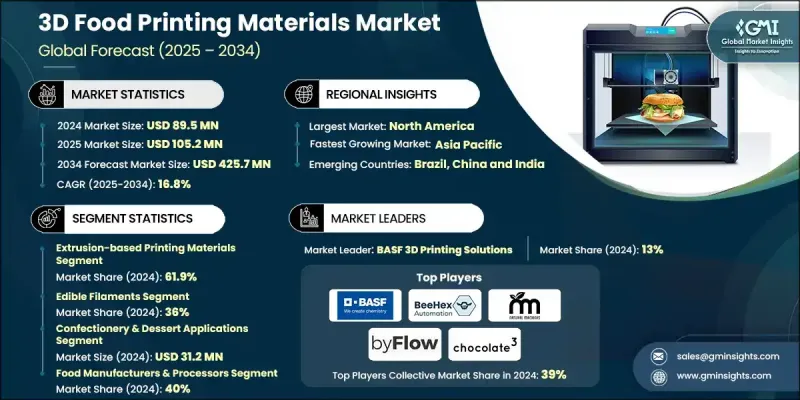
이 시장은 식품 기술의 진보가 매일 식생활에서 맞춤형 영양과 기능성으로 소비자의 변화와 일치함에 따라 강한 기세를 늘리고 있습니다. 깨끗한 라벨, 알레르기 안전성, 지속 가능한 식품 옵션에 대한 관심이 높아짐에 따라 기업은 식물 기반 페이스트부터 창조적이고 모양에 특화된 영양소를 대상으로 한 프린팅을 지원하는 고급 하이드로콜로이드에 이르기까지 다양한 재료를 도입하고 있습니다. 소비자, 특히 젊은층과 플렉시탈리언층은 성분의 투명성 및 윤리적 조달에 큰 가치를 두고 혁신적이고 건강 지향적인 대안에 대한 요구를 밀어 올리고 있습니다. 수요 증가는 가정, 레스토랑, 헬스케어에서 식품 안전 3D 프린팅 시스템이 널리 채택되고 있다는 것을 뒷받침하고 있습니다. 북미가 시장을 선도하고 있지만, 이것은 식품 혁신의 상황이 잘 정비되고 있으며, 기술 도입이 빠른 것이 배경에 있습니다. 한편, 아시아태평양은 도시화의 진전, 식생활의 변화, 편리하고 건강 지향적인 식품 솔루션에 대한 관심이 높아짐에 따라 급속히 확대되고 있습니다.
| 시장 범위 | |
|---|---|
| 시작 연도 | 2024년 |
| 예측 연도 | 2025-2034년 |
| 시장 규모 | 8,950만 달러 |
| 예측 금액 | 4억 2,570만 달러 |
| CAGR | 16.8% |
압출 기반 재료 부문은 2024년에 61.9%의 점유율을 차지했으며, 2034년까지 연평균 복합 성장률(CAGR) 16.4%로 성장할 것으로 예측됩니다. 이 재료는 일회용 카트리지를 사용한 정확한 분량 관리 용도를 위해 설계되었으며 편의성을 높이고 식품 폐기물을 줄입니다. 강화 퓌레에서 식물 기반의 원단에 이르기까지 다양한 식감에 대한 적응성으로 주택용이나 상업용에도 이상적입니다.
식용 필라멘트 분야는 2024년에 36%의 점유율을 차지했으며, 2034년까지 16.8%의 연평균 복합 성장률(CAGR)로 성장할 것으로 예측됩니다. 이 필라멘트는 뛰어난 휴대성, 소규모 3D 프린터와의 호환성, 취급성을 제공합니다. 일반적으로 식이섬유와 단백질이 풍부하게 포함되어 에너지 중시의 영양과 신속한 소비를 지원하도록 설계되어 편의성과 기능이 융합된 페이스의 빠른 라이프 스타일에 원활하게 맞습니다.
북미의 3D 식품 프린팅 재료 시장은 2024년에 35.7%의 점유율을 차지했습니다. 맞춤형 식품 옵션, 효율적인 다이어트 솔루션, 가정용 주방 혁신에 대한 소비자의 관심은 이 지역 전체에서 3D 식품 프린팅의 채택을 촉진하고 있습니다. 상업적 성장은 식품에 안전한 배합을 최적화하는 성분 개발자와 식품 기술 기업과의 제휴에 의해 촉진되고 있습니다. 의료 제공자는 3D 프린팅 재료를 모색하여 개별화된 다이어트 케어, 특히 식감에 맞는 다이어트를 제공합니다. 게다가, 요리 전문가와 레스토랑은 인쇄된 재료를 활용하여 시각적으로 매력적이고 완전히 맞춤화된 식사 경험을 제공하려고 합니다.
3D 식품 프린팅 재료 시장의 주요 기업은 BeeHex, Chocolate3, Print4Taste, Wiiboox, Stratasys Ltd., BASF 3D Printing Solutions, Redefine Meat, Shiyintech, Nourished, FilaMunch Materials, Natural Machines, Felix Printer, Novameat, Steakholder Foods, 3D Systems Corporation, ByFlow 등이 있습니다. 3D 식품 프린팅 재료 시장에서의 존재감을 높이기 위해 기업은 클린 라벨, 채식주의자, 영양 강화, 알레르겐 프리 제제를 개발하고 소재의 혁신에 주력하고 있습니다. 많은 기업들은 지속가능한 조달을 선호하며 환경 의식이 높은 소비자를 대상으로 합니다. 푸드텍의 신흥기업과 식품 소재 제조업체와의 전략적 협업은 개발을 신속하게 진행하고 확장성을 확보하는 시너지 효과를 창출하고 있습니다. 음식 용도 및 치료 용도에서 소재의 다양성을 소개하기 위해서, 요리 기관이나 의료 시설과의 제휴가 모색되고 있습니다.
자주 묻는 질문
목차
제1장 조사 방법 및 범위
제2장 주요 요약
제3장 업계 인사이트
- 생태계 분석
- 공급자의 상황
- 이익률
- 각 단계에서의 부가가치
- 밸류체인에 영향을 주는 요인
- 혁신
- 업계에 미치는 영향요인
- 성장 촉진요인
- 개별화 영양 솔루션에 대한 수요 증가
- 성장하는 연하장애 치료의 헬스케어 용도
- 대체 단백질 시장의 수렴
- 업계의 잠재적 위험 및 과제
- 식품 안전 인증 및 규격의 제한
- 높은 재료 개발 및 인증 비용
- 시장 기회
- 의약품 및 영양보조식품의 통합
- 지속 가능한 식품 생산 및 폐기물 감축
- 성장 촉진요인
- 성장 가능성 분석
- 규제 상황
- 북미
- 유럽
- 아시아태평양
- 라틴아메리카
- 중동 및 아프리카
- Porter's Five Forces 분석
- PESTEL 분석
- 가격 동향
- 지역별
- 기술 유형별
- 향후 시장 동향
- 기술 및 혁신의 전망
- 현재의 기술 동향
- 신흥 기술
- 특허 상황
- 무역 통계(HS코드)(주 : 무역 통계는 주요 국가에 대해서만 제공됨)
- 주요 수입국
- 주요 수출국
- 지속가능성 및 환경 측면
- 지속가능한 실천
- 폐기물 감축 전략
- 생산에서 에너지 효율
- 환경 친화적인 노력
- 탄소발자국
제4장 경쟁 구도
- 서문
- 기업의 시장 점유율 분석
- 지역별
- 북미
- 유럽
- 아시아태평양
- 라틴아메리카
- 중동 및 아프리카
- 지역별
- 기업 매트릭스 분석
- 주요 시장 기업의 경쟁 분석
- 경쟁 포지셔닝 매트릭스
- 주요 발전
- 합병 및 인수
- 파트너십
- 신제품 발표
- 확장 계획
제5장 시장 추계 및 예측 : 기술 유형별(2021-2034년)
- 주요 동향
- 압출 기반 프린팅 재료
- 파우더 베드 융합 재료
- 박쥐 광중합 재료
- 신흥 기술
제6장 시장 추계 및 예측 : 재료 유형별(2021-2034년)
- 주요 동향
- 식용 필라멘트
- 분말 조성물
- 페이스트 및 겔 제형
- 바이오잉크 및 세포 기반 재료
- 멀티 머티리얼 시스템
제7장 시장 추계 및 예측 : 용도별(2021-2034년)
- 주요 동향
- 과자류 및 디저트 용도
- 헬스케어 및 의료 영양
- 개별화 영양 및 보충제
- 대체 단백질 및 육류
- 고급 레스토랑 및 요리
- 비상식 및 우주식 용도
제8장 시장 추계 및 예측 : 최종 용도별(2021-2034년)
- 주요 동향
- 식품 제조업체 및 가공업자
- 의료 시설 및 병원
- 레스토랑 및 요리점
- 연구기관 및 대학
- 소비자 및 가정 용도
제9장 시장 추계 및 예측 : 지역별(2021-2034년)
- 주요 동향
- 북미
- 미국
- 캐나다
- 유럽
- 독일
- 영국
- 프랑스
- 스페인
- 이탈리아
- 기타 유럽
- 아시아태평양
- 중국
- 인도
- 일본
- 호주
- 한국
- 기타 아시아태평양
- 라틴아메리카
- 브라질
- 멕시코
- 아르헨티나
- 기타 라틴아메리카
- 중동 및 아프리카
- 사우디아라비아
- 남아프리카
- 아랍에미리트(UAE)
- 기타 중동 및 아프리카
제10장 기업 프로파일
- BASF 3D Printing Solutions
- FilaMunch Materials(USA)
- BeeHex(USA)
- Natural Machines(Foodini)
- ByFlow(Focus Systems)
- 3D Systems Corporation
- Stratasys Ltd.
- Chocolate3(Germany)
- Print4Taste(Germany)
- Shiyintech(China)
- Wiiboox(China)
- Felix Printer(Netherlands)
- Novameat(Spain)
- Redefine Meat(Israel)
- Nourished(UK)
- Steakholder Foods(Israel)
The Global 3D Food Printing Materials Market was valued at USD 89.5 million in 2024 and is estimated to grow at a CAGR of 16.8% to reach USD 425.7 million by 2034.
This market is gaining strong momentum as advancements in food technology align with consumer shifts toward customized nutrition and functionality in daily diets. With increasing interest in clean-label, allergy-safe, and sustainable food options, companies are introducing a wide range of materials from plant-based pastes to advanced hydrocolloids that support creative, shape-specific, and nutrient-targeted printing. Consumers, especially younger and flexitarian groups, are placing greater value on ingredient transparency and ethical sourcing, pushing the need for innovative, health-conscious alternatives. The rise in demand is also fueled by the broader adoption of food-safe 3D printing systems across homes, restaurants, and healthcare. North America leads the market, driven by a well-developed food innovation landscape and early technology adoption. Meanwhile, Asia-Pacific region is expanding rapidly due to increasing urbanization, changing diets, and a growing interest in convenient, health-forward food solutions.
| Market Scope | |
|---|---|
| Start Year | 2024 |
| Forecast Year | 2025-2034 |
| Start Value | $89.5 Million |
| Forecast Value | $425.7 Million |
| CAGR | 16.8% |
The extrusion-based materials segment held 61.9% share in 2024 and is projected to grow at a CAGR of 16.4% through 2034. These materials are designed for precise, portion-controlled applications using disposable cartridges, which enhance convenience and reduce food waste. Their adaptability to diverse food textures ranging from fortified purees to plant-based doughs makes them ideal for residential and commercial uses alike.
The edible filaments segment held a 36% share in 2024 and is expected to grow at a CAGR of 16.8% through 2034. These filaments offer superior portability, compatibility with small-scale 3D printers, and ease of handling. Typically enriched with fiber and protein, they are designed to support energy-focused nutrition and fast consumption, fitting seamlessly into fast-paced lifestyles where convenience meets function.
North America 3D Food Printing Materials Market held a 35.7% share in 2024. Consumer interest in tailored food options, efficient meal solutions, and innovations in home kitchens has driven the adoption of 3D food printing across the region. Commercial growth is being fueled by partnerships between ingredient developers and food technology companies that are optimizing food-safe formulations. Healthcare providers are also exploring 3D-printed materials to deliver personalized dietary care, particularly texture-adapted meals. Additionally, culinary professionals and restaurants are leveraging printed ingredients to offer visually appealing and fully customized dining experiences.
Key players in the 3D food printing materials market include BeeHex, Chocolate3, Print4Taste, Wiiboox, Stratasys Ltd., BASF 3D Printing Solutions, Redefine Meat, Shiyintech, Nourished, FilaMunch Materials, Natural Machines, Felix Printer, Novameat, Steakholder Foods, 3D Systems Corporation, and ByFlow. To enhance their presence in the 3D food printing materials market, companies are focusing on material innovation by developing formulations that are clean-label, vegan, fortified, and allergen-free. Many firms are prioritizing sustainable sourcing, targeting environmentally conscious consumers. Strategic collaborations between food tech startups and ingredient manufacturers are creating synergies that fast-track development and ensure scalability. Partnerships with culinary institutions and healthcare facilities are being explored to showcase material versatility in gourmet and therapeutic applications.
Table of Contents
Chapter 1 Methodology & Scope
- 1.1 Market scope and definition
- 1.2 Research design
- 1.2.1 Research approach
- 1.2.2 Data collection methods
- 1.3 Data mining sources
- 1.3.1 Global
- 1.3.2 Regional/Country
- 1.4 Base estimates and calculations
- 1.4.1 Base year calculation
- 1.4.2 Key trends for market estimation
- 1.5 Primary research and validation
- 1.5.1 Primary sources
- 1.6 Forecast model
- 1.7 Research assumptions and limitations
Chapter 2 Executive Summary
- 2.1 Industry 360° synopsis
- 2.2 Key market trends
- 2.2.1 Regional
- 2.2.2 Technology type
- 2.2.3 Material type
- 2.2.4 Application
- 2.2.5 End use
- 2.3 TAM Analysis, 2025-2034
- 2.4 CXO perspectives: Strategic imperatives
- 2.4.1 Executive decision points
- 2.4.2 Critical success factors
- 2.5 Future Outlook and Strategic Recommendations
Chapter 3 Industry Insights
- 3.1 Industry ecosystem analysis
- 3.1.1 Supplier landscape
- 3.1.2 Profit margin
- 3.1.3 Value addition at each stage
- 3.1.4 Factor affecting the value chain
- 3.1.5 Disruptions
- 3.2 Industry impact forces
- 3.2.1 Growth drivers
- 3.2.1.1 Rising demand for personalized nutrition solutions
- 3.2.1.2 Growing healthcare applications for dysphagia treatment
- 3.2.1.3 Alternative protein market convergence
- 3.2.2 Industry pitfalls and challenges
- 3.2.2.1 Limited food safety certification & standards
- 3.2.2.2 High material development & certification costs
- 3.2.3 Market opportunities
- 3.2.3.1 Pharmaceutical & nutraceutical integration
- 3.2.3.2 Sustainable food production & waste reduction
- 3.2.1 Growth drivers
- 3.3 Growth potential analysis
- 3.4 Regulatory landscape
- 3.4.1 North America
- 3.4.2 Europe
- 3.4.3 Asia Pacific
- 3.4.4 Latin America
- 3.4.5 Middle East & Africa
- 3.5 Porter's analysis
- 3.6 PESTEL analysis
- 3.7 Price trends
- 3.7.1 By region
- 3.7.2 By technology type
- 3.8 Future market trends
- 3.9 Technology and Innovation landscape
- 3.9.1 Current technological trends
- 3.9.2 Emerging technologies
- 3.10 Patent Landscape
- 3.11 Trade statistics (HS code)( Note: the trade statistics will be provided for key countries only)
- 3.11.1 Major importing countries
- 3.11.2 Major exporting countries
- 3.12 Sustainability and environmental aspects
- 3.12.1 Sustainable practices
- 3.12.2 Waste reduction strategies
- 3.12.3 Energy efficiency in production
- 3.12.4 Eco-friendly initiatives
- 3.13 Carbon footprint consideration
Chapter 4 Competitive Landscape, 2024
- 4.1 Introduction
- 4.2 Company market share analysis
- 4.2.1 By region
- 4.2.1.1 North America
- 4.2.1.2 Europe
- 4.2.1.3 Asia Pacific
- 4.2.1.4 LATAM
- 4.2.1.5 MEA
- 4.2.1 By region
- 4.3 Company matrix analysis
- 4.4 Competitive analysis of major market players
- 4.5 Competitive positioning matrix
- 4.6 Key developments
- 4.6.1 Mergers & acquisitions
- 4.6.2 Partnerships & collaborations
- 4.6.3 New Product Launches
- 4.6.4 Expansion Plans
Chapter 5 Market Estimates and Forecast, By Technology Type, 2021-2034 (USD Million)
- 5.1 Key trends
- 5.2 Extrusion-Based Printing Materials
- 5.3 Powder Bed Fusion Materials
- 5.4 Vat Photopolymerization Materials
- 5.5 Emerging Technologies
Chapter 6 Market Estimates and Forecast, By Material Type, 2021-2034 (USD Million)
- 6.1 Key trends
- 6.2 Edible filaments
- 6.3 Powder compositions
- 6.4 Paste & gel formulations
- 6.5 Bio-inks & cell-based materials
- 6.6 Multi-material systems
Chapter 7 Market Estimates and Forecast, By Application, 2021-2034 (USD Million)
- 7.1 Key trends
- 7.2 Confectionery & dessert applications
- 7.3 Healthcare & medical nutrition
- 7.4 Personalized nutrition & supplements
- 7.5 Alternative protein & meat analogs
- 7.6 Fine dining & culinary arts
- 7.7 Emergency & space food applications
Chapter 8 Market Estimates and Forecast, By End Use, 2021-2034 (USD Million)
- 8.1 Key trends
- 8.2 Food manufacturers & processors
- 8.3 Healthcare facilities & hospitals
- 8.4 Restaurants & culinary establishments
- 8.5 Research institutions & universities
- 8.6 Consumer & home applications
Chapter 9 Market Estimates and Forecast, By Region, 2021-2034 (USD Million)
- 9.1 Key trends
- 9.2 North America
- 9.2.1 U.S.
- 9.2.2 Canada
- 9.3 Europe
- 9.3.1 Germany
- 9.3.2 UK
- 9.3.3 France
- 9.3.4 Spain
- 9.3.5 Italy
- 9.3.6 Rest of Europe
- 9.4 Asia Pacific
- 9.4.1 China
- 9.4.2 India
- 9.4.3 Japan
- 9.4.4 Australia
- 9.4.5 South Korea
- 9.4.6 Rest of Asia Pacific
- 9.5 Latin America
- 9.5.1 Brazil
- 9.5.2 Mexico
- 9.5.3 Argentina
- 9.5.4 Rest of Latin America
- 9.6 Middle East and Africa
- 9.6.1 Saudi Arabia
- 9.6.2 South Africa
- 9.6.3 UAE
- 9.6.4 Rest of Middle East and Africa
Chapter 10 Company Profiles
- 10.1 BASF 3D Printing Solutions
- 10.2 FilaMunch Materials (USA)
- 10.3 BeeHex (USA)
- 10.4 Natural Machines (Foodini)
- 10.5 ByFlow (Focus Systems)
- 10.6 3D Systems Corporation
- 10.7 Stratasys Ltd.
- 10.8 Chocolate³ (Germany)
- 10.9 Print4Taste (Germany)
- 10.10 Shiyintech (China)
- 10.11 Wiiboox (China)
- 10.12 Felix Printer (Netherlands)
- 10.13 Novameat (Spain)
- 10.14 Redefine Meat (Israel)
- 10.15 Nourished (UK)
- 10.16 Steakholder Foods (Israel)


