|
시장보고서
상품코드
1871078
자동차용 수소 연료전지 스택 시장 기회, 성장 요인, 업계 동향 분석 및 예측(2025-2034년)Automotive Hydrogen Fuel Cell Stack Market Opportunity, Growth Drivers, Industry Trend Analysis, and Forecast 2025 - 2034 |
||||||

세계의 자동차 수소 연료전지 스택 시장은 2024년 6억 6,910만 달러로 평가되었으며, 2034년까지 연평균 복합 성장률(CAGR) 24.2%를 나타내 58억 달러에 이를 것으로 예측됩니다.

대기 오염과 기후 변화와 같은 환경 과제에 대한 세계적인 인식 증가가 제로 방출 이동성으로의 전환을 가속화하고 있습니다. 수소를 동력원으로 하는 차량은 수증기만을 배출하기 때문에 기존의 내연기관을 대체하는 깨끗하고 지속 가능한 옵션으로 자리매김하고 있습니다. 재료과학과 공학의 진보에 견인된 연료전지 기술의 지속적인 진화에 의해 수소연료전지의 효율성, 성능, 수명이 현저히 향상되었습니다. 이러한 진전은 배터리식 전기자동차와의 경쟁력을 높이는 동시에 자동차 분야에서 폭넓은 용도로의 전개를 촉진하고 있습니다. 게다가 수소는 다수의 국내 자원으로부터 제조가능하기 때문에 수입 석유에 대한 의존도를 줄이고 에너지의 다양화와 안보에 기여합니다. 세제 혜택, 재정적 인센티브, 조사 보조금 등의 정부 지원책은 제조 비용 절감과 녹색 교통 인프라 홍보를 통해 수소 보급을 더욱 강화하고 있습니다. 이러한 조치는 지속 가능한 이동성과 깨끗한 에너지 생태계로의 세계 전환을 가속화하는 데 도움이 됩니다.
| 시장 범위 | |
|---|---|
| 시작 연도 | 2024년 |
| 예측 연도 | 2025-2034년 |
| 시작 금액 | 6억 6,910만 달러 |
| 예측 금액 | 58억 달러 |
| CAGR | 24.2% |
막 전극 어셈블리(MEA) 부문은 2024년 33.2%의 점유율을 차지했습니다. 수소연료전지의 전기화학적 코어 역할을 하는 MEA는 수소와 산소가 결합하여 발전하는 장소입니다. 이 부문은 촉매 성능, 멤브레인 강도 및 종합 효율의 지속적인 기술 발전을 반영합니다. MEA 개발의 지속적인 진보에 의해 백금 의존도의 저감, 에너지 변환 효율의 향상, 내구성의 강화가 실현되고, 생산 코스트의 삭감과 승용차·상용차 카테고리를 불문하고 수소 자동차의 가동 수명 연장이 촉진되고 있습니다.
양성자 교환막 연료전지(PEMFC) 부문은 2024년에 73.4%의 점유율을 차지했으며, 2034년까지 연평균 복합 성장률(CAGR) 24%를 나타낼 것으로 예측됩니다. PEMFC는 콤팩트한 사이즈, 경량성, 고출력 밀도를 특징으로 하며, 효율성과 공간 최적화가 필수적인 차량 통합에 이상적이기 때문에 자동차 분야에서 널리 채용되고 있습니다. 낮은 작동 온도와 빠른 시동 능력으로 세단, SUV, 소형 상용 트럭 등 다양한 차종에 특히 적합합니다. 막의 내구성과 촉매의 안정성에 있어서 지속적인 개선이 성능을 한층 더 향상시켜, 세계 시장에 있어서 PEMFC의 대규모 도입을 가능하게 하고 있습니다.
2024년 기준 미국의 자동차 수소 연료전지 스택 시장은 86.4%의 점유율을 차지했습니다. 정부 주도의 시책에 의해 연료전지 스택의 국내 생산과 기술 진보가 촉진되고 있어 출력 밀도, 비용 효율, 수명의 향상에 중점을 두고 있습니다. 수소 인프라에 대한 인민 투자 증가와 자동차 제조업체와 부품 제조업체 간의 협력으로 중형 및 대형 차량용 수소 연료전지 시스템의 대규모 제조 및 통합이 진행되고 있습니다. 이 지역은 청정 에너지와 혁신을 강조하며 수소 이동성 솔루션의 리더십을 지속적으로 강화하고 있습니다.
세계의 자동차 수소 연료전지 스택 시장에 참여하는 주요 기업으로는 Toyota Motor, PowerCell Sweden, Cummins, Honda Motor, Hyundai Motor, Ballard Power Systems, Symbio, Weichai Power, Robert Bosch, and EKPO Fuel Cell Technologies 등이 있습니다. 자동차용 수소 연료전지 스택 시장의 주요 기업은 고효율, 저비용, 내구성이 뛰어난 스택 시스템 개발에 주력하여 지속적인 연구와 혁신을 통해 경쟁력을 강화하고 있습니다. 많은 기업들이 백금 사용량을 최소화하고 출력을 높이고 연료전지의 수명을 연장하기 위해 차세대 재료에 투자하고 있습니다. 자동차 제조업체와 기술 개발자 간의 전략적 제휴로 수소 연료전지의 대규모 생산과 상용 차량으로의 통합이 가속화되고 있습니다. 또한 기업은 인프라의 확장과 연구개발을 위한 자금 확보를 위해 정부와의 제휴를 우선하고 있습니다.
자주 묻는 질문
목차
제1장 조사 방법
- 시장 범위와 정의
- 조사 설계
- 조사 접근
- 데이터 수집 방법
- 데이터 마이닝의 출처
- 세계
- 지역별/국가별
- 기본 추정치와 계산
- 기준연도 계산
- 시장 추정에서의 주요 동향
- 1차 조사 및 검증
- 1차 정보
- 예측
- 조사의 전제조건과 제한 사항
제2장 주요 요약
제3장 업계 인사이트
- 생태계 분석
- 공급자의 상황
- 원재료 공급자
- 부품 제조업체
- 시스템 통합자
- OEM
- 최종 용도
- 업계에 미치는 영향요인
- 성장 촉진요인
- 정부 인센티브와 정책
- 환경에의 배려
- 기술적 진보
- 에너지 안보와 다양화
- 업계의 잠재적 위험 및 과제
- 고비용 생산
- 한정적인 연료 보급 인프라
- 수소 제조에 있어서 과제
- 소비자의 인지도와 인식
- 시장 기회
- 연료전지 기술의 진보
- 신재생에너지원과의 통합
- 대형 수송 분야로의 전개
- 세계 정책 지원
- 성장 촉진요인
- 성장 가능성 분석
- 규제 상황
- Porter's Five Forces 분석
- PESTEL 분석
- 기술과 혁신의 상황
- 현행 기술
- 신흥기술
- 특허 분석
- 가격 동향 분석
- 제품별
- 지역별
- 코스트 내역 분석
- 생산 통계
- 생산 거점
- 소비 거점
- 수출입
- 관세 및 무역 장벽
- 공급 체인의 탄력과 다양화
- 지속가능성과 환경면
- 지속가능한 실천
- 폐기물 감축 전략
- 생산에 있어서 에너지 효율
- 환경에 배려한 대처
- 탄소발자국에 관한 고려 사항
- 공급망 및 물류
- 수소 공급망 인프라
- 유통 네트워크와 채널
- 연료 보급 인프라 정비
- 콜드체인 관리 및 보관
- 물류상의 과제와 해결책
- 라스트마일 배송 고려 사항
- 총소유비용(TCO) 분석
- 자동차 인증 및 시험 비용
- 제조 및 도입 비용
- 보수 및 교환 비용
- 기술 유형별 TCO 비교
- 제조 공정 및 품질 관리 분석
제4장 경쟁 구도
- 서론
- 기업의 시장 점유율 분석
- 북미
- 유럽
- 아시아태평양
- 라틴아메리카
- 중동 및 아프리카
- 주요 시장 기업의 경쟁 분석
- 경쟁 포지셔닝 매트릭스
- 전략적 전망 매트릭스
- 주요 뉴스와 대처
- 합병 및 인수
- 제휴 및 협력 관계
- 신제품 발매
- 확대계획과 자금조달
제5장 시장 추계·예측 : 구성 요소별(2021-2034년)
- 주요 동향
- 막 전극 조립체(MEA)
- 양극판
- 개스킷 및 씰
- 엔드 플레이트 및 집전 장치
- 냉각 플레이트
- 매니폴드 및 가스 확산층
제6장 시장추계·예측 : 출력별(2021-2034년)
- 주요 동향
- 100kW 미만
- 100-250kW
- 250kW 이상
제7장 시장 추계·예측 : 연료전지 기술별(2021-2034년)
- 주요 동향
- 양성자 교환막 연료전지(PEMFC)
- 고체 산화물 연료전지(SOFC)
- 알칼리 연료전지(AFC)
- 용융 탄산염 연료전지(MCFC)
제8장 시장추계·예측 : 차량별(2021-2034년)
- 주요 동향
- 승용차
- 해치백
- 세단
- SUV
- 상용차
- LCV
- MCV
- 대형 상용차(HCV)
- 특수 차량
- 산업용 차량
- 군용 차량
제9장 시장추계·예측 : 판매 채널별(2021-2034년)
- 주요 동향
- OEM
- 애프터마켓
제10장 시장추계·예측 : 지역별(2021-2034년)
- 주요 동향
- 북미
- 미국
- 캐나다
- 유럽
- 독일
- 영국
- 프랑스
- 이탈리아
- 스페인
- 북유럽 국가
- 네덜란드
- 러시아
- 아시아태평양
- 중국
- 인도
- 일본
- 호주
- 한국
- 동남아시아
- 라틴아메리카
- 브라질
- 멕시코
- 아르헨티나
- 중동 및 아프리카
- 남아프리카
- 사우디아라비아
- 아랍에미리트(UAE)
제11장 기업 프로파일
- 세계 기업
- BMW
- Robert Bosch
- Daimler
- General Motors(GM)
- Honda Motor
- Hyundai Mobis
- Hyundai Motor
- Stellantis
- Toyota Motor
- Volvo
- Regional Champions
- EKPO Fuel Cell Technologies
- ElringKlinger
- Nissan Motor
- SAIC Motor
- Schaeffler
- Weichai Power
- 신흥 및 전문 기업
- Ballard Power Systems
- 두산
- Hyzon Motors
- Nuvera
- PowerCell
- Symbio
The Global Automotive Hydrogen Fuel Cell Stack Market was valued at USD 669.1 million in 2024 and is estimated to grow at a CAGR of 24.2% to reach USD 5.8 Billion by 2034.
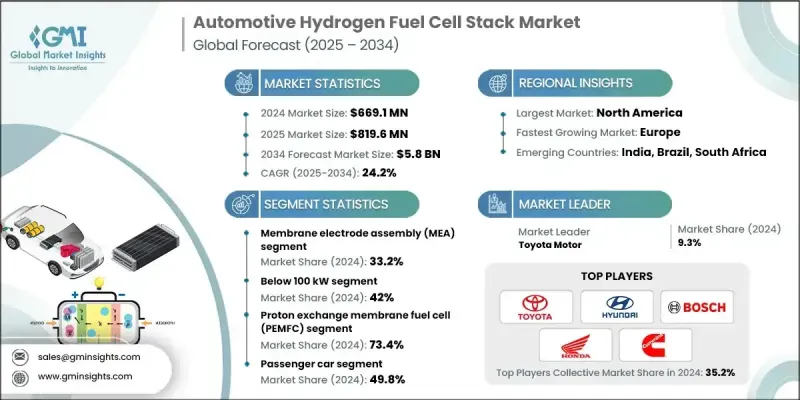
Rising global awareness about environmental challenges such as air pollution and climate change is accelerating the transition toward zero-emission mobility. Hydrogen-powered vehicles emit only water vapor, positioning them as a clean and sustainable alternative to conventional combustion engines. The continuous evolution of fuel cell technology, driven by advances in materials science and engineering, has significantly improved the efficiency, performance, and lifespan of hydrogen fuel cells. These developments are enhancing their competitiveness with battery electric vehicles and broadening their use across automotive applications. Moreover, hydrogen's ability to be produced from multiple domestic sources reduces dependency on imported oil and contributes to energy diversification and security. Supportive government initiatives such as tax benefits, financial incentives, and research grants are further encouraging adoption by reducing manufacturing costs and promoting green transportation infrastructure. Such measures are helping accelerate the global shift toward sustainable mobility and cleaner energy ecosystems.
| Market Scope | |
|---|---|
| Start Year | 2024 |
| Forecast Year | 2025-2034 |
| Start Value | $669.1 Million |
| Forecast Value | $5.8 Billion |
| CAGR | 24.2% |
The membrane electrode assembly (MEA) segment held a 33.2% share in 2024. Serving as the electrochemical core of a hydrogen fuel cell, the MEA is where hydrogen and oxygen combine to generate electricity. The segment reflects the ongoing technological progress in catalyst performance, membrane strength, and overall efficiency. Continued advancements in MEA development have led to reduced platinum dependency, better energy conversion, and enhanced durability, driving down production costs and extending the operational lifespan of hydrogen-powered vehicles across passenger and commercial categories.
The proton exchange membrane fuel cell (PEMFC) segment held a 73.4% share in 2024 and is expected to grow at a CAGR of 24% through 2034. PEMFCs are widely adopted in the automotive sector due to their compact size, low weight, and high power density, which make them ideal for vehicle integration where efficiency and space optimization are essential. Their low operating temperature and rapid start-up capabilities make them particularly suitable for diverse vehicle categories such as sedans, SUVs, and light commercial trucks. Continuous improvements in membrane durability and catalyst stability are further enhancing performance, enabling large-scale deployment of PEMFCs across global markets.
U.S. Automotive Hydrogen Fuel Cell Stack Market held 86.4% share in 2024. Government-backed initiatives are promoting domestic production and technological advancement in fuel cell stacks, with a focus on improving power density, cost-efficiency, and lifespan. Increasing public and private sector investment in hydrogen infrastructure, along with collaboration between automakers and component manufacturers, is advancing large-scale manufacturing and integration of hydrogen fuel cell systems for medium- and heavy-duty vehicles. The region's emphasis on clean energy and innovation continues to reinforce its leadership in hydrogen mobility solutions.
Key companies participating in the Global Automotive Hydrogen Fuel Cell Stack Market include Toyota Motor, PowerCell Sweden, Cummins, Honda Motor, Hyundai Motor, Ballard Power Systems, Symbio, Weichai Power, Robert Bosch, and EKPO Fuel Cell Technologies. Leading companies in the Automotive Hydrogen Fuel Cell Stack Market are enhancing their competitive edge through continuous research and innovation, focusing on developing high-efficiency, low-cost, and durable stack systems. Many firms are investing in next-generation materials to minimize platinum usage, boost power output, and extend fuel cell lifespan. Strategic collaborations between automakers and technology developers are accelerating large-scale production and integration of hydrogen fuel cells into commercial fleets. Companies are also prioritizing partnerships with governments to secure funding for infrastructure expansion and R&D.
Table of Contents
Chapter 1 Methodology
- 1.1 Market scope and definition
- 1.2 Research design
- 1.2.1 Research approach
- 1.2.2 Data collection methods
- 1.3 Data mining sources
- 1.3.1 Global
- 1.3.2 Regional/Country
- 1.4 Base estimates and calculations
- 1.4.1 Base year calculation
- 1.4.2 Key trends for market estimation
- 1.5 Primary research and validation
- 1.5.1 Primary sources
- 1.6 Forecast
- 1.7 Research assumptions and limitations
Chapter 2 Executive Summary
- 2.1 Industry 360° synopsis, 2021 - 2034
- 2.2 Key market trends
- 2.2.1 Component
- 2.2.2 Power output
- 2.2.3 Fuel cell technology
- 2.2.4 Vehicle
- 2.2.5 Sales channel
- 2.2.6 Regional
- 2.3 TAM Analysis, 2025-2034
- 2.4 CXO perspectives: Strategic imperatives
- 2.4.1 Executive decision points
- 2.4.2 Critical success factors
- 2.5 Future outlook and strategic recommendations
Chapter 3 Industry Insights
- 3.1 Industry ecosystem analysis
- 3.2 Supplier landscape
- 3.2.1 Raw material suppliers
- 3.2.2 Component manufacturers
- 3.2.3 System integrators
- 3.2.4 OEM
- 3.2.5 End Use
- 3.3 Industry impact forces
- 3.3.1 Growth drivers
- 3.3.1.1 Government Incentives and Policies
- 3.3.1.2 Environmental Concerns
- 3.3.1.3 Technological Advancements
- 3.3.1.4 Energy Security and Diversification
- 3.3.2 Industry pitfalls and challenges
- 3.3.2.1 High Production Costs
- 3.3.2.2 Limited Refueling Infrastructure
- 3.3.2.3 Hydrogen Production Challenges
- 3.3.2.4 Consumer Awareness and Perception
- 3.3.3 Market opportunities
- 3.3.3.1 Advancements in Fuel Cell Technology
- 3.3.3.2 Integration with Renewable Energy Sources
- 3.3.3.3 Expansion into Heavy-Duty Transport
- 3.3.3.4 Global Policy Support
- 3.3.1 Growth drivers
- 3.4 Growth potential analysis
- 3.5 Regulatory landscape
- 3.5.1 North America
- 3.5.2 Europe
- 3.5.3 Asia Pacific
- 3.5.4 Latin America
- 3.5.5 Middle east and Africa
- 3.6 Porter's analysis
- 3.7 PESTEL analysis
- 3.8 Technology and Innovation landscape
- 3.8.1 Current technology
- 3.8.2 Emerging technology
- 3.9 Patent analysis
- 3.10 Price Trends Analysis
- 3.10.1 By product
- 3.10.2 By region
- 3.11 Cost Breakdown Analysis
- 3.12 Production statistics
- 3.12.1 Production hubs
- 3.12.2 Consumption hubs
- 3.12.3 Export and import
- 3.12.4 Tariffs and Trade Barriers
- 3.12.5 Supply Chain Resilience and Diversification
- 3.13 Sustainability and Environmental Aspects
- 3.13.1 Sustainable Practices
- 3.13.2 Waste Reduction Strategies
- 3.13.3 Energy Efficiency in Production
- 3.13.4 Eco-friendly Initiatives
- 3.13.5 Carbon Footprint Considerations
- 3.14 Supply Chain & Logistics
- 3.14.1 Hydrogen Supply Chain Infrastructure
- 3.14.2 Distribution Networks and Channels
- 3.14.3 Refueling Infrastructure Development
- 3.14.4 Cold Chain Management and Storage
- 3.14.5 Logistics Challenges and Solutions
- 3.14.6 Last-mile Delivery Considerations
- 3.15 Total Cost of Ownership (TCO) Analysis
- 3.15.1 Automotive Qualification & Testing Costs
- 3.15.2 Manufacturing & Deployment Expenses
- 3.15.3 Maintenance & Replacement Costs
- 3.15.4 TCO Comparison by Technology Type
- 3.16 Manufacturing Process & Quality Control Analysis
Chapter 4 Competitive Landscape, 2024
- 4.1 Introduction
- 4.2 Company market share analysis
- 4.2.1 North America
- 4.2.2 Europe
- 4.2.3 Asia Pacific
- 4.2.4 LATAM
- 4.2.5 MEA
- 4.3 Competitive analysis of major market players
- 4.4 Competitive positioning matrix
- 4.5 Strategic outlook matrix
- 4.6 Key news and initiatives
- 4.6.1 Mergers & acquisitions
- 4.6.2 Partnerships & collaborations
- 4.6.3 New Product Launches
- 4.6.4 Expansion Plans and funding
Chapter 5 Market Estimates & Forecast, By Component, 2021 - 2034 ($Bn, Units)
- 5.1 Key trends
- 5.2 Membrane electrode assembly (MEA)
- 5.3 Bipolar plates
- 5.4 Gaskets and seals
- 5.5 End plates & current collectors
- 5.6 Cooling plates
- 5.7 Manifolds & gas diffusion layers
Chapter 6 Market Estimates & Forecast, By Power output, 2021 - 2034 ($Bn, Units)
- 6.1 Key trends
- 6.2 Below 100 kW
- 6.3 100-250 kW
- 6.4 Above 250 kW
Chapter 7 Market Estimates & Forecast, By Fuel Cell Technology, 2021 - 2034 ($Bn, Units)
- 7.1 Key trends
- 7.2 Proton exchange membrane fuel cell (PEMFC)
- 7.3 Solid oxide fuel cell (SOFC)
- 7.4 Alkaline fuel cell (AFC)
- 7.5 Molten carbonate fuel cell (MCFC)
Chapter 8 Market Estimates & Forecast, By Vehicle, 2021 - 2034 ($Bn, Units)
- 8.1 Key trends
- 8.2 Passenger Car
- 8.2.1 Hatchback
- 8.2.2 Sedan
- 8.2.3 SUVs
- 8.3 Commercial Vehicle
- 8.3.1 LCV
- 8.3.2 MCV
- 8.3.3 HCV
- 8.4 Specialized Vehicles
- 8.4.1 Industrial vehicles
- 8.4.2 Military vehicles
Chapter 9 Market Estimates & Forecast, By Sales Channel, 2021 - 2034 ($Bn, Units)
- 9.1 Key trends
- 9.2 OEM
- 9.3 Aftermarket
Chapter 10 Market Estimates & Forecast, By Region, 2021 - 2034 ($Bn, Units)
- 10.1 Key trends
- 10.2 North America
- 10.2.1 US
- 10.2.2 Canada
- 10.3 Europe
- 10.3.1 Germany
- 10.3.2 UK
- 10.3.3 France
- 10.3.4 Italy
- 10.3.5 Spain
- 10.3.6 Nordics
- 10.3.7 Netherlands
- 10.3.8 Russia
- 10.4 Asia Pacific
- 10.4.1 China
- 10.4.2 India
- 10.4.3 Japan
- 10.4.4 Australia
- 10.4.5 South Korea
- 10.4.6 Southeast Asia
- 10.5 Latin America
- 10.5.1 Brazil
- 10.5.2 Mexico
- 10.5.3 Argentina
- 10.6 MEA
- 10.6.1 South Africa
- 10.6.2 Saudi Arabia
- 10.6.3 UAE
Chapter 11 Company Profiles
- 11.1 Global Players
- 11.1.1 BMW
- 11.1.2 Robert Bosch
- 11.1.3 Daimler
- 11.1.4 General Motors (GM)
- 11.1.5 Honda Motor
- 11.1.6 Hyundai Mobis
- 11.1.7 Hyundai Motor
- 11.1.8 Stellantis
- 11.1.9 Toyota Motor
- 11.1.10 Volvo
- 11.2 Regional Champions
- 11.2.1 EKPO Fuel Cell Technologies
- 11.2.2 ElringKlinger
- 11.2.3 Nissan Motor
- 11.2.4 SAIC Motor
- 11.2.5 Schaeffler
- 11.2.6 Weichai Power
- 11.3 Emerging Players & Specialists
- 11.3.1 Ballard Power Systems
- 11.3.2 Doosan
- 11.3.3 Hyzon Motors
- 11.3.4 Nuvera
- 11.3.5 PowerCell
- 11.3.6 Symbio