|
시장보고서
상품코드
1871103
석유 및 가스 증기 회수 장치 시장 : 기회, 성장 요인, 업계 동향 분석 및 예측(2025-2034년)Oil and Gas Vapor Recovery Units Market Opportunity, Growth Drivers, Industry Trend Analysis, and Forecast 2025 - 2034 |
||||||

세계의 석유 및 가스 증기 회수 장치 시장은 2024년 8억 9,640만 달러로 평가되었고, 2034년까지 연평균 복합 성장률(CAGR)은 5.2%를 나타낼 것으로 예측되며 14억 8,000만 달러에 달할 전망입니다.
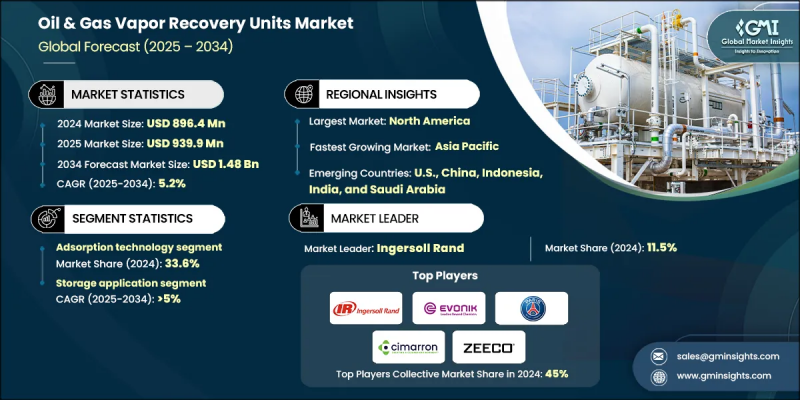
주요 산유 지역의 강화된 환경 정책으로 인해 상류 및 하류 부문 운영사들이 휘발성 유기 화합물(VOC) 배출을 억제하기 위해 증기 회수 장치(VRU) 도입을 추진하면서 시장이 주목받고 있습니다. 이 시스템은 원유 및 정제 연료와 같은 휘발성 액체의 저장, 취급, 처리 과정에서 방출되는 탄화수소 증기를 포집하고 회수하도록 설계되었습니다. 정유소, 터미널, 연료 저장 시설에 설치가 증가하는 것은 대기 오염을 줄이면서 동시에 가치 있는 탄화수소를 회수하는 이중 혜택을 반영하며, 이를 지속 가능한 유전 운영의 핵심 구성 요소로 자리매김하고 있습니다. 개발도상국에서의 원유 및 연료 저장 용량 확장은 수요를 더욱 촉진하고 있으며, 메탄 배출 제한을 위한 글로벌 이니셔티브는 유정 패드와 압축기 스테이션 전반에 걸친 채택을 주도하고 있습니다. 분산 제어 시스템(DCS) 및 SCADA 기반 자동화와 같은 스마트 기술의 통합은 실시간 모니터링, 예측 유지보수 및 향상된 성능 가시성을 가능하게 하여 운영자가 효율성을 높이고 환경 규정 준수를 유지할 수 있도록 합니다.
| 시장 범위 | |
|---|---|
| 시작 연도 | 2024년 |
| 예측 연도 | 2025-2034년 |
| 시작 금액 | 8억 9,640만 달러 |
| 예측 금액 | 14억 8,000만 달러 |
| CAGR | 5.2% |
2024년 기준, 흡착 기반 기술 부문은 33.6%의 점유율을 기록했으며, 2034년까지 연평균 5%의 성장률을 보일 것으로 예상됩니다. 고표면적 복합재를 포함한 차세대 흡착재의 도입으로 까다로운 현장 조건에서도 증기 회수 성능이 개선되고 있습니다. 유지보수가 적고 재생 가능한 흡착 시스템으로의 전환은 일관된 회수 작업과 신뢰할 수 있는 배출 관리가 필요한 업스트림 및 미드스트림 시설에 특히 유리합니다.
저장 용도 부문은 2025-2034년 연평균 5%의 성장률을 보일 것입니다. 탱크 저장 작업에서 발생하는 벤젠 및 휘발성 유기 화합물(VOCs) 배출에 대한 감시가 강화되면서 저장 시설에 증기 회수 장치(VRU)의 도입이 증가하고 있습니다. 대형 탱크 팜에 이중 단계 증기 회수 시스템을 통합함으로써 탄화수소 회수 효율이 크게 향상되어 운영자가 엄격한 배출 기준을 준수하면서도 제품 손실을 최소화할 수 있게 되었습니다.
북미의 석유 및 가스 증기 회수 장치 시장은 2034년까지 연평균 복합 성장률(CAGR) 4.5%로 확대될 전망입니다. 지역 중간 유통 사업자들은 응축수 안정화 및 가스 처리 활동에서 발생하는 증기 배출을 관리하기 위해 VRU를 점점 더 많이 활용하여 운영 지속 가능성을 개선하고 있습니다. 메탄 감축에 초점을 맞춘 연방 기후 정책은 상류 생산업체들 사이에서 VRU의 광범위한 채택을 더욱 촉진하고 있습니다. 환경 및 사회 및 지배구조(ESG) 목표에 대한 강조가 증가함에 따라 에너지 기업들은 진화하는 지속 가능성 기준을 충족하기 위해 첨단 회수 솔루션에 투자하고 기존 인프라를 업그레이드하고 있습니다.
석유 및 가스 증기 회수 장치 시장의 주요 기업은 ALMA Group, Cimarron Energy, BORSIG, Cool Sorption, Ingersoll Rand, Flogistix, KAPPA GI, Koch Engineered Solutions, Kilburn Engineering, LeROI, Evonik, PETROGAS, PSG, SCS Technologies, Reyn Technical, Tecam, VOCZero, Zeeco 등이 있습니다. 석유 및 가스 증기 회수 장치 시장의 기업들은 시장 지위를 강화하기 위해 혁신, 파트너십 및 글로벌 확장을 중심으로 다양한 성장 전략을 채택하고 있습니다. 많은 기업들이 다양한 운영 환경에 유연하게 적용 가능한 첨단 배출 제어 기술과 모듈식 VRU 설계에 투자하고 있습니다. 또한 기업들은 국제 환경 기준을 준수하는 턴키 방식의 회수 솔루션을 제공하기 위해 유전 운영사 및 EPC 계약업체와 협력하고 있습니다. 전략적 제휴 및 합병을 통해 글로벌 유통 역량이 강화되는 한편, IoT 기반 모니터링 시스템을 통한 디지털 통합으로 효율성과 신뢰성이 향상되고 있습니다.
자주 묻는 질문
목차
제1장 조사 방법과 범위
제2장 주요 요약
제3장 업계 인사이트
- 생태계 분석
- 원재료 가용성 및 조달 분석
- 제조 능력 평가
- 공급망의 회복력과 위험 요인
- 유통 네트워크 분석
- 규제 상황
- 업계에 미치는 영향요인
- 성장 촉진요인
- 업계의 잠재적 억제요인 및 과제
- 성장 가능성 분석
- Porter's Five Forces 분석
- PESTEL 분석
- 증기 회수 장치의 비용 구조 분석
- 새로운 기회와 동향
- 디지털화와 IoT 통합
- 투자분석과 전망
제4장 경쟁 구도
- 소개
- 기업의 시장 점유율 분석 : 지역별
- 북미
- 유럽
- 아시아태평양
- 중동 및 아프리카
- 라틴아메리카
- 전략적 대시보드
- Key partnerships &collaborations
- Major M&A activities
- Product innovations &launches
- Market expansion strategies
- 전략적 노력
- 경쟁 벤치마킹
- 혁신과 기술의 정세
제5장 시장 규모와 예측 : 기술별(2021-2034년)
- 주요 동향
- 응축
- 흡착
- 흡수
- 압축
제6장 시장 규모와 예측 : 용도별(2021-2034년)
- 주요 동향
- 가공
- 저장
- 운송
제7장 시장 규모와 예측 : 지역별(2021-2034년)
- 주요 동향
- 북미
- 미국
- 캐나다
- 유럽
- 영국
- 독일
- 프랑스
- 이탈리아
- 스페인
- 러시아
- 노르웨이
- 폴란드
- 아시아태평양
- 중국
- 인도
- 일본
- 한국
- 인도네시아
- 말레이시아
- 중동 및 아프리카
- 사우디아라비아
- 아랍에미리트(UAE)
- 카타르
- 이집트
- 오만
- 남아프리카
- 나이지리아
- 라틴아메리카
- 브라질
- 멕시코
- 아르헨티나
제8장 기업 프로파일
- ALMA Group
- BORSIG
- Cimarron Energy
- Cool Sorption
- Evonik
- Flogistix
- Ingersoll Rand
- KAPPA GI
- Kilburn Engineering
- Koch Engineered Solutions
- LeROI
- PETROGAS
- PSG
- Reynold India
- S&S Technical
- SCS Technologies
- SYMEX Technologies
- Tecam
- VOCZero
- Zeeco
The Global Oil and Gas Vapor Recovery Units Market was valued at USD 896.4 million in 2024 and is estimated to grow at a CAGR of 5.2% to reach USD 1.48 Billion by 2034.
The market is gaining traction as stricter environmental policies across key oil-producing regions push operators in both upstream and downstream sectors to adopt vapor recovery units (VRUs) to curb emissions of volatile organic compounds (VOCs). These systems are designed to capture and recover hydrocarbon vapors released during the storage, handling, and processing of volatile liquids such as crude oil and refined fuels. Their growing installation in refineries, terminals, and fuel storage sites reflects their dual benefit of reducing air pollution while reclaiming valuable hydrocarbons, positioning them as a critical component of sustainable oilfield operations. The expansion of crude oil and fuel storage capacity in developing economies is further fueling demand, while global initiatives to limit methane emissions are driving adoption across well pads and compressor stations. Integration of smart technologies such as distributed control systems (DCS) and SCADA-based automation enables real-time monitoring, predictive maintenance, and improved performance visibility, allowing operators to enhance efficiency and maintain environmental compliance.
| Market Scope | |
|---|---|
| Start Year | 2024 |
| Forecast Year | 2025-2034 |
| Start Value | $896.4 Million |
| Forecast Value | $1.48 Billion |
| CAGR | 5.2% |
In 2024, the adsorption-based technology segment accounted for a 33.6% share and is expected to grow at a CAGR of 5% through 2034. The introduction of next-generation adsorbent materials, including high-surface-area composites, is improving vapor recovery performance under challenging field conditions. The shift toward low-maintenance and regenerative adsorption systems is especially beneficial for upstream and midstream facilities that require consistent recovery operations and reliable emission control.
The storage application segment will grow at a CAGR of 5% from 2025 to 2034. Heightened scrutiny over emissions of benzene and VOCs from tank storage operations is increasing the deployment of VRUs in storage facilities. The integration of dual-stage vapor recovery systems in larger tank farms is significantly enhancing hydrocarbon recovery efficiency, helping operators comply with stringent emission standards while minimizing product loss.
North America Oil and Gas Vapor Recovery Units Market will grow at a CAGR of 4.5% through 2034. Regional midstream operators are increasingly utilizing VRUs to manage vapor emissions from condensate stabilization and gas processing activities, improving operational sustainability. Federal climate initiatives focused on methane reduction are further encouraging widespread adoption among upstream producers. The growing emphasis on environmental, social, and governance (ESG) objectives is driving energy companies to invest in advanced recovery solutions and upgrade existing infrastructure to meet evolving sustainability benchmarks.
Leading companies operating in the Oil and Gas Vapor Recovery Units Market include ALMA Group, Cimarron Energy, BORSIG, Cool Sorption, Ingersoll Rand, Flogistix, KAPPA GI, Koch Engineered Solutions, Kilburn Engineering, LeROI, Evonik, PETROGAS, PSG, SCS Technologies, Reynold India, SYMEX Technologies, S&S Technical, Tecam, VOCZero, and Zeeco. To strengthen their market position, companies in the Oil and Gas Vapor Recovery Units Market are adopting diverse growth strategies centered on innovation, partnerships, and global expansion. Many are investing in advanced emission control technologies and modular VRU designs that enable flexible deployment across varied operating environments. Firms are also collaborating with oilfield operators and EPC contractors to deliver turnkey recovery solutions that comply with international environmental standards. Strategic alliances and mergers are enhancing global distribution capabilities, while digital integration through IoT-enabled monitoring systems is improving efficiency and reliability.
Table of Contents
Chapter 1 Methodology & Scope
- 1.1 Research design
- 1.1.1 Research approach
- 1.1.2 Data collection methods
- 1.2 Base estimates and calculations
- 1.2.1 Base year calculation
- 1.2.2 Market estimates & forecast parameters
- 1.3 Forecast
- 1.3.1 Key trends for market estimates
- 1.3.2 Quantified market impact analysis
- 1.3.2.1 Mathematical impact of growth parameters on forecast
- 1.3.3 Scenario analysis framework
- 1.4 Primary research and validation
- 1.4.1 Some of the primary sources (but not limited to)
- 1.5 Data mining sources
- 1.5.1 Paid Sources
- 1.5.2 Sources, by region
- 1.6 Research trail & scoring components
- 1.6.1 Research trail components
- 1.6.2 Scoring components
- 1.7 Research transparency addendum
- 1.7.1 Source attribution framework
- 1.7.2 Quality assurance metrics
- 1.7.3 Our commitment to trust
- 1.8 Market definitions
Chapter 2 Executive Summary
- 2.1 Industry 3600 synopsis, 2021 - 2034
- 2.2 Business trends
- 2.3 Technology trends
- 2.4 Application trends
- 2.5 Regional trends
Chapter 3 Industry Insights
- 3.1 Industry ecosystem analysis
- 3.1.1 Raw material availability & sourcing analysis
- 3.1.2 Manufacturing capacity assessment
- 3.1.3 Supply chain resilience & risk factors
- 3.1.4 Distribution network analysis
- 3.2 Regulatory landscape
- 3.3 Industry impact forces
- 3.3.1 Growth drivers
- 3.3.2 Industry pitfalls & challenges
- 3.4 Growth potential analysis
- 3.5 Porter's analysis
- 3.5.1 Bargaining power of suppliers
- 3.5.2 Bargaining power of buyers
- 3.5.3 Threat of new entrants
- 3.5.4 Threat of substitutes
- 3.6 PESTEL analysis
- 3.6.1 Political factors
- 3.6.2 Economic factors
- 3.6.3 Social factors
- 3.6.4 Technological factors
- 3.6.5 Legal factors
- 3.6.6 Environmental factors
- 3.7 Cost structure analysis of vapor recovery units
- 3.8 Emerging opportunities & trends
- 3.9 Digitalization and IoT integration
- 3.10 Investment analysis & future outlook
Chapter 4 Competitive Landscape, 2025
- 4.1 Introduction
- 4.2 Company market share analysis, by region, 2024
- 4.2.1 North America
- 4.2.2 Europe
- 4.2.3 Asia Pacific
- 4.2.4 Middle East & Africa
- 4.2.5 Latin America
- 4.3 Strategic dashboard
- 4.3.1 Key partnerships & collaborations
- 4.3.2 Major M&A activities
- 4.3.3 Product innovations & launches
- 4.3.4 Market expansion strategies
- 4.4 Strategic initiatives
- 4.5 Competitive benchmarking
- 4.6 Innovation & technology landscape
Chapter 5 Market Size and Forecast, By Technology, 2021 - 2034 (USD Million)
- 5.1 Key trends
- 5.2 Condensation
- 5.3 Adsorption
- 5.4 Absorption
- 5.5 Compression
Chapter 6 Market Size and Forecast, By Application, 2021 - 2034 (USD Million)
- 6.1 Key trends
- 6.2 Processing
- 6.3 Storage
- 6.4 Transportation
Chapter 7 Market Size and Forecast, By Region, 2021 - 2034 (USD Million)
- 7.1 Key trends
- 7.2 North America
- 7.2.1 U.S.
- 7.2.2 Canada
- 7.3 Europe
- 7.3.1 UK
- 7.3.2 Germany
- 7.3.3 France
- 7.3.4 Italy
- 7.3.5 Spain
- 7.3.6 Russia
- 7.3.7 Norway
- 7.3.8 Poland
- 7.4 Asia Pacific
- 7.4.1 China
- 7.4.2 India
- 7.4.3 Japan
- 7.4.4 South Korea
- 7.4.5 Indonesia
- 7.4.6 Malaysia
- 7.5 Middle East & Africa
- 7.5.1 Saudi Arabia
- 7.5.2 UAE
- 7.5.3 Qatar
- 7.5.4 Egypt
- 7.5.5 Oman
- 7.5.6 South Africa
- 7.5.7 Nigeria
- 7.6 Latin America
- 7.6.1 Brazil
- 7.6.2 Mexico
- 7.6.3 Argentina
Chapter 8 Company Profiles
- 8.1 ALMA Group
- 8.2 BORSIG
- 8.3 Cimarron Energy
- 8.4 Cool Sorption
- 8.5 Evonik
- 8.6 Flogistix
- 8.7 Ingersoll Rand
- 8.8 KAPPA GI
- 8.9 Kilburn Engineering
- 8.10 Koch Engineered Solutions
- 8.11 LeROI
- 8.12 PETROGAS
- 8.13 PSG
- 8.14 Reynold India
- 8.15 S&S Technical
- 8.16 SCS Technologies
- 8.17 SYMEX Technologies
- 8.18 Tecam
- 8.19 VOCZero
- 8.20 Zeeco