|
시장보고서
상품코드
1871110
자기 치유 바닥재 시장 : 기회, 성장 요인, 업계 동향 분석, 예측(2025-2034년)Self-healing Flooring Materials Market Opportunity, Growth Drivers, Industry Trend Analysis, and Forecast 2025 - 2034 |
||||||

세계의 자기 치유 바닥재 시장은 2024년 69억 달러로, 2034년까지 연평균 복합 성장률(CAGR) 21.7%로 성장하여 487억 달러에 이를 것으로 예측됩니다.
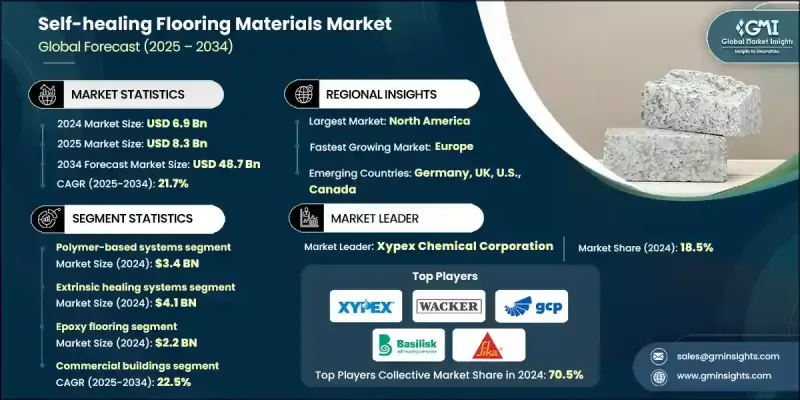
시장 확대의 배경으로는 상업시설, 의료시설, 산업시설에서 내구성이 우수하고 유지보수 비용이 낮은 바닥재에 대한 수요가 높아지고 있습니다. 자기 치유 바닥재는 교통량이 많은 환경에서 수리 비용을 절감하고 다운타임을 최소화하기 위해 주목을 받고 있습니다. 첨단 재료 기술이 건설 및 산업 분야에서 널리 받아 들여지고 있으며 시장에 크게 기여하고 있습니다. 에폭시, 폴리우레탄, 콘크리트, 비닐, 고무 복합재, 스마트 모듈식 타일 등의 바닥재 유형은 채용률과 가격 프리미엄의 영향을 받으면서 각각 역할을 하고 있습니다. 조사에 의하면, 자기 치유 중합체는 손상 후 기계적 강도의 상당 부분을 회복할 수 있기 때문에 마모나 충격을 받기 쉬운 표면에 최적입니다. 지속가능성의 이점 외에도, 이러한 재료는 재료 폐기물 및 탄소 배출량을 줄이는 데 기여하며 환경에서 매력을 높입니다. 최근 기술 혁신을 통해 항균 및 열 안정성과 같은 추가 기능이 바닥재 시스템에 통합되었습니다. 특히, 온화한 조건 하에서 강도를 유지하면서 반복적으로 자기 치유하는 능력으로부터, 비트리머와 초분자 폴리머가 주요 재료로서 대두하고 있습니다. 이러한 진보는 의료시설과 식품가공시설 등 내구성과 위생적인 표면을 동시에 요구하는 엄격한 용도에 대응하고 있습니다.
| 시장 범위 | |
|---|---|
| 시작 연도 | 2024년 |
| 예측 연도 | 2025-2034년 |
| 시작 금액 | 69억 달러 |
| 예측 금액 | 487억 달러 |
| CAGR | 21.7% |
폴리머 기반 시스템 부문은 2024년 50%의 점유율을 차지했고 2034년까지 연평균 복합 성장률(CAGR) 21.2%로 추이할 것으로 예측되고 있습니다. 이러한 시스템은 에폭시, 폴리우레탄, 고급 고분자 블렌드 등의 재료를 활용하고, 고유한 분자 설계 또는 내장된 마이크로캡슐을 통한 자기 치유 메커니즘을 통합합니다.
외인성 치유 시스템 부문은 2024년 41억 달러 규모를 차지했습니다. 이 시스템은 마이크로 캡슐 또는 도관 네트워크 기술에 따라 달라지며 수리제를 별도의 저장소에 보관하고 손상이 발생하면 자동으로 방출합니다. 마이크로 캡슐 기반 외인성 시스템은 예측 가능하고 신뢰할 수 있는 성능 특성을 갖추고 있으며 상업적으로 실현 가능합니다.
북미의 자기 치유 바닥재 시장은 첨단 건축 기준에 대한 수요, 의료 인프라의 고도화, 산업 시설 개발을 배경으로 2024년 41.5%의 점유율을 획득했습니다. 미국은 엄격한 건축 기준과 성능 요건으로 첨단 재료의 도입을 촉진하고 있기 때문에 최대의 단일 국가 시장입니다. 병원과 임상시설에서 자기수복성 바닥재의 도입을 뒷받침하는 주요 요인으로는 위생관리, 피팅가 없는 표면, 낮은 유지보수성 등이 있습니다.
자가 수리 바닥재 시장의 주요 기업은 Green-Basilisk BV, Pacific Northwest National Laboratory (PNNL), Sika Group, Sensicon Ventures Ltd, Saint Gobain, Xypex Chemical Corporation, Oscrete Construction Products, Corbion, Fescon Oy, HEGGEL GmbH, Wacker Chemie AG, Polycoat Products, SCHOMBURG GmbH, Minicrete 등이 있습니다. 자기 치유 바닥재 시장의 기업들은 첨단 고분자 블렌드 개발, 다기능 통합, 마이크로캡슐 기반 수리 기술 확대에 주력하고 있습니다. 건설 회사, 의료 제공업체, 산업 시설 개발자와의 제휴는 시장 침투 강화에 기여합니다. 연구개발에 대한 투자는 항균성, 내열성, 환경친화적인 바닥 시스템의 혁신을 추진하고 있습니다. 제조업체는 환경 의식이 높은 구매자를 끌어들이기 위해 비용 효율적인 솔루션과 지속가능성 메시지를 강조합니다. 디지털 마케팅, 계발 캠페인, 파일럿 설치 사례를 통해 제품의 우위성을 강조하여 채용 촉진을 도모하고 있습니다.
자주 묻는 질문
목차
제1장 조사 방법과 범위
제2장 주요 요약
제3장 업계 인사이트
- 생태계 분석
- 공급자의 상황
- 이익률
- 각 단계에서의 부가가치
- 밸류체인에 영향을 주는 요인
- 혁신
- 업계에 미치는 영향요인
- 성장 촉진요인
- 인프라 유지관리 비용 절감
- 의료 감염 관리 요건
- 산업에서 다운타임 최소화의 필요성
- 업계의 잠재적 위험 및 과제
- 높른 초기 투자액 및 촉매 비용
- 설치 복잡성과 계약자의 연수
- 온도 및 환경 활성화 장벽
- 시장 기회
- 팬데믹 후의 의료시설 확충
- 정부에 의한 인프라의 현대화
- 성장 촉진요인
- 성장 가능성 분석
- 규제 상황
- 북미
- 유럽
- 아시아태평양
- 라틴아메리카
- 중동 및 아프리카
- Porter's Five Forces 분석
- PESTEL 분석
- 가격 동향
- 지역별
- 재료 유형
- 자기 치유 메커니즘
- 바닥재의 유형
- 최종 용도
- 미래 시장 동향
- 기술과 혁신의 상황
- 현재의 기술 동향
- 신흥기술
- 특허 상황
- 무역 통계(HS코드)(참고 : 무역 통계는 주요 국가에서만 제공됨)
- 주요 수입국
- 주요 수출국
- 지속가능성과 환경면
- 지속가능한 대처
- 폐기물 감축 전략
- 생산에서의 에너지 효율
- 환경에 배려한 대처
- 탄소발자국에 관한 고려 사항
제4장 경쟁 구도
- 소개
- 기업의 시장 점유율 분석
- 지역별
- 북미
- 유럽
- 아시아태평양
- 라틴아메리카
- 중동 및 아프리카
- 지역별
- 기업 매트릭스 분석
- 주요 시장 기업의 경쟁 분석
- 경쟁 포지셔닝 매트릭스
- 주요 발전
- 인수합병
- 제휴 및 협업
- 신제품 발매
- 확대 계획
제5장 시장 추계 및 예측 : 재료 유형별, 2021-2034년
- 주요 동향
- 폴리머계 시스템
- 에폭시 수지
- 폴리우레탄
- 아크릴 및 메타크릴레이트
- 폴리우레아
- 폴리디메틸실록산(PDMS)
- 시멘트계 및 콘크리트계 시스템
- 포틀랜드 시멘트 매트릭스
- 지오폴리머 시스템
- 섬유 강화 변종
- 하이브리드 및 복합 시스템
- 폴리머 및 콘크리트 복합재
- 섬유 강화 폴리머(FRP)
- 다층 시스템
- 바이오 베이스 및 지속 가능한 재료
- 식물 유래 폴리머계
- 재생재의 배합
- 생분해성 성분
- 기타
제6장 시장 추계 및 예측 : 자기 치유 메커니즘별, 2021-2034년
- 주요 동향
- 외인성 치유 시스템
- 마이크로 캡슐 기반 자기 수복제
- 도관 네트워크 기반 시스템
- 봉입형 세균 및 효소 시스템
- 중공사 통합
- 외부 저장소 시스템
- 자기 치유 시스템
- 동적 공유 결합 네트워크
- 초분자 상호작용
- 형상 기억 폴리머
- 금속 리간드 배위
- 수소 결합 시스템
- 온도 응답성 시스템
- 자기 조직화 메커니즘
- 기타
제7장 시장 추계 및 예측 : 바닥재 유형별, 2021-2034년
- 주요 동향
- 에폭시 바닥재
- 폴리우레탄 바닥재
- 비닐 바닥재
- 고급 비닐 타일
- 비닐 복합 타일
- 콘크리트 바닥재
- 고무 및 복합 바닥재
- 스마트 모듈러 타일
제8장 시장 추계 및 예측 : 최종 용도별, 2021-2034년
- 주요 동향
- 주택건축
- 상업 빌딩
- 오피스 빌딩
- 소매 시설
- 교육기관
- 접객 및 엔터테인먼트
- 스포츠 및 레크리에이션
- 데이터센터
- 의료 및 제약
- 병원 수술실
- 멸균 처리 영역
- 실험 시설
- 의약품 제조
- 공업용 건물
- 화학 처리 플랜트
- 자동차 조립
- 전자기기 제조
- 항공우주시설
- 기타
제9장 시장 추계 및 예측 : 지역별, 2021-2034년
- 주요 동향
- 북미
- 미국
- 캐나다
- 유럽
- 독일
- 영국
- 프랑스
- 스페인
- 이탈리아
- 기타 유럽
- 아시아태평양
- 중국
- 인도
- 일본
- 호주
- 한국
- 기타 아시아태평양
- 라틴아메리카
- 브라질
- 멕시코
- 아르헨티나
- 기타 라틴아메리카
- 중동 및 아프리카
- 사우디아라비아
- 남아프리카
- 아랍에미리트(UAE)
- 기타 중동 및 아프리카
제10장 기업 프로파일
- Xypex Chemical Corporation
- Green-Basilisk BV
- Sika Group
- Oscrete Construction Products
- Fescon Oy
- Wacker Chemie AG
- Polycoat Products
- Saint Gobain
- Corbion
- Giatec Scientific Inc.
- HEGGEL GmbH
- SCHOMBURG GmbH
- Minicrete
- Sensicon Ventures Ltd
- Pacific Northwest National Laboratory(PNNL)
The Global Self-healing Flooring Materials Market was valued at USD 6.9 Billion in 2024 and is estimated to grow at a CAGR of 21.7% to reach USD 48.7 Billion by 2034.
The market expansion is driven by rising demand for durable, low-maintenance flooring across commercial, healthcare, and industrial sectors. Self-healing flooring is gaining traction as it reduces repair costs and minimizes downtime in high-traffic environments. Advanced materials technologies are becoming widely accepted in construction and industrial applications, contributing significantly to the market. Flooring types such as epoxy, polyurethane, concrete, vinyl, rubber composites, and smart modular tiles all play a role, influenced by adoption rates and price premiums. Research demonstrates that self-healing polymers can recover a substantial portion of their mechanical strength after damage, making them ideal for abrasive and impact-prone surfaces. In addition to sustainability benefits, these materials help reduce material waste and carbon emissions, enhancing environmental appeal. Recent innovations have integrated additional functionalities into flooring systems, such as antimicrobial properties and thermal stability. Vitrimers and supramolecular polymers are emerging as leading materials due to their ability to repeatedly self-heal under mild conditions while retaining strength. These advancements cater to demanding applications requiring both durability and hygienic surfaces, particularly in healthcare and food processing facilities.
| Market Scope | |
|---|---|
| Start Year | 2024 |
| Forecast Year | 2025-2034 |
| Start Value | $6.9 Billion |
| Forecast Value | $48.7 Billion |
| CAGR | 21.7% |
The polymer-based systems segment held a 50% share in 2024 with a projected CAGR of 21.2% through 2034. These systems leverage materials like epoxy, polyurethane, and advanced polymer blends, incorporating self-healing mechanisms either through intrinsic molecular design or embedded microcapsules.
The extrinsic healing systems segment accounted for USD 4.1 Billion in 2024. These systems rely on microcapsule or vascular network technologies, storing healing agents in discrete reservoirs and releasing them automatically when damage occurs. Microcapsule-based extrinsic systems are commercially viable, with predictable and reliable performance characteristics.
North America Self-healing Flooring Materials Market captured 41.5% share in 2024, driven by demand for advanced construction standards, upgraded healthcare infrastructure, and industrial facility development. The United States is the largest single-country market due to strict building codes and performance requirements favoring advanced material adoption. Key factors supporting self-healing flooring in hospitals and clinical facilities include hygiene control, seamless surfaces, and lower maintenance needs.
Key players in the Self-healing Flooring Materials Market include Green-Basilisk BV, Pacific Northwest National Laboratory (PNNL), Sika Group, Sensicon Ventures Ltd, Saint Gobain, Xypex Chemical Corporation, Oscrete Construction Products, Corbion, Fescon Oy, HEGGEL GmbH, Wacker Chemie AG, Polycoat Products, SCHOMBURG GmbH, and Minicrete. Companies in the self-healing flooring market focus on developing advanced polymer blends, integrating multifunctional properties, and expanding microcapsule-based healing technologies. Partnerships with construction firms, healthcare providers, and industrial facility developers help enhance market penetration. Investment in R&D drives innovation in antimicrobial, thermal-resistant, and eco-friendly floor systems. Manufacturers emphasize cost-effective solutions and sustainability messaging to attract environmentally conscious buyers. Digital marketing, educational campaigns, and pilot installations highlight product advantages, boosting adoption.
Table of Contents
Chapter 1 Methodology & Scope
- 1.1 Market scope and definition
- 1.2 Research design
- 1.2.1 Research approach
- 1.2.2 Data collection methods
- 1.3 Data mining sources
- 1.3.1 Global
- 1.3.2 Regional/Country
- 1.4 Base estimates and calculations
- 1.4.1 Base year calculation
- 1.4.2 Key trends for market estimation
- 1.5 Primary research and validation
- 1.5.1 Primary sources
- 1.6 Forecast model
- 1.7 Research assumptions and limitations
Chapter 2 Executive Summary
- 2.1 Industry 360° synopsis
- 2.2 Key market trends
- 2.2.1 Regional
- 2.2.2 Material Type
- 2.2.3 Self-Healing Mechanism
- 2.2.4 Flooring type
- 2.2.5 End Use
- 2.3 TAM Analysis, 2025-2034
- 2.4 CXO perspectives: Strategic imperatives
- 2.4.1 Executive decision points
- 2.4.2 Critical success factors
- 2.5 Future Outlook and Strategic Recommendations
Chapter 3 Industry Insights
- 3.1 Industry ecosystem analysis
- 3.1.1 Supplier Landscape
- 3.1.2 Profit Margin
- 3.1.3 Value addition at each stage
- 3.1.4 Factor affecting the value chain
- 3.1.5 Disruptions
- 3.2 Industry impact forces
- 3.2.1 Growth drivers
- 3.2.1.1 Infrastructure maintenance cost reduction
- 3.2.1.2 Healthcare infection control requirements
- 3.2.1.3 Industrial downtime minimization needs
- 3.2.2 Industry pitfalls and challenges
- 3.2.2.1 High initial investment & catalyst costs
- 3.2.2.2 Installation complexity & contractor training
- 3.2.2.3 Temperature & environmental activation barriers
- 3.2.3 Market opportunities
- 3.2.3.1 Post-pandemic healthcare facility expansion
- 3.2.3.2 Government infrastructure modernization
- 3.2.1 Growth drivers
- 3.3 Growth potential analysis
- 3.4 Regulatory landscape
- 3.4.1 North America
- 3.4.2 Europe
- 3.4.3 Asia Pacific
- 3.4.4 Latin America
- 3.4.5 Middle East & Africa
- 3.5 Porter's analysis
- 3.6 PESTEL analysis
- 3.6.1 Technology and Innovation Landscape
- 3.6.2 Current technological trends
- 3.6.3 Emerging technologies
- 3.7 Price trends
- 3.7.1 By region
- 3.7.2 Material Type
- 3.7.3 Self-Healing Mechanism
- 3.7.4 Flooring type
- 3.7.5 End Use
- 3.8 Future market trends
- 3.9 Technology and Innovation Landscape
- 3.9.1 Current technological trends
- 3.9.2 Emerging technologies
- 3.10 Patent Landscape
- 3.11 Trade statistics (HS code) (Note: the trade statistics will be provided for key countries only)
- 3.11.1 Major importing countries
- 3.11.2 Major exporting countries
- 3.12 Sustainability and environmental aspects
- 3.12.1 Sustainable practices
- 3.12.2 Waste reduction strategies
- 3.12.3 Energy efficiency in production
- 3.12.4 Eco-friendly initiatives
- 3.13 Carbon footprint considerations
Chapter 4 Competitive Landscape, 2024
- 4.1 Introduction
- 4.2 Company market share analysis
- 4.2.1 By region
- 4.2.1.1 North America
- 4.2.1.2 Europe
- 4.2.1.3 Asia Pacific
- 4.2.1.4 LATAM
- 4.2.1.5 MEA
- 4.2.1 By region
- 4.3 Company matrix analysis
- 4.4 Competitive analysis of major market players
- 4.5 Competitive positioning matrix
- 4.6 Key developments
- 4.6.1 Mergers & acquisitions
- 4.6.2 Partnerships & collaborations
- 4.6.3 New product launches
- 4.6.4 Expansion plans
Chapter 5 Market Estimates and Forecast, By Material Type, 2021 - 2034 (USD Billion) (Kilo Tons)
- 5.1 Key trends
- 5.2 Polymer-based systems
- 5.2.1 Epoxy Resins
- 5.2.2 Polyurethane
- 5.2.3 Acrylic & methacrylate
- 5.2.4 Polyurea
- 5.2.5 Polydimethylsiloxane (PDMS)
- 5.3 Cementitious/concrete-based systems
- 5.3.1 Portland cement matrix
- 5.3.2 Geopolymer systems
- 5.3.3 Fiber-reinforced variants
- 5.4 Hybrid/composite systems
- 5.4.1 Polymer-concrete composites
- 5.4.2 Fiber-reinforced polymers (FRP)
- 5.4.3 Multi-layer systems
- 5.5 Bio-based/sustainable materials
- 5.5.1 Plant-based polymer systems
- 5.5.2 Recycled content integration
- 5.5.3 Biodegradable components
- 5.6 Others
Chapter 6 Market Estimates and Forecast, By Self-Healing Mechanism, 2021 - 2034 (USD Billion) (Kilo Tons)
- 6.1 Key trends
- 6.2 Extrinsic healing systems
- 6.2.1 Microcapsule-based healing agents
- 6.2.2 Vascular network-based systems
- 6.2.3 Encapsulated bacteria/enzyme system
- 6.2.4 Hollow fiber integration
- 6.2.5 External reservoir systems
- 6.3 Intrinsic healing systems
- 6.3.1 Dynamic covalent networks
- 6.3.2 Supramolecular interactions
- 6.3.3 Shape memory polymers
- 6.3.4 Metal-ligand coordination
- 6.3.5 Hydrogen bonding systems
- 6.3.6 Temperature-responsive systems
- 6.3.7 Self-assembly mechanisms
- 6.4 Others
Chapter 7 Market Estimates and Forecast, By Flooring Type, 2021 - 2034 (USD Billion) (Kilo Tons)
- 7.1 Key trends
- 7.2 Epoxy flooring
- 7.3 Polyurethane flooring
- 7.4 Vinyl flooring
- 7.4.1 Luxury vinyl tile
- 7.4.2 Vinyl composite tile
- 7.5 Concrete flooring
- 7.6 Rubber/composites flooring
- 7.7 Smart modular tiles
Chapter 8 Market Estimates and Forecast, By End Use, 2021 - 2034 (USD Billion) (Kilo Tons)
- 8.1 Key trends
- 8.2 Residential buildings
- 8.3 Commercial buildings
- 8.3.1 Office buildings
- 8.3.2 Retail facilities
- 8.3.3 Educational institutions
- 8.3.4 Hospitality & entertainment
- 8.3.5 Sports & recreation
- 8.3.6 Data centers
- 8.4 Healthcare & pharmaceuticals
- 8.4.1 Hospital operating rooms
- 8.4.2 Sterile processing areas
- 8.4.3 Laboratory facilities
- 8.4.4 Pharmaceutical manufacturing
- 8.5 Industrial buildings
- 8.5.1 Chemical processing plants
- 8.5.2 Automotive assembly
- 8.5.3 Electronics manufacturing
- 8.5.4 Aerospace facilities
- 8.6 Other
Chapter 9 Market Estimates and Forecast, By Region, 2021 - 2034 (USD Billion) (Kilo Tons)
- 9.1 Key trends
- 9.2 North America
- 9.2.1 U.S.
- 9.2.2 Canada
- 9.3 Europe
- 9.3.1 Germany
- 9.3.2 UK
- 9.3.3 France
- 9.3.4 Spain
- 9.3.5 Italy
- 9.3.6 Rest of Europe
- 9.4 Asia Pacific
- 9.4.1 China
- 9.4.2 India
- 9.4.3 Japan
- 9.4.4 Australia
- 9.4.5 South Korea
- 9.4.6 Rest of Asia Pacific
- 9.5 Latin America
- 9.5.1 Brazil
- 9.5.2 Mexico
- 9.5.3 Argentina
- 9.5.4 Rest of Latin America
- 9.6 Middle East and Africa
- 9.6.1 Saudi Arabia
- 9.6.2 South Africa
- 9.6.3 UAE
- 9.6.4 Rest of Middle East and Africa
Chapter 10 Company Profiles
- 10.1 Xypex Chemical Corporation
- 10.2 Green-Basilisk BV
- 10.3 Sika Group
- 10.4 Oscrete Construction Products
- 10.5 Fescon Oy
- 10.6 Wacker Chemie AG
- 10.7 Polycoat Products
- 10.8 Saint Gobain
- 10.9 Corbion
- 10.10 Giatec Scientific Inc.
- 10.11 HEGGEL GmbH
- 10.12 SCHOMBURG GmbH
- 10.13 Minicrete
- 10.14 Sensicon Ventures Ltd
- 10.15 Pacific Northwest National Laboratory (PNNL)