|
시장보고서
상품코드
1871212
자동차 사이버 보안 반도체 시장 : 기회, 성장 요인, 업계 동향 분석 및 예측(2025-2034년)Automotive Cybersecurity Semiconductors Market Opportunity, Growth Drivers, Industry Trend Analysis, and Forecast 2025 - 2034 |
||||||

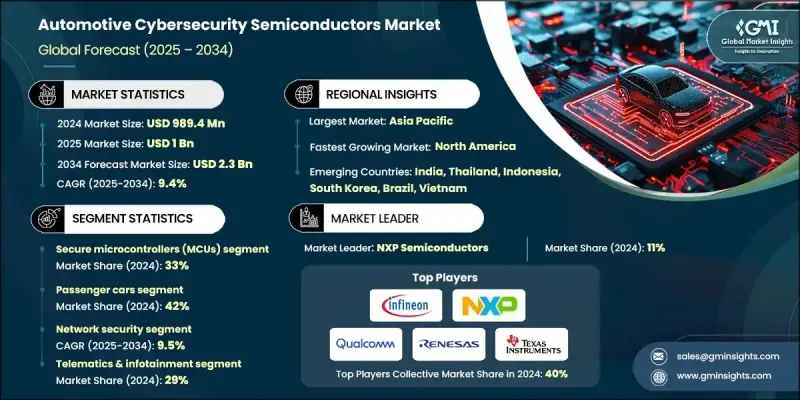
세계의 자동차 사이버 보안 반도체 시장은 2024년 9억 8,940만 달러로 평가되었으며 CAGR 9.4%로 성장해 2034년까지 23억 달러에 이를 것으로 예측됩니다.
시장 범위
| 시장 범위 | |
|---|---|
| 시작 연도 | 2024년 |
| 예측 기간 | 2025-2034년 |
| 시작 금액 | 9억 8,940만 달러 |
| 예측 금액 | 23억 달러 |
| CAGR | 9.4% |
자동차가 소프트웨어 주도형이고 커넥티드화됨에 따라 보안 기능을 내장한 반도체 수요가 높아지고 있습니다. 자동차 제조업체가 전기화 및 소프트웨어 정의 아키텍처로 전환하는 동안 이러한 칩은 자동차 시스템을 사이버 위협으로부터 보호하는 데 필수적입니다. ADAS의 확산과 자율 이동으로의 전환은 보안 하드웨어 구성 요소의 통합을 가속화하고 있습니다. 자동차 제조업체는 안전한 통신, 무선 업데이트, 실시간 침입 감지를 보장하기 위해 보안 네트워크 요소, 암호화 가능 프로세서 및 신뢰할 수 있는 플랫폼을 통합합니다. 이러한 강화는 진화하는 규제 프레임워크를 따르며, 국제 사이버 보안 표준을 준수하는 데 도움이 되는 동시에 차량 데이터 보호 및 시스템 무결성을 강화합니다.
하이브리드 자동차 및 전기자동차의 보급에 따라 안전성을 중시한 반도체에 대한 수요가 높아지고 있습니다. 이들은 안전한 배터리 모니터링, 충전 및 추진 제어 시스템을 지원합니다. 차세대 차량은 인포테인먼트, 진단 및 원격 소프트웨어 관리 기능을 통해 완벽한 보안을 제공하는 고도로 확장 가능하고 지능적인 집적 회로를 요구합니다. 반도체 제조업체는 AI를 활용한 사이버 위협 감지 기술에 대한 투자를 추진하고 자동차 등급의 신뢰성 요구 사항을 충족하기 위해 반도체 제품의 내열성과 견고성을 향상시키기 위해 노력하고 있습니다. 각 벤더는 승용차와 상용차 응용 분야에 대응하는 제품 라인을 확충하는 동시에 모듈성, 에너지 최적화, 컴플라이언스 대응에 주력하여 업계 전체의 가치 향상을 추진하고 있습니다.
보안 마이크로컨트롤러(MCU) 부문은 2024년 33%의 점유율을 차지했으며, 2025년부터 2034년까지 연평균 복합 성장률(CAGR) 9.5%를 보일 것으로 예측됩니다. 이 MCU는 보안 부팅, 인증 및 암호화 기능을 통합하여 통신 인터페이스, 제어 장치 및 자동차 전자 장치에 대한 필수 하드웨어 기반 보호를 제공합니다. 커넥티드카, 전동화, 자율주행 플랫폼의 상승과 함께, 보안 MCU 수요는 급속히 확대되고 있습니다. 자동차 사이버 보안에 대한 규제 요건으로 OEM 제조업체와 공급업체는 변조 방지 및 암호화 기능을 갖춘 구성 요소를 채택하고 있으며, 보안 MCU는 현대 차량 아키텍처의 기반이 되었습니다.
승용차 부문은 2024년 42%의 점유율을 차지했으며, 2034년까지 연평균 복합 성장률(CAGR) 9.8%를 보일 것으로 예측됩니다. 커넥티드카 및 소프트웨어 정의 차량으로의 전환이 진행되고 있는 가운데, 자동차 제조업체는 인포테인먼트, ADAS, V2X 통신 등 폭넓은 영역에서 고도의 반도체 기반의 보호 시스템을 도입하고 있습니다. 보안 부팅 기능, 하드웨어 기반 암호화 및 임베디드 침입 감지 시스템이 전자 제어 장치에 통합되어 차량 네트워크를 보호합니다. 개인 차량이 보다 진보된 디지털 플랫폼을 채택함에 따라 차량 탑재 사이버 보안의 필요성은 계속 증가하고 있습니다.
아시아태평양의 자동차 사이버 보안 반도체 시장은 2024년 42%의 점유율을 차지했으며 중국에서는 1억 7,610만 달러의 규모가 되었습니다. 강력한 디지털화 동향, ADAS 기능의 급속한 도입, EV 생산 증가가 지역의 성장을 이끌고 있습니다. 아시아태평양에서는 높은 R&D 비용, 현지 반도체 제조, 자동차 제조업체와 사이버 보안 기술 제공업체 간의 견고한 협력을 통해 현저한 진전을 볼 수 있습니다. 특히 중국은 지원적인 정책 틀과 커넥티드 및 자율 주행 모빌리티 에코시스템 전체에서의 보안 통신 모듈의 채용 확대에 힘입어 견조한 성장을 이루고 있습니다.
자동차 사이버 보안 반도체 시장의 주요 기업으로는 Samsung Electronics, Microchip Technology, NXP Semiconductors, Infineon Technologies, Texas Instruments, STMicroelectronics, Renesas Electronics, Continental, Qualcomm Technologies, ON Semiconductor 등이 있습니다. 자동차 사이버 보안 반도체 분야에서 사업을 전개하는 기업은 보안 부팅 메커니즘, 실시간 침입 감지, 암호화 모듈 등 하드웨어 기반 보안 기능의 혁신을 우선하고 있습니다. AI 기반의 위협 감지 엔진에 대한 전략적 투자로 칩 아키텍처의 내결함성이 향상되었습니다. 주요 기업은 세계 사이버 보안 컴플라이언스 기준에 포트폴리오를 정합시키고 승용차와 상용차 모두를 위한 확장 가능한 플랫폼을 개발하고 있습니다.
자주 묻는 질문
목차
제1장 조사 방법
- 시장 범위와 정의
- 조사 설계
- 조사 접근
- 데이터 수집 방법
- 데이터 마이닝 소스
- 세계
- 지역별/국가별
- 기본 추정치와 계산
- 기준연도 계산
- 시장 추정에서의 주요 동향
- 1차 조사와 검증
- 1차 정보
- 예측 모델
- 조사의 전제조건과 제한 사항
제2장 주요 요약
제3장 업계 인사이트
- 생태계 분석
- 공급자의 상황
- 이익률 분석
- 비용 구조
- 각 단계에서의 부가가치
- 밸류체인에 영향을 주는 요인
- 혁신
- 업계에 미치는 영향요인
- 성장 촉진요인
- 차량 접속성 및 디지털화 진전
- 자율주행 기술 및 ADAS 기술의 확대
- 소프트웨어 정의 및 중앙 집중식 차량 아키텍처 도입
- 전기자동차 및 커넥티드카(EV 및 HEV) 성장
- 사이버 위협의 빈도 증가 및 고도화
- 업계의 잠재적 위험 및 과제
- 여러 ECU 및 도메인에 걸친 사이버 보안 통합의 고급 복잡성
- 진화하고 단편화하는 세계 사이버 보안 규제
- 시장 기회
- 커넥티드카 및 자율주행 차량 플랫폼과의 통합
- 전기차 및 하이브리드차(EV 및 HEV)의 보급 확대
- AI 구동형 및 양자 내성 보안 기술의 진전
- 보안 무선 업데이트(OTA) 및 클라우드 연결성에 대한 수요 증가
- 성장 가능성 분석
- 규제 상황
- Porter's Five Forces 분석
- PESTEL 분석
- 기술과 혁신의 상황
- 현재의 기술 동향
- 신흥기술
- 가격 분석과 비용 구조의 동향
- 과거 가격 동향 분석(2021-2024년)
- 구성요소별 비용 내역
- 제조 비용 구조 분석
- R&D 투자가 가격 설정에 미치는 영향
- 볼륨 기반 가격 설정 전략
- 지역별 가격 변동과 영향요인
- 특허 분석
- 지속가능성과 환경면
- 지속가능한 실천
- 폐기물 감축 전략
- 생산에 있어서의 에너지 효율화
- 환경에 배려한 대처
- 탄소발자국에 관한 고려 사항
- 거시 경제적 동향의 영향 분석
- 세계 반도체 부족의 영향(2021-2024년)
- 인플레이션 및 원재료 비용의 압력
- 지정학적 무역 마찰과 공급 체인의 혼란
- 환율 변동이 세계 가격 설정에 미치는 영향
- 경기후퇴가 자동차 수요에 미치는 영향
- 금리 변동과 자본 투자의 의사 결정
- 마이크로 경제 동향과 업계 고유의 요인
- 자동차 생산량의 변동
- OEM별 기술 도입률의 차이
- 경쟁적인 가격 설정 압력 분석
- 고객의 협상력과 조달 전략
- 공급업체 집중과 시장 역학
- 제품 라이프 사이클 및 기술 갱신 사이클
- 위협의 정세와 업계의 대응 분석
- 신흥 사이버 보안 위협 벡터
- 국가 주체의 위협 및 고도 지속적 위협
- 공급망 공격 취약성
- 제로데이 공격의 리스크와 경감책
- 양자 컴퓨팅 위협의 타임라인
- 업계 제휴에 의한 방어 이니셔티브
- 기업의 전략적 대응과 적응 전략
- 수직 통합과 파트너십 전략의 비교
- 지리적 다양화와 니어쇼어링의 동향
- 기술 포트폴리오 확대 전략
- 규제 준수 투자 전략
- 인재 획득 및 정착의 과제
- 고객 관계 및 고객 봉쇄 전략
제4장 경쟁 구도
- 소개
- 기업의 시장 점유율 분석
- 북미
- 유럽
- 아시아태평양
- 라틴아메리카
- 중동 및 아프리카
- 주요 시장 기업의 경쟁 분석
- 경쟁 포지셔닝 매트릭스
- 전략적 전망 매트릭스
- 주요 발전
- 인수합병
- 제휴 및 협력관계
- 신제품 발매
- 확대계획과 자금조달
제5장 시장 추계 및 예측 : 컴포넌트별, 2021-2034년
- 주요 동향
- 하드웨어 보안 모듈(HSM)
- 보안 마이크로컨트롤러(MCU)
- 신뢰할 수 있는 플랫폼 모듈(TPM)
- 암호화 프로세서 및 코프로세서
- 네트워크 보안 칩
- 신뢰할 수 있는 실행 환경(TEE)
제6장 시장 추계 및 예측 : 차종별, 2021-2034년
- 주요 동향
- 승용차
- 해치백 자동차
- 세단
- SUV
- 상용차
- 소형 상용차
- 중형 상용차
- 대형 상용차
- 전기자동차
- 자율주행차
제7장 시장 추계 및 예측 : 증권별, 2021-2034년
- 주요 동향
- 네트워크 보안
- 용도 보안
- 클라우드 보안
- 엔드포인트 보안
제8장 시장 추계 및 예측 : 용도별, 2021-2034년
- 주요 동향
- 텔레매틱스 및 인포테인먼트
- ADAS 및 자율주행 시스템
- 파워트레인 및 EV 시스템
- Vehicle-to-Everything(V2X)
- 게이트웨이 및 존 컨트롤러
- 무선 갱신(OTA)
제9장 시장 추계 및 예측 : 지역별, 2021-2034년
- 주요 동향
- 북미
- 미국
- 캐나다
- 유럽
- 독일
- 영국
- 프랑스
- 이탈리아
- 스페인
- 러시아
- 북유럽 국가
- 포르투갈
- 크로아티아
- 아시아태평양
- 중국
- 인도
- 일본
- 호주
- 한국
- 싱가포르
- 태국
- 인도네시아
- 베트남
- 라틴아메리카
- 브라질
- 멕시코
- 아르헨티나
- 중동 및 아프리카
- 남아프리카
- 사우디아라비아
- 아랍에미리트(UAE)
- 튀르키예
제10장 기업 프로파일
- 수탁 제조업체
- GlobalFoundries
- Samsung Electronics
- Taiwan Semiconductor Manufacturing Company(TSMC)
- United Microelectronics
- 통합 기기 제조업체
- Analog Devices
- Continental
- Infineon Technologies
- Microchip Technology
- NXP Semiconductors
- ON Semiconductor
- Renesas Electronics
- STMicroelectronics
- Texas Instruments
- 팹리스 반도체 회사
- Broadcom
- Marvell Technology
- Qualcomm Technologies
- IP 프로바이더
- ARM Holdings
- Cadence Design Systems
- Imagination Technologies
- Synopsys
The Global Automotive Cybersecurity Semiconductors Market was valued at USD 989.4 million in 2024 and is estimated to grow at a CAGR of 9.4% to reach USD 2.3 Billion by
2034.
| Market Scope | |
|---|---|
| Start Year | 2024 |
| Forecast Year | 2025-2034 |
| Start Value | $989.4 Million |
| Forecast Value | $2.3 Billion |
| CAGR | 9.4% |
As vehicles become increasingly software-driven and connected, the demand for semiconductors with built-in security features is rising. These chips are essential for protecting automotive systems against cyber threats as automakers transition to electrified and software-defined architectures. The growing presence of advanced driver assistance systems and the shift toward autonomous mobility are accelerating the integration of secure hardware components. Automakers are embedding secure network elements, encryption-enabled processors, and trusted platforms to ensure secure communications, over-the-air updates, and real-time intrusion detection. These enhancements align with evolving regulatory frameworks, supporting compliance with international cybersecurity standards while strengthening vehicle data protection and system integrity.
With the rise in hybrid and electric mobility, there is a growing demand for safety-focused semiconductors that support secure battery monitoring, charging, and propulsion control systems. Next-generation vehicles require highly scalable and intelligent integrated circuits that offer seamless security across infotainment, diagnostics, and remote software management functions. Chipmakers are investing in AI-enabled cyber threat detection and improving the thermal endurance and ruggedness of semiconductor products to meet automotive-grade reliability. Vendors are expanding portfolios to address both passenger and commercial vehicle applications while also focusing on modularity, energy optimization, and compliance to drive value across the industry.
The secure microcontrollers (MCUs) segment held a 33% share in 2024 and is expected to grow at a 9.5% CAGR between 2025 and 2034. These MCUs provide essential hardware-based protections for communication interfaces, control units, and vehicle electronics by integrating secure boot, authentication, and encryption capabilities. With the rise in connected, electrified, and automated vehicle platforms, demand for secure MCUs is scaling rapidly. Regulatory mandates around automotive cybersecurity are compelling OEMs and suppliers to adopt tamper-resistant and cryptography-enabled components, making secure MCUs foundational to modern vehicle architectures.
The passenger cars segment held a 42% share in 2024 and is forecasted to grow at a CAGR of 9.8% through 2034. The growing shift toward connected and software-defined vehicles is prompting automakers to deploy advanced semiconductor-based protection systems across infotainment, ADAS, and vehicle-to-everything communications. Secure boot functions, hardware-based encryption, and embedded intrusion detection systems are being integrated into electronic control units to safeguard vehicle networks. As personal vehicles adopt more sophisticated digital platforms, the need for onboard cybersecurity continues to increase.
Asia Pacific Automotive Cybersecurity Semiconductors Market held a 42% share in 2024, with China generating USD 176.1 million. Strong digitalization trends, rapid deployment of ADAS features, and increasing EV production are propelling regional growth. Asia Pacific is witnessing significant advancements due to high R&D spending, localized semiconductor manufacturing, and stronger alliances between OEMs and cybersecurity technology providers. China's growth is particularly robust, backed by supportive policy frameworks and increasing adoption of secure communication modules across connected and autonomous mobility ecosystems.
Major companies in the Automotive Cybersecurity Semiconductors Market include Samsung Electronics, Microchip Technology, NXP Semiconductors, Infineon Technologies, Texas Instruments, STMicroelectronics, Renesas Electronics, Continental, Qualcomm Technologies, and ON Semiconductor. Companies operating in the automotive cybersecurity semiconductors sector are prioritizing innovation in hardware-based security features such as secure boot mechanisms, real-time intrusion detection, and cryptographic modules. Strategic investments in AI-driven threat detection engines are enhancing the resilience of chip architectures. Leading firms are aligning their portfolios with global cybersecurity compliance standards and developing scalable platforms for both passenger and commercial vehicles.
Table of Contents
Chapter 1 Methodology
- 1.1 Market scope and definition
- 1.2 Research design
- 1.2.1 Research approach
- 1.2.2 Data collection methods
- 1.3 Data mining sources
- 1.3.1 Global
- 1.3.2 Regional/Country
- 1.4 Base estimates and calculations
- 1.4.1 Base year calculation
- 1.4.2 Key trends for market estimation
- 1.5 Primary research and validation
- 1.5.1 Primary sources
- 1.6 Forecast model
- 1.7 Research assumptions and limitations
Chapter 2 Executive Summary
- 2.1 Industry 3600 synopsis, 2021 - 2034
- 2.2 Key market trends
- 2.2.1 Regional
- 2.2.2 Component
- 2.2.3 Vehicles
- 2.2.4 Security
- 2.2.5 Application
- 2.3 TAM Analysis, 2025-2034
- 2.4 CXO perspectives: Strategic imperatives
- 2.4.1 Executive decision points
- 2.4.2 Critical success factors
- 2.5 Future outlook and strategic recommendations
Chapter 3 Industry Insights
- 3.1 Industry ecosystem analysis
- 3.1.1 Supplier landscape
- 3.1.2 Profit margin analysis
- 3.1.3 Cost structure
- 3.1.4 Value addition at each stage
- 3.1.5 Factor affecting the value chain
- 3.1.6 Disruptions
- 3.2 Industry impact forces
- 3.2.1.1 Growth drivers
- 3.2.1.2 Rising connectivity and digitalization of vehicles
- 3.2.1.3 Expansion of autonomous and ADAS technologies
- 3.2.1.4 Adoption of software-defined and centralized vehicle architecture
- 3.2.1.5 Growth in electric and connected vehicles (EVs and HEVs)
- 3.2.1.6 Increasing frequency and sophistication of cyber threats
- 3.2.2 Industry pitfalls and challenges
- 3.2.2.1 High complexity of cybersecurity integration across multiple ECUs and domains
- 3.2.2.2 Evolving and fragmented global cybersecurity regulations
- 3.2.3 Market opportunities
- 3.2.3.1 Integration with connected and autonomous vehicle platforms
- 3.2.3.2 Growing adoption of electric and hybrid vehicles (EVs & HEVs)
- 3.2.3.3 Advancements in AI-driven and quantum-resistant security technologies
- 3.2.3.4 Rising demand for secure over-the-air (OTA) updates and cloud connectivity
- 3.3 Growth potential analysis
- 3.4 Regulatory landscape
- 3.5 Porter's analysis
- 3.6 PESTEL analysis
- 3.7 Technology and innovation landscape
- 3.7.1 Current technological trends
- 3.7.2 Emerging technologies
- 3.8 Pricing analysis & cost structure dynamics
- 3.8.1 Historical price trend analysis (2021-2024)
- 3.8.2 Cost breakdown by component
- 3.8.3 Manufacturing cost structure analysis
- 3.8.4 R&D investment impact on pricing
- 3.8.5 Volume-based pricing strategies
- 3.9 Regional Price Variations & Influencing Factors
- 3.10 Patent analysis
- 3.11 Sustainability and environmental aspects
- 3.11.1 Sustainable practices
- 3.11.2 Waste reduction strategies
- 3.11.3 Energy efficiency in production
- 3.11.4 Eco-friendly Initiatives
- 3.11.5 Carbon footprint considerations
- 3.12 Macro-economic dynamics impact analysis
- 3.12.1 Global semiconductor shortage impact (2021-2024)
- 3.12.2 Inflation & raw material cost pressures
- 3.12.3 Geopolitical trade tensions & supply chain disruptions
- 3.12.4 Currency fluctuation impact on global pricing
- 3.12.5 Economic recession impact on automotive demand
- 3.12.6 Interest rate changes & capital investment decisions
- 3.13 Micro-economic dynamics & industry-specific factors
- 3.13.1 Automotive production volume fluctuations
- 3.13.2 Technology adoption rate variations by OEM
- 3.13.3 Competitive pricing pressure analysis
- 3.13.4 Customer bargaining power & procurement strategies
- 3.13.5 Supplier concentration & market power dynamics
- 3.13.6 Product lifecycle & technology refresh cycles
- 3.14 Threat landscape & industry response analysis
- 3.14.1 Emerging cybersecurity threat vectors
- 3.14.2 Nation-state & advanced persistent threats
- 3.14.3 Supply chain attack vulnerabilities
- 3.14.4 Zero-day exploit risks & mitigation strategies
- 3.14.5 Quantum computing threat timeline
- 3.14.6 Industry collaborative defense initiatives
- 3.15 Company strategic response & adaptation strategies
- 3.15.1 Vertical integration vs partnership strategies
- 3.15.2 Geographic diversification & nearshoring trends
- 3.15.3 Technology portfolio expansion strategies
- 3.15.4 Regulatory compliance investment strategies
- 3.15.5 Talent acquisition & retention challenges
- 3.15.6 Customer relationship & lock-in strategies
Chapter 4 Competitive Landscape, 2024
- 4.1 Introduction
- 4.2 Company market share analysis
- 4.2.1 North America
- 4.2.2 Europe
- 4.2.3 Asia Pacific
- 4.2.4 LATAM
- 4.2.5 MEA
- 4.3 Competitive analysis of major market players
- 4.4 Competitive positioning matrix
- 4.5 Strategic outlook matrix
- 4.6 Key developments
- 4.6.1 Mergers & acquisitions
- 4.6.2 Partnerships & collaborations
- 4.6.3 New Product Launches
- 4.6.4 Expansion Plans and funding
Chapter 5 Market Estimates & Forecast, By Component, 2021 - 2034 (USD Mn, Units)
- 5.1 Key trends
- 5.2 Hardware security modules (HSMs)
- 5.3 Secure microcontrollers (MCUs)
- 5.4 Trusted platform modules (TPMs)
- 5.5 Crypto processors / co-processors
- 5.6 Network security chips
- 5.7 Trusted execution environments (TEE)
Chapter 6 Market Estimates & Forecast, By Vehicles, 2021 - 2034 (USD Mn, Units)
- 6.1 Key trends
- 6.2 Passenger cars
- 6.2.1 Hatchbacks
- 6.2.2 Sedans
- 6.2.3 SUVs
- 6.3 Commercial vehicles
- 6.3.1 Light commercial vehicles
- 6.3.2 Medium commercial vehicles
- 6.3.3 Heavy commercial vehicles
- 6.4 Electric vehicles
- 6.5 Autonomous vehicles
Chapter 7 Market Estimates & Forecast, By Security, 2021 - 2034 (USD Mn, Units)
- 7.1 Key trends
- 7.2 Network security
- 7.3 Application security
- 7.4 Cloud security
- 7.5 Endpoint security
Chapter 8 Market Estimates & Forecast, By Application, 2021 - 2034 (USD Mn, Units)
- 8.1 Key trends
- 8.2 Telematics & infotainment
- 8.3 ADAS & autonomous systems
- 8.4 Powertrain & EV systems
- 8.5 Vehicle-to-everything (V2X)
- 8.6 Gateway & zonal controllers
- 8.7 Over-the-Air (OTA) updates
Chapter 9 Market Estimates & Forecast, By Region, 2021 - 2034 (USD Mn, Units)
- 9.1 Key trends
- 9.2 North America
- 9.2.1 US
- 9.2.2 Canada
- 9.3 Europe
- 9.3.1 Germany
- 9.3.2 UK
- 9.3.3 France
- 9.3.4 Italy
- 9.3.5 Spain
- 9.3.6 Russia
- 9.3.7 Nordics
- 9.3.8 Portugal
- 9.3.9 Croatia
- 9.4 Asia Pacific
- 9.4.1 China
- 9.4.2 India
- 9.4.3 Japan
- 9.4.4 Australia
- 9.4.5 South Korea
- 9.4.6 Singapore
- 9.4.7 Thailand
- 9.4.8 Indonesia
- 9.4.9 Vietnam
- 9.5 Latin America
- 9.5.1 Brazil
- 9.5.2 Mexico
- 9.5.3 Argentina
- 9.6 MEA
- 9.6.1 South Africa
- 9.6.2 Saudi Arabia
- 9.6.3 UAE
- 9.6.4 Turkey
Chapter 10 Company Profiles
- 10.1 Contract Manufacturers
- 10.1.1 GlobalFoundries
- 10.1.2 Samsung Electronics
- 10.1.3 Taiwan Semiconductor Manufacturing Company (TSMC)
- 10.1.4 United Microelectronics
- 10.2 Integrated Device Manufacturers
- 10.2.1 Analog Devices
- 10.2.2 Continental
- 10.2.3 Infineon Technologies
- 10.2.4 Microchip Technology
- 10.2.5 NXP Semiconductors
- 10.2.6 ON Semiconductor
- 10.2.7 Renesas Electronics
- 10.2.8 STMicroelectronics
- 10.2.9 Texas Instruments
- 10.3 Fabless Semiconductor Companies
- 10.3.1 Broadcom
- 10.3.2 Marvell Technology
- 10.3.3 Qualcomm Technologies
- 10.4 IP Providers
- 10.4.1 ARM Holdings
- 10.4.2 Cadence Design Systems
- 10.4.3 Imagination Technologies
- 10.4.4 Synopsys