|
시장보고서
상품코드
1871308
포스트 바이오틱스 보충제 시장 : 기회, 성장 요인, 업계 동향 분석, 예측(2025-2034년)Postbiotic Supplements Market Opportunity, Growth Drivers, Industry Trend Analysis, and Forecast 2025 - 2034 |
||||||

세계 포스트 바이오틱스 보충제 시장은 2024년에 17억 달러로 평가되었으며, 2034년까지 연평균 복합 성장률(CAGR) 21%로 성장하여 129억 달러에 이를 것으로 예측됩니다.

포스트바이오틱스란 국제프로바이오틱스 프리바이오틱스 과학협회(ISAPP)에 의한 공식 정의에서 생존능력이 부족함에도 불구하고 생물활성을 유지함으로써 숙주에게 건강효과를 가져오는 비생존 미생물 및/또는 그 성분의 제제를 말합니다. 과학적 증거가 축적됨에 따라, 건강한 개인으로부터 취약한 그룹에 이르기까지 소화기계, 면역계, 대사계의 건강에 대한 그 유익한 효과가 뒷받침되고 있습니다. 임상 검증도 진행되고 있으며, 변질 개선, 장관 장벽 기능 강화, 호흡기 건강 증진을 나타내는 연구 결과가 보고되었습니다. 이러한 실증의 축적이 시장의 신뢰감을 높여 기존의 캡슐이나 분말 제품에 더해 기능성 음료, 바, 즉식 제품 등에의 전개를 촉진하고 있습니다. 포스트 바이오틱스의 열 안정성을 활용하여 일상적인 영양 섭취로의 통합이 진행되고 있습니다. 그 안전성과 안정성으로부터 유아, 면역 결핍 환자, 노인에 대한 적응이 특히 기대되고 있으며, 임상시험에서는 장내 환경의 건강 유지와 염증 억제를 지원하는 단쇄 지방산 등의 대사산물을 통해 소아의 성장과 건강한 노화에 대한 효과가 뒷받침되고 있습니다.
| 시장 범위 | |
|---|---|
| 시작 연도 | 2024년 |
| 예측 연도 | 2025-2034년 |
| 시작 금액 | 17억 달러 |
| 예측 금액 | 129억 달러 |
| CAGR | 21% |
복합 비생존 미생물 제제(CX)는 2024년에 27.6%의 점유율을 차지하고 2034년까지 연평균 복합 성장률(CAGR) 20.5%를 보일 것으로 예측됩니다. 이러한 완전 불활성화 제제는 세포 구조와 대사산물을 보유하고 있기 때문에 살아있는 프로바이오틱스에 일반적으로 귀속되는 건강 효과를 충족시키거나 이를 초과할 수도 있습니다. 제조업체는 제어된 발효 공정과 캡슐과 식품 제제에 사용되는 생물활성 성분을 보존하는 열에 의한 검증된 불활성화 방법을 채택함으로써 이를 실현하고 있습니다.
영양 보충제 부문은 49.8%의 점유율을 차지했고 2034년까지 연평균 복합 성장률(CAGR) 20.8%를 보일 것으로 예측됩니다. 포스트 바이오틱의 생물학적 활성 화합물은 안정성, 안전성 및 적응성이 우수하므로 영양 보조 식품, 기능성 식품 및 음료에 사용하기에 이상적입니다. 식품 제조업체는 클린 라벨 제품과 마이크로바이옴 지원 제품을 요구하는 소비자 요구에 부응하여 간식, 음료 및 대체 유제품에 대한 포스트 바이오틱스 배합을 확대하고 있습니다. 보충제는 캡슐, 분말, 구미 등 사용하기 쉬운 형태로 제공되며 면역 건강과 대사 기능을 지원합니다. 다양한 가공 조건 하에서 포스트 바이오틱스의 내성은 혁신과 상업 보급의 길을 열고 있습니다.
북미 포스트 바이오틱스 보충제 시장은 2024년 41%의 점유율을 차지했습니다. 이 주도적 지위는 의료 종사자에 의한 높은 수용성, 소비자의 의식 향상, 미국/캐나다 전역에서의 광범위한 소매 유통망에 의해 지지되고 있습니다. 미국 시장은 영양 보충제의 표시와 건강 강조 표시에 대한 명확한 규제 가이드라인에 의해 지원되며, 기능성 음료와 바를 통해 성장을 이끌고 있습니다. 캐나다에서는 클린 라벨 제품에 대한 선호와 면역·소화기의 건강에 대한 관심 증가가 냉장 불필요하고 투여가 간편한 안정된 비생존형 제품 수요를 지지하고 있습니다. 의료 종사자 채널의 프리미엄화 진행과 주류 제품 전개의 확대가 함께 예측 기간 동안 시장 성장을 가속할 것으로 전망됩니다.
세계 포스트 바이오틱스 보충제 시장의 주요 기업으로는 Immuse Health (Kirin Holdings/Kyowa Hakko Bio), Biofarma Group, Culturelle (i-Health, Inc.), DSM-Firmenich, Kerry Group Plc, Metagenics, Probi AB, Ritua, SCD Probiotics, Archer Daniels Midland (ADM), Cargill, Incorporated, Chr.Hansen A/S (now Novonesis), VSL Pharmaceuticals, and Labcorp 등을 들 수 있습니다. 포스트 바이오틱스 보충제 시장의 기업은 시장에서의 존재감을 강화하고 지속적인 성장을 도모하기 위해 적극적으로 전략을 채택하고 있습니다. 여기에는 안전, 효능 및 새로운 건강 효과를 강조하는 임상적으로 검증된 제형을 개발하기 위한 R&D(R&D)에 대한 많은 투자가 포함됩니다. 학술기관이나 임상연구기관과의 연계는 제품의 검증과 규제 당국의 승인을 가속화하는데 도움이 됩니다. 각 회사는 변화하는 소비자의 라이프 스타일과 선호도에 부응하는 음료, 바, 즉식 상품 등의 혁신적인 형태를 출시하여 제품 포트폴리오 확대에 주력하고 있습니다. 소매업체 및 의료 제공업체와의 전략적 제휴는 유통 범위의 확대와 소비자의 신뢰 향상에 기여하고 있습니다.
자주 묻는 질문
목차
제1장 조사 방법과 범위
제2장 주요 요약
제3장 업계 인사이트
- 생태계 분석
- 공급자의 상황
- 이익률
- 각 단계에서의 부가가치
- 밸류체인에 영향을 주는 요인
- 혁신
- 업계에 미치는 영향요인
- 성장 촉진요인
- 장뇌축의 건강효과에 대한 소비자의 의식의 고조
- 프로바이오틱스에 대한 우수한 안정성과 유통기한 이점
- ISAPP 합의 정의에 기초한 규제의 명확화
- 업계의 잠재적 위험 및 과제
- 제품 특성 평가를 위한 제한된 표준화된 분석 방법
- 균주 특이적인 임상 검증에 있어서의 높은 연구 개발 비용
- 시장 기회
- 미개척 소아 및 노인 인구 부문
- 기능성 식품 및 음료 분야에의 전개
- 성장 촉진요인
- 성장 가능성 분석
- 규제 상황
- 북미
- 유럽
- 아시아태평양
- 라틴아메리카
- 중동 및 아프리카
- Porter's Five Forces 분석
- PESTEL 분석
- 가격 동향
- 지역별
- 제품 유형별
- 장래 시장 동향
- 기술과 혁신 동향
- 현재의 기술 동향
- 신규기술
- 특허 상황
- 무역 통계(HS 코드 참고 : 무역 통계는 주요 국가에서만 제공됨)
- 주요 수입국
- 주요 수출국
- 지속가능성과 환경면
- 지속가능한 대처
- 폐기물 감축 전략
- 생산에 있어서의 에너지 효율
- 환경에 배려한 대처
- 탄소 발자국 고려
제4장 경쟁 구도
- 소개
- 기업의 시장 점유율 분석
- 지역별
- 북미
- 유럽
- 아시아태평양
- 라틴아메리카
- 중동 및 아프리카
- 지역별
- 기업 매트릭스 분석
- 주요 시장 기업의 경쟁 분석
- 경쟁 포지셔닝 매트릭스
- 주요 발전
- 인수합병
- 제휴 및 협력관계
- 신제품 발매
- 사업 확대 계획
제5장 시장 추정 및 예측 : 제품 유형별, 2021-2034
- 주요 동향
- 복합 비생존 미생물 제제(CX)
- 미생물 대사산물(MM)
- 완전 비생존 미생물 세포(IC)
- 단편화 미생물 세포(FC)
- 특수 제제
제6장 시장추정 및 예측 : 용도별, 2021-2034
- 주요 동향
- 소화기 건강 지원
- 면역 시스템 지원
- 대사 건강 지원
- 정신 건강 및 인지 기능 지원
- 피부 건강 및 안티 에이징
제7장 시장 추정 및 예측 : 최종 용도별, 2021-2034
- 주요 동향
- 영양보조식품업계
- 기능성 식음료
- 임상영양
- 화장품 및 퍼스널케어
- 동물 영양·사료
제8장 시장추정 및 예측 : 지역별, 2021-2034
- 주요 동향
- 북미
- 미국
- 캐나다
- 유럽
- 독일
- 영국
- 프랑스
- 스페인
- 이탈리아
- 기타 유럽
- 아시아태평양
- 중국
- 인도
- 일본
- 호주
- 한국
- 기타 아시아태평양
- 라틴아메리카
- 브라질
- 멕시코
- 아르헨티나
- 기타 라틴아메리카
- 중동 및 아프리카
- 사우디아라비아
- 남아프리카
- 아랍에미리트(UAE)
- 기타 중동 및 아프리카
제9장 기업 프로파일
- DSM-Firmenich
- Cargill, Incorporated
- Archer Daniels Midland(ADM)
- Kerry Group Plc
- Chr. Hansen A/S(now Novonesis)
- Immuse Health(Kirin Holdings/Kyowa Hakko Bio)
- SCD Probiotics
- Biofarma Group
- Probi AB
- Culturelle(i-Health, Inc.)
- VSL Pharmaceuticals
- Ritual
- Metagenics
The Global Postbiotic Supplements Market was valued at USD 1.7 billion in 2024 and is estimated to grow at a CAGR of 21% to reach USD 12.9 billion by 2034.
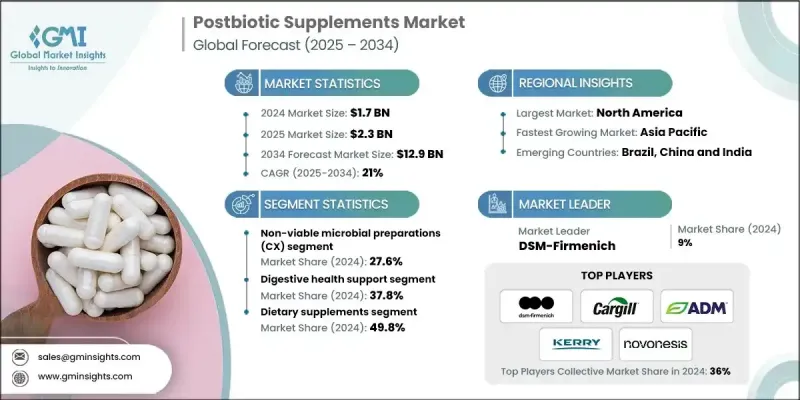
Postbiotics, as officially defined by the International Scientific Association for Probiotics and Prebiotics (ISAPP) are preparations of non-living microorganisms and/or their components that provide health benefits to the host by preserving bioactivity despite the absence of viability. Mounting scientific evidence supports their positive effects on digestive, immune, and metabolic health across both healthy individuals and vulnerable groups. Clinical validation is gaining momentum, with studies showing improvements in stool quality, gut barrier function, and respiratory health. This growing body of proof is driving market confidence and broadening product offerings beyond traditional capsules and powders to include functional beverages, bars, and ready-to-eat products, leveraging the heat stability of postbiotics for daily nutrition integration. Their safety and stability make them especially suitable for infants, immunocompromised patients, and older adults, with clinical trials reinforcing their benefits for pediatric growth and healthy aging through metabolites like short-chain fatty acids that support gut health and inflammation control.
| Market Scope | |
|---|---|
| Start Year | 2024 |
| Forecast Year | 2025-2034 |
| Start Value | $1.7 Billion |
| Forecast Value | $12.9 Billion |
| CAGR | 21% |
The complex non-viable microbial preparations (CX) held a 27.6% share in 2024 and are expected to grow at a CAGR of 20.5% through 2034. These fully inactivated preparations maintain cellular structures and metabolites, enabling them to meet or even exceed the health benefits typically attributed to live probiotics. Manufacturers achieve this by employing controlled fermentation followed by validated inactivation methods, often thermal, which preserves the bioactive components used in capsule and food formulations.
The dietary supplements segment held a 49.8% share and is forecasted to grow at a CAGR of 20.8% through 2034. Postbiotic bioactive compounds are favored for their stability, safety, and adaptability, making them ideal for use in dietary supplements, functional foods, and beverages. Food producers are increasingly incorporating postbiotics to fortify snacks, drinks, and dairy alternatives, responding to consumer demand for clean-label and microbiome-supportive products. Supplements are offered in user-friendly forms like capsules, powders, and gummies, supporting immune health and metabolic function. The resilience of postbiotics under various processing conditions paves the way for innovation and wider commercial availability.
North America Postbiotic Supplements Market held a 41% share in 2024. This leadership is fueled by strong clinician acceptance, heightened consumer awareness, and extensive retail distribution across the U.S. and Canada. The U.S. market is driving growth through functional beverages and bars, supported by clear regulatory guidelines on labeling and health claims in dietary supplements. In Canada, the preference for clean-label products and growing interest in immune and digestive wellness sustain demand for stable, non-viable formats that do not require refrigeration and offer simple dosing. The ongoing premiumization within healthcare practitioner channels, combined with expanding mainstream product launches, is expected to propel market growth during the forecast period.
Key industry players in the Global Postbiotic Supplements Market include Immuse Health (Kirin Holdings/Kyowa Hakko Bio), Biofarma Group, Culturelle (i-Health, Inc.), DSM-Firmenich, Kerry Group Plc, Metagenics, Probi AB, Ritua, SCD Probiotics, Archer Daniels Midland (ADM), Cargill, Incorporated, Chr. Hansen A/S (now Novonesis), VSL Pharmaceuticals, and Labcorp. Companies in the Postbiotic Supplements Market are actively adopting strategies to strengthen their market presence and sustain growth. These include investing heavily in R&D to develop clinically validated formulations that highlight safety, efficacy, and novel health benefits. Collaborations with academic institutions and clinical research organizations help accelerate product validation and regulatory approval. Firms focus on expanding product portfolios by launching innovative formats such as beverages, bars, and ready-to-eat items that cater to evolving consumer lifestyles and preferences. Strategic partnerships with retailers and healthcare providers enhance distribution reach and consumer trust.
Table of Contents
Chapter 1 Methodology & Scope
- 1.1 Market scope and definition
- 1.2 Research design
- 1.2.1 Research approach
- 1.2.2 Data collection methods
- 1.3 Data mining sources
- 1.3.1 Global
- 1.3.2 Regional/Country
- 1.4 Base estimates and calculations
- 1.4.1 Base year calculation
- 1.4.2 Key trends for market estimation
- 1.5 Primary research and validation
- 1.5.1 Primary sources
- 1.6 Forecast model
- 1.7 Research assumptions and limitations
Chapter 2 Executive Summary
- 2.1 Industry 360° synopsis
- 2.2 Key market trends
- 2.2.1 Regional
- 2.2.2 Product type
- 2.2.3 Application
- 2.2.4 End use
- 2.3 TAM Analysis, 2025-2034
- 2.4 CXO perspectives: Strategic imperatives
- 2.4.1 Executive decision points
- 2.4.2 Critical success factors
- 2.5 Future Outlook and strategic recommendations
Chapter 3 Industry Insights
- 3.1 Industry ecosystem analysis
- 3.1.1 Supplier landscape
- 3.1.2 Profit margin
- 3.1.3 Value addition at each stage
- 3.1.4 Factor affecting the value chain
- 3.1.5 Disruptions
- 3.2 Industry impact forces
- 3.2.1 Growth drivers
- 3.2.1.1 Growing consumer awareness of gut-brain axis health benefits
- 3.2.1.2 Superior stability & shelf-life advantages over probiotics
- 3.2.1.3 Regulatory clarity following ISAPP consensus definition
- 3.2.2 Industry pitfalls and challenges
- 3.2.2.1 Limited standardized analytical methods for product characterization
- 3.2.2.2 High R&D costs for strain-specific clinical validation
- 3.2.3 Market opportunities
- 3.2.3.1 Untapped pediatric & elderly population segments
- 3.2.3.2 Expansion into functional foods & beverage applications
- 3.2.1 Growth drivers
- 3.3 Growth potential analysis
- 3.4 Regulatory landscape
- 3.4.1 North America
- 3.4.2 Europe
- 3.4.3 Asia Pacific
- 3.4.4 Latin America
- 3.4.5 Middle East & Africa
- 3.5 Porter's analysis
- 3.6 PESTEL analysis
- 3.7 Price trends
- 3.7.1 By region
- 3.7.2 By product type
- 3.8 Future market trends
- 3.9 Technology and Innovation landscape
- 3.9.1 Current technological trends
- 3.9.2 Emerging technologies
- 3.10 Patent Landscape
- 3.11 Trade statistics (HS code Note: the trade statistics will be provided for key countries only)
- 3.11.1 Major importing countries
- 3.11.2 Major exporting countries
- 3.12 Sustainability and environmental aspects
- 3.12.1 Sustainable practices
- 3.12.2 Waste reduction strategies
- 3.12.3 Energy efficiency in production
- 3.12.4 Eco-friendly initiatives
- 3.13 Carbon footprint consideration
Chapter 4 Competitive Landscape, 2024
- 4.1 Introduction
- 4.2 Company market share analysis
- 4.2.1 By region
- 4.2.1.1 North America
- 4.2.1.2 Europe
- 4.2.1.3 Asia Pacific
- 4.2.1.4 LATAM
- 4.2.1.5 MEA
- 4.2.1 By region
- 4.3 Company matrix analysis
- 4.4 Competitive analysis of major market players
- 4.5 Competitive positioning matrix
- 4.6 Key developments
- 4.6.1 Mergers & acquisitions
- 4.6.2 Partnerships & collaborations
- 4.6.3 New Product Launches
- 4.6.4 Expansion Plans
Chapter 5 Market Estimates and Forecast, By Product Type, 2021-2034 (USD Million) (Kilo Tons)
- 5.1 Key trends
- 5.2 Complex non-viable microbial preparations (CX)
- 5.3 Microbial metabolic products (MM)
- 5.4 Intact non-viable microbial cells (IC)
- 5.5 Fragmented microbial cells (FC)
- 5.6 Specialized formulations
Chapter 6 Market Estimates and Forecast, By Application, 2021-2034 (USD Million) (Kilo Tons)
- 6.1 Key trends
- 6.2 Digestive health support
- 6.3 Immune system support
- 6.4 Metabolic health support
- 6.5 Mental health & cognitive support
- 6.6 Skin health & anti-aging
Chapter 7 Market Estimates and Forecast, By End Use, 2021-2034 (USD Million) (Kilo Tons)
- 7.1 Key trends
- 7.2 Dietary supplements industry
- 7.3 Functional foods & beverages
- 7.4 Clinical nutrition
- 7.5 Cosmetics & personal care
- 7.6 Animal nutrition & feed
Chapter 8 Market Estimates and Forecast, By Region, 2021-2034 (USD Million) (Kilo Tons)
- 8.1 Key trends
- 8.2 North America
- 8.2.1 U.S.
- 8.2.2 Canada
- 8.3 Europe
- 8.3.1 Germany
- 8.3.2 UK
- 8.3.3 France
- 8.3.4 Spain
- 8.3.5 Italy
- 8.3.6 Rest of Europe
- 8.4 Asia Pacific
- 8.4.1 China
- 8.4.2 India
- 8.4.3 Japan
- 8.4.4 Australia
- 8.4.5 South Korea
- 8.4.6 Rest of Asia Pacific
- 8.5 Latin America
- 8.5.1 Brazil
- 8.5.2 Mexico
- 8.5.3 Argentina
- 8.5.4 Rest of Latin America
- 8.6 Middle East and Africa
- 8.6.1 Saudi Arabia
- 8.6.2 South Africa
- 8.6.3 UAE
- 8.6.4 Rest of Middle East and Africa
Chapter 9 Company Profiles
- 9.1 DSM-Firmenich
- 9.2 Cargill, Incorporated
- 9.3 Archer Daniels Midland (ADM)
- 9.4 Kerry Group Plc
- 9.5 Chr. Hansen A/S (now Novonesis)
- 9.6 Immuse Health (Kirin Holdings/Kyowa Hakko Bio)
- 9.7 SCD Probiotics
- 9.8 Biofarma Group
- 9.9 Probi AB
- 9.10 Culturelle (i-Health, Inc.)
- 9.11 VSL Pharmaceuticals
- 9.12 Ritual
- 9.13 Metagenics