|
시장보고서
상품코드
1876543
대사체학 기반 건강기능식품 시장 : 기회, 성장 촉진요인, 업계 동향 분석, 예측(2025-2034년)Metabolomics-based Nutritional Products Market Opportunity, Growth Drivers, Industry Trend Analysis, and Forecast 2025 - 2034 |
||||||

세계의 대사체학 기반 건강기능식품 시장은 2024년 28억 달러로 평가되었고, 2034년까지 연평균 복합 성장률(CAGR) 23.3%로 성장하고, 272억 달러에 이를 것으로 예측됩니다.
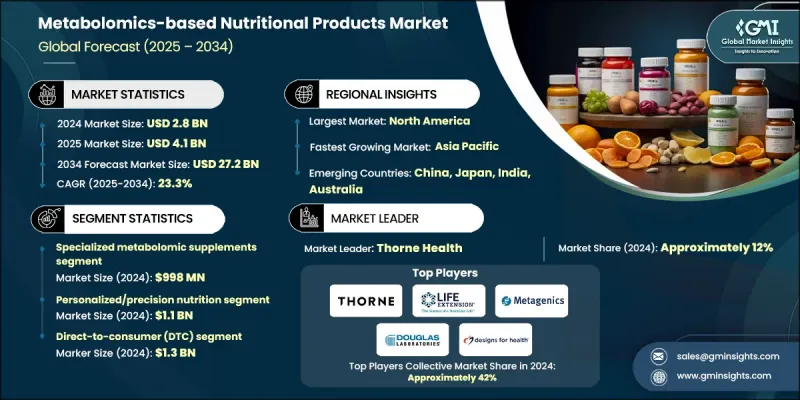
시장 성장의 주요 요인은 정밀 영양 분야에서 비타민과 아미노산 기반 제품의 보급 확대 외에도 전문적인 대사 보충제 및 특정 질병에 대한 제형에 대한 수요 증가입니다. 대사체학 프로파일링 기술의 진보는 보다 맞춤 영양 전략을 가능하게 하고, 임상 조사는 대상을 좁힌 건강 개입의 효능을 지속적으로 입증하고 있습니다. FDA의 규제 지침과 의료, 생명 공학, 웰빙 분야의 개별화 영양 채택 확대가 시장 확대를 더욱 뒷받침하고 있습니다. 차세대 대사체학 제품은 치료 개발에 원활하게 통합되어 확장 가능하고 안전하고 효과적인 생물학적 활성 화합물을 제공합니다. 이러한 혁신은 정밀 영양 분야에서 상업 규모의 기회를 창출하고 전문 보충제, 멀티 바이오 마커 기술, 바이오 마커 주도 처방전의 응용 범위를 확대하는 동시에 특수 영양 및 웰니스 시책에서 대사 기반 기반 접근법의보다 광범위한 수용을 가능하게합니다.
| 시장 범위 | |
|---|---|
| 시작 연도 | 2024년 |
| 예측 연도 | 2025-2034년 |
| 시작 금액 | 28억 달러 |
| 예측 금액 | 272억 달러 |
| CAGR | 23.3% |
전문 대사체학 보충제 부문은 2024년 9억 9,800만 달러로 평가되었고, 2034년까지 연평균 복합 성장률(CAGR) 25.7%로 성장하고 시장의 35%를 차지할 것으로 예측됩니다. 이 부문의 성장은 보충제 디자인의 혁신, 정밀 영양학 응용 분야의 다양성 및 견고한 바이오 마커 검증 프레임 워크에 의해 추진되고 있습니다. 이러한 보충제는 확장 가능한 분자 프로파일링과 생물학적 활성 성분의 최적화를 가능하게 하며, 조사, 파일럿 및 상업 생산 환경 전반에 걸쳐 안정적인 수요를 확립합니다.
개인화 및 정밀 영양분야는 2024년에 11억 달러 시장 규모를 기록했으며 2034년까지 연평균 복합 성장률(CAGR)은 27.1%를 보일 것으로 예측됩니다. 그 성장은 맞춤 영양 프로파일링의 진보, 건강 최적화의 다양성, 검증된 대사 표준에 의해 뒷받침됩니다. 확장 가능한 프로파일링은 개입에 대한 대사 반응을 정확하게 파악할 수 있어 임상, 조사, 상업적 웰빙 환경에서 일관된 수요를 유지합니다.
미국 대사체학 기반 건강기능식품 시장은 2024년 10억 달러로 평가되었으며 80%의 점유율을 차지하고 있습니다. 이러한 이점은 정밀 영양 연구를 촉진하는 정부의 이니셔티브, 첨단 대사산물 분석 인프라, 주요 산업 기업의 존재에 의해 지원됩니다. 이 시장은 FDA의 영양보조식품 지침, 개인화된 영양규제, 신진대사 프로파일링 기술의 혁신에 의해 형성됩니다. 조달 및 공급 기준은 임상시험 프레임워크 및 바이오마커 검증 프로토콜과 일치하며, 개인화된 웰빙과 정밀 영양 분야에서 첨단 대사체학 기반 제품에 대한 수요를 지속하고 있습니다.
세계의 대사체학를 기반으로 한 영양 제품 시장의 주요 기업은 Life Extension, Thorne Health, Metagenics, Designs for Health, Pure Encapsulations, Douglas Laboratories, Jarrow Formulas, Cambridge Isotope Laboratories, Sigma-Aldrich(Merck), NOW FoodsIn, Products, Allergy Research Group, SFI Health(Klaire Labs), Nutricology, Biotics Research, Vital Nutrients, Protocol for Life Balance, Researched Nutritionals, Apex Energetics, Bioclinic Naturals, Quicksilver Scientific, Seeking Health 등이 있습니다. 대사체학를 기반으로 한 영양 제품 시장의 각 회사는 시장에서의 지위를 강화하기 위해 몇 가지 전략을 추진하고 있습니다. 대사체학 프로파일링 능력의 향상, 생물활성 성분의 동정의 최적화 및 멀티바이오마커 배합의 개발을 목적으로 연구개발에 많은 투자를 실시했습니다. 전략적 제휴 및 파트너십을 통해 제품 포트폴리오를 확대하고 신규 시장에 진출할 수 있습니다. 제품의 신뢰성을 높이기 위해 임상적 검증과 규제 준수를 우선적으로 진행하고 있습니다.
자주 묻는 질문
목차
제1장 조사 방법과 범위
제2장 주요 요약
제3장 업계 인사이트
- 업계 생태계 분석
- 공급자의 상황
- 이익률
- 각 단계에서의 부가가치
- 밸류체인에 영향을 주는 요인
- 혁신
- 업계에 미치는 영향요인
- 성장 촉진요인
- 과제와 어려움
- 기회
- 성장 가능성 분석
- 규제 상황
- 북미
- 유럽
- 아시아태평양
- 라틴아메리카
- 중동 및 아프리카
- Porter's Five Forces 분석
- PESTEL 분석
- 가격 동향
- 지역별
- 제품 유형별
- 장래 시장 동향
- 기술과 혁신 동향
- 현재의 기술 동향
- 신규 기술
- 특허 상황
- 무역 통계(HS코드)(참고 : 무역 통계는 주요 국가에서만 제공됨)
- 주요 수입국
- 주요 수출국
- 지속가능성과 환경적 측면
- 지속가능한 대처
- 폐기물 감축 전략
- 생산에 있어서의 에너지 효율
- 친환경 이니셔티브
- 탄소발자국 고려
제4장 경쟁 구도
- 소개
- 기업의 시장 점유율 분석
- 지역별
- 북미
- 유럽
- 아시아태평양
- 라틴아메리카
- 중동 및 아프리카
- 지역별
- 기업 매트릭스 분석
- 주요 시장 기업의 경쟁 분석
- 경쟁 포지셔닝 매트릭스
- 주요 발전
- 합병 및 인수
- 제휴 및 협력관계
- 신제품 발매
- 사업 확대 계획
제5장 시장 추정 및 예측 : 제품 유형별, 2021년-2034년
- 주요 동향
- 비타민·비타민 관련 보충제
- 지용성 비타민
- 비타민 A (레티놀/베타카로틴)
- 비타민 D3(콜레칼시페롤)
- 비타민 E(토코페롤/토코트리에놀)
- 비타민 K2(메나퀴논)
- 수용성 비타민
- 엽산(비타민 B9)
- 비타민 B12(코발라민/메틸코발라민)
- 비타민 B6(피리독신/피리독살-5'-인산)
- 기타 비타민 B군(B1, B2, B3, B5, B7)
- 지용성 비타민
- 미네랄·미량 원소 보충제
- 필수 미네랄
- 미량 원소
- 아미노산·단백질 관련 보충제
- 분지쇄 아미노산(BCAA)
- 필수 아미노산
- 비필수 아미노산
- 아미노산 유도체
- 지방산 보충제
- 오메가 3 다가 불포화 지방산
- 기타 지방산
- 항산화물질·식물화학물질 보충제
- 폴리페놀 풍부한 추출물
- 카로티노이드
- 특수 항산화 물질
- 프리바이오틱스 프로바이오틱스 보충제
- 프리바이오틱 섬유질
- 프로바이오틱스 균주
- 전문적인 대사체학 보충제
- 미토콘드리아 지원
- 메틸화 지원
- 신경전달물질의 전구체
- 특정 질환용 처방
- 대사 증후군 지원
- 심혈관 건강
- 간 건강
제6장 시장 추정 및 예측 : 용도별, 2021년-2034년
- 주요 동향
- 개별화/정밀영양학
- 임상·건강 분야에 있어서의 응용
- 기능성 식품·뉴트라슈티컬의 개발
- 마이크로바이옴을 대상으로 한 응용 분야
제7장 시장 추정 및 예측 : 유통 채널별, 2021년-2034년
- 주요 동향
- 소비자용 직접 판매(DTC)
- 전자상거래 웹사이트
- 모바일 애플리케이션
- 자택용 검체 채취 키트
- 기타
- 의료·임상 채널
- 의사 및 임상의
- 공인 영양사
- 기능의학 전문의
- 병원내 검사실
- 기타
- 소매·약국 채널
- 건강식품점
- 약국
- 슈퍼마켓 및 하이퍼마켓
- 기타
- 전문·B2B 채널
- 대학·연구센터
- 정부·연구시설
- 영양 보조 식품 제조업체
- 수탁제조기관
- 기타
- 디지털 기술을 활용한 채널
- 바이오인포매틱스 서비스
- AI 탑재 플랫폼
- 멀티오믹스 플랫폼
- 기타
제8장 시장 추정 및 예측 : 지역별, 2021년-2034년
- 주요 동향
- 북미
- 미국
- 캐나다
- 유럽
- 독일
- 영국
- 프랑스
- 스페인
- 이탈리아
- 기타 유럽
- 아시아태평양
- 중국
- 인도
- 일본
- 호주
- 한국
- 기타 아시아태평양
- 라틴아메리카
- 브라질
- 멕시코
- 아르헨티나
- 기타 라틴아메리카
- 중동 및 아프리카
- 사우디아라비아
- 남아프리카
- 아랍에미리트(UAE)
- 기타 중동 및 아프리카
제9장 기업 프로파일
- Thorne Health
- Life Extension
- Metagenics
- Douglas Laboratories
- Designs for Health
- Pure Encapsulations
- Jarrow Formulas
- Cambridge Isotope Laboratories
- Sigma-Aldrich(Merck)
- NOW Foods
- Cayman Chemical
- Integrative Therapeutics
- XYMOGEN
- Ortho Molecular Products
- Allergy Research Group
- SFI Health(Klaire Labs)
- Nutricology
- Biotics Research
- Vital Nutrients
- Protocol for Life Balance
- Researched Nutritionals
- Apex Energetics
- Bioclinic Naturals
- Quicksilver Scientific
- Seeking Health
The Global Metabolomics-based Nutritional Products Market was valued at USD 2.8 billion in 2024 and is estimated to grow at a CAGR of 23.3% to reach USD 27.2 billion by 2034.
The market growth is primarily driven by increasing demand for specialized metabolomic supplements and condition-specific formulations, alongside the broader adoption of vitamin- and amino acid-based products in precision nutrition applications. Advances in metabolomic profiling enable more personalized nutrition strategies, while clinical research continues to validate targeted health interventions. Regulatory guidance from the FDA and growing adoption of personalized nutrition in healthcare, biotechnology, and wellness sectors further reinforce market expansion. Next-generation metabolomic products integrate seamlessly into therapeutic development, delivering scalable, safe, and effective bioactive compounds. These innovations are creating commercial-scale opportunities in precision nutrition, expanding applications for specialized supplements, multi-biomarker technologies, and biomarker-driven formulations, while enabling wider acceptance of metabolomics-based approaches in specialty nutrition and wellness initiatives.
| Market Scope | |
|---|---|
| Start Year | 2024 |
| Forecast Year | 2025-2034 |
| Start Value | $2.8 Billion |
| Forecast Value | $27.2 Billion |
| CAGR | 23.3% |
The specialized metabolomic supplements segment was valued at USD 998 million in 2024 and is projected to grow at a CAGR of 25.7% through 2034, accounting for a 35% share of the market. The segment's growth is fueled by innovations in supplement design, its versatility across precision nutrition applications, and robust biomarker validation frameworks. These supplements allow scalable molecular profiling and bioactive component optimization, establishing steady demand across research, pilot, and commercial production environments.
The personalized and precision nutrition segment generated USD 1.1 billion in 2024 and is anticipated to grow at a CAGR of 27.1% through 2034. Its growth is supported by advancements in individualized nutritional profiling, versatility in health optimization, and validated metabolomic standards. Scalable profiling enables precise identification of metabolic responses to interventions, supporting consistent demand across clinical, research, and commercial wellness environments.
U.S. Metabolomics-based Nutritional Products Market was valued at USD 1 billion in 2024, accounting for an 80% share. This dominance is supported by government initiatives promoting precision nutrition research, advanced metabolomics infrastructure, and the presence of leading industry players. The market is shaped by FDA dietary supplement guidelines, personalized nutrition regulations, and innovations in metabolomic profiling technologies. Procurement and supplier standards are aligned with clinical trial frameworks and biomarker validation protocols, sustaining downstream demand for advanced metabolomics-based products in both personalized wellness and precision nutrition applications.
Key players in the Global Metabolomics-based Nutritional Products Market include Life Extension, Thorne Health, Metagenics, Designs for Health, Pure Encapsulations, Douglas Laboratories, Jarrow Formulas, Cambridge Isotope Laboratories, Sigma-Aldrich (Merck), NOW Foods, Integrative Therapeutics, XYMOGEN, Ortho Molecular Products, Allergy Research Group, SFI Health (Klaire Labs), Nutricology, Biotics Research, Vital Nutrients, Protocol for Life Balance, Researched Nutritionals, Apex Energetics, Bioclinic Naturals, Quicksilver Scientific, and Seeking Health. Companies in the Metabolomics-based Nutritional Products Market are pursuing several strategies to strengthen their market position. They are heavily investing in research and development to enhance metabolomic profiling capabilities, optimize bioactive component identification, and develop multi-biomarker formulations. Strategic collaborations and partnerships allow firms to expand product portfolios and access new markets. Companies are prioritizing clinical validation and regulatory compliance to reinforce product credibility.
Table of Contents
Chapter 1 Methodology & Scope
- 1.1 Market scope and definition
- 1.2 Research design
- 1.2.1 Research approach
- 1.2.2 Data collection methods
- 1.3 Data mining sources
- 1.3.1 Global
- 1.3.2 Regional/Country
- 1.4 Base estimates and calculations
- 1.4.1 Base year calculation
- 1.4.2 Key trends for market estimation
- 1.5 Primary research and validation
- 1.5.1 Primary sources
- 1.6 Forecast model
- 1.7 Research assumptions and limitations
Chapter 2 Executive Summary
- 2.1 Industry 3600 synopsis
- 2.2 Key market trends
- 2.2.1 Product type trends
- 2.2.2 Application trends
- 2.2.3 Distribution channel trends
- 2.2.4 Regional trends
- 2.3 TAM Analysis, 2025-2034
- 2.4 CXO perspectives: Strategic imperatives
- 2.4.1 Executive decision points
- 2.4.2 Critical success factors
- 2.5 Future Outlook and Strategic Recommendations
Chapter 3 Industry Insights
- 3.1 Industry ecosystem analysis
- 3.1.1 Supplier landscape
- 3.1.2 Profit margin
- 3.1.3 Value addition at each stage
- 3.1.4 Factor affecting the value chain
- 3.1.5 Disruptions
- 3.2 Industry impact forces
- 3.2.1 Drivers
- 3.2.2 Pitfalls & Challenges
- 3.2.3 Opportunities
- 3.3 Growth potential analysis
- 3.4 Regulatory landscape
- 3.4.1 North America
- 3.4.2 Europe
- 3.4.3 Asia Pacific
- 3.4.4 Latin America
- 3.4.5 Middle East & Africa
- 3.5 Porter's analysis
- 3.6 PESTEL analysis
- 3.7 Price trends
- 3.7.1 By region
- 3.7.2 By product type
- 3.8 Future market trends
- 3.9 Technology and Innovation landscape
- 3.9.1 Current technological trends
- 3.9.2 Emerging technologies
- 3.10 Patent Landscape
- 3.11 Trade statistics (HS code) (Note: the trade statistics will be provided for key countries only)
- 3.11.1 Major importing countries
- 3.11.2 Major exporting countries
- 3.12 Sustainability and environmental aspects
- 3.12.1 Sustainable practices
- 3.12.2 Waste reduction strategies
- 3.12.3 Energy efficiency in production
- 3.12.4 Eco-friendly initiatives
- 3.13 Carbon footprint consideration
Chapter 4 Competitive Landscape, 2024
- 4.1 Introduction
- 4.2 Company market share analysis
- 4.2.1 By region
- 4.2.1.1 North America
- 4.2.1.2 Europe
- 4.2.1.3 Asia Pacific
- 4.2.1.4 LATAM
- 4.2.1.5 MEA
- 4.2.1 By region
- 4.3 Company matrix analysis
- 4.4 Competitive analysis of major market players
- 4.5 Competitive positioning matrix
- 4.6 Key developments
- 4.6.1 Mergers & acquisitions
- 4.6.2 Partnerships & collaborations
- 4.6.3 New Product Launches
- 4.6.4 Expansion Plans
Chapter 5 Market Estimates and Forecast, By Product Type, 2021-2034 (USD Million & Units)
- 5.1 Key trends
- 5.2 Vitamin and vitamin-related supplements
- 5.2.1 Fat-soluble vitamins
- 5.2.1.1 Vitamin A (retinol/Beta-carotene)
- 5.2.1.2 Vitamin D3 (cholecalciferol)
- 5.2.1.3 Vitamin E (tocopherols/tocotrienols)
- 5.2.1.4 Vitamin K2 (menaquinone)
- 5.2.2 Water-soluble vitamins
- 5.2.2.1 Folate/Folic Acid (B9)
- 5.2.2.2 Vitamin B12 (cobalamin/methylcobalamin)
- 5.2.2.3 Vitamin B6 (pyridoxine/pyridoxal-5-phosphate)
- 5.2.2.4 Other B vitamins (B1, B2, B3, B5, B7)
- 5.2.1 Fat-soluble vitamins
- 5.3 Mineral and trace element supplements
- 5.3.1 Essential minerals
- 5.3.2 Trace elements
- 5.4 Amino acid and protein-related supplements
- 5.4.1 Branched-chain amino acids (BCAAs)
- 5.4.2 Essential amino acids
- 5.4.3 Non-essential amino acids
- 5.4.4 Amino acid derivatives
- 5.5 Fatty acid supplements
- 5.5.1 Omega-3 polyunsaturated fatty acids
- 5.5.2 Other fatty acids
- 5.6 Antioxidant and phytochemical supplements
- 5.6.1 Polyphenol-rich extracts
- 5.6.2 Carotenoids
- 5.6.3 Specialized antioxidants
- 5.7 Prebiotic and probiotic supplements
- 5.7.1 Prebiotic fibers
- 5.7.2 Probiotic strains
- 5.8 Specialized metabolomic supplements
- 5.8.1 Mitochondrial support
- 5.8.2 Methylation support
- 5.8.3 Neurotransmitter precursors
- 5.9 Condition-specific formulations
- 5.9.1 Metabolic syndrome support
- 5.9.2 Cardiovascular health
- 5.9.3 Liver health
Chapter 6 Market Estimates and Forecast, By Application, 2021-2034 (USD Million & Units)
- 6.1 Key trends
- 6.2 Personalized/precision nutrition
- 6.3 Clinical and health applications
- 6.4 Functional food and nutraceutical development
- 6.5 Microbiome-targeted applications
Chapter 7 Market Estimates and Forecast, By Distribution Channel, 2021-2034 (USD Million & Units)
- 7.1 Key trends
- 7.1.1 Direct-to-consumer (DTC)
- 7.1.2 E-commerce websites
- 7.1.3 Mobile applications
- 7.1.4 At-home collection kits
- 7.1.5 Others
- 7.2 Healthcare and clinical channels
- 7.2.1 Physicians and clinicians
- 7.2.2 Registered dietitians
- 7.2.3 Functional medicine practitioners
- 7.2.4 Hospital-based labs
- 7.2.5 Others
- 7.3 Retail and pharmacy channels
- 7.3.1 Health food stores
- 7.3.2 Pharmacies
- 7.3.3 Supermarkets & hypermarkets
- 7.3.4 Others
- 7.4 Professional and b2b channels
- 7.4.1 Universities and research centers
- 7.4.2 Government research facilities
- 7.4.3 Nutraceutical manufacturers
- 7.4.4 Contract manufacturing organizations
- 7.4.5 Others
- 7.5 Digital and technology-enabled channels
- 7.5.1 Bioinformatics services
- 7.5.2 Ai-powered platforms
- 7.5.3 Multi-omics platforms
- 7.5.4 Others
Chapter 8 Market Estimates and Forecast, By Region, 2021-2034 (USD Million & Units)
- 8.1 Key trends
- 8.2 North America
- 8.2.1 U.S.
- 8.2.2 Canada
- 8.3 Europe
- 8.3.1 Germany
- 8.3.2 UK
- 8.3.3 France
- 8.3.4 Spain
- 8.3.5 Italy
- 8.3.6 Rest of Europe
- 8.4 Asia Pacific
- 8.4.1 China
- 8.4.2 India
- 8.4.3 Japan
- 8.4.4 Australia
- 8.4.5 South Korea
- 8.4.6 Rest of Asia Pacific
- 8.5 Latin America
- 8.5.1 Brazil
- 8.5.2 Mexico
- 8.5.3 Argentina
- 8.5.4 Rest of Latin America
- 8.6 Middle East and Africa
- 8.6.1 Saudi Arabia
- 8.6.2 South Africa
- 8.6.3 UAE
- 8.6.4 Rest of Middle East and Africa
Chapter 9 Company Profiles
- 9.1 Thorne Health
- 9.2 Life Extension
- 9.3 Metagenics
- 9.4 Douglas Laboratories
- 9.5 Designs for Health
- 9.6 Pure Encapsulations
- 9.7 Jarrow Formulas
- 9.8 Cambridge Isotope Laboratories
- 9.9 Sigma-Aldrich (Merck)
- 9.10 NOW Foods
- 9.11 Cayman Chemical
- 9.12 Integrative Therapeutics
- 9.13 XYMOGEN
- 9.14 Ortho Molecular Products
- 9.15 Allergy Research Group
- 9.16 SFI Health (Klaire Labs)
- 9.17 Nutricology
- 9.18 Biotics Research
- 9.19 Vital Nutrients
- 9.20 Protocol for Life Balance
- 9.21 Researched Nutritionals
- 9.22 Apex Energetics
- 9.23 Bioclinic Naturals
- 9.24 Quicksilver Scientific
- 9.25 Seeking Health