|
시장보고서
상품코드
1876577
마이크로플루이딕스 시장 기회, 성장 촉진요인, 업계 동향 분석 및 예측(2025-2034년)Microfluidics Market Opportunity, Growth Drivers, Industry Trend Analysis, and Forecast 2025 - 2034 |
||||||

세계의 마이크로플루이딕스 시장은 2024년에 315억 달러로 평가되었고, 2034년까지 연평균 복합 성장률(CAGR) 14.8%를 나타내 1,242억 달러에 달할 것으로 예측되고 있습니다.

시장 확대는 POC(Point of Care) 진단 시스템의 보급 확대, 정밀의료의 상승, 보다 빠르고 정확한 샘플 분석에 대한 수요 증가에 의해 견인되고 있습니다. 암, 심혈관질환, 당뇨병 등 만성질환의 유병률 증가는 환자의 쾌적성을 확보하면서 효율적인 결과를 제공하는 진단기술의 필요성을 크게 높여주고 있습니다. 마이크로플루이딕스 장치는 최소한의 샘플 양으로 고정밀하고 신속한 결과를 제공할 수 있는 특성으로 인해 임상 및 조사 응용 분야에서 널리 받아들여지고 있습니다. 디지털 마이크로플루이딕스 기술, 소형화된 실험실 칩 시스템, 3D 세포 배양 모델 등 혁신 기술의 등장으로 이 기술의 적용 범위는 신약 개발, 생물의학 연구, 임상 진단 등 다양한 분야로 확대되고 있습니다. 또한 의료 인프라 확충과 강력한 R&D 투자가 마이크로플루이딕스 기술 채택을 가속화하고 있습니다. 마이크로플루이딕스 기술은 미세한 유량을 마이크로스케일 채널 내에서 조작하는 기술로, 정밀한 제어, 시약 소비 감소, 비용 효율 등의 이점을 제공합니다. 이것에 의해 현대의 진단 기술이나 치료법 개발에 있어서 필수적인 존재가 되고 있습니다.
| 시장 범위 | |
|---|---|
| 시작 연도 | 2024년 |
| 예측 연도 | 2025-2034년 |
| 시작 가치 | 315억 달러 |
| 예측 금액 | 1,242억 달러 |
| CAGR | 14.8% |
마이크로플루이딕스 칩 및 카트리지 부문은 휴대성, 효율성 및 비용 효율적인 진단 용도를 구현하는 데 중요한 역할을 했기 때문에 2024년에는 36.5%의 점유율을 차지했습니다. 이러한 칩은 실험실 칩 시스템 및 POC(Point-of-Care) 검사에 필수적이며 분산 의료 환경을 위한 확장 가능한 솔루션을 제공합니다. 제한된 진단 인프라 지역에서 마이크로플루이딕스 카트리지 채택 확대는 또한 이 부문의 성장을 더욱 뒷받침하고 있습니다. 이러한 장치는 복잡한 실험실 장비 없이 신속하고 정확한 결과를 제공하기 때문입니다.
체외 진단(IVD) 부문은 2024년에 42.1%의 점유율을 차지했습니다. 이것은 만성 질환과 감염에서 합리적인 가격으로 정확하고 높은 처리량 검사에 대한 수요 증가가 배경입니다. 마이크로플루이딕스 기술을 기반으로 하는 IVD 솔루션은 다중 분석 능력과 탁월한 감도로 액체 생검, 유전자 분석 및 감염증 검출에 널리 활용됩니다. 현대적인 실험실 워크플로우에 통합하여 진단 효율성을 높이고 결과 보고까지의 시간을 단축할 수 있어 시장 확대에 크게 기여하고 있습니다.
북미의 마이크로플루이딕스 시장은 2024년 43.5%의 점유율을 차지했습니다. 이 지역의 이점은 미국과 캐나다의 첨단 의료 시스템, 대규모 R&D 투자, 혁신적인 진단 기술의 적극적인 도입으로 인한 것입니다. 연구기관, 병원, 학술센터에서 마이크로플루이딕스 플랫폼의 활용 확대는 지속적인 기술 개발을 위한 비옥한 환경을 창출하고 있습니다. 또한 분자진단, 맞춤형 의료, 인공지능 기반 건강 분석을 지원하는 정부 주도 노력은 의료 및 생명 과학 분야 전반에 걸친 마이크로플루이딕스 시장 침투와 채택을 더욱 가속화하고 있습니다.
세계의 마이크로플루이딕스 시장에서 주요 기업로 활동하는 기업은 Danaher, Ilmina, Biorad Laboratories, F. Hofman La Roche, Kiagen, Vecton Dickinson, Thermo Fisher Scientific, Agilent Technologies, bioMerieux, Bartels Mikrotechnik, Dolomite Microfluidics, Fluigent, Standard BioTools, PerkinElmer, Boston Pharmaceutical (Nanomix), Emulate, uFluidix, Sphere Fluidics, Xona Microfluidics 등을 들 수 있습니다. 세계 마이크로플루이딕스 시장에서의 지위를 강화하기 위해 주요 기업은 제품 혁신, 자동화 통합, 진단 및 제약 기업과의 제휴에 주력하고 있습니다. 많은 기업들이 신속하고 고정밀 검사를 목적으로 다기능 랩 칩 플랫폼, 디지털 마이크로플루이딕스 시스템, 확장 가능한 카트리지 기반 솔루션 개발에 투자하고 있습니다. 장비 제조업체와 생명 공학 기업 간의 전략적 제휴는 제품 포트폴리오의 확장과 임상 검증의 가속화에 기여합니다. 또한, 분산형 진단이나 맞춤형 의료의 확대 동향에 대응하기 위해, 소형화와 접속성의 향상도 우선 과제로서 임하고 있습니다.
자주 묻는 질문
목차
제1장 조사 방법과 범위
제2장 주요 요약
제3장 업계 인사이트
- 생태계 분석
- 공급자의 상황
- 각 단계에서의 부가가치
- 밸류체인에 영향을 주는 요인
- 업계에 미치는 영향요인
- 성장 촉진요인
- POC(Point of Care) 진단에 대한 수요 증가
- 맞춤형 의료와 유전체학의 확대
- AI 및 디지털 헬스 플랫폼과의 통합
- 미세 가공 기술과 재료의 진보
- 업계의 잠재적 위험 및 과제
- 개발·제조 비용의 높이
- 규제 및 표준화의 장벽
- 시장 기회
- 장기 온칩 및 3D 세포 배양 플랫폼의 성장
- 저자원 환경 및 분산형 환경에서의 도입
- 성장 촉진요인
- 성장 가능성 분석
- 규제 상황
- 향후 시장 동향
- 기술적 상황
- 현행 기술
- 신흥기술
- 특허 분석
- Porter's Five Forces 분석
- PESTEL 분석
제4장 경쟁 구도
- 서론
- 기업의 시장 점유율 분석
- 기업 매트릭스 분석
- 주요 시장 기업의 경쟁 분석
- 경쟁 포지셔닝 매트릭스
- 주요 발전
- 인수 및 합병
- 제휴 및 협력 관계
- 신제품 발매
- 확장 계획
제5장 시장 추계·예측 : 제품별(2021-2034년)
- 주요 동향
- 마이크로플루이딕스 칩 및 카트리지
- 계측기 및 분석기
- 펌프, 밸브 및 센서
- 시약 및 소모품
- 기타 제품
제6장 시장 추계·예측 : 용도별(2021-2034년)
- 주요 동향
- 제약
- 의료기기
- 체외 진단
- 기타 용도
제7장 시장 추계·예측 : 기술별(2021-2034년)
- 주요 동향
- 랩 온 어 칩
- 장기 온 칩
- 연속 유동 마이크로플루이딕스 기술
- 기타 기술
제8장 시장 추계·예측 : 재료별(2021-2034년)
- 주요 동향
- 실리콘
- 유리
- 폴리머
- 기타 재료
제9장 시장 추계·예측 : 최종 용도별(2021-2034년)
- 주요 동향
- 병원 및 진단센터
- 학술 및 연구 기관
- 제약 및 바이오테크놀러지 기업
- 기타 최종 용도
제10장 시장 추계·예측 : 지역별(2021-2034년)
- 주요 동향
- 북미
- 미국
- 캐나다
- 유럽
- 독일
- 영국
- 프랑스
- 스페인
- 이탈리아
- 네덜란드
- 아시아태평양
- 중국
- 일본
- 인도
- 호주
- 한국
- 라틴아메리카
- 브라질
- 멕시코
- 아르헨티나
- 중동 및 아프리카
- 남아프리카
- 사우디아라비아
- 아랍에미리트(UAE)
제11장 기업 프로파일
- Agilent Technologies
- Bartels Mikrotechnik
- Becton Dickinson
- bioMerieux
- Bio-Rad Laboratories
- Boston Pharmaceutical(Nanomix)
- Danaher
- Dolomite Microfluidics
- Emulate
- F. Hoffmann-La Roche
- Fluigent
- Illumina
- PerkinElmer
- Qiagen
- Sphere Fluidics
- Standard BioTools
- Thermo Fisher Scientific
- uFluidix
- Xona Microfluidics
The Global Microfluidics Market was valued at USD 31.5 billion in 2024 and is estimated to grow at a CAGR of 14.8% to reach USD 124.2 billion by 2034.
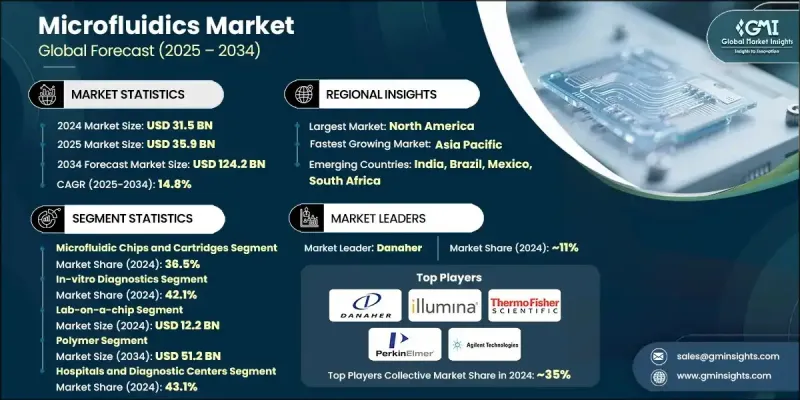
The market's expansion is driven by increasing adoption of point-of-care diagnostic systems, the rise of precision medicine, and the growing demand for faster and more accurate sample analysis. The increasing prevalence of chronic diseases, including cancer, cardiovascular disorders, and diabetes, has significantly amplified the need for diagnostic technologies that deliver efficient results while ensuring patient comfort. Microfluidic devices are gaining widespread acceptance in clinical and research applications due to their ability to provide rapid results with high accuracy using minimal sample quantities. The emergence of innovations such as digital microfluidics, miniaturized lab-on-a-chip systems, and 3D cell culture models is extending the technology's use across diverse domains, including drug discovery, biomedical research, and clinical diagnostics. Furthermore, expanding healthcare infrastructure and strong R&D investments are accelerating the adoption of microfluidic technologies. Microfluidics, which involves manipulating extremely small fluid volumes within microscale channels, offers advantages such as precision control, low reagent consumption, and cost efficiency, making it indispensable for modern diagnostics and therapeutic development.
| Market Scope | |
|---|---|
| Start Year | 2024 |
| Forecast Year | 2025-2034 |
| Start Value | $31.5 Billion |
| Forecast Value | $124.2 Billion |
| CAGR | 14.8% |
The microfluidic chips and cartridges segment held 36.5% share in 2024, because of their critical role in enabling portable, efficient, and cost-effective diagnostic applications. These chips are vital for lab-on-a-chip systems and point-of-care testing, offering scalable solutions for decentralized healthcare settings. The rising adoption of microfluidic cartridges in regions with limited diagnostic infrastructure is further supporting this segment's growth, as these devices provide rapid, accurate results without requiring complex laboratory setups.
The in-vitro diagnostics segment held 42.1% share in 2024, fueled by increasing demand for affordable, precise, and high-throughput testing across chronic and infectious diseases. Microfluidic-based IVD solutions are widely used for liquid biopsies, genetic analyses, and infectious disease detection due to their multiplexing capabilities and exceptional sensitivity. Their integration into modern laboratory workflows enhances diagnostic efficiency while reducing turnaround times, contributing significantly to market expansion.
North America Microfluidics Market held a 43.5% share in 2024. The region's dominance stems from advanced healthcare systems, large-scale R&D spending, and strong adoption of innovative diagnostic technologies in the U.S. and Canada. Growing utilization of microfluidic platforms in research institutes, hospitals, and academic centers has created a fertile environment for continued technological development. Additionally, government-backed initiatives supporting molecular diagnostics, personalized medicine, and AI-based health analytics are further accelerating market penetration and enhancing the adoption of microfluidic devices across healthcare and life sciences sectors.
Key players active in the Global Microfluidics Market include Danaher, Illumina, Bio-Rad Laboratories, F. Hoffmann-La Roche, Qiagen, Becton Dickinson, Thermo Fisher Scientific, Agilent Technologies, bioMerieux, Bartels Mikrotechnik, Dolomite Microfluidics, Fluigent, Standard BioTools, PerkinElmer, Boston Pharmaceutical (Nanomix), Emulate, uFluidix, Sphere Fluidics, and Xona Microfluidics. To strengthen their foothold in the Global Microfluidics Market, major companies are focusing on product innovation, automation integration, and partnerships with diagnostic and pharmaceutical firms. Many are investing in the development of multifunctional lab-on-chip platforms, digital microfluidic systems, and scalable cartridge-based solutions designed for rapid, high-precision testing. Strategic collaborations between device manufacturers and biotechnology companies are helping expand product portfolios and accelerate clinical validation. Firms are also prioritizing miniaturization and connectivity to align with the growing trend of decentralized diagnostics and personalized medicine.
Table of Contents
Chapter 1 Methodology and Scope
- 1.1 Market scope and definitions
- 1.2 Research design
- 1.2.1 Research approach
- 1.2.2 Data collection methods
- 1.3 Data mining sources
- 1.3.1 Global
- 1.3.2 Regional/country
- 1.4 Base estimates and calculations
- 1.4.1 Base year calculation
- 1.4.2 Key trends for market estimation
- 1.5 Primary research and validation
- 1.5.1 Primary sources
- 1.6 Forecast model
- 1.7 Research assumption and limitations
Chapter 2 Executive Summary
- 2.1 Industry 3600 synopsis
- 2.2 Key market trends
- 2.2.1 Regional trends
- 2.2.2 Product trends
- 2.2.3 Application trends
- 2.2.4 Technology trends
- 2.2.5 Material trends
- 2.2.6 End use trends
- 2.3 CXO perspectives: Strategic imperatives
- 2.3.1 Key decision points for industry executives
- 2.3.2 Critical success factors for market players
- 2.4 Future outlook and strategic recommendations
Chapter 3 Industry Insights
- 3.1 Industry ecosystem analysis
- 3.1.1 Supplier landscape
- 3.1.2 Value addition at each stage
- 3.1.3 Factor affecting the value chain
- 3.2 Industry impact forces
- 3.2.1 Growth drivers
- 3.2.1.1 Rising demand for point-of-care diagnostics
- 3.2.1.2 Expansion of personalized medicine and genomics
- 3.2.1.3 Integration with AI and digital health platforms
- 3.2.1.4 Advancements in microfabrication and materials
- 3.2.2 Industry pitfalls and challenges
- 3.2.2.1 High development and manufacturing costs
- 3.2.2.2 Regulatory and standardization hurdles
- 3.2.3 Market opportunities
- 3.2.3.1 Growth in organ-on-chip and 3D cell culture platforms
- 3.2.3.2 Adoption in low-resource and decentralized settings
- 3.2.1 Growth drivers
- 3.3 Growth potential analysis
- 3.4 Regulatory landscape
- 3.4.1 North America
- 3.4.2 Europe
- 3.4.3 Asia Pacific
- 3.4.4 Latin America
- 3.4.5 Middle East and Africa
- 3.5 Future market trends
- 3.6 Technological landscape
- 3.6.1 Current technologies
- 3.6.2 Emerging technologies
- 3.7 Patent analysis
- 3.8 Porter's analysis
- 3.9 PESTEL analysis
Chapter 4 Competitive Landscape, 2024
- 4.1 Introduction
- 4.2 Company market share analysis
- 4.3 Company matrix analysis
- 4.4 Competitive analysis of major market players
- 4.5 Competitive positioning matrix
- 4.6 Key developments
- 4.6.1 Merger and acquisition
- 4.6.2 Partnership and collaboration
- 4.6.3 New product launches
- 4.6.4 Expansion plans
Chapter 5 Market Estimates and Forecast, By Product, 2021 - 2034 ($ Mn)
- 5.1 Key trends
- 5.2 Microfluidic chips and cartridges
- 5.3 Instruments and analyzers
- 5.4 Pumps, valves and sensors
- 5.5 Reagents and consumables
- 5.6 Other products
Chapter 6 Market Estimates and Forecast, By Application, 2021 - 2034 ($ Mn)
- 6.1 Key trends
- 6.2 Pharmaceuticals
- 6.3 Medical devices
- 6.4 In-vitro diagnostics
- 6.5 Other applications
Chapter 7 Market Estimates and Forecast, By Technology, 2021 - 2034 ($ Mn)
- 7.1 Key trends
- 7.2 Lab-on-a-chip
- 7.3 Organs-on-chips
- 7.4 Continuous flow microfluidics
- 7.5 Other technologies
Chapter 8 Market Estimates and Forecast, By Material, 2021 - 2034 ($ Mn)
- 8.1 Key trends
- 8.2 Silicon
- 8.3 Glass
- 8.4 Polymer
- 8.5 Other materials
Chapter 9 Market Estimates and Forecast, By End Use, 2021 - 2034 ($ Mn)
- 9.1 Key trends
- 9.2 Hospitals and diagnostic centers
- 9.3 Academic and research centers
- 9.4 Pharmaceutical and biotechnology companies
- 9.5 Other end use
Chapter 10 Market Estimates and Forecast, By Region, 2021 - 2034 ($ Mn)
- 10.1 Key trends
- 10.2 North America
- 10.2.1 U.S.
- 10.2.2 Canada
- 10.3 Europe
- 10.3.1 Germany
- 10.3.2 UK
- 10.3.3 France
- 10.3.4 Spain
- 10.3.5 Italy
- 10.3.6 Netherlands
- 10.4 Asia Pacific
- 10.4.1 China
- 10.4.2 Japan
- 10.4.3 India
- 10.4.4 Australia
- 10.4.5 South Korea
- 10.5 Latin America
- 10.5.1 Brazil
- 10.5.2 Mexico
- 10.5.3 Argentina
- 10.6 Middle East and Africa
- 10.6.1 South Africa
- 10.6.2 Saudi Arabia
- 10.6.3 UAE
Chapter 11 Company Profiles
- 11.1 Agilent Technologies
- 11.2 Bartels Mikrotechnik
- 11.3 Becton Dickinson
- 11.4 bioMerieux
- 11.5 Bio-Rad Laboratories
- 11.6 Boston Pharmaceutical (Nanomix)
- 11.7 Danaher
- 11.8 Dolomite Microfluidics
- 11.9 Emulate
- 11.10 F. Hoffmann-La Roche
- 11.11 Fluigent
- 11.12 Illumina
- 11.13 PerkinElmer
- 11.14 Qiagen
- 11.15 Sphere Fluidics
- 11.16 Standard BioTools
- 11.17 Thermo Fisher Scientific
- 11.18 uFluidix
- 11.19 Xona Microfluidics