

|
시장보고서
상품코드
1876601
자동차용 향기 전달 시스템 시장 : 시장 기회, 성장 요인, 업계 동향 분석 및 예측(2025-2034년)Automotive Scent Delivery System Market Opportunity, Growth Drivers, Industry Trend Analysis, and Forecast 2025 - 2034 |
||||||

세계의 자동차용 향기 전달 시스템 시장은 2024년 7억 1,170만 달러로 평가되었고, 2034년까지 연평균 복합 성장률(CAGR) 4.2%로 성장할 전망이며, 10억 7,000만 달러에 이를 것으로 예측됩니다.
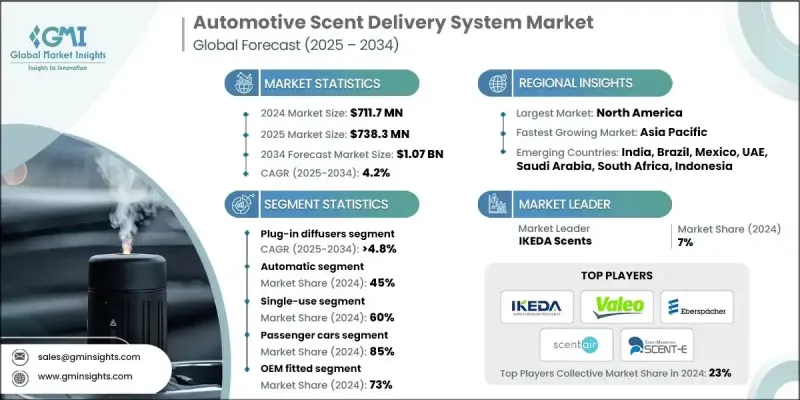
차내 쾌적성 및 분위기 기술로 분류되는 이 틈새 분야는 자동차 제조업체나 애프터마켓 공급자가 차내 체험의 향상에 주력하고 있는 가운데 주목을 끌고 있습니다. 자동차용 향기 전달 시스템은 HVAC 시스템과의 통합 또는 독립 유닛으로서 차내에 향기를 방출하는 기능을 갖습니다. 이러한 솔루션에는 일반적으로 향기 카트리지, 분무기 및 팬과 같은 확산 부품과 사용자가 타이밍과 강도를 관리할 수 있는 전자 제어 장치가 포함됩니다. 시장 성장의 주요 요인은 웰니스, 맞춤형 및 편안함에 대한 소비자 관심 증가에 있습니다. 차량이 연결된 생활 공간으로 진화하는 동안 운전자와 승객은 더 나은 감각 체험을 요구하고 있습니다. IoT(사물인터넷) 및 AI(인공지능) 기술의 지속적인 통합이 이 분야를 변화시켜 스마트 시스템이 차내 공기질이나 외기온 등의 요소에 따라 향기의 수준과 유형을 자동 조절할 수 있게 되어 보다 직관적이고 적응성이 높은 차내 환경을 제공합니다.
| 시장 범위 | |
|---|---|
| 시작 연도 | 2024년 |
| 예측 기간 | 2025-2034년 |
| 시작 시 가치 | 7억 1,170만 달러 |
| 예측 금액 | 10억 7,000만 달러 |
| CAGR | 4.2% |
플러그인식 디퓨저 부문은 28%의 점유율을 차지했고, 2025-2034년 연평균 복합 성장률(CAGR) 4.8%로 성장할 것으로 예측됩니다. 이 부문은 향기의 힘, 내구성, 사용자에게 친숙함으로 알려진 배터리 구동 장치의 보급으로 계속 주도적인 지위를 유지하고 있습니다. 이러한 디퓨저는 쾌적한 실내 환경 유지가 고객의 편안함 및 만족도에 필수적인 상용 차량 및 공유 모빌리티 용도 분야에서 특히 널리 사용됩니다.
자동식 부문은 2024년에 45%의 점유율을 차지했으며, 2034년까지 연평균 복합 성장률(CAGR) 4%로 성장할 것으로 추정됩니다. 자동식은 현대 향기 전달 시스템의 핵심 기능이 되어 첨단 차량 전자 장치와 원활하게 통합됩니다. 이 시스템은 수동 조작 없이 균일한 향기의 확산을 보장하여 운전자의 안전성과 편의성을 향상시킵니다. 자동 향기 디스펜서는 차량의 센서 및 환기 시스템을 통해 작동하며 기류, 차내 점유 상황, 점화 상태 등의 변수에 따라 향기 출력을 조정합니다.
북미의 자동차용 향기 전달 시스템 시장은 2024년에 35%의 점유율을 차지했으며, 2억 5,030만 달러의 규모가 되었습니다. 이 지역의 이점은 높은 자동차 보유율과 차내 쾌적 기술에 대한 소비자의 강한 선호에 의해 지원됩니다. 이 지역의 운전자는 자동차를 라이프 스타일과 작업 공간의 연장으로 파악하는 경향이 있으며 종종 '세 번째 공간'으로 표현됩니다. 이러한 인식은 첨단 차량 내 환경 솔루션에 대한 수요 증가에 크게 기여하고 있습니다.
세계의 자동차용 향기 전달 시스템 시장에서 활동하는 주요 기업으로는 ScentAir Technologies, Eberspacher Group, AromaTech, Valeo, Air Aroma International, Scenta, ELiX Group, IKEDA Scents, Prolitec, Guangzhou SCENT-E SCENT 등이 있습니다. 자동차용 향기 전달 시스템 시장의 주요 기업의 전략은 시장에서의 지위 강화를 위해 혁신, 파트너십 및 기술 진보에 중점을 둡니다. 주요 기업은 차량 전자기기 및 IoT 프레임워크와 통합하는 보다 스마트하고 효율적인 향기 확산 시스템 개발을 위해 연구 개발에 많은 투자를 하고 있습니다. 자동차 제조업체와의 제휴를 통해 이들 기업은 공장 출하 시 탑재 시스템을 공급할 수 있어 장기적인 비즈니스 관계를 강화하고 있습니다. 또한 변화하는 소비자의 취향에 부응하기 위해 맞춤형 환경 친화적인 향기 옵션으로 제품 포트폴리오를 확대하고 있습니다.
자주 묻는 질문
목차
제1장 조사 방법
- 시장 범위 및 정의
- 조사 설계
- 조사 접근
- 데이터 수집 방법
- 데이터 마이닝의 출처
- 세계
- 지역별 및 국가별
- 기본 추정치 및 계산
- 기준 연도 계산
- 시장 추정에서의 주요 동향
- 1차 조사 및 검증
- 1차 정보
- 예측
- 조사의 전제조건 및 제한 사항
제2장 주요 요약
제3장 업계 인사이트
- 생태계 분석
- 공급자의 상황
- 이익률 분석
- 비용 구조
- 각 단계에서의 부가가치
- 밸류체인에 영향을 주는 요인
- 혁신
- 업계에 미치는 영향요인
- 성장 촉진요인
- 고급 차량에서 체험의 차별화
- 차량의 전동화 및 강화된 캐빈에 대한 주력
- IoT 및 커넥티드카의 통합
- 실내 공기질에 관한 규제 추진
- 업계의 잠재적 위험 및 과제
- 엄격한 휘발성 유기 화합물(VOC) 배출 규제
- 향료에 대한 감수성 및 건강 상의 우려
- 시장 기회
- AI를 활용한 개인화된 센팅 시스템
- 치료 및 웰니스 분야에서의 용도
- 도난 방지 및 보안 통합
- 플릿 및 상용차용 용도
- 성장 촉진요인
- 성장 가능성 분석
- 특허 분석
- Porter's Five Forces 분석
- PESTEL 분석
- 비용 내역 분석
- 기술 동향
- 현재의 기술 동향
- 신흥 기술
- 규제 상황
- 가격 동향
- 지역별
- 제품별
- 생산 통계
- 생산 거점
- 소비 거점
- 수출 및 수입
- 지속가능성 및 환경면
- 지속가능한 실천
- 폐기물 감축 전략
- 생산에서의 에너지 효율
- 환경에 배려한 대처
- 탄소발자국에 관한 고려 사항
- 투자 및 공급망 분석
- 투자 및 자금 조달 동향 분석
- 공급망 동향 및 원재료에 미치는 영향
- 소비자 및 기술 분석
- 소비자 행동 및 기호 분석
- 향료 화학 및 배합 과학
- 원재료 조달 및 원료 분석
- OEM 파트너십 및 라이선싱 모델
제4장 경쟁 구도
- 서문
- 기업의 시장 점유율 분석
- 주요 시장 기업의 경쟁 분석
- 경쟁 포지셔닝 매트릭스
- 전략적 전망 매트릭스
- 주요 발전
- 합병 및 인수
- 제휴 및 협업
- 신기술 도입
- 사업 확대 계획 및 자금 조달
제5장 시장 추계 및 예측 : 제품별(2021-2034년)
- 주요 동향
- 플러그인 디퓨저
- 벤트 클립 디퓨저
- 젤 및 왁스 디퓨저
- 스프레이 디퓨저
- 충전식 디퓨저
- 기타
제6장 시장 추계 및 예측 : 기술별(2021-2034년)
- 주요 동향
- 수동 제어
- 자동
- 스마트 및 IoT 베이스
제7장 시장 추계 및 예측 : 용도별(2021-2034년)
- 주요 동향
- 일회용
- 리필식
제8장 시장 추계 및 예측 : 차량별(2021-2034년)
- 주요 동향
- 승용차
- 해치백
- 세단
- SUV
- 상용차
- 소형 상용차(LCV)
- 중형 상용차(MCV)
- 대형 상용차(HCV)
제9장 시장 추계 및 예측 : 유통 채널별(2021-2034년)
- 주요 동향
- OEM용
- 애프터마켓
- 온라인 및 전자상거래
- 전문점
- 기타
제10장 시장 추계 및 예측 : 지역별(2021-2034년)
- 주요 동향
- 북미
- 미국
- 캐나다
- 유럽
- 독일
- 영국
- 프랑스
- 이탈리아
- 스페인
- 북유럽 국가
- 러시아
- 아시아태평양
- 중국
- 인도
- 일본
- 호주
- 인도네시아
- 필리핀
- 태국
- 한국
- 싱가포르
- 라틴아메리카
- 브라질
- 멕시코
- 아르헨티나
- 중동 및 아프리카
- 사우디아라비아
- 남아프리카
- 아랍에미리트(UAE)
제11장 기업 프로파일
- 세계 기업
- Air Aroma International
- AromaTech
- Eberspacher
- ELiX
- Guangzhou SCENT-E SCENT
- IKEDA Scents
- Prolitec
- Scenta
- ScentAir Technologies
- Valeo
- 지역 기업
- Ambius
- Aroma360
- CLEMT
- Hanon Systems
- Ogawa
- Pura Scents
- Scentys
- Sensirion
- Symrise
- Zhongshan Aovli Technology
- 신흥기업 및 디스럽터
- Aqdot
- Aryballe
- Inhalio
- InnoGear
- Xiamen Maxmac Air Technology
The Global Automotive Scent Delivery System Market was valued at USD 711.7 million in 2024 and is estimated to grow at a CAGR of 4.2% to reach USD 1.07 billion by 2034.
This niche segment, which falls under in-vehicle comfort and ambience technologies, is gaining attention as automakers and aftermarket suppliers continue to focus on enhancing the in-cabin experience. Automotive scent delivery systems function by releasing fragrances inside the vehicle through integration with the HVAC system or as independent units. These solutions typically include fragrance cartridges, diffusion components such as atomizers or fans, and electronic controls that allow users to manage timing and intensity. Market growth is largely attributed to increasing consumer interest in wellness, personalization, and comfort. As vehicles evolve into connected living environments, drivers and passengers are seeking improved sensory experiences. The ongoing integration of Internet of Things (IoT) and artificial intelligence (AI) technologies is reshaping this space, allowing smart systems to automatically regulate scent levels or fragrance choices according to factors like cabin air quality or outside weather, providing a more intuitive and adaptive in-car atmosphere.
| Market Scope | |
|---|---|
| Start Year | 2024 |
| Forecast Year | 2025-2034 |
| Start Value | $711.7 Million |
| Forecast Value | $1.07 Billion |
| CAGR | 4.2% |
The plug-in diffusers segment held a 28% share and is forecast to grow at a CAGR of 4.8% between 2025 and 2034. This segment continues to dominate due to the widespread adoption of battery-powered units known for their fragrance strength, durability, and user familiarity. These diffusers are particularly prevalent in commercial fleets and shared mobility applications, where maintaining a pleasant interior environment is essential for customer comfort and satisfaction.
The automatic segment held a 45% share in 2024 and is estimated to grow at 4% CAGR through 2034. Automation has become a central feature in modern scent delivery systems, integrating seamlessly with advanced vehicle electronics. These systems ensure uniform scent diffusion without manual input, enhancing safety and convenience for drivers. Automated fragrance dispensers operate through a vehicle's sensor and ventilation systems, adjusting scent output based on variables such as airflow, cabin occupancy, and ignition status.
North America Automotive Scent Delivery System Market held a 35% share and generated USD 250.3 million in 2024. The region's dominance is supported by high vehicle ownership and strong consumer preference for in-car comfort technologies. Drivers in this region tend to view their vehicles as personal extensions of their lifestyle and workspace, often described as a "third space," which has contributed significantly to the growing demand for advanced in-cabin ambience solutions.
Prominent companies active in the Global Automotive Scent Delivery System Market include ScentAir Technologies, Eberspacher Group, AromaTech, Valeo, Air Aroma International, Scenta, ELiX Group, IKEDA Scents, Prolitec, and Guangzhou SCENT-E SCENT. Key strategies adopted by companies in the Automotive Scent Delivery System Market focus on innovation, partnerships, and technological advancement to enhance market positioning. Leading players are investing heavily in research and development to create smarter and more efficient scent diffusion systems that integrate with vehicle electronics and IoT frameworks. Collaborations with automakers enable these firms to supply factory-installed systems, strengthening long-term business relationships. Companies are also expanding their product portfolios with customizable and eco-friendly fragrance options to meet evolving consumer preferences.
Table of Contents
Chapter 1 Methodology
- 1.1 Market scope and definition
- 1.2 Research design
- 1.2.1 Research approach
- 1.2.2 Data collection methods
- 1.3 Data mining sources
- 1.3.1 Global
- 1.3.2 Regional/Country
- 1.4 Base estimates and calculations
- 1.4.1 Base year calculation
- 1.4.2 Key trends for market estimation
- 1.5 Primary research and validation
- 1.5.1 Primary sources
- 1.6 Forecast
- 1.7 Research assumptions and limitations
Chapter 2 Executive Summary
- 2.1 Industry 360° synopsis, 2021 - 2034
- 2.2 Key market trends
- 2.2.1 Regional
- 2.2.2 Product
- 2.2.3 Technology
- 2.2.4 Usage
- 2.2.5 Vehicle
- 2.2.6 Distribution channel
- 2.3 TAM analysis, 2025-2034
- 2.4 CXO perspectives: Strategic imperatives
- 2.4.1 Executive decision points
- 2.4.2 Critical success factors
- 2.5 Future-outlook and strategic recommendations
Chapter 3 Industry Insights
- 3.1 Industry ecosystem analysis
- 3.1.1 Supplier landscape
- 3.1.2 Profit margin analysis
- 3.1.3 Cost structure
- 3.1.4 Value addition at each stage
- 3.1.5 Factors affecting the value chain
- 3.1.6 Disruptions
- 3.2 Industry impact forces
- 3.2.1 Growth drivers
- 3.2.1.1 Luxury vehicle experience differentiation
- 3.2.1.2 Vehicle electrification and enhanced cabin focus
- 3.2.1.3 IoT and connected vehicle integration
- 3.2.1.4 Regulatory push for interior air quality
- 3.2.2 Industry pitfalls and challenges
- 3.2.2.1 Stringent VOC emission regulations
- 3.2.2.2 Fragrance sensitivity and health concerns
- 3.2.3 Market opportunities
- 3.2.3.1 AI-driven personalized scenting systems
- 3.2.3.2 Therapeutic and wellness applications
- 3.2.3.3 Anti-theft and security integration
- 3.2.3.4 Fleet and commercial vehicle applications
- 3.2.1 Growth drivers
- 3.3 Growth potential analysis
- 3.4 Patent analysis
- 3.5 Porter's analysis
- 3.6 PESTEL analysis
- 3.7 Cost breakdown analysis
- 3.8 Technology landscape
- 3.8.1 Current technological trends
- 3.8.2 Emerging technologies
- 3.9 Regulatory landscape
- 3.9.1 North America
- 3.9.2 Europe
- 3.9.3 Asia Pacific
- 3.9.4 Latin America
- 3.9.5 Middle East and Africa
- 3.10 Price trends
- 3.10.1 By region
- 3.10.2 By product
- 3.11 Production statistics
- 3.11.1 Production hubs
- 3.11.2 Consumption hubs
- 3.11.3 Export and import
- 3.12 Sustainability and environmental aspects
- 3.12.1 Sustainable practices
- 3.12.2 Waste reduction strategies
- 3.12.3 Energy efficiency in production
- 3.12.4 Eco-friendly initiatives
- 3.13 Carbon footprint considerations
- 3.14 Investment and supply chain analysis
- 3.14.1 Investment and funding trends analysis
- 3.14.2 Supply chain dynamics and raw material impact
- 3.15 Consumer and technical analysis
- 3.15.1 Consumer behavior and preference analysis
- 3.15.2 Fragrance chemistry and formulation science
- 3.15.3 Material sourcing and raw material analysis
- 3.16 OEM partnership and licensing models
Chapter 4 Competitive Landscape, 2024
- 4.1 Introduction
- 4.2 Company market share analysis
- 4.2.1 North America
- 4.2.2 Europe
- 4.2.3 Asia Pacific
- 4.2.4 Latin America
- 4.2.5 Middle East and Africa
- 4.3 Competitive analysis of major market players
- 4.4 Competitive positioning matrix
- 4.5 Strategic outlook matrix
- 4.6 Key developments
- 4.6.1 Mergers & acquisitions
- 4.6.2 Partnerships & collaborations
- 4.6.3 New technology launches
- 4.6.4 Expansion plans and funding
Chapter 5 Market Estimates & Forecast, By Product, 2021 - 2034 (USD Mn, Units)
- 5.1 Key trends
- 5.2 Plug-in diffusers
- 5.3 Vent-clip diffusers
- 5.4 Gel/wax diffusers
- 5.5 Spray diffusers
- 5.6 Rechargeable diffusers
- 5.7 Others
Chapter 6 Market Estimates & Forecast, By Technology, 2021 - 2034 (USD Mn, Units)
- 6.1 Key trends
- 6.2 Manual control
- 6.3 Automatic
- 6.4 Smart/IoT based
Chapter 7 Market Estimates & Forecast, By Usage, 2021 - 2034 (USD Mn, Units)
- 7.1 Key trends
- 7.2 Single-Use
- 7.3 Refillable
Chapter 8 Market Estimates & Forecast, By Vehicle, 2021 - 2034 (USD Mn, Units)
- 8.1 Key trends
- 8.2 Passenger cars
- 8.2.1 Hatchback
- 8.2.2 Sedan
- 8.2.3 SUV
- 8.3 Commercial vehicles
- 8.3.1 Light commercial vehicles (LCV)
- 8.3.2 Medium commercial vehicles (MCV)
- 8.3.3 Heavy commercial vehicles (HCV)
Chapter 9 Market Estimates & Forecast, By Distribution Channel, 2021 - 2034 (USD Mn, Units)
- 9.1 Key trends
- 9.2 OEM fitted
- 9.3 Aftermarket
- 9.3.1 Online/e-commerce
- 9.3.2 Specialty stores
- 9.3.3 Others
Chapter 10 Market Estimates & Forecast, By Region, 2021 - 2034 (USD Mn, Units)
- 10.1 Key trends
- 10.2 North America
- 10.2.1 US
- 10.2.2 Canada
- 10.3 Europe
- 10.3.1 Germany
- 10.3.2 UK
- 10.3.3 France
- 10.3.4 Italy
- 10.3.5 Spain
- 10.3.6 Nordics
- 10.3.7 Russia
- 10.4 Asia Pacific
- 10.4.1 China
- 10.4.2 India
- 10.4.3 Japan
- 10.4.4 Australia
- 10.4.5 Indonesia
- 10.4.6 Philippines
- 10.4.7 Thailand
- 10.4.8 South Korea
- 10.4.9 Singapore
- 10.5 Latin America
- 10.5.1 Brazil
- 10.5.2 Mexico
- 10.5.3 Argentina
- 10.6 Middle East and Africa
- 10.6.1 Saudi Arabia
- 10.6.2 South Africa
- 10.6.3 UAE
Chapter 11 Company Profiles
- 11.1 Global Players
- 11.1.1 Air Aroma International
- 11.1.2 AromaTech
- 11.1.3 Eberspacher
- 11.1.4 ELiX
- 11.1.5 Guangzhou SCENT-E SCENT
- 11.1.6 IKEDA Scents
- 11.1.7 Prolitec
- 11.1.8 Scenta
- 11.1.9 ScentAir Technologies
- 11.1.10 Valeo
- 11.2 Regional Players
- 11.2.1 Ambius
- 11.2.2 Aroma360
- 11.2.3 CLEMT
- 11.2.4 Hanon Systems
- 11.2.5 Ogawa
- 11.2.6 Pura Scents
- 11.2.7 Scentys
- 11.2.8 Sensirion
- 11.2.9 Symrise
- 11.2.10 Zhongshan Aovli Technology
- 11.3 Emerging Players / Disruptors
- 11.3.1 Aqdot
- 11.3.2 Aryballe
- 11.3.3 Inhalio
- 11.3.4 InnoGear
- 11.3.5 Xiamen Maxmac Air Technology


