|
시장보고서
상품코드
1876621
전기자동차 배터리 관리 칩 시장 : 시장 기회, 성장 요인, 업계 동향 분석 및 예측(2025-2034년)Electric Vehicle Battery Management Chips Market Opportunity, Growth Drivers, Industry Trend Analysis, and Forecast 2025 - 2034 |
||||||

세계의 전기자동차 배터리 관리 칩 시장은 2024년에 15억 6,000만 달러로 평가되었고, 2034년까지 연평균 복합 성장률(CAGR) 14.6%로 성장할 전망이며, 59억 4,000만 달러에 이를 것으로 예측되고 있습니다.
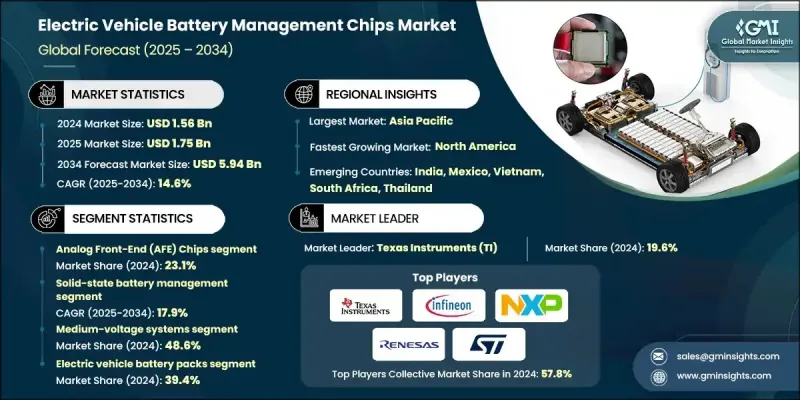
배터리 안전성의 중요성이 높아지는 가운데, 과열, 단락 및 과충전에 수반하는 리스크 저감을 도모하는 제조업체 각사 수요 증가가 시장 도입을 견인하고 있습니다. 이러한 관리 칩은 배터리 팩의 셀 상태를 지속적으로 모니터링하여 안정적인 성능과 운영 안전을 보장합니다. 세계 안전 기준이 엄격해짐에 따라 자동차 제조업체는 차세대 관리 칩에 대한 투자를 크게 확대하여 보호 기능을 강화하고 배터리 수명을 연장하며 소비자 신뢰를 높이고 있습니다. 안전성 향상과 더불어 환경 우선 정책, 정부 보조금, 배출가스 감축 의무에 견인된 전기차 수요의 급증이 여전히 중요한 시장 카탈리스트가 되고 있습니다. 배터리 관리 칩은 전력 효율 최적화, 충전 사이클 조정 및 고장 방지에 매우 중요한 역할을 합니다. 첨단 모니터링 기능과 예측 유지 보수 시스템의 통합으로 배터리 관리는 고도로 데이터 구동 프로세스로 변모하고 있습니다. 커넥티드카와 자율주행차의 상승에 따라 제조업체는 통신 기능 강화, 에너지 최적화, 진단 기능을 갖춘 칩 개발에 주력하고 있습니다. 안전성, 효율성, 디지털화의 융합이 예측 기간을 통해 지속적인 시장 확대를 추진할 전망입니다.
| 시장 범위 | |
|---|---|
| 시작 연도 | 2024년 |
| 예측 기간 | 2025-2034년 |
| 시작 시 가치 | 15억 6,000만 달러 |
| 예측 금액 | 59억 4,000만 달러 |
| CAGR | 14.6% |
아날로그 프론트엔드(AFE) 칩 부문은 2024년에 23.1%의 점유율을 차지하였고, 2034년까지 연평균 복합 성장률(CAGR) 13.4%로 성장할 것으로 예측됩니다. AFE 칩은 배터리 셀과 디지털 컨트롤러 간의 중요한 인터페이스 역할을 하며 전압 및 온도와 같은 아날로그 신호를 정확하게 디지털 데이터로 변환하여 정밀한 모니터링과 제어를 실현합니다. 최신 AFE 컴포넌트는 높은 측정 정확도를 요구하며 전체 전압 범위 및 고속 측정 윈도우에서 최적의 성능과 안정성을 보장합니다.
고체 배터리 관리 부문은 2025-2034년 연평균 복합 성장률(CAGR) 17.9%로 성장할 전망입니다. 고체 배터리 시스템은 액체 전해질을 대체하는 불연성 고체 전해질을 채택하여 안전성, 에너지 밀도, 사이클 수명 및 내열성을 크게 향상시킵니다. 이 배터리는 400Wh/kg 이상의 에너지 밀도를 달성하고 더 긴 가동 수명을 제공하기 때문에 독특한 전기적 특성을 처리할 수 있는 고급 배터리 관리 칩에 대한 수요가 높아지고 있습니다.
2024년 현재 미국 전기자동차 배터리 관리 칩 시장은 87.4%의 점유율을 차지했습니다. 국내 생산 촉진을 목적으로 하는 연방 정부의 지원 정책, 세제 우대 조치 및 이니셔티브는 이 나라의 EV 생태계를 크게 강화하고 있습니다. 청정 에너지와 제조 혁신을 촉진하는 입법 조치는 현지에서 칩 개발을 지속적으로 추진하고 공급망의 혼란 위험을 완화합니다. 미국 제조업체는 성능 향상, 실시간 감시 강화, 배터리 전체의 수명 연장을 도모하기 위해 인공지능(AI) 및 예측 분석을 배터리 관리 시스템에 통합하고 있으며, 이는 업계의 지능형 에너지 시스템으로의 진화를 더욱 뒷받침하고 있습니다.
세계의 전기자동차 배터리 관리 칩 시장에서 주요 기업으로는 STMicroelectronics (ST), NXP Semiconductors, Texas Instruments (TI), Microchip Technology, Infineon Technologies, ABLIC Inc., Rohm Co. Ltd, Nisshinbo Micro Devices 및 Renesas Electronics 등을 들 수 있습니다. 전기자동차 배터리 관리 칩 시장의 주요 기업은 시장에서의 존재감을 강화하기 위해 제품 혁신, 협업, 전략적 확대에 주력하고 있습니다. 각 회사는 에너지 관리의 강화 및 안전 기준의 향상을 도모하는 고효율 및 저소비 전력 칩의 개발을 향해 연구 개발 투자를 확대하고 있습니다. 자동차 제조업체나 전지 제조업체와의 제휴에 의해 차세대 전기자동차용의 커스터마이즈 칩 통합이 가능해지고 있습니다. 많은 기업들이 예측 진단과 실시간 최적화를 실현하는 AI 탑재 감시 솔루션을 채용하고 있습니다. 지역 제조 기지로의 진출과 공급망 내에서의 수직 통합은 신뢰성과 비용 효율성을 보장하기 위한 주요 전략입니다. 지속가능성과 스마트 에너지 관리는 경쟁력 강화와 전동화 이동성으로의 세계 전환을 지원하는 기업 이니셔티브의 핵심을 이루고 있습니다.
자주 묻는 질문
목차
제1장 조사 방법
- 시장 범위 및 정의
- 조사 설계
- 조사 접근
- 데이터 수집 방법
- 데이터 마이닝의 출처
- 세계
- 지역별 및 국가별
- 기본 추정치 및 계산
- 기준 연도 계산
- 시장 추정에서의 주요 동향
- 1차 조사 및 검증
- 1차 정보
- 예측
- 조사의 전제조건 및 제한 사항
제2장 주요 요약
제3장 업계 인사이트
- 생태계 분석
- 밸류체인 분석 및 산업 구조
- 원재료 및 웨이퍼 제조
- BMS IC의 설계 및 개발
- 반도체 제조 및 시험
- BMS 모듈 조립 및 통합
- 배터리 팩의 통합 및 검증
- OEM 차량 통합 및 도입
- 애프터마켓 및 서비스 에코시스템
- 사용한 제품의 재활용 및 지속가능성
- 밸류체인 분석 및 산업 구조
- 공급자의 상황
- 원재료 공급자
- 부품 제조업체
- 배터리 제조업체
- 시스템 통합자
- OEM
- 최종 용도
- 업계에 미치는 영향요인
- 성장 촉진요인
- 전기자동차 시장 확대
- 배터리 안전 및 규제 요건
- 에너지 밀도 및 성능 최적화 수요
- 급속 충전 인프라 개발
- 그리드 에너지 저장 시장의 성장
- 업계의 잠재적 위험 및 과제
- 높은 개발 및 인정 비용
- 복잡한 멀티셀 감시의 과제
- 시장 기회
- 고체 전지 기술의 통합
- 무선 배터리 관리 시스템
- AI를 활용한 배터리 최적화
- 2차 이용 배터리 응용
- 성장 촉진요인
- 성장 가능성 분석
- 규제 상황
- Porter's Five Forces 분석
- PESTEL 분석
- 기술 및 혁신 동향
- 현재의 기술
- 신흥 기술
- 특허 분석
- 가격 동향 분석
- 제품별
- 지역별
- 비용 내역 분석
- 생산 통계
- 생산 거점
- 소비 허브
- 수출 및 수입
- 지속가능성 및 환경면
- 지속가능한 대처
- 폐기물 감축 전략
- 생산에 있어서 에너지 효율
- 환경에 배려한 대처
- 탄소발자국에 관한 고려 사항
- 시장의 성숙도 및 보급 상황의 분석
- 기술 성숙도 레벨 평가
- 지역별 도입 성숙도 비교
- 용도 영역의 성숙도 분석
- 제조 준비도 및 스케일 평가
- 상용 전개의 타임라인
- 총소유비용(TCO) 분석
- BMS 칩 부품 비용
- 시스템 통합 및 개발 비용
- 자동차의 인정 및 시험 비용
- 제조 및 도입 비용
- 보수 및 교환 라이프 사이클 코스트
- 기술 유형별 TCO 비교
- 통합의 복잡성 및 구현상의 과제
- 멀티 셀 아키텍처 설계의 과제
- 고전압 절연 및 안전 요건
- 통신 프로토콜 통합
- 열 관리 및 방열 대책
- 소프트웨어 통합 및 알고리즘 개발
- 제조 공정 및 품질 관리 분석
- 반도체 제조 및 수율 최적화
- 자동차 등급 시험 및 인정
- 품질 보증 및 신뢰성 시험
- 공급망 관리 및 조달
- 비용 절감 및 프로세스 최적화
- 안전과 기능 안전 프레임워크 분석
- ISO 26262 ASIL 적합 요건
- 배터리 안전 기준 및 규제
- 고장 모드 해석 및 예방
- 중복성 및 내결함성 설계
- 사이버 보안 및 데이터 보호
제4장 경쟁 구도
- 서문
- 기업의 시장 점유율 분석
- 북미
- 유럽
- 아시아태평양
- 라틴아메리카
- 중동 및 아프리카
- 주요 시장 기업의 경쟁 분석
- 경쟁 포지셔닝 매트릭스
- 전략적 전망 매트릭스
- 주요 뉴스 및 대처
- 합병 및 인수
- 제휴 및 협업
- 신제품 발매
- 사업 확대 계획 및 자금 조달
제5장 시장 추계 및 예측 : 기술별(2021-2034년)
- 주요 동향
- 아날로그 프론트 엔드(AFE) 칩
- 셀 감시용 IC
- 배터리 밸런스 회로
- 보호 IC
- 배터리 관리 컨트롤러
- 전류 검출 IC
제6장 시장 추계 및 예측 : 배터리별(2021-2034년)
- 주요 동향
- 리튬 이온 배터리 관리
- 인산철 리튬 배터리 관리
- 고체 배터리 관리
- 니켈 수소 배터리 관리
- 첨단 화학 기술에 의한 지원
제7장 시장 추계 및 예측 : 전압 범위별(2021-2034년)
- 주요 동향
- 저전압 시스템
- 중전압 시스템
- 고전압 시스템
- 초고압 시스템
제8장 시장 추계 및 예측 : 통합 레벨별(2021-2034년)
- 주요 동향
- 이산 부품
- 통합 솔루션
- 시스템 온 칩(SoC)
- 모듈형 시스템
제9장 시장 추계 및 예측 : 용도별(2021-2034년)
- 주요 동향
- 전기자동차 배터리 팩
- 하이브리드 전기자동차 시스템
- 에너지 저장 시스템
- 충전 인프라
- 보조 배터리 시스템
- 휴대용 에너지 저장
제10장 시장 추계 및 예측 : 차량별(2021-2034년)
- 주요 동향
- 승용 전기자동차(EV)
- BEV(배터리식 전기자동차)
- PHEV
- 연료전지자동차(FCEV)
- 상용 전기자동차
- 밴
- BEV(배터리식 전기자동차)
- PHEV
- 버스
- BEV(배터리식 전기자동차)
- 연료전지자동차(FCEV)
- 트럭
- BEV(배터리식 전기자동차)
- 연료전지자동차(FCEV)
- 밴
제11장 시장 추계 및 예측 : 지역별(2021-2034년)
- 주요 동향
- 북미
- 미국
- 캐나다
- 유럽
- 독일
- 영국
- 프랑스
- 이탈리아
- 스페인
- 북유럽 국가
- 네덜란드
- 러시아
- 아시아태평양
- 중국
- 인도
- 일본
- 호주
- 한국
- 싱가포르
- 베트남
- 인도네시아
- 라틴아메리카
- 브라질
- 콜롬비아
- 코스타리카
- 멕시코
- 아르헨티나
- 중동 및 아프리카
- 남아프리카
- 사우디아라비아
- 아랍에미리트(UAE)
제12장 기업 프로파일
- 세계 기업
- Texas Instruments Incorporated
- Analog Devices
- Infineon Technologies
- NXP Semiconductors
- STMicroelectronics
- Renesas Electronics
- Maxim Integrated Products(Analog Devices)
- ON Semiconductor Corporation
- Microchip Technology
- 지역 선도기업
- Tesla
- General Motors
- Ford Motor
- BYD
- Contemporary Amperex Technology(CATL)
- LG
- Panasonic
- Samsung
- 신흥기업 및 전문 제조업체
- Monolithic Power Systems
- Linear Technology(Analog Devices)
- Intersil Corporation(Renesas)
- Richtek Technology Corporation
- Diodes Incorporated
- ROHM Semiconductor
- Cypress Semiconductor(Infineon)
- Semtech Corporation
The Global Electric Vehicle Battery Management Chips Market was valued at USD 1.56 billion in 2024 and is estimated to grow at a CAGR of 14.6% to reach USD 5.94 billion by 2034.
Growing emphasis on battery safety continues to fuel market adoption as manufacturers seek to reduce the risks associated with overheating, short-circuiting, and overcharging. These chips continuously monitor cell conditions within the battery pack, ensuring reliable performance and operational safety. As global safety standards become increasingly strict, automotive companies are investing heavily in next-generation management chips to enhance protection, extend battery life, and boost consumer confidence. In addition to safety improvements, the rapid surge in electric vehicle demand-driven by environmental priorities, government incentives, and emission reduction mandates-remains a crucial market catalyst. Battery management chips play a vital role in optimizing power efficiency, regulating charge cycles, and preventing failures. The integration of advanced monitoring capabilities and predictive maintenance systems is transforming battery management into a highly data-driven process. With the rise of connected and autonomous vehicles, manufacturers are focusing on chips that can deliver enhanced communication, energy optimization, and diagnostic features. This convergence of safety, efficiency, and digitalization is set to propel sustained market expansion throughout the forecast period.
| Market Scope | |
|---|---|
| Start Year | 2024 |
| Forecast Year | 2025-2034 |
| Start Value | $1.56 Billion |
| Forecast Value | $5.94 Billion |
| CAGR | 14.6% |
The Analog Front-End (AFE) chips segment held a 23.1% share in 2024 and is expected to witness a CAGR of 13.4% through 2034. AFE chips serve as critical interfaces between battery cells and the digital controller, accurately converting analog signals such as voltage and temperature into digital data for precise monitoring and control. Modern AFE components demand high measurement accuracy, ensuring optimal performance and stability across voltage ranges and rapid measurement windows.
The solid-state battery management segment will grow at a CAGR of 17.9% from 2025 to 2034. Solid-state battery systems utilize non-flammable solid electrolytes instead of liquid ones, offering significant improvements in safety, energy density, cycle life, and temperature tolerance. These batteries can achieve energy densities exceeding 400 Wh/kg and provide longer operational lifespans, driving the need for sophisticated battery management chips capable of handling their unique electrical characteristics.
United States Electric Vehicle Battery Management Chips Market held an 87.4% share in 2024. Supportive federal policies, tax incentives, and initiatives aimed at advancing domestic production have significantly strengthened the country's EV ecosystem. Legislative measures promoting clean energy and manufacturing innovation continue to bolster local chip development, mitigating potential supply chain disruptions. U.S. manufacturers are integrating artificial intelligence and predictive analytics into their battery management systems to improve performance, enhance real-time monitoring, and extend the overall lifespan of batteries, which further supports the industry's evolution toward intelligent energy systems.
Major companies operating in the Global Electric Vehicle Battery Management Chips Market include STMicroelectronics (ST), NXP Semiconductors, Texas Instruments (TI), Microchip Technology, Infineon Technologies, ABLIC Inc., Rohm Co. Ltd, Nisshinbo Micro Devices, and Renesas Electronics. Leading companies in the Electric Vehicle Battery Management Chips Market are focusing on product innovation, collaboration, and strategic expansion to reinforce their market presence. Firms are investing in research and development to design high-efficiency, low-power chips that enhance energy management and improve safety standards. Partnerships with automotive OEMs and battery producers are enabling customized chip integration for next-generation electric vehicles. Many players are adopting AI-powered monitoring solutions to enable predictive diagnostics and real-time optimization. Expansion into regional manufacturing hubs and vertical integration within the supply chain are key strategies to ensure reliability and cost efficiency. Sustainability and smart energy management are central to corporate initiatives aimed at strengthening competitiveness and supporting the global transition toward electrified mobility.
Table of Contents
Chapter 1 Methodology
- 1.1 Market scope and definition
- 1.2 Research design
- 1.2.1 Research approach
- 1.2.2 Data collection methods
- 1.3 Data mining sources
- 1.3.1 Global
- 1.3.2 Regional/Country
- 1.4 Base estimates and calculations
- 1.4.1 Base year calculation
- 1.4.2 Key trends for market estimation
- 1.5 Primary research and validation
- 1.5.1 Primary sources
- 1.6 Forecast
- 1.7 Research assumptions and limitations
Chapter 2 Executive Summary
- 2.1 Industry 360° synopsis, 2021 - 2034
- 2.2 Key market trends
- 2.2.1 Technology
- 2.2.2 Battery
- 2.2.3 Voltage range
- 2.2.4 Integration level
- 2.2.5 Application
- 2.2.6 Vehicle
- 2.2.7 Regional
- 2.3 TAM Analysis, 2025-2034
- 2.4 CXO perspectives: Strategic imperatives
- 2.4.1 Executive decision points
- 2.4.2 Critical success factors
- 2.5 Future outlook and strategic recommendations
Chapter 3 Industry Insights
- 3.1 Industry ecosystem analysis
- 3.1.1 Value Chain Analysis & Industry Structure
- 3.1.1.1 Raw Materials & Wafer Fabrication
- 3.1.1.2 BMS IC Design & Development
- 3.1.1.3 Semiconductor Manufacturing & Testing
- 3.1.1.4 BMS Module Assembly & Integration
- 3.1.1.5 Battery Pack Integration & Validation
- 3.1.1.6 OEM Vehicle Integration & Deployment
- 3.1.1.7 Aftermarket & Service Ecosystem
- 3.1.1.8 End-of-Life Recycling & Sustainability
- 3.1.1 Value Chain Analysis & Industry Structure
- 3.2 Supplier landscape
- 3.2.1 Raw material suppliers
- 3.2.2 Component manufacturers
- 3.2.3 Battery manufacturers
- 3.2.4 System integrators
- 3.2.5 OEM
- 3.2.6 End use
- 3.3 Industry impact forces
- 3.3.1 Growth drivers
- 3.3.1.1 Electric Vehicle Market Proliferation
- 3.3.1.2 Battery Safety & Regulatory Requirements
- 3.3.1.3 Energy Density & Performance Optimization Demand
- 3.3.1.4 Fast Charging Infrastructure Development
- 3.3.1.5 Grid Energy Storage Market Growth
- 3.3.2 Industry pitfalls and challenges
- 3.3.2.1 High Development & Qualification Costs
- 3.3.2.2 Complex Multi-Cell Monitoring Challenges
- 3.3.3 Market opportunities
- 3.3.3.1 Solid-State Battery Technology Integration
- 3.3.3.2 Wireless Battery Management Systems
- 3.3.3.3 AI-Enhanced Battery Optimization
- 3.3.3.4 Second-Life Battery Applications
- 3.3.1 Growth drivers
- 3.4 Growth potential analysis
- 3.5 Regulatory landscape
- 3.5.1 North America
- 3.5.2 Europe
- 3.5.3 Asia Pacific
- 3.5.4 Latin America
- 3.5.5 Middle East and Africa
- 3.6 Porter's analysis
- 3.7 PESTEL analysis
- 3.8 Technology and Innovation landscape
- 3.8.1 Current technology
- 3.8.2 Emerging technology
- 3.9 Patent analysis
- 3.10 Price Trends Analysis
- 3.10.1 By product
- 3.10.2 By region
- 3.11 Cost Breakdown Analysis
- 3.12 Production staistics
- 3.12.1 Production hubs
- 3.12.2 Consumption hubs
- 3.12.3 Export and import
- 3.13 Sustainability and Environmental Aspects
- 3.13.1 Sustainable Practices
- 3.13.2 Waste Reduction Strategies
- 3.13.3 Energy Efficiency in Production
- 3.13.4 Eco-friendly Initiatives
- 3.13.5 Carbon Footprint Considerations
- 3.14 Market Maturity & Adoption Analysis
- 3.14.1 Technology Readiness Level Assessment
- 3.14.2 Regional Adoption Maturity Comparison
- 3.14.3 Application Domain Maturity Analysis
- 3.14.4 Manufacturing Readiness & Scale Assessment
- 3.14.5 Commercial Deployment Timeline
- 3.15 Total Cost of Ownership (TCO) Analysis
- 3.15.1 BMS Chip Component Costs
- 3.15.2 System Integration & Development Expenses
- 3.15.3 Automotive Qualification & Testing Costs
- 3.15.4 Manufacturing & Deployment Expenses
- 3.15.5 Maintenance & Replacement Lifecycle Costs
- 3.15.6 TCO Comparison by Technology Type
- 3.16 Integration Complexity & Implementation Challenges
- 3.16.1 Multi-Cell Architecture Design Challenges
- 3.16.2 High-Voltage Isolation & Safety Requirements
- 3.16.3 Communication Protocol Integration
- 3.16.4 Thermal Management & Heat Dissipation
- 3.16.5 Software Integration & Algorithm Development
- 3.17 Manufacturing Process & Quality Control Analysis
- 3.17.1 Semiconductor Fabrication & Yield Optimization
- 3.17.2 Automotive-Grade Testing & Qualification
- 3.17.3 Quality Assurance & Reliability Testing
- 3.17.4 Supply Chain Management & Sourcing
- 3.17.5 Cost Reduction & Process Optimization
- 3.18 Safety & Functional Safety Framework Analysis
- 3.18.1 ISO 26262 ASIL Compliance Requirements
- 3.18.2 Battery Safety Standards & Regulations
- 3.18.3 Failure Mode Analysis & Prevention
- 3.18.4 Redundancy & Fault Tolerance Design
- 3.18.5 Cybersecurity & Data Protection
Chapter 4 Competitive Landscape, 2024
- 4.1 Introduction
- 4.2 Company market share analysis
- 4.2.1 North America
- 4.2.2 Europe
- 4.2.3 Asia Pacific
- 4.2.4 LATAM
- 4.2.5 MEA
- 4.3 Competitive analysis of major market players
- 4.4 Competitive positioning matrix
- 4.5 Strategic outlook matrix
- 4.6 Key news and initiatives
- 4.6.1 Mergers & acquisitions
- 4.6.2 Partnerships & collaborations
- 4.6.3 New Product Launches
- 4.6.4 Expansion Plans and funding
Chapter 5 Market Estimates & Forecast, By Technology, 2021 - 2034 ($Bn, Units)
- 5.1 Key trends
- 5.2 Analog Front-End (AFE) chips
- 5.3 Cell Monitoring ICs
- 5.4 Battery balancing circuits
- 5.5 Protection ICs
- 5.6 Battery management controllers
- 5.7 Current sensing ICs
Chapter 6 Market Estimates & Forecast, By Battery, 2021 - 2034 ($Bn, Units)
- 6.1 Key trends
- 6.2 Lithium-ion battery management
- 6.3 Lithium iron phosphate management
- 6.4 Solid-state battery management
- 6.5 Nickel-metal hydride management
- 6.6 Advanced chemistry support
Chapter 7 Market Estimates & Forecast, By Voltage Range, 2021 - 2034 ($Bn, Units)
- 7.1 Key trends
- 7.2 Low-voltage system
- 7.3 Medium-voltage system
- 7.4 High-voltage system
- 7.5 Ultra-high voltage system
Chapter 8 Market Estimates & Forecast, By Integration level, 2021 - 2034 ($Bn, Units)
- 8.1 Key trends
- 8.2 Discrete component
- 8.3 Integrated solution
- 8.4 System-on-Chip (SoC)
- 8.5 Modular system
Chapter 9 Market Estimates & Forecast, By Application, 2021 - 2034 ($Bn, Units)
- 9.1 Key trends
- 9.2 Electric vehicle battery packs
- 9.3 Hybrid electric vehicle systems
- 9.4 Energy storage systems
- 9.5 Charging infrastructure
- 9.6 Auxiliary battery systems
- 9.7 Portable energy storage
Chapter 10 Market Estimates & Forecast, By Vehicle, 2021 - 2034 ($Bn, Units)
- 10.1 Key trends
- 10.2 Passenger EVs
- 10.2.1 BEV
- 10.2.2 PHEV
- 10.2.3 FCEV
- 10.3 Commercial EV
- 10.3.1 Vans
- 10.3.1.1 BEV
- 10.3.1.2 PHEV
- 10.3.2 Buses
- 10.3.2.1 BEV
- 10.3.2.2 FCEV
- 10.3.3 Trucks
- 10.3.3.1 BEV
- 10.3.3.2 FCEV
- 10.3.1 Vans
Chapter 11 Market Estimates & Forecast, By Region, 2021 - 2034 ($Bn, Units)
- 11.1 Key trends
- 11.2 North America
- 11.2.1 US
- 11.2.2 Canada
- 11.3 Europe
- 11.3.1 Germany
- 11.3.2 UK
- 11.3.3 France
- 11.3.4 Italy
- 11.3.5 Spain
- 11.3.6 Nordics
- 11.3.7 Netherlands
- 11.3.8 Russia
- 11.4 Asia Pacific
- 11.4.1 China
- 11.4.2 India
- 11.4.3 Japan
- 11.4.4 Australia
- 11.4.5 South Korea
- 11.4.6 Singapore
- 11.4.7 Vietnam
- 11.4.8 Indonesia
- 11.5 Latin America
- 11.5.1 Brazil
- 11.5.2 Colombia
- 11.5.3 Costa Rica
- 11.5.4 Mexico
- 11.5.5 Argentina
- 11.6 MEA
- 11.6.1 South Africa
- 11.6.2 Saudi Arabia
- 11.6.3 UAE
Chapter 12 Company Profiles
- 12.1 Global Players
- 12.1.1 Texas Instruments Incorporated
- 12.1.2 Analog Devices
- 12.1.3 Infineon Technologies
- 12.1.4 NXP Semiconductors
- 12.1.5 STMicroelectronics
- 12.1.6 Renesas Electronics
- 12.1.7 Maxim Integrated Products (Analog Devices)
- 12.1.8 ON Semiconductor Corporation
- 12.1.9 Microchip Technology
- 12.2 Regional Champions
- 12.2.1 Tesla
- 12.2.2 General Motors
- 12.2.3 Ford Motor
- 12.2.4 BYD
- 12.2.5 Contemporary Amperex Technology (CATL)
- 12.2.6 LG
- 12.2.7 Panasonic
- 12.2.8 Samsung
- 12.3 Emerging Players & Specialists
- 12.3.1 Monolithic Power Systems
- 12.3.2 Linear Technology (Analog Devices)
- 12.3.3 Intersil Corporation (Renesas)
- 12.3.4 Richtek Technology Corporation
- 12.3.5 Diodes Incorporated
- 12.3.6 ROHM Semiconductor
- 12.3.7 Cypress Semiconductor (Infineon)
- 12.3.8 Semtech Corporation