

|
시장보고서
상품코드
1885817
그린 빌딩 시장 : 시장 기회, 성장 요인, 업계 동향 분석 및 예측(2025-2034년)Green Building Market Opportunity, Growth Drivers, Industry Trend Analysis, and Forecast 2025 - 2034 |
||||||

세계의 그린 빌딩 시장은 2024년 5,302억 달러로 평가되었고, 2034년까지 연평균 복합 성장률(CAGR) 10.2%로 성장할 전망이며, 1조 3,900억 달러에 이를 것으로 예측됩니다.
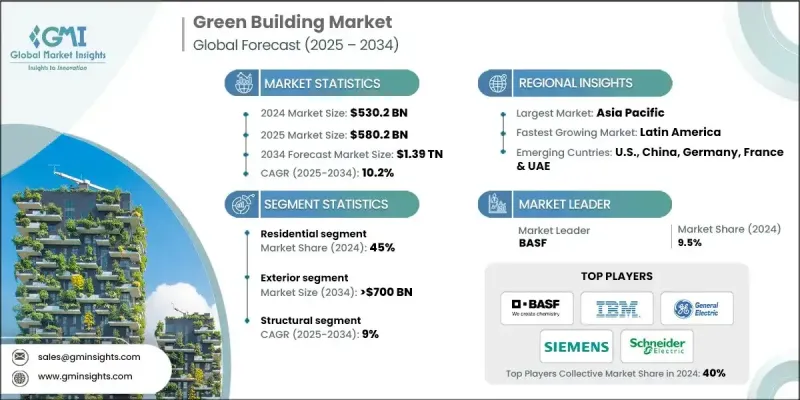
지속가능성, 에너지효율, 환경책임이 정부, 소비자, 부동산 개발업체들에게 핵심적인 우선 순위가 되는 가운데 이 업계는 계속 확대되고 있습니다. 가속화하는 도시화 및 보다 엄격한 건축 규제, 기후 변화에 대한 영향에 대한 의식 고조가 함께 시장 성장을 견인하고 있습니다. 현대 건축에서는 에너지 효율적인 건축 자재, 첨단 공조 솔루션, 현장 설치형 재생에너지 시스템이 점점 채용되어 건물의 설계 및 운용 방법이 근본적으로 변화하고 있습니다. 그린 빌딩 실천은 자원 소비 절감, 실내 환경 품질 향상, 주택, 상업 및 산업 용도에 있어서 장기적인 비용 절감을 실현합니다. 게다가 세계적인 인증 프레임워크, 기업의 지속가능성 목표, 환경 배려형 개발에 대한 사회적 기대 증가가 수요를 뒷받침하고 있습니다. 다양한 분야의 조직이 야심찬 배출 목표 달성, 운영 성능 최적화, 국제 환경 기준 준수를 목표로 시설을 업그레이드하고 있습니다.
| 시장 범위 | |
|---|---|
| 시작 연도 | 2024년 |
| 예측 연도 | 2025-2034년 |
| 시작 시 가치 | 5,302억 달러 |
| 예측 금액 | 1조 3,900억 달러 |
| CAGR | 10.2% |
주택 부문은 2024년에 45%의 점유율을 차지하였고, 2034년까지 연평균 복합 성장률(CAGR) 9.5%로 성장할 것으로 예측됩니다. 주택 소유자는 운영 비용 절감, 실내 공기 품질 향상, 환경 친화적인 설계 기능을 점점 더 중시하고 있습니다. 지속가능성을 중시한 건축재료, 스마트홈 기술, 탄소 배출량을 최소화하는 건축 수법의 도입이 추진되고 있습니다. 정부의 우대조치 및 건축 기준의 개정이 보급을 지원하고, 주택용 그린 빌딩은 향후 도시 개발의 중요한 요소로 확립되고 있습니다.
실내 그린 빌딩 분야는 2024년에 1,888억 달러 규모에 달했으며, 환경에 배려한 자재 및 시스템을 채용한 건강한 실내 공간에 대한 관심의 고조를 반영하고 있습니다. 재활용 및 저배출 제품, 자연 채광 강화, 고급 환기 시스템, 편안함과 에너지 성능을 최적화하는 스마트 제어 장치에 대한 수요가 증가 중입니다. ESG(환경, 사회 및 거버넌스)에 대한 대처 강화와 건강 지향의 디자인 기준이 지속 가능한 실내 환경으로의 이행을 가속화하고 있습니다.
북미의 녹색 빌딩 시장은 2034년까지 4,000억 달러에 이를 것으로 예측됩니다. 강력한 환경 규제와 강화되는 지속가능성에 대한 기대가 개발자에게 에코 효율적인 설계, 자원 절약형 자재, 인텔리전트 빌딩 기술의 도입을 촉구하고 있습니다. 지원 정책, 확대하는 인증 프로그램, 건강한 실내 공간에 대한 중점 강화가 지역 전체에서 장기적인 보급을 지속적으로 추진하고 있습니다.
자주 묻는 질문
목차
제1장 조사 방법 및 범위
제2장 주요 요약
제3장 업계 인사이트
- 생태계 분석
- 원재료 가용성 및 조달 분석
- 제조 능력 평가
- 공급망의 회복력 및 리스크 요인
- 유통 네트워크 분석
- 규제 상황
- 업계에 미치는 영향요인
- 성장 촉진요인
- 업계의 잠재적 위험 및 과제
- 성장 가능성 분석
- Porter's Five Forces 분석
- PESTEL 분석
- 그린 빌딩의 비용 구조 분석
- 새로운 성장 기회
- 지속 가능한 건설을 형성하는 주요 동향
- 투자 환경 및 장기적인 전망
- 디지털 전환 및 인더스트리 4.0의 통합
- 지속가능성 이니셔티브 및 기준
제4장 경쟁 구도
- 서문
- 기업의 시장 점유율 분석 : 지역별
- 북미
- 유럽
- 아시아태평양
- 중동 및 아프리카
- 라틴아메리카
- 전략적 대시보드
- 전략적 노력
- 주요 제휴 및 협력관계
- 주요 M&A 활동
- 제품 혁신 및 신제품 출시
- 시장 확대 전략
- 경쟁 벤치마킹
- 혁신 및 지속가능성의 정세
제5장 시장 규모 및 예측 : 최종 용도별(2021-2034년)
- 주요 동향
- 주택용
- 상업용
- 산업용
제6장 시장 규모 및 예측 : 프로젝트 유형별(2021-2034년)
- 주요 동향
- 신규
- 리노베이션
제7장 시장 규모 및 예측 : 제품별(2021-2034년)
- 주요 동향
- 인테리어
- 외장
- 기타
제8장 시장 규모 및 예측 : 소재 유형별(2021-2034년)
- 주요 동향
- 구조용
- 단열재
- 마무리
- 유리 및 유리 가공
제9장 시장 규모 및 예측 : 판매 채널별(2021-2034년)
- 주요 동향
- 온라인
- 오프라인
제10장 시장 규모 및 예측 : 지역별(2021-2034년)
- 주요 동향
- 북미
- 미국
- 캐나다
- 멕시코
- 유럽
- 독일
- 영국
- 프랑스
- 네덜란드
- 스웨덴
- 이탈리아
- 스페인
- 덴마크
- 노르웨이
- 아시아태평양
- 중국
- 일본
- 인도
- 한국
- 호주
- 싱가포르
- 인도네시아
- 말레이시아
- 중동 및 아프리카
- 아랍에미리트(UAE)
- 사우디아라비아
- 남아프리카
- 카타르
- 쿠웨이트
- 이집트
- 케냐
- 모로코
- 라틴아메리카
- 브라질
- 칠레
- 아르헨티나
제11장 기업 프로파일
- ABB
- Alleguard
- Alumasc Building Products
- BASF
- Bauder Ltd.
- Binderholz GmbH
- Bosch Sicherheitssysteme GmbH
- BSW GROUP
- CEMEX
- CertainTeed, LLC
- Daikin
- DuPont
- Forbo
- General Electric Company
- HOLCIM
- IBM
- Interface, Inc.
- Johnson Controls
- Kingspan Group
- Owens Corning
- RedBuilt
- Schneider Electric
- Siemens
- Signify Holding
The Global Green Building Market was valued at USD 530.2 billion in 2024 and is estimated to grow at a CAGR of 10.2% to reach USD 1.39 trillion by 2034.
The industry is expanding as sustainability, energy efficiency, and environmental responsibility become core priorities for governments, consumers, and real estate developers. Accelerating urbanization, combined with stricter building regulations and heightened awareness of climate impacts, continues to drive market growth. Modern construction increasingly incorporates energy-efficient materials, advanced HVAC solutions, and on-site renewable systems, fundamentally reshaping how buildings are designed and operated. Green building practices reduce resource consumption, improve indoor environmental quality, and support long-term cost savings across residential, commercial, and industrial applications. Demand is further reinforced by global certification frameworks, corporate sustainability goals, and rising public expectations for environmentally conscious development. Organizations across multiple sectors are upgrading facilities to meet ambitious emissions targets, optimize operational performance, and align with global environmental standards.
| Market Scope | |
|---|---|
| Start Year | 2024 |
| Forecast Year | 2025-2034 |
| Start Value | $530.2 Billion |
| Forecast Value | $1.39 Trillion |
| CAGR | 10.2% |
The residential segment held a 45% share in 2024 and is projected to grow at a CAGR of 9.5% through 2034. Homeowners increasingly value lower operating costs, improved indoor air quality, and eco-friendly design features. Adoption is fueled by sustainability-driven materials, smart home technologies, and construction methods that minimize carbon output. Government incentives and updated building regulations support widespread integration, establishing residential green buildings as a key component of future urban development.
The interior green building segment reached USD 188.8 billion in 2024, reflecting growing interest in healthier indoor spaces that incorporate environmentally responsible materials and systems. Demand is rising for recycled and low-emission products, enhanced natural light, advanced ventilation, and smart controls that optimize comfort and energy performance. Strengthening ESG commitments and wellness-oriented design standards are accelerating the shift toward sustainable interior environments.
North America Green Building Market is expected to reach USD 400 billion by 2034. Strong environmental regulations and heightened sustainability expectations are encouraging developers to deploy eco-efficient designs, resource-saving materials, and intelligent building technologies. Supportive policies, expanding certification programs, and increased emphasis on healthy indoor spaces continue to drive long-term adoption across the region.
Key companies active in the Green Building Market include CertainTeed, DuPont, Binderholz, Johnson Controls, Alumasc Building Products, General Electric Company, BSW GROUP, Kingspan Group, Signify Holding, CEMEX, HOLCIM, Forbo, Bosch Sicherheitssysteme, Owens Corning, Daikin, Bauder, Interface, ABB, Alleguard, Schneider Electric, RedBuilt, Siemens, BASF, and IBM. Companies competing in the Green Building Market are employing a range of strategies to strengthen their market position and expand global reach. Many firms are investing in advanced sustainable materials, energy-efficient building systems, and low-carbon manufacturing processes to meet growing regulatory and consumer expectations. Partnerships with construction firms, technology providers, and certification bodies help accelerate innovation and create integrated solutions tailored to modern green standards. Companies are also expanding product portfolios to address diverse applications, from residential retrofits to large-scale commercial projects.
Table of Contents
Chapter 1 Methodology & Scope
- 1.1 Research design
- 1.1.1 Research approach
- 1.1.2 Data collection methods
- 1.2 Base estimates and calculations
- 1.2.1 Base year calculation
- 1.2.2 Market estimates & forecast parameters
- 1.3 Forecast model
- 1.3.1 Key trends for market estimates
- 1.3.2 Quantified market impact analysis
- 1.3.2.1 Mathematical impact of growth parameters on forecast
- 1.3.3 Scenario analysis framework
- 1.4 Primary research and validation
- 1.4.1 Some of the primary sources (but not limited to)
- 1.5 Data mining sources
- 1.5.1 Paid Sources
- 1.5.2 Sources, by region
- 1.6 Research trail & scoring components
- 1.6.1 Research trail components
- 1.6.2 Scoring components
- 1.7 Research transparency addendum
- 1.7.1 Source attribution framework
- 1.7.2 Quality assurance metrics
- 1.7.3 Our commitment to trust
- 1.8 Market definitions
Chapter 2 Executive Summary
- 2.1 Industry synopsis, 2021 - 2034
- 2.1.1 Business trends
- 2.1.2 End use trends
- 2.1.3 Project type trends
- 2.1.4 Product trends
- 2.1.5 Material type trends
- 2.1.6 Sales channel trends
- 2.1.7 Regional trends
Chapter 3 Industry Insights
- 3.1 Industry ecosystem analysis
- 3.1.1 Raw material availability & sourcing analysis
- 3.1.2 Manufacturing capacity assessment
- 3.1.3 Supply chain resilience & risk factors
- 3.1.4 Distribution network analysis
- 3.2 Regulatory landscape
- 3.3 Industry impact forces
- 3.3.1 Growth drivers
- 3.3.2 Industry pitfalls & challenges
- 3.4 Growth potential analysis
- 3.5 Porter's analysis
- 3.5.1 Bargaining power of suppliers
- 3.5.2 Bargaining power of buyers
- 3.5.3 Threat of new entrants
- 3.5.4 Threat of substitutes
- 3.6 PESTEL analysis
- 3.6.1 Political factors
- 3.6.2 Economic factors
- 3.6.3 Social factors
- 3.6.4 Technological factors
- 3.6.5 Legal factors
- 3.6.6 Environmental factors
- 3.7 Cost structure analysis of green buildings
- 3.8 Emerging growth opportunities
- 3.9 Key trends shaping sustainable construction
- 3.10 Investment landscape & long-term prospects
- 3.11 Digital transformation & industry 4.0 integration
- 3.12 Sustainability initiatives & standards
Chapter 4 Competitive Landscape, 2025
- 4.1 Introduction
- 4.2 Company market share analysis, by region, 2024
- 4.2.1 North America
- 4.2.2 Europe
- 4.2.3 Asia Pacific
- 4.2.4 Middle East & Africa
- 4.2.5 Latin America
- 4.3 Strategic dashboard
- 4.4 Strategic initiatives
- 4.4.1 Key partnerships & collaborations
- 4.4.2 Major M&A activities
- 4.4.3 Product innovations & launches
- 4.4.4 Market expansion strategies
- 4.5 Competitive benchmarking
- 4.6 Innovation & sustainability landscape
Chapter 5 Market Size and Forecast, By End Use, 2021 - 2034 (USD Million)
- 5.1 Key trends
- 5.2 Residential
- 5.3 Commercial
- 5.4 Industrial
Chapter 6 Market Size and Forecast, By Project Type, 2021 - 2034 (USD Million)
- 6.1 Key trends
- 6.2 New
- 6.3 Retrofit
Chapter 7 Market Size and Forecast, By Product, 2021 - 2034 (USD Million)
- 7.1 Key trends
- 7.2 Interior
- 7.3 Exterior
- 7.4 Others
Chapter 8 Market Size and Forecast, By Material Type, 2021 - 2034 (USD Million)
- 8.1 Key trends
- 8.2 Structural
- 8.3 Insulation
- 8.4 Finishing
- 8.5 Glass & glazing
Chapter 9 Market Size and Forecast, By Sales Channel, 2021 - 2034 (USD Million)
- 9.1 Key trends
- 9.2 Online
- 9.3 Offline
Chapter 10 Market Size and Forecast, By Region, 2021 - 2034 (USD Million)
- 10.1 Key trends
- 10.2 North America
- 10.2.1 U.S.
- 10.2.2 Canada
- 10.2.3 Mexico
- 10.3 Europe
- 10.3.1 Germany
- 10.3.2 UK
- 10.3.3 France
- 10.3.4 Netherlands
- 10.3.5 Sweden
- 10.3.6 Italy
- 10.3.7 Spain
- 10.3.8 Denmark
- 10.3.9 Norway
- 10.4 Asia Pacific
- 10.4.1 China
- 10.4.2 Japan
- 10.4.3 India
- 10.4.4 South Korea
- 10.4.5 Australia
- 10.4.6 Singapore
- 10.4.7 Indonesia
- 10.4.8 Malaysia
- 10.5 Middle East & Africa
- 10.5.1 UAE
- 10.5.2 Saudi Arabia
- 10.5.3 South Africa
- 10.5.4 Qatar
- 10.5.5 Kuwait
- 10.5.6 Egypt
- 10.5.7 Kenya
- 10.5.8 Morocco
- 10.6 Latin America
- 10.6.1 Brazil
- 10.6.2 Chile
- 10.6.3 Argentina
Chapter 11 Company Profiles
- 11.1 ABB
- 11.2 Alleguard
- 11.3 Alumasc Building Products
- 11.4 BASF
- 11.5 Bauder Ltd.
- 11.6 Binderholz GmbH
- 11.7 Bosch Sicherheitssysteme GmbH
- 11.8 BSW GROUP
- 11.9 CEMEX
- 11.10 CertainTeed, LLC
- 11.11 Daikin
- 11.12 DuPont
- 11.13 Forbo
- 11.14 General Electric Company
- 11.15 HOLCIM
- 11.16 IBM
- 11.17 Interface, Inc.
- 11.18 Johnson Controls
- 11.19 Kingspan Group
- 11.20 Owens Corning
- 11.21 RedBuilt
- 11.22 Schneider Electric
- 11.23 Siemens
- 11.24 Signify Holding


