|
시장보고서
상품코드
1885913
신생아 케어 시장 : 기회, 성장 요인, 업계 동향 분석 및 예측(2025-2034년)Neonatal Infant Care Market Opportunity, Growth Drivers, Industry Trend Analysis, and Forecast 2025 - 2034 |
||||||

세계의 신생아 케어 시장은 2024년에 28억 달러로 평가되었고, 2034년까지 연평균 복합 성장률(CAGR)은 6.4%를 나타낼 것으로 예측되며 53억 달러로 성장할 전망입니다.
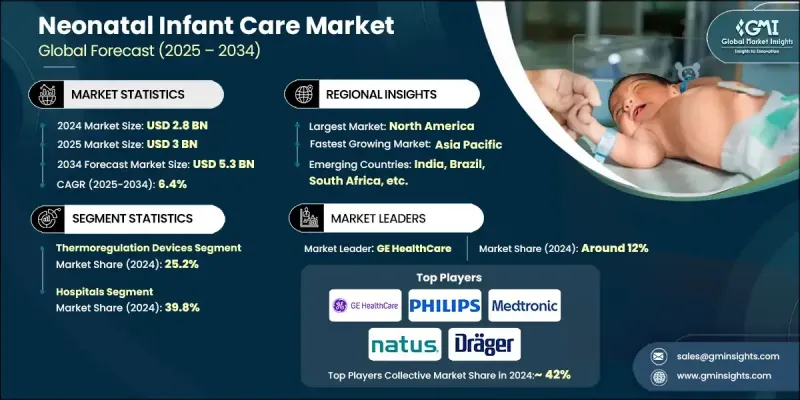
시장 확장은 신생아 집중 치료실(NICU)의 증가, 모자 보건에 대한 정부 투자 확대, 조산아 출생률 증가에 의해 주도되고 있습니다. 신생아 치료 기술의 발전과 영아 사망률 및 의료 품질 기준에 대한 인식 제고가 시장 채택을 촉진하고 있습니다. 휴대용 및 비침습적 신생아 치료 솔루션 개발과 신흥 경제국의 의료비 지출 증가 역시 주요 성장 요인입니다. 공중보건 정책과 국제 기금은 신생아 의료기기 접근성을 지원하며, 병원 보조금 및 환급 정책은 기관들이 첨단 기술에 투자할 수 있도록 합니다. 이러한 요소들이 종합적으로 작용하여 전 세계적으로 신생아 치료 기기 채택을 위한 견고한 환경을 조성하고 있습니다.
| 시장 범위 | |
|---|---|
| 시작 연도 | 2024년 |
| 예측 연도 | 2025-2034년 |
| 시작 금액 | 28억 달러 |
| 예측 금액 | 53억 달러 |
| CAGR | 6.4% |
2024년 체온 조절 장치 부문은 25.2%의 점유율을 차지했습니다. 인큐베이터 및 방사선 온열기 같은 기기는 조산아 및 저체중 신생아의 최적 체온을 유지하여 저체온증 및 관련 합병증을 예방합니다. 모자 보건 프로그램에 대한 정부 지원은 이러한 기술에 대한 수요를 더욱 촉진합니다.
2024년 병원 부문은 39.8%의 점유율을 차지했습니다. 신생아 치료 기기의 주요 사용자로서 병원은 전문 신생아 집중 치료실(NICU)과 첨단 인프라의 혜택을 받습니다. 증가하는 환자 수와 꾸준한 정부 지원으로 인공호흡기, 모니터링 시스템, 인큐베이터 등 지속적인 업그레이드가 촉진되고 있습니다. 종합적인 신생아 솔루션을 통합할 수 있는 역량 덕분에 병원은 시장 성장의 핵심으로 남아 있습니다
북미의 신생아 케어 시장은 2024년 34.1%의 점유율을 차지했습니다. 미국과 캐나다의 강력한 의료 인프라, 영유아 건강에 대한 인식 제고, 첨단 신생아중환자실(NICU)의 존재가 시장 확장을 뒷받침하고 있습니다. AI 및 IoT 기반 기기의 신속한 통합과 유리한 보험급여 정책이 도입을 더욱 촉진하고 있습니다.
자주 묻는 질문
목차
제1장 조사 방법과 범위
제2장 주요 요약
제3장 업계 인사이트
- 생태계 분석
- 업계에 미치는 영향요인
- 성장 촉진요인
- 조산율 증가 경향
- 신생아중환자실(NICU) 설치 증가
- 모자보건 프로그램에 대한 정부 투자 확대
- 신생아 치료 장비 기술 발전
- 업계의 잠재적 위험 및 과제
- 고급 신생아 치료 장비의 높은 비용
- 저소득 지역의 신생아중환자실(NICU) 시설 접근성 제한
- 기회
- 가정 기반 신생아 치료 솔루션의 확대
- 성장 촉진요인
- 성장 가능성 분석
- 규제 상황
- 북미
- 유럽
- 아시아태평양
- LAMEA
- 기술과 혁신 동향
- 현재의 기술 동향
- 신흥기술
- 정책 환경
- 역학 시나리오
- NICU의 환자 안전과 감염 관리 대책
- 지역별 신생아 집중 치료실(NICU)수(2024년)
- 세계
- 북미
- 유럽
- 아시아태평양
- 라틴아메리카
- 중동 및 아프리카
- Porter's Five Forces 분석
- PESTEL 분석
- 갭 분석
- 장래 시장 동향
제4장 경쟁 구도
- 소개
- 기업 매트릭스 분석
- 기업의 시장 점유율 분석
- 세계
- 북미
- 유럽
- 아시아태평양
- LAMEA
- 주요 시장 기업의 경쟁 분석
- 경쟁 포지셔닝 매트릭스
- 주요 발전
- 합병 및 인수
- 제휴 및 협업
- 신제품 발매
- 확대 계획
제5장 시장 추계 및 예측 : 제품 유형별(2021-2034년)
- 주요 동향
- 체온 조절 장치
- 신생아 인큐베이터
- 보온기
- 신생아 냉각 시스템
- 광선 치료 장치
- LED 광선 치료 시스템
- CFL 광선 치료 시스템
- 모니터링 시스템
- 신생아 인공호흡기
- 혈액가스 모니터링 시스템
- 뇌 모니터링
- 기타 모니터링 시스템
- 신생아 소생 장치
- 신생아 청각 스크리닝
- 시력 스크리닝
- 기타 제품 유형
제6장 시장 추계 및 예측 : 최종 용도별(2021-2034년)
- 주요 동향
- 병원
- 소아과 및 신생아과 클리닉
- 간병 시설
제7장 시장 추계 및 예측 : 지역별(2021-2034년)
- 주요 동향
- 북미
- 미국
- 캐나다
- 유럽
- 독일
- 영국
- 프랑스
- 스페인
- 이탈리아
- 네덜란드
- 아시아태평양
- 중국
- 일본
- 인도
- 호주
- 한국
- 라틴아메리카
- 브라질
- 멕시코
- 아르헨티나
- 중동 및 아프리카
- 남아프리카
- 사우디아라비아
- 아랍에미리트(UAE)
- 나이지리아
- 이집트
제8장 기업 프로파일
- ATOM MEDICAL
- AVI Healthcare
- COBAMS
- DAVID
- Drager
- Fanem Medical Devices
- Fisher &Paykel HEALTHCARE
- GE Healthcare
- INSPIRATION HEALTHCARE GROUP
- MASIMO
- Medtronic
- Natus Medical
- Novos Medical Systems
- PHILIPS
- PHOENIX
- PLUSS
The Global Neonatal Infant Care Market was valued at USD 2.8 billion in 2024 and is estimated to grow at a CAGR of 6.4% to reach USD 5.3 billion by 2034.
The market expansion is driven by the increasing establishment of NICU units, rising government investments in maternal and child healthcare, and the growing incidence of premature births. Advances in neonatal care technology, coupled with heightened awareness of infant mortality and healthcare quality standards, are fueling adoption. The development of portable and non-invasive neonatal care solutions and increased healthcare spending in emerging economies are also key growth contributors. Public health initiatives and international grants support access to neonatal devices, while hospital subsidies and reimbursement policies enable institutions to invest in advanced technology. Collectively, these factors are creating a robust environment for the adoption of neonatal infant care devices globally.
| Market Scope | |
|---|---|
| Start Year | 2024 |
| Forecast Year | 2025-2034 |
| Start Value | $2.8 Billion |
| Forecast Value | $5.3 Billion |
| CAGR | 6.4% |
In 2024, the thermoregulation devices segment accounted for a 25.2% share. Devices such as incubators and radiant warmers maintain optimal body temperature for premature and low-birth-weight infants, preventing hypothermia and related complications. Government support for maternal and child health programs further drives demand for these technologies.
The hospitals segment held a 39.8% share in 2024. As primary users of neonatal care devices, hospitals benefit from specialized NICUs and advanced infrastructure. The rising patient population and consistent government funding encourage continuous upgrades, including ventilators, monitoring systems, and incubators. Hospitals remain central to market growth due to their capacity to integrate comprehensive neonatal solutions.
North America Neonatal Infant Care Market held 34.1% share in 2024. Strong healthcare infrastructure, increased awareness of infant health, and the presence of advanced NICUs in the U.S. and Canada support market expansion. The rapid integration of AI- and IoT-enabled devices, along with favorable reimbursement policies, further propels adoption.
Key players in the Neonatal Infant Care Market include GE Healthcare, Drager, Fisher & Paykel Healthcare, Medtronic, ATOM Medical, Masimo, Philips, Phoenix, Inspiration Healthcare Group, Cobams, Natus Medical, David, Novos Medical Systems, Fanem Medical Devices, Pluss, and AVI Healthcare. Companies operating in the Neonatal Infant Care Market are strengthening their position by investing in innovative device technologies, such as AI-driven monitoring systems and portable care solutions. They focus on strategic collaborations with hospitals and healthcare providers to expand distribution networks and increase market penetration. Continuous R&D initiatives enhance product reliability, energy efficiency, and usability, ensuring compliance with regulatory standards.
Table of Contents
Chapter 1 Methodology and Scope
- 1.1 Market scope and definition
- 1.2 Research design
- 1.2.1 Research approach
- 1.2.2 Data collection methods
- 1.3 Data mining sources
- 1.3.1 Global
- 1.3.2 Regional/Country
- 1.4 Base estimates and calculations
- 1.4.1 Base year calculation
- 1.4.2 Key trends for market estimation
- 1.5 Primary research and validation
- 1.5.1 Primary sources
- 1.6 Forecast model
- 1.7 Research assumptions and limitations
Chapter 2 Executive Summary
- 2.1 Industry 360° synopsis
- 2.2 Key market trends
- 2.2.1 Regional trends
- 2.2.2 Product type trends
- 2.2.3 End use trends
- 2.3 CXO perspectives: Strategic imperatives
- 2.3.1 Key decision points for industry executives
- 2.3.2 Critical success factors for market players
- 2.4 Future outlook and strategic recommendations
Chapter 3 Industry Insights
- 3.1 Industry ecosystem analysis
- 3.2 Industry impact forces
- 3.2.1 Growth drivers
- 3.2.1.1 Rising incidence of premature birth rate
- 3.2.1.2 Increasing number of installations for NICU units
- 3.2.1.3 Growing government investments in maternal and child health programs
- 3.2.1.4 Technological advancements in neonatal infant care devices
- 3.2.2 Industry pitfalls and challenges
- 3.2.2.1 High cost of advanced neonatal care equipment
- 3.2.2.2 Limited accessibility to NICU facilities in low-income regions
- 3.2.3 Opportunities
- 3.2.3.1 Expansion of home-based neonatal care solutions
- 3.2.1 Growth drivers
- 3.3 Growth potential analysis
- 3.4 Regulatory landscape
- 3.4.1 North America
- 3.4.2 Europe
- 3.4.3 Asia Pacific
- 3.4.4 LAMEA
- 3.5 Technology and innovation landscape
- 3.5.1 Current technological trends
- 3.5.2 Emerging technologies
- 3.6 Policy landscape
- 3.7 Epidemiology scenario
- 3.8 Patient safety and infection control measures in NICUs
- 3.9 Number of neonatal intensive care units, by region, 2024
- 3.9.1 Global
- 3.9.2 North America
- 3.9.3 Europe
- 3.9.4 Asia Pacific
- 3.9.5 Latin America
- 3.9.6 MEA
- 3.10 Porter's analysis
- 3.11 PESTEL analysis
- 3.12 Gap analysis
- 3.13 Future market trends
Chapter 4 Competitive Landscape, 2024
- 4.1 Introduction
- 4.2 Company matrix analysis
- 4.3 Company market share analysis
- 4.3.1 Global
- 4.3.2 North America
- 4.3.3 Europe
- 4.3.4 Asia Pacific
- 4.3.5 LAMEA
- 4.4 Competitive analysis of major market players
- 4.5 Competitive positioning matrix
- 4.6 Key developments
- 4.6.1 Mergers & acquisitions
- 4.6.2 Partnerships & collaborations
- 4.6.3 New product launches
- 4.6.4 Expansion plans
Chapter 5 Market Estimates and Forecast, By Product Type, 2021 - 2034 ($ Mn)
- 5.1 Key trends
- 5.2 Thermoregulation devices
- 5.2.1 Neonatal incubators
- 5.2.2 Warmers
- 5.2.3 Neonatal cooling systems
- 5.3 Phototherapy devices
- 5.3.1 LED phototherapy system
- 5.3.2 CFL phototherapy system
- 5.4 Monitoring systems
- 5.4.1 Neonatal ventilation
- 5.4.2 Blood gas monitoring system
- 5.4.3 Brain monitoring
- 5.4.4 Other monitoring systems
- 5.5 Neonatal infant resuscitator devices
- 5.6 Neonatal hearing screening
- 5.7 Vision screening
- 5.8 Other product types
Chapter 6 Market Estimates and Forecast, By End Use, 2021 - 2034 ($ Mn)
- 6.1 Key trends
- 6.2 Hospitals
- 6.3 Pediatric & neonatal clinics
- 6.4 Nursing homes
Chapter 7 Market Estimates and Forecast, By Region, 2021 - 2034 ($ Mn)
- 7.1 Key trends
- 7.2 North America
- 7.2.1 U.S.
- 7.2.2 Canada
- 7.3 Europe
- 7.3.1 Germany
- 7.3.2 UK
- 7.3.3 France
- 7.3.4 Spain
- 7.3.5 Italy
- 7.3.6 Netherlands
- 7.4 Asia Pacific
- 7.4.1 China
- 7.4.2 Japan
- 7.4.3 India
- 7.4.4 Australia
- 7.4.5 South Korea
- 7.5 Latin America
- 7.5.1 Brazil
- 7.5.2 Mexico
- 7.5.3 Argentina
- 7.6 MEA
- 7.6.1 South Africa
- 7.6.2 Saudi Arabia
- 7.6.3 UAE
- 7.6.4 Nigeria
- 7.6.5 Egypt
Chapter 8 Company Profiles
- 8.1 ATOM MEDICAL
- 8.2 AVI Healthcare
- 8.3 COBAMS
- 8.4 DAVID
- 8.5 Drager
- 8.6 Fanem Medical Devices
- 8.7 Fisher & Paykel HEALTHCARE
- 8.8 GE Healthcare
- 8.9 INSPIRATION HEALTHCARE GROUP
- 8.10 MASIMO
- 8.11 Medtronic
- 8.12 Natus Medical
- 8.13 Novos Medical Systems
- 8.14 PHILIPS
- 8.15 PHOENIX
- 8.16 PLUSS