|
시장보고서
상품코드
1982323
리튬 이온 배터리 재활용 시장의 기회, 성장 요인, 업계 동향 분석 및 예측(2026-2035년)Lithium-Ion Battery Recycling Market Opportunity, Growth Drivers, Industry Trend Analysis, and Forecast 2026 - 2035 |
||||||

세계의 리튬 이온 배터리 재활용 시장은 2025년 58억 달러로 평가되었고 CAGR은 20.6%를 나타낼 것으로 보이며, 2035년까지 375억 달러에 이를 것으로 추정됩니다.
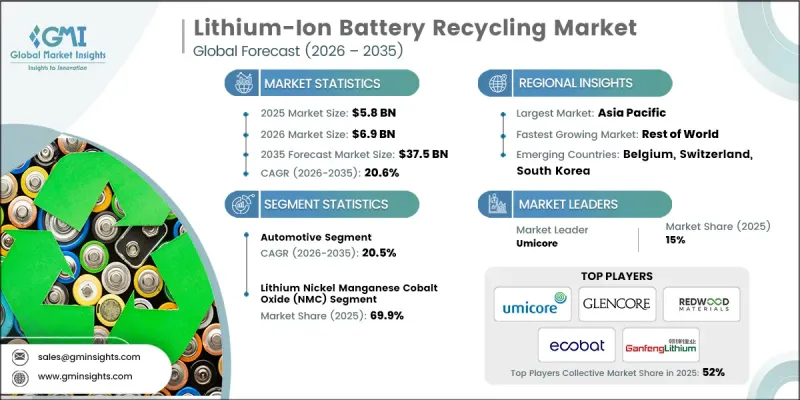
이 산업은 전문적인 환경 서비스에서 세계의 청정 에너지 공급망의 핵심 축으로 빠르게 전환되었습니다. 지난 몇 년간 수력 제련 공정은 기존 제련 방식보다 훨씬 정밀하게 리튬, 코발트, 니켈과 같은 고부가가치 금속을 회수할 수 있다는 장점 덕분에 선호되는 옵션으로 자리 잡았습니다. 이러한 전환은 높은 금속 회수 효율을 달성한 재활용 업체에 인센티브를 제공하는 새로운 글로벌 규정을 포함한 개정된 규제 체계에 의해 더욱 뒷받침되고 있으며, 이는 수성 정제 기술의 광범위한 도입을 촉진하고 있습니다. 또한 이 업계는 추가적인 금속 추출을 위한 중간 재료로 사용되는 블랙 매스의 생산 및 거래 분야에서 강력한 성장세를 보이고 있습니다. 소규모 재활용 업체들은 대형 수력제련 정제업체에 블랙 매스를 공급함으로써 이 부문에 점점 더 많이 참여하고 있습니다. 전기 이동 수단, 에너지 저장 프로젝트 및 제조 스크랩에서 발생하는 배터리 폐기물의 양이 증가함에 따라, 시장은 예측 기간 동안 가속화된 확장을 이룰 것으로 전망됩니다.
| 시장 범위 | |
|---|---|
| 시작 연도 | 2025년 |
| 예측 기간 | 2026-2035년 |
| 시작 시장 규모 | 58억 달러 |
| 예측 금액 | 375억 달러 |
| CAGR | 20.6% |
비자동차 부문은 2035년까지 연평균 성장률(CAGR) 20.9%로 성장할 것으로 전망됩니다. 전력망 안정화, 상업용 백업 전력, 재생 에너지 통합을 위한 에너지 저장 시스템(ESS)의 도입이 증가함에 따라, 긴 수명과 향상된 안전성으로 인해 배터리, 특히 인산철리튬(LFP) 화학 물질에 대한 수요가 크게 증가하고 있습니다. 구형 ESS 장비가 수명 주기의 끝을 맞이함에 따라, 귀중한 자원을 회수하고 차세대 기술을 위한 용량을 확보하기 위한 재활용 수요가 증가하여 시장 성장을 더욱 촉진하고 있습니다.
리튬 니켈 망간 코발트 산화물(NMC) 부문은 2025년 69.9%의 점유율을 기록했으며, 2026년부터 2035년까지 연평균 성장률(CAGR) 21%로 성장할 것으로 전망됩니다. 배터리 폐기 및 핵심 재료 재사용에 초점을 맞춘 정부 규제 및 정책의 강화는 배터리 재활용 부문의 성장을 뒷받침하고 있습니다. NMC 배터리는 이미 상업적으로 성숙한 열금속공법 및 습식금속공법 재활용 공정 모두와 높은 호환성을 보여 니켈, 코발트, 망간과 같은 금속을 효율적으로 회수할 수 있습니다. 또한, 전기차(EV) 및 고정형 저장 장치 용도의 핵심 요구 사항인 높은 에너지 밀도, 긴 수명, 안정적인 열 성능을 제공하는 화학 물질에 대한 선호도가 높아짐에 따라 NMC 배터리의 입지가 더욱 공고해지고 있습니다.
자주 묻는 질문
목차
제1장 조사 방법과 범위
제2장 주요 요약
제3장 업계 인사이트
- 업계의 생태계
- 원재료 가용성 및 조달 분석
- 생산 능력 평가
- 공급망의 탄력성과 위험요인
- 유통 네트워크 분석
- 규제 상황
- 업계에 미치는 영향요인
- 성장 촉진요인
- 업계의 잠재적 위험 및 과제
- 성장 가능성 분석
- Porter's Five Forces 분석
- 공급기업의 협상력
- 구매자의 협상력
- 신규 참가업체의 위협
- 대체품의 위협
- PESTEL 분석
- 비용 구조 분석
- 가격 동향 분석(달러/톤)
- 화학 조성별
- 기술 동향과 혁신
- 알칼리 배터리와 충전식 배터리 시장 침식
- 리튬 이온 화학의 진화
- 급속 충전 및 고방전 배터리의 혁신
- 신흥 화학 성분 전망
- 투자분석과 전망
제4장 경쟁 구도
- 소개
- 기업의 시장 점유율 분석 : 지역별
- 북미
- 유럽
- 아시아태평양
- 세계 기타 지역
- 경쟁 벤치마킹
- 주요 발전
- 합병 및 인수
- 제휴 및 협업
- 신제품 발매
- 사업 확대 계획과 자금 조달
제5장 시장 규모 및 예측 : 화학 조성별(2022-2035년)
- 리튬 니켈 망간 코발트 산화물(NMC)
- 인산철 리튬(LFP)
- 산화리튬 코발트(LCO)
- 기타
제6장 시장 규모 및 예측 : 프로세스별(2022-2035년)
- 열 제련
- 습식 제련
- 물리적 및 기계적
제7장 시장 규모 및 예측 : 원료별(2022-2035년)
- 자동차
- 비자동차
제8장 시장 규모 및 예측 : 지역별(2022-2035년)
- 북미
- 미국
- 캐나다
- 유럽
- 영국
- 프랑스
- 벨기에
- 스위스
- 독일
- 아시아태평양
- 중국
- 한국
- 일본
- 세계 기타 지역
제9장 기업 프로파일
- 3R Recycler
- Accurec Recycling
- ACE Green Recycling
- American Battery Technology Company
- Attero Recycling
- Altilium Metals
- BatX Energies
- Cylib
- Cirba Solutions
- Ecobat
- Eramet
- Glencore
- Ganfeng Lithium
- Lohum Cleantech
- Neometals
- Recyclus Group
- RecycLiCo Battery Material
- Redwood Materials
- SK TES
- Umicore
The Global Lithium-Ion Battery Recycling Market was valued at USD 5.8 billion in 2025 and is estimated to grow at a CAGR of 20.6% to reach USD 37.5 billion by 2035.
The industry has rapidly shifted from a specialized environmental service to a central part of the clean energy supply chain worldwide. Over the past few years, hydrometallurgical processes have become the preferred option due to their ability to recover high-value metals such as lithium, cobalt, and nickel with far greater precision than conventional smelting. This transition is further supported by updated regulatory frameworks, including new global rules that reward recyclers achieving high metal recovery efficiencies, encouraging wider adoption of water-based refining technologies. The industry is also experiencing strong momentum in the production and trade of black mass, which serves as an intermediate material for further metal extraction. Smaller recyclers are increasingly participating in this segment by supplying black mass to larger hydrometallurgical refiners. With the growing volume of battery waste generated from electric mobility, energy storage projects, and manufacturing scrap, the market is positioned for accelerated expansion throughout the forecast period.
| Market Scope | |
|---|---|
| Start Year | 2025 |
| Forecast Year | 2026-2035 |
| Start Value | $5.8 Billion |
| Forecast Value | $37.5 Billion |
| CAGR | 20.6% |
The non-automotive segment is projected to grow at a CAGR of 20.9% by 2035. Increasing deployment of energy storage systems (ESS) for grid stabilization, commercial backup power, and integration of renewable energy sources is driving strong demand for batteries, particularly lithium iron phosphate (LFP) chemistries, due to their long cycle life and enhanced safety. As older ESS units reach the end of their operational lifespan, the need for recycling rises to recover valuable materials and free capacity for next-generation technologies, further fueling market growth.
The lithium nickel manganese cobalt oxide (NMC) segment held a 69.9% share in 2025 and is expected to grow at a CAGR of 21% from 2026 to 2035. Strengthening government regulations and policies focused on battery disposal and critical material reuse are supporting the growth of the battery recycling sector. NMC batteries are highly compatible with both pyrometallurgical and hydrometallurgical recycling processes, which are already commercially mature, enabling efficient recovery of metals such as nickel, cobalt, and manganese. Additionally, growing preference for chemistries offering high energy density, long operational life, and stable thermal performance-key requirements for EVs and stationary storage applications is reinforcing the prominence of NMC batteries.
U.S. Lithium-Ion Battery Recycling Market held 86.5% share in 2025 and is expected to generate USD 5.4 billion by 2035. Federal initiatives, including Department of Energy (DOE) grants, tax incentives, and investments under the Bipartisan Infrastructure Law, are accelerating domestic recycling capacities. These programs aim to reduce reliance on imported critical minerals, improve supply chain resilience, and support circular economy objectives, encouraging large-scale recycling projects. The rapid increase in EV adoption is also producing a growing volume of spent lithium-ion batteries, intensifying demand for robust recycling infrastructure.
Major companies active in the Global Lithium-Ion Battery Recycling Market include Redwood Materials, Ganfeng Lithium, Umicore, Glencore, and Attero Recycling. Companies in the Lithium-Ion Battery Recycling Market are implementing multiple strategies to strengthen their presence and expand their competitive advantage. Many are investing heavily in hydrometallurgical capacity to improve recovery rates and reduce environmental impact, while also modernizing facilities with automation and advanced separation technologies. Firms are forging long-term supply agreements with EV manufacturers and battery producers to secure consistent waste streams. Strategic collaborations with government agencies help unlock funding and regulatory support for large-scale recycling initiatives.
Table of Contents
Chapter 1 Methodology & Scope
- 1.1 Research design
- 1.2 Quality commitment
- 1.2.1 GMI AI policy & data integrity commitment
- 1.2.1.1 Source consistency protocol
- 1.2.1 GMI AI policy & data integrity commitment
- 1.3 Research Trail & Confidence Scoring
- 1.3.1 Research Trail Components
- 1.3.2 Scoring Components
- 1.4 Data Collection
- 1.4.1 Partial list of primary sources
- 1.5 Data mining sources
- 1.5.1 Paid sources
- 1.5.1.1 Sources, by region
- 1.5.1 Paid sources
- 1.6 Base estimates and calculations
- 1.6.1 Base year calculation for any one approach
- 1.7 Forecast model
- 1.8 Research transparency addendum
- 1.8.1 Source attribution framework
- 1.8.2 Quality assurance metrics
- 1.8.3 Our commitment to trust
- 1.9 Market definitions
Chapter 2 Executive Summary
- 2.1 Industry synopsis, 2022 - 2035
- 2.2 Business trends
- 2.3 Chemistry trends
- 2.4 Process trends
- 2.5 Source trends
- 2.6 Regional trends
Chapter 3 Industry Insights
- 3.1 Industry ecosystem
- 3.1.1 Raw material availability & sourcing analysis
- 3.1.2 Manufacturing capacity assessment
- 3.1.3 Supply chain resilience & risk factors
- 3.1.4 Distribution network analysis
- 3.2 Regulatory landscape
- 3.3 Industry impact forces
- 3.3.1 Growth drivers
- 3.3.2 Industry pitfalls & challenges
- 3.4 Growth potential analysis
- 3.5 Porter's analysis
- 3.5.1 Bargaining power of suppliers
- 3.5.2 Bargaining power of buyers
- 3.5.3 Threat of new entrants
- 3.5.4 Threat of substitutes
- 3.6 PESTEL analysis
- 3.6.1 Political factors
- 3.6.2 Economic factors
- 3.6.3 Social factors
- 3.6.4 Technological factors
- 3.6.5 Legal factors
- 3.6.6 Environmental factors
- 3.7 Cost structure analysis
- 3.8 Price trend analysis (USD/Tons)
- 3.8.1 By chemistry
- 3.9 Technology trends & disruptions
- 3.9.1 Alkaline vs. rechargeable cannibalization
- 3.9.2 Lithium-ion chemistry evolution
- 3.9.3 Fast-charging & high-drain battery innovations
- 3.9.4 Emerging chemistries outlook
- 3.10 Investment analysis & future outlook
Chapter 4 Competitive landscape, 2026
- 4.1 Introduction
- 4.2 Company market share analysis, by region, 2025
- 4.2.1 North America
- 4.2.2 Europe
- 4.2.3 Asia Pacific
- 4.2.4 Rest of world
- 4.3 Competitive benchmarking
- 4.4 Key developments
- 4.4.1 Mergers & acquisitions
- 4.4.2 Partnerships & collaborations
- 4.4.3 New product launches
- 4.4.4 Expansion plans and funding
Chapter 5 Market Size and Forecast, By Chemistry, 2022 - 2035 (USD Billion & Thousand Tons)
- 5.1 Key trends
- 5.2 Lithium nickel manganese cobalt oxide (NMC)
- 5.3 Lithium iron phosphate (LFP)
- 5.4 Lithium cobalt oxide (LCO)
- 5.5 Others
Chapter 6 Market Size and Forecast, By Process, 2022 - 2035 (USD Billion & Thousand Tons)
- 6.1 Key trends
- 6.2 Pyrometallurgical
- 6.3 Hydrometallurgical
- 6.4 Physical/mechanical
Chapter 7 Market Size and Forecast, By Source, 2022 - 2035 (USD Billion & Thousand Tons)
- 7.1 Key trends
- 7.2 Automotive
- 7.3 Non-automotive
Chapter 8 Market Size and Forecast, By Region, 2022 - 2035 (USD Billion & Thousand Tons)
- 8.1 Key trends
- 8.2 North America
- 8.2.1 U.S.
- 8.2.2 Canada
- 8.3 Europe
- 8.3.1 UK
- 8.3.2 France
- 8.3.3 Belgium
- 8.3.4 Switzerland
- 8.3.5 Germany
- 8.4 Asia Pacific
- 8.4.1 China
- 8.4.2 South Korea
- 8.4.3 Japan
- 8.5 Rest of World
Chapter 9 Company Profiles
- 9.1 3R Recycler
- 9.2 Accurec Recycling
- 9.3 ACE Green Recycling
- 9.4 American Battery Technology Company
- 9.5 Attero Recycling
- 9.6 Altilium Metals
- 9.7 BatX Energies
- 9.8 Cylib
- 9.9 Cirba Solutions
- 9.10 Ecobat
- 9.11 Eramet
- 9.12 Glencore
- 9.13 Ganfeng Lithium
- 9.14 Lohum Cleantech
- 9.15 Neometals
- 9.16 Recyclus Group
- 9.17 RecycLiCo Battery Material
- 9.18 Redwood Materials
- 9.19 SK TES
- 9.20 Umicore