



|
시장보고서
상품코드
1892710
카셰어링 플랫폼 기술 시장 기회, 성장요인, 업계 동향 분석 및 예측(2025-2034년)Car-Sharing Platform Technologies Market Opportunity, Growth Drivers, Industry Trend Analysis, and Forecast 2025 - 2034 |
||||||

세계의 카셰어링 플랫폼 기술 시장은 2024년에 15억 달러로 평가되었고, 2034년까지 연평균 복합 성장률(CAGR) 8.9%로 성장하여 35억 달러에 이를 것으로 예측됩니다.

이러한 성장은 도시 지역의 인구 밀도 증가와 혼잡한 도로에 개인 차량을 추가하지 않고도 더 큰 편리함을 제공하는 교통 수단에 대한 수요 증가에 의해 주도되고 있습니다. 도시가 교통 체증, 급증하는 주차 수요, 변화하는 모빌리티 선호도를 해결하기 위해 노력하는 가운데, 소비자들은 디지털 생태계를 기반으로 한 공유 차량으로 이동하고 있습니다. 텔레매틱스 및 커넥티드카 시스템에서 AI를 활용한 차량 관리에 이르기까지 현대의 플랫폼 기술은 사업자가 차량 유지 관리, 사용량 모니터링 및 운영 비용을 절감하는 방법을 개선하고 있습니다. 데이터에 기반한 통찰력은 차량 재배치, 동적 가격 책정, 효율적인 배차를 지원하여 궁극적으로 차량 가동률 향상과 다운타임 감소로 이어집니다. 공유 모빌리티가 진화하는 가운데, 소유보다 유연성을 중시하는 사용자에게는 구독형이나 종량제 옵션이 매력적입니다. 원활한 모바일 애플리케이션, 통합 결제, 소셜 인증 기능은 도입 장벽을 더욱 낮춥니다. 젊은 층의 사용자들은 편리한 온디맨드 교통수단을 선호하고, 일상적인 이동과 비수기 이동을 위해 공유 모빌리티에 대한 의존도를 높이고 있으며, 도시와 교외 지역 모두에서 수요가 증가하고 있습니다.
| 시장 범위 | |
|---|---|
| 개시 연도 | 2024년 |
| 예측 연도 | 2025-2034년 |
| 개시 연도 시장 규모 | 15억 달러 |
| 예측 금액 | 35억 달러 |
| CAGR | 8.9% |
가솔린 자동차 부문은 2024년 51%의 점유율을 차지할 것으로 예상되며, 2025년부터 2034년까지 연평균 8%의 성장률을 보일 것으로 전망됩니다. 휘발유 차량은 주행거리가 길고 빠르게 급유할 수 있어 충전 네트워크가 아직 부족한 지역에 적합하며, 수요가 지속될 것으로 예측됩니다. 플랫폼 기술은 실시간 차량 모니터링, 연비 효율 분석, 지능형 경로 설정을 통해 성능을 향상시키고, 차량 수명을 연장하는 동시에 운영 비용을 절감합니다.
플랫폼 소프트웨어 및 백엔드 시스템 분야는 2024년 28%의 점유율을 차지하며 2034년까지 연평균 복합 성장률(CAGR) 9.8%를 보일 것으로 예측됩니다. 사업자들은 차량 배차, 출입 통제, 경로 설정, 운전자 인증을 처리하는 자동화된 소프트웨어 스택에 대한 의존도가 높아지고 있습니다. 이러한 시스템은 수작업을 크게 줄이고, 정확도를 향상시키며, 차량 가동률을 높이는 데 도움을 줍니다. 실시간 분석을 통해 예측 가능한 차량 밸런스를 조정할 수 있어 경쟁이 치열한 시장에서도 일관된 서비스 수준을 유지할 수 있습니다.
미국 카셰어링 플랫폼 기술 시장은 2024년 86%의 점유율을 차지하며 5억 7,400만 달러의 수익을 창출할 것으로 예측됩니다. 인구의 고밀도화, 주차 공간 부족, 교통비 상승으로 인해 미국 주요 대도시 지역에서 유연한 교통수단에 대한 수요가 증가하고 있습니다. 카셰어링 기술은 지속가능성 목표와 자동차 소유에 대한 인식의 변화에 따라 적응력이 뛰어나고 비용 효율적인 옵션을 제공합니다.
자주 묻는 질문
목차
제1장 조사 방법
- 시장 범위와 정의
- 조사 설계
- 조사 접근
- 데이터 수집 방법
- 데이터 마이닝 소스
- 세계
- 지역별/국가별
- 기본 추정치와 계산
- 기준연도 계산
- 시장 추정 주요 동향
- 1차 조사와 검증
- 1차 정보
- 예측 모델
- 조사의 전제조건과 제한 사항
제2장 주요 요약
제3장 업계 인사이트
- 생태계 분석
- 공급업체 상황
- 이익률 분석
- 비용 구조
- 각 단계별 부가가치
- 밸류체인에 영향을 미치는 요인
- 파괴적 변화
- 업계에 대한 영향요인
- 성장 촉진요인
- 업계의 잠재적 리스크&과제
- 시장 기회
- 성장 가능성 분석
- 주요 시장 동향과 변혁
- 향후 시장 동향
- 규제 상황
- Porter's Five Forces 분석
- PESTEL 분석
- 기술과 혁신 동향
- 현행 기술
- 실시간 차량 관리 플랫폼
- 커넥티드카용 텔레매틱스
- 모바일 기반 예약 및 액세스 시스템
- 통합 결제 및 청구 솔루션
- 신기술
- AI를 활용한 플릿 최적화와 예지보전
- 자율주행차 양통합
- 블록체인 기반 스마트 계약
- 5G 대응 V2X(Vehicle-to-Everything) 통신
- 현행 기술
- 특허 분석
- 지속가능성과 환경면
- 지속가능한 실천
- 폐기물 감축 전략
- 생산 에너지 효율
- 친환경 이니셔티브
- 탄소발자국에 관한 고려사항
- 시장 매력도 분석
- 기술 유형별 시장의 매력
- 비즈니스 모델별 시장의 매력
- 지역별 시장의 매력
- 시장 포화도 지수
- 도입 장벽 히트맵
- 비용 분석과 수익성에 관한 지견
- 총 소유비용(TCO) 분석
- 투자수익률(ROI) 분석
- 비용 구조 분석
- 수익성 모델과 유닛 경제
- 비용 절감 전략과 베스트 프랙티스
- 업계 벤치마크 및 핵심성과지표
- 업무 성과 지표
- 사용자 경험 지표
- 재무 성과 지표
- 기술 성과 지표
- 전략적 프레임워크와 의사결정 툴
- 기술 선정 프레임워크
- 자사개발 vs. 구입 vs. 파트너 선택 의사 의사결정 프레임워크
- 시장 진출 전략적 프레임워크
- 스케일링 및 성장 전략적 프레임워크
- 디지털 전환 로드맵
제4장 경쟁 구도
- 서론
- 기업의 시장 점유율 분석
- 주요 시장 기업의 경쟁 분석
- 경쟁 포지셔닝 매트릭스
- 전략적 전망 매트릭스
- 주요 발전
- 인수합병(M&A)
- 제휴 및 협업
- 신제품 발매
- 사업 확대 계획과 자금조달
제5장 시장 추산 및 예측 : 기술별, 2021-2034
- 주요 동향
- 플랫폼 소프트웨어 및 백엔드 시스템
- 모바일 및 사용자 인터페이스 용도
- 텔레매틱스 및 IoT 하드웨어
- 차량 액세스 제어 시스템
- 결제 및 청구 시스템
- 플릿 운영 및 최적화 시스템
- 기타
제6장 시장 추산 및 예측 : 추진력별, 2021-2034
- 주요 동향
- 가솔린
- 디젤
- BEV(배터리 전기자동차)
- PHEV
- HEV
제7장 시장 추산 및 예측 : 운영 모델별, 2021-2034
- 주요 동향
- Station-based round-trip
- Station-based one-way
- Home-zone car-sharing
- Free-floating one-way
- Peer-to-peer
제8장 시장 추산 및 예측 : 용도별, 2021-2034
- 주요 동향
- 도시 모빌리티 및 라스트 마일 배송
- MaaS 플랫폼 통합
- 기업용 차량 관리
- 기타
제9장 시장 추산 및 예측 : 최종 용도별, 2021-2034
- 주요 동향
- 카셰어링 사업자
- 자동차 제조업체
- 대중교통
- 기술 플랫폼 제공 기업 및 통합 사업자
- 기타
제10장 시장 추산 및 예측 : 지역별, 2021-2034
- 주요 동향
- 북미
- 미국
- 캐나다
- 유럽
- 영국
- 독일
- 프랑스
- 이탈리아
- 스페인
- 러시아
- 북유럽 국가
- 아시아태평양
- 중국
- 인도
- 일본
- 한국
- ANZ
- 동남아시아
- 라틴아메리카
- 브라질
- 멕시코
- 아르헨티나
- 중동 및 아프리카
- 남아프리카공화국
- 사우디아라비아
- 아랍에미리트(UAE)
제11장 기업 개요
- 세계 기업
- ATOM
- Getaround
- INVERS
- Ridecell
- Smartcar
- Turo
- Unbound
- Vulog
- Wunder
- Zipcar
- 지역 사업자
- Car2 Go
- DriveNow
- Modo
- GoGet
- Car Club
- GreenMobility
- Sixt Share
- ShareNow
- BlueIndy
- Communauto
- Convadis
- Fluctuo
- 신흥 사업자
- BluSmart
- Zuch
- Koenigsegg
- P2 P CarShare
- Ubeeqo
- DriveMyCar
- RidePark
- Karhoo
The Global Car-Sharing Platform Technologies Market was valued at USD 1.5 billion in 2024 and is estimated to grow at a CAGR of 8.9% to reach USD 3.5 billion by 2034.
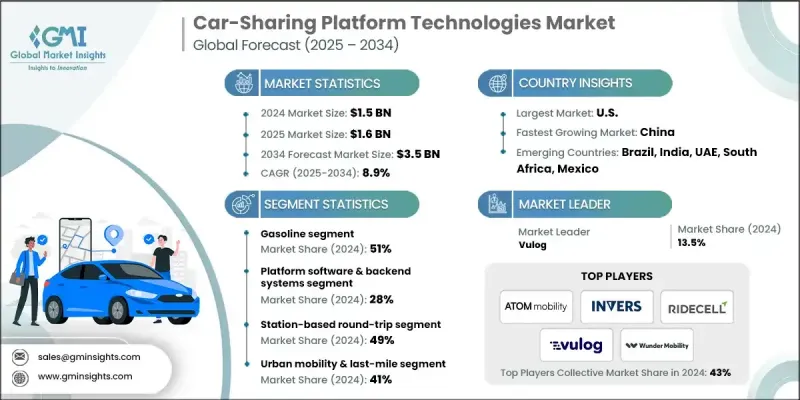
Growth is fueled by rising urban density and the increasing need for transportation models that provide greater convenience without adding more personal vehicles to crowded streets. With cities managing congestion, soaring parking demand, and shifting mobility preferences, consumers are gravitating toward shared fleets supported by digital ecosystems. Modern platform technologies ranging from telematics and connected vehicle systems to AI-powered fleet management are improving how operators maintain vehicles, monitor usage, and reduce operating costs. Data-driven insights support vehicle repositioning, dynamic pricing, and efficient dispatching, ultimately boosting fleet availability and reducing downtime. As shared mobility evolves, subscription-based and pay-per-use options appeal to users who prioritize flexibility over ownership. Seamless mobile applications, integrated payments, and social validation features further reduce adoption barriers. Younger users prefer convenient, on-demand transportation and are increasingly relying on shared mobility for both routine and off-peak travel, strengthening demand across urban and suburban areas.
| Market Scope | |
|---|---|
| Start Year | 2024 |
| Forecast Year | 2025-2034 |
| Start Value | $1.5 Billion |
| Forecast Value | $3.5 Billion |
| CAGR | 8.9% |
The gasoline vehicle segment held a 51% share in 2024 and is anticipated to grow at a CAGR of 8% from 2025 to 2034. Gasoline-powered fleets remain in demand due to dependable driving range and fast refueling, making them suitable for regions where charging networks are still limited. Platform technologies improve their performance through real-time vehicle monitoring, fuel-efficiency analytics, and intelligent routing that extends fleet life while lowering operational expenses.
The platform software and backend systems segment held a 28% share in 2024 and is expected to grow at a CAGR of 9.8% through 2034. Operators increasingly rely on automated software stacks that handle fleet dispatch, access control, routing, and driver verification. These systems significantly reduce manual labor, enhance accuracy, and support higher fleet utilization. Real-time analytics also make it possible to balance vehicles predictively and maintain consistent service levels across competitive markets.
U.S Car-Sharing Platform Technologies Market held an 86% share, generating USD 507.4 million in 2024. High population concentration, limited parking, and rising traffic costs are contributing to the demand for flexible transportation alternatives across major US metropolitan areas. Car-sharing technologies offer adaptable, cost-efficient options that align with sustainability goals and changing attitudes toward vehicle ownership.
Major companies in the Global Car-Sharing Platform Technologies Market include ATOM, Convadis, Fluctuo, INVERS, Karhoo, Ridecell, Smartcar, Unbound, Vulog, and Wunder. Companies in the Car-Sharing Platform Technologies Market are reinforcing their market presence by investing heavily in integrated mobility software, enhanced telematics, and scalable backend systems. Many firms focus on expanding real-time analytics capabilities to improve vehicle repositioning, optimize asset performance, and strengthen pricing strategies. Partnerships with automakers, urban mobility planners, and payment providers help broaden platform reach and support seamless service delivery. Providers are also adding modular and customizable software features to accommodate diverse fleet models and city regulations. Continuous upgrades to app interfaces, in-app payments, and user verification tools strengthen customer experience and retention.
Table of Contents
Chapter 1 Methodology
- 1.1 Market scope and definition
- 1.2 Research design
- 1.2.1 Research approach
- 1.2.2 Data collection methods
- 1.3 Data mining sources
- 1.3.1 Global
- 1.3.2 Regional/Country
- 1.4 Base estimates and calculations
- 1.4.1 Base year calculation
- 1.4.2 Key trends for market estimation
- 1.5 Primary research and validation
- 1.5.1 Primary sources
- 1.6 Forecast model
- 1.7 Research assumptions and limitations
Chapter 2 Executive Summary
- 2.1 Industry 360° synopsis, 2021 - 2034
- 2.2 Key market trends
- 2.2.1 Regional
- 2.2.2 Technology
- 2.2.3 Propulsion
- 2.2.4 Operational model
- 2.2.5 Application
- 2.2.6 End use
- 2.3 TAM Analysis, 2025-2034
- 2.4 CXO perspectives: Strategic imperatives
- 2.4.1 Executive decision points
- 2.4.2 Critical success factors
- 2.5 Future outlook
- 2.6 Strategic recommendations
Chapter 3 Industry Insights
- 3.1 Industry ecosystem analysis
- 3.1.1 Supplier landscape
- 3.1.2 Profit margin analysis
- 3.1.3 Cost structure
- 3.1.4 Value addition at each stage
- 3.1.5 Factor affecting the value chain
- 3.1.6 Disruptions
- 3.2 Industry impact forces
- 3.2.1 Growth drivers
- 3.2.1.1 Urbanization & shift toward shared mobility
- 3.2.1.2 Growth in connected vehicle technologies
- 3.2.1.3 Rising adoption of EV-based shared fleets
- 3.2.1.4 Integration of multimodal mobility ecosystems
- 3.2.2 Industry pitfalls and challenges
- 3.2.2.1 High deployment & integration costs
- 3.2.2.2 Regulatory compliance complexities
- 3.2.2.3 Vandalism, misuse & asset damage risks
- 3.2.2.4 Low profitability at low utilization
- 3.2.3 Market opportunities
- 3.2.3.1 Expansion into emerging smart-city markets
- 3.2.3.2 EV and decarbonization mandates
- 3.2.3.3 Corporate mobility programs
- 3.2.3.4 MaaS and API monetization
- 3.2.1 Growth drivers
- 3.3 Growth potential analysis
- 3.4 Major market trends and disruptions
- 3.5 Future market trends
- 3.6 Regulatory landscape
- 3.6.1 North America
- 3.6.2 Europe
- 3.6.3 Asia Pacific
- 3.6.4 Latin America
- 3.6.5 MEA
- 3.7 Porter's analysis
- 3.8 PESTEL analysis
- 3.9 Technology and innovation landscape
- 3.9.1 Current Technologies
- 3.9.1.1 Real-time fleet management platforms
- 3.9.1.2 Connected vehicle telematics
- 3.9.1.3 Mobile-based booking & access systems
- 3.9.1.4 Integrated payment & billing solutions
- 3.9.2 Emerging Technologies
- 3.9.2.1 AI-powered fleet optimization & predictive maintenance
- 3.9.2.2 autonomous vehicle integration
- 3.9.2.3 blockchain-based smart contracts
- 3.9.2.4 5g-enabled vehicle-to-everything (V2X) communication
- 3.9.1 Current Technologies
- 3.10 Patent analysis
- 3.11 Sustainability and environmental aspects
- 3.11.1 Sustainable practices
- 3.11.2 Waste reduction strategies
- 3.11.3 Energy efficiency in production
- 3.11.4 Eco-friendly initiatives
- 3.12 Carbon footprint considerations
- 3.13 Market attractiveness analysis
- 3.13.1 Market attractiveness by technology type
- 3.13.2 Market attractiveness by business model
- 3.13.3 Market attractiveness by region
- 3.13.4 Market saturation index
- 3.13.5 Adoption barriers heatmap
- 3.14 Cost analysis & profitability insights
- 3.14.1 Total cost of ownership (tco) analysis
- 3.14.2 Return on investment (roi) analysis
- 3.14.3 Cost structure breakdown
- 3.14.4 Profitability models & unit economics
- 3.14.5 Cost reduction strategies & best practices
- 3.15 Industry benchmarks & key performance indicators
- 3.15.1 Operational performance metrics
- 3.15.2 User experience metrics
- 3.15.3 Financial performance indicators
- 3.15.4 Technology performance metrics
- 3.16 Strategy frameworks & decision tools
- 3.16.1 Technology selection framework
- 3.16.2 Build vs. Buy vs. Partner decision framework
- 3.16.3 Market entry strategy framework
- 3.16.4 Scaling & growth strategy framework
- 3.16.5 Digital transformation roadmap
Chapter 4 Competitive Landscape, 2024
- 4.1 Introduction
- 4.2 Company market share analysis
- 4.2.1 North America
- 4.2.2 Europe
- 4.2.3 Asia Pacific
- 4.2.4 Latin America
- 4.2.5 MEA
- 4.3 Competitive analysis of major market players
- 4.4 Competitive positioning matrix
- 4.5 Strategic outlook matrix
- 4.6 Key developments
- 4.6.1 Mergers & acquisitions
- 4.6.2 Partnerships & collaborations
- 4.6.3 New product launches
- 4.6.4 Expansion plans and funding
Chapter 5 Market Estimates & Forecast, By Technology, 2021 - 2034 ($Bn)
- 5.1 Key trends
- 5.2 Platform software & backend systems
- 5.3 Mobile & user interface applications
- 5.4 Telematics & IoT hardware
- 5.5 Vehicle access control systems
- 5.6 Payment & billing systems
- 5.7 Fleet operations & optimization systems
- 5.8 Others
Chapter 6 Market Estimates & Forecast, By Propulsion, 2021 - 2034 ($Bn)
- 6.1 Key trends
- 6.2 Gasoline
- 6.3 Diesel
- 6.4 BEV
- 6.5 PHEV
- 6.6 HEV
Chapter 7 Market Estimates & Forecast, By Operational Model, 2021 - 2034 ($Bn)
- 7.1 Key trends
- 7.2 Station-based round-trip
- 7.3 Station-based one-way
- 7.4 Home-zone car-sharing
- 7.5 Free-floating one-way
- 7.6 Peer-to-peer
Chapter 8 Market Estimates & Forecast, By Application, 2021 - 2034 ($Bn)
- 8.1 Key trends
- 8.2 Urban mobility & last-mile
- 8.3 MaaS platform integration
- 8.4 Corporate fleet management
- 8.5 Others
Chapter 9 Market Estimates & Forecast, By End Use, 2021 - 2034 ($Bn)
- 9.1 Key trends
- 9.2 Car-sharing operators
- 9.3 Automotive OEMs
- 9.4 Public transport authorities
- 9.5 Technology platform providers & integrators
- 9.6 Others
Chapter 10 Market Estimates & Forecast, By Region, 2021-2034 ($Bn)
- 10.1 Key trends
- 10.2 North America
- 10.2.1 US
- 10.2.2 Canada
- 10.3 Europe
- 10.3.1 UK
- 10.3.2 Germany
- 10.3.3 France
- 10.3.4 Italy
- 10.3.5 Spain
- 10.3.6 Russia
- 10.3.7 Nordics
- 10.4 Asia Pacific
- 10.4.1 China
- 10.4.2 India
- 10.4.3 Japan
- 10.4.4 South Korea
- 10.4.5 ANZ
- 10.4.6 Southeast Asia
- 10.5 Latin America
- 10.5.1 Brazil
- 10.5.2 Mexico
- 10.5.3 Argentina
- 10.6 MEA
- 10.6.1 South Africa
- 10.6.2 Saudi Arabia
- 10.6.3 UAE
Chapter 11 Company Profiles
- 11.1 Global players
- 11.1.1 ATOM
- 11.1.2 Getaround
- 11.1.3 INVERS
- 11.1.4 Ridecell
- 11.1.5 Smartcar
- 11.1.6 Turo
- 11.1.7 Unbound
- 11.1.8 Vulog
- 11.1.9 Wunder
- 11.1.10 Zipcar
- 11.2 Regional players
- 11.2.1. Car2 Go
- 11.2.2 DriveNow
- 11.2.3 Modo
- 11.2.4 GoGet
- 11.2.5 Car Club
- 11.2.6 GreenMobility
- 11.2.7 Sixt Share
- 11.2.8 ShareNow
- 11.2.9 BlueIndy
- 11.2.10 Communauto
- 11.2.11 Convadis
- 11.2.12 Fluctuo
- 11.3 Emerging Players
- 11.3.1 BluSmart
- 11.3.2 Zuch
- 11.3.3 Koenigsegg
- 11.3.4. P2 P CarShare
- 11.3.5 Ubeeqo
- 11.3.6 DriveMyCar
- 11.3.7 RidePark
- 11.3.8 Karhoo


