|
시장보고서
상품코드
1892733
인터모달 운송 허브 시장 기회, 성장요인, 업계 동향 분석 및 예측(2025-2034년)Intermodal Transportation Hubs Market Opportunity, Growth Drivers, Industry Trend Analysis, and Forecast 2025 - 2034 |
||||||

세계의 인터모달 운송 허브 시장은 2024년에 475억 8,000만 달러로 평가되었고, 2034년까지 연평균 복합 성장률(CAGR) 9.3%로 성장하여 1,147억 9,000만 달러에 이를 것으로 예측됩니다.
이러한 성장은 철도, 도로, 항공, 해운 네트워크가 원활하게 통합되어 조정된 물류 생태계를 형성하는 화물 시스템으로의 전환에 의해 형성되고 있습니다. 현대식 복합운송 허브는 화물 사업자, 인프라 개발자 및 공급망 조직이 단일 운송 모드에 대한 의존도를 줄임으로써 화물 운송 효율을 향상시킵니다. 이 모델은 운송 비용을 절감하고, 배송 기간을 단축하며, 전체 경로의 유연성을 높입니다. 세계 무역 활동의 활성화, 국경 간 사업 확장, 전자상거래의 가속화는 강력한 디지털 추적과 운송 모드 간의 원활한 인계인수를 기반으로 한 멀티모달 연결의 필요성을 더욱 높이고 있습니다. 대량의 산업 물류를 취급하는 공급망은 신뢰성과 탄력성을 갖춘 경로를 필요로 하며, 복잡한 화물 이동을 더 높은 가시성과 신뢰성으로 관리할 수 있는 허브에 대한 수요를 증가시키고 있습니다. 이러한 모멘텀은 세계 지속가능성 목표, 대규모 인프라 구축, 저배출 물류의 추진으로 더욱 강화되고 있습니다. 청정 에너지 시스템, 전기자동차 화물 솔루션, 중요 광물 운송 네트워크의 급속한 발전은 장거리 화물 운송을 최적화할 수 있는 기회를 창출하고 있습니다. 복합운송 거점은 철도 및 해상 운송의 효율성과 최종 배송의 도로 기반 유연성을 결합하여 이러한 물류 흐름을 간소화하는 역할을 합니다.
| 시장 범위 | |
|---|---|
| 개시 연도 | 2024년 |
| 예측 연도 | 2025-2034년 |
| 개시 연도 시장 규모 | 475억 8,000만 달러 |
| 예측 금액 | 1,147억 9,000만 달러 |
| CAGR | 9.3% |
철도 및 도로 운송 부문은 2024년 52.58%의 점유율을 차지할 것으로 예상되며, 2034년까지 연평균 9.6%의 성장률을 보일 것으로 예측됩니다. 이 부문이 지배적인 지위를 유지하는 이유는 장거리 화물 운송에는 철도를, 유연한 지역 배송에는 도로를 활용함으로써 운송 시간을 단축하고 운영 비용을 예측 가능한 범위로 억제할 수 있기 때문입니다. 철도망의 연결성은 산업 회랑의 핵심이며, 대량 자재, 제조품, 부품, 소비재의 일관되고 안정적인 운송을 지원합니다.
제조 부문은 2024년 27.2%의 점유율을 차지할 것으로 예상되며, 2025년부터 2034년까지 연평균 9.4%의 성장률을 보일 것으로 전망됩니다. 제조업체들은 대량의 원자재와 완제품을 효율적으로 운송하기 위해 복합운송 허브에 크게 의존하고 있습니다. 철도, 도로, 항만의 통합 네트워크는 기계, 자동차, 전자기기, 중장비 등의 분야에서 병목현상 해소, 납기 안정화, 비용관리 개선에 기여하고 있습니다. 표준화된 컨테이너 및 중량화물의 관리 능력은 이 분야의 선도적 위치를 강화하고 있습니다.
미국 복합운송 허브 시장은 2024년 85%의 점유율을 차지하며 139억 7,000만 달러를 창출할 것으로 예측됩니다. 철도 용량 확대, 터미널 자동화, 항만 인프라 현대화에 대한 지속적인 투자가 전국적인 도입을 강력하게 추진하고 있습니다. 지역 내 전자상거래 활동의 확대, 제조업 생산량 증가, 국경 간 무역 증가로 인해 가시성을 높이고 지연을 줄이는 멀티모달 연결성에 대한 수요가 증가하고 있습니다. IoT 모니터링, RFID 기반 화물 추적, 통합 물류 소프트웨어와 같은 첨단 디지털 도구는 미국의 주요 허브 간 화물 조정을 최적화하는 데 핵심적인 역할을 하고 있습니다.
자주 묻는 질문
목차
제1장 조사 방법
- 시장 범위와 정의
- 조사 설계
- 조사 접근
- 데이터 수집 방법
- 데이터 마이닝 소스
- 세계
- 지역별/국가별
- 기본 추정치와 계산
- 기준연도 계산
- 시장 추정 주요 동향
- 1차 조사와 검증
- 1차 정보
- 예측 모델
- 조사의 전제조건과 제한 사항
제2장 주요 요약
제3장 업계 인사이트
- 생태계 분석
- 공급업체 상황
- 이익률 분석
- 비용 구조
- 각 단계별 부가가치
- 밸류체인에 영향을 미치는 요인
- 파괴적 변화
- 업계에 대한 영향요인
- 성장 촉진요인
- 업계의 잠재적 리스크&과제
- 시장 기회
- 성장 가능성 분석
- 규제 상황
- Porter's Five Forces 분석
- PESTEL 분석
- 기술과 혁신 동향
- 현재 기술 동향
- 화물 취급 자동화와 로보틱스
- 디지털 트윈 및 시뮬레이션 기술
- 자산 추적을 위한 IoT 및 센서 네트워크
- 신기술
- 인공지능과 예측 분석
- 문서 관리와 추적 가능성을 위한 블록체인
- 5G 접속성과 엣지 컴퓨팅
- 현재 기술 동향
- 특허 분석
- 가격 동향
- 지역별
- 유형별
- 비용 내역 분석
- 사업 계획과 투자수익률(ROI) 분석
- 총 소유비용 프레임워크
- 투자수익률(ROI) 산출 조사 방법
- 시행 스케줄과 주요 마일스톤
- 리스크 평가 및 경감 전략
- 지속가능성과 환경 영향 평가
- 지속가능한 대처
- 폐기물 감축 전략
- 생산 에너지 효율
- 친환경 이니셔티브
- 탄소발자국에 관한 고려사항
- 투자 및 자금조달 분석
- 인프라 투자 및 고용법(IIJA)의 영향
- 민관 제휴(PPP) 모델
- 프라이빗 에퀴티(equity) 및 벤처캐피털 활동
- 그린 파이낸싱 및 지속가능성 연동형 자금조달
- 인프라 용량 이용률과 보틀넥 분석
- 온쇼어 접근성 및 퍼스트/라스트 마일 인프라 접속성
제4장 경쟁 구도
- 서론
- 기업의 시장 점유율 분석
- 주요 시장 기업의 경쟁 분석
- 경쟁 포지셔닝 매트릭스
- 전략적 전망 매트릭스
- 주요 발전
- 인수합병(M&A)
- 제휴 및 협업
- 신제품 발매
- 사업 확대 계획과 자금조달
제5장 시장 추산 및 예측 : 운송 수단별, 2021-2034
- 주요 동향
- 철도 및 도로 운송
- 항공수송 및 도로 운송
- 해상운송 및 도로 운송
- 기타
제6장 시장 추산 및 예측 : 거점별, 2021-2034
- 주요 동향
- 해항 인터모달 허브
- 철도·도로 복합 운송 터미널
- 드라이 포트/내륙 컨테이너 창고(ICD)
- 항공화물 인터모달 허브
- 도시형 멀티모달 물류센터
제7장 시장 추산 및 예측 : 최종 용도별, 2021-2034
- 주요 동향
- 제조업
- 석유 및 가스
- 건설
- 소비재 및 소매
- 자동차
- 식품 및 음료
- 의약품 및 헬스케어
- 기타
제8장 시장 추산 및 예측 : 운영 모델별, 2021-2034
- 주요 동향
- 공공/정부 운영
- 민간 운영
- PPP(민관 제휴)
- 컨세션 방식/BOT 방식
- 3PL/4PL 운영
제9장 시장 추산 및 예측 : 자동화 레벨별, 2021-2034
- 주요 동향
- 기존/수동 허브
- 반자동 허브
- 완전 자동화
제10장 시장 추산 및 예측 : 처리 능력별, 2021-2034
- 주요 동향
- 소용량
- 중용량
- 고용량
- 메가 허브
제11장 시장 추산 및 예측 : 지역별, 2021-2034
- 주요 동향
- 북미
- 미국
- 캐나다
- 유럽
- 독일
- 영국
- 프랑스
- 이탈리아
- 스페인
- 러시아
- 북유럽 국가
- 아시아태평양
- 중국
- 인도
- 일본
- 호주
- 한국
- 필리핀
- 인도네시아
- 라틴아메리카
- 브라질
- 멕시코
- 아르헨티나
- 중동 및 아프리카
- 남아프리카공화국
- 사우디아라비아
- 아랍에미리트(UAE)
제12장 기업 개요
- 세계 기업
- APM Terminals(A.P. Moller-Maersk)
- BNSF Railway
- C.H. Robinson Worldwide
- Canadian National Railway
- China Merchants Port
- CMA CGM Terminal Link
- COSCO SHIPPING Ports
- DHL Global
- DP World
- Hutchison Ports
- J.B. Hunt Transport Services
- Kalmar
- Konecranes
- Kuehne+Nagel
- Maersk Line
- MSC Terminal &Logistics(TIL)
- Navis
- PSA International
- Union Pacific Railroad
- Zebra Technologies
- 지역 기업
- Georgia Ports Authority
- Mi-Jack Products
- Port of Los Angeles
- Port of Rotterdam
- Port of Singapore Authority(MPA)
- South Carolina Ports Authority
- Tideworks Technology
- Virginia Port Authority
- Norfolk Southern
- 신규 기업
- Kaleris
- Portchain
- TuSimple
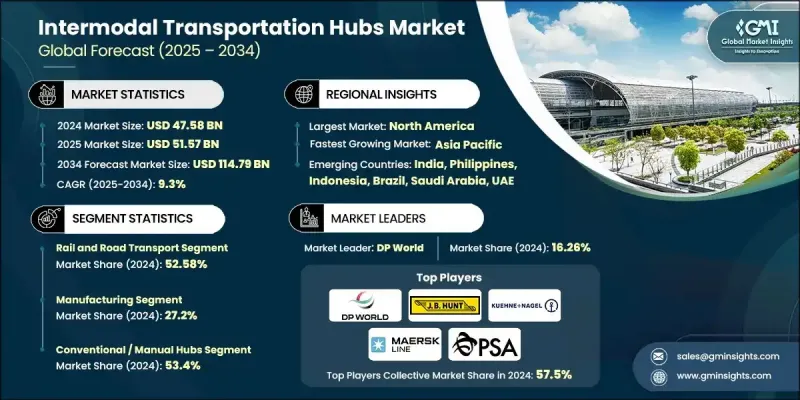
The Global Intermodal Transportation Hubs Market was valued at USD 47.58 billion in 2024 and is estimated to grow at a CAGR of 9.3% to reach USD 114.79 billion by 2034.
Growth is shaped by a worldwide shift toward freight systems that can seamlessly combine rail, road, air, and maritime networks into a coordinated logistics ecosystem. Modern intermodal hubs allow cargo operators, infrastructure developers, and supply chain organizations to move shipments more efficiently by reducing dependence on a single mode. This model lowers transportation expenses, shortens delivery windows, and increases overall routing flexibility. Rising global trade activity, expanding cross-border operations, and the acceleration of e-commerce continue to amplify the need for multimodal connectivity supported by strong digital tracking and smooth handoffs between transport modes. Supply chains that handle high-volume industrial flows also require dependable, resilient routes, pushing demand for hubs that can manage complex freight transitions with better visibility and reliability. Momentum is further reinforced by global sustainability goals, large-scale infrastructure upgrades, and the push for low-emission logistics. The rapid development of clean energy systems, electric vehicle freight solutions, and critical mineral transport networks is creating opportunities for long-distance freight optimization. Intermodal nodes help streamline these flows by combining the efficiency of rail and maritime transport with road-based flexibility for final delivery.
| Market Scope | |
|---|---|
| Start Year | 2024 |
| Forecast Year | 2025-2034 |
| Start Value | $47.58 Billion |
| Forecast Value | $114.79 Billion |
| CAGR | 9.3% |
The rail and road transport segment held a 52.58% share in 2024 and is projected to grow at a CAGR of 9.6% through 2034. This segment remains dominant because the combination of rail for long-distance freight and road for flexible local distribution allows operators to reduce transit time and keep operating costs predictable. Railroad connectivity remains central to industrial corridors, supporting the movement of bulk materials, manufactured goods, parts, and consumer products with consistent reliability.
The manufacturing segment held a 27.2% share in 2024 and is expected to grow at a CAGR of 9.4% from 2025 to 2034. Manufacturers rely heavily on intermodal hubs to move high volumes of raw materials and finished products efficiently. Integrated rail, road, and port networks help reduce bottlenecks, stabilize delivery schedules, and improve cost control for sectors including machinery, automotive, electronics, and heavy equipment. The ability to manage standardized containers and heavy freight loads strengthens the segment's leadership position.
US Intermodal Transportation Hubs Market held an 85% share, generating USD 13.97 billion in 2024. Continued investment in expanding rail capacity, automating terminals, and modernizing port infrastructure is driving strong adoption nationwide. Growing e-commerce activity, manufacturing output, and cross-border trade within the region are pushing demand for multimodal connectivity that improves visibility and reduces delays. Advanced digital tools, including IoT monitoring, RFID-based freight tracking, and integrated logistics software, are becoming central to optimizing cargo coordination across major US hubs.
Major companies active in the Global Intermodal Transportation Hubs Market include BNSF Railway, C.H. Robinson Worldwide, DHL Global, DP World, J.B. Hunt Transport Services, Kuehne + Nagel, Maersk Line, Norfolk Southern, PSA International, and Union Pacific Railroad. Companies competing in the Intermodal Transportation Hubs Market are strengthening their position by expanding multimodal infrastructure, enhancing cargo visibility technologies, and forming strategic partnerships with logistics providers. Many are investing in automated terminals, digital freight platforms, and analytics-driven routing tools that streamline container handling and accelerate turnaround times. Firms also prioritize integrating IoT tracking, smart yard management systems, and cloud-based coordination tools to improve transparency throughout the supply chain. Collaborative agreements with rail operators, port authorities, and trucking networks help optimize cross-modal transitions and stabilize capacity during peak demand.
Table of Contents
Chapter 1 Methodology
- 1.1 Market scope and definition
- 1.2 Research design
- 1.2.1 Research approach
- 1.2.2 Data collection methods
- 1.3 Data mining sources
- 1.3.1 Global
- 1.3.2 Regional/Country
- 1.4 Base estimates and calculations
- 1.4.1 Base year calculation
- 1.4.2 Key trends for market estimation
- 1.5 Primary research and validation
- 1.5.1 Primary sources
- 1.6 Forecast model
- 1.7 Research assumptions and limitations
Chapter 2 Executive Summary
- 2.1 Industry 360° synopsis, 2021 - 2034
- 2.2 Key market trends
- 2.2.1 Regional
- 2.2.2 Transportation mode
- 2.2.3 Hub
- 2.2.4 End Use
- 2.2.5 Operation Model
- 2.2.6 Automation Level
- 2.2.7 Throughput Capacity
- 2.3 TAM Analysis, 2026-2034
- 2.4 CXO perspectives: Strategic imperatives
- 2.4.1 Executive decision points
- 2.4.2 Critical success factors
- 2.5 Future outlook and strategic recommendations
Chapter 3 Industry Insights
- 3.1 Industry ecosystem analysis
- 3.1.1 Supplier landscape
- 3.1.2 Profit margin analysis
- 3.1.3 Cost structure
- 3.1.4 Value addition at each stage
- 3.1.5 Factor affecting the value chain
- 3.1.6 Disruptions
- 3.2 Industry impact forces
- 3.2.1 Growth drivers
- 3.2.1.1 Rapid expansion of cross-border trade & global supply chains
- 3.2.1.2 Increase in government investments in rail corridors, smart ports, and multimodal logistics parks
- 3.2.1.3 Surge in e-commerce and retail distribution
- 3.2.1.4 Increase in industrial corridors, SEZs, and smart city developments
- 3.2.1.5 Rise in sustainability and emission-reduction mandates
- 3.2.2 Industry pitfalls and challenges
- 3.2.2.1 High capital expenditure for terminal construction & automation
- 3.2.2.2 Operational fragmentation between multiple transport modes
- 3.2.3 Market opportunities
- 3.2.3.1 Rise in adoption of AI-driven terminal operating systems (TOS)
- 3.2.3.2 Increase in development of strategic trade corridors
- 3.2.3.3 Surge in demand for electrified and automated cargo-handling equipment
- 3.2.3.4 Rise in deployment of digital customs, blockchain, and smart gate systems
- 3.2.1 Growth drivers
- 3.3 Growth potential analysis
- 3.4 Regulatory landscape
- 3.4.1 North America
- 3.4.2 Europe
- 3.4.3 Asia Pacific
- 3.4.4 Latin America
- 3.4.5 MEA
- 3.5 Porter's analysis
- 3.6 PESTEL analysis
- 3.7 Technology and Innovation landscape
- 3.7.1 Current technological trends
- 3.7.1.1 Automation & robotics in cargo handling
- 3.7.1.2 Digital twin & simulation technologies
- 3.7.1.3 Iot & sensor networks for asset tracking
- 3.7.2 Emerging technologies
- 3.7.2.1 Artificial intelligence & predictive analytics
- 3.7.2.2 Blockchain for documentation & traceability
- 3.7.2.3 5g connectivity & edge computing
- 3.7.1 Current technological trends
- 3.8 Patent analysis
- 3.9 Price trends
- 3.9.1 By region
- 3.9.2 By type
- 3.10 Cost breakdown analysis
- 3.11 Business Case & ROI Analysis
- 3.11.1 Total cost of ownership framework
- 3.11.2 ROI calculation methodologies
- 3.11.3 Implementation timeline & milestones
- 3.11.4 Risk assessment & mitigation strategies
- 3.12 Sustainability and environmental impact analysis
- 3.12.1 Sustainable practices
- 3.12.2 Waste reduction strategies
- 3.12.3 Energy efficiency in production
- 3.12.4 Eco-friendly initiatives
- 3.12.5 Carbon footprint considerations
- 3.13 Investment & Funding Analysis
- 3.13.1 Infrastructure investment & jobs act (IIJA) impact
- 3.13.2 Public-private partnership (PPP) models
- 3.13.3 Private equity & venture capital activity
- 3.13.4 Green finance & sustainability-linked funding
- 3.14 Infrastructure capacity utilization & bottleneck analysis
- 3.14.1 Port congestion metrics & dwell time analysis
- 3.14.2 Rail terminal capacity constraints
- 3.14.3 Chassis availability & pool management challenges
- 3.14.4 Gate processing throughput limitations
- 3.14.5 On-dock rail capacity vs. Demand gap
- 3.14.6 Storage yard utilization rates
- 3.14.7 Peak season surge capacity requirements
- 3.14.8 Intermodal connector bottleneck identification
- 3.15 Landside accessibility & first/last-mile infrastructure connectivity
- 3.15.1 Intermodal connector program (FHWA) investment priorities
- 3.15.2 Grade-separated crossings & congestion relief projects
- 3.15.3 Drayage trucking capacity & driver shortages
- 3.15.4 Urban freight corridors & truck route restrictions
- 3.15.5 Rail network capacity & class i railroad congestion
- 3.15.6 Short-line railroad connectivity & infrastructure condition
- 3.15.7 Dedicated freight corridors & high-speed rail conflicts
- 3.15.8 Last-mile delivery infrastructure for e-commerc3
Chapter 4 Competitive Landscape, 2024
- 4.1 Introduction
- 4.2 Company market share analysis
- 4.2.1 North America
- 4.2.2 Europe
- 4.2.3 Asia Pacific
- 4.2.4 Latin America
- 4.2.5 MEA
- 4.3 Competitive analysis of major market players
- 4.4 Competitive positioning matrix
- 4.5 Strategic outlook matrix
- 4.6 Key developments
- 4.6.1 Mergers & acquisitions
- 4.6.2 Partnerships & collaborations
- 4.6.3 New Product Launches
- 4.6.4 Expansion Plans and funding
Chapter 5 Market Estimates & Forecast, By Transportation Mode, 2021 - 2034 ($Bn, TEU)
- 5.1 Key trends
- 5.2 Rail and road transport
- 5.3 Air and road transport
- 5.4 Maritime and road transport
- 5.5 Others
Chapter 6 Market Estimates & Forecast, By Hub, 2021 - 2034 ($Bn, TEU)
- 6.1 Key trends
- 6.2 Seaport Intermodal Hubs
- 6.3 Rail-Road Intermodal Terminals
- 6.4 Dry Ports / Inland Container Depots (ICDs)
- 6.5 Air Cargo Intermodal Hubs
- 6.6 Urban Multimodal Logistics Centers
Chapter 7 Market Estimates & Forecast, By End Use, 2021 - 2034 ($Bn, TEU)
- 7.1 Key trends
- 7.2 Manufacturing
- 7.3 Oil & gas
- 7.4 Construction
- 7.5 Consumer goods and retail
- 7.6 Automotive
- 7.7 Food and beverages
- 7.8 Pharmaceuticals and healthcare
- 7.9 Others
Chapter 8 Market Estimates & Forecast, By Operation Model, 2021 - 2034 ($Bn, TEU)
- 8.1 Key trends
- 8.2 Public/Government-Operated
- 8.3 Private-Operated
- 8.4 PPP (Public-Private Partnership)
- 8.5 Concession-Based / BOT
- 8.6 3PL / 4PL Operated
Chapter 9 Market Estimates & Forecast, By Automation Level, 2021 - 2034 ($Bn, TEU)
- 9.1 Key trends
- 9.2 Conventional / Manual Hubs
- 9.3 Semi-Automated Hubs
- 9.4 Fully Automated
Chapter 10 Market Estimates & Forecast, By Throughput Capacity, 2021 - 2034 ($Bn, TEU)
- 10.1 Key trends
- 10.2 Low Capacity
- 10.3 Medium Capacity
- 10.4 High Capacity
- 10.5 Mega Hubs
Chapter 11 Market Estimates & Forecast, By Region, 2021 - 2034 ($Bn, TEU)
- 11.1 Key trends
- 11.2 North America
- 11.2.1 US
- 11.2.2 Canada
- 11.3 Europe
- 11.3.1 Germany
- 11.3.2 UK
- 11.3.3 France
- 11.3.4 Italy
- 11.3.5 Spain
- 11.3.6 Russia
- 11.3.7 Nordics
- 11.4 Asia Pacific
- 11.4.1 China
- 11.4.2 India
- 11.4.3 Japan
- 11.4.4 Australia
- 11.4.5 South Korea
- 11.4.6 Philippines
- 11.4.7 Indonesia
- 11.5 Latin America
- 11.5.1 Brazil
- 11.5.2 Mexico
- 11.5.3 Argentina
- 11.6 MEA
- 11.6.1 South Africa
- 11.6.2 Saudi Arabia
- 11.6.3 UAE
Chapter 12 Company Profiles
- 12.1 Global Players
- 12.1.1 APM Terminals (A.P. Moller-Maersk)
- 12.1.2 BNSF Railway
- 12.1.3 C.H. Robinson Worldwide
- 12.1.4 Canadian National Railway
- 12.1.5 China Merchants Port
- 12.1.6 CMA CGM Terminal Link
- 12.1.7 COSCO SHIPPING Ports
- 12.1.8 DHL Global
- 12.1.9 DP World
- 12.1.10 Hutchison Ports
- 12.1.11 J.B. Hunt Transport Services
- 12.1.12 Kalmar
- 12.1.13 Konecranes
- 12.1.14 Kuehne + Nagel
- 12.1.15 Maersk Line
- 12.1.16 MSC Terminal & Logistics (TIL)
- 12.1.17 Navis
- 12.1.18 PSA International
- 12.1.19 Union Pacific Railroad
- 12.1.20 Zebra Technologies
- 12.2 Regional Players
- 12.2.1 Georgia Ports Authority
- 12.2.2 Mi-Jack Products
- 12.2.3 Port of Los Angeles
- 12.2.4 Port of Rotterdam
- 12.2.5 Port of Singapore Authority (MPA)
- 12.2.6 South Carolina Ports Authority
- 12.2.7 Tideworks Technology
- 12.2.8 Virginia Port Authority
- 12.2.9 Norfolk Southern
- 12.3 Emerging Players
- 12.3.1 Kaleris
- 12.3.2 Portchain
- 12.3.3 TuSimple