

|
시장보고서
상품코드
1892834
접이식 공기주입 보트 시장 기회, 성장요인, 업계 동향 분석 및 예측(2026-2035년)Foldable Inflatable Boats Market Opportunity, Growth Drivers, Industry Trend Analysis, and Forecast 2026 - 2035 |
||||||

세계의 접이식 공기주입 보트 시장은 2025년에 8억 5,130만 달러로 평가되었고, 2035년까지 연평균 복합 성장률(CAGR) 6.6%로 성장하여 16억 달러에 이를 것으로 예측됩니다.
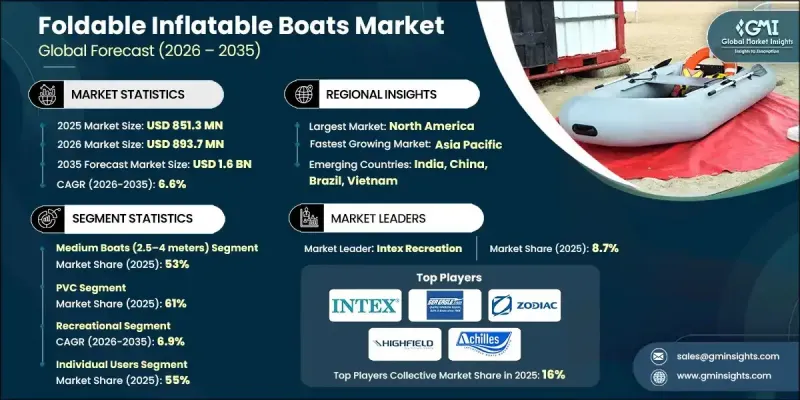
이 보트는 휴대성, 내구성, 보관의 용이성 때문에 레크리에이션, 전문직, 비상 대응 분야에서 수요가 지속적으로 증가하고 있습니다. 견고한 선체의 내구성과 컴팩트한 접이식 특성을 겸비한 특성으로 레저 활동, 상업적 운영, 구조 활동에서 채용이 확대되고 있습니다. 소재의 혁신이 시장을 재구성하고 있으며, 제조업체는 기존 소재에 비해 훨씬 더 높은 내마모성을 제공하는 폴리우레탄 코팅 원단을 통합하고 있습니다. 구조 기술의 향상과 첨단 복합소재로의 전환으로 제품의 내구성이 향상되고 장기적인 유지보수 비용이 절감되고 있습니다. 환경 의식 증가는 디자인 선택에도 영향을 미치고 있으며, 기업들은 재생 가능한 소재, 환경 부하가 적은 생산 방식, 깨끗한 추진 시스템을 채택하고 있습니다. 해양 환경 지속가능성 기준이 진화함에 따라 접이식 공기주입 보트 분야는 빠르게 적응하고 있으며, 성능 향상, 내구성 강화, 친환경 보트 솔루션에 대한 고객의 기대치가 높아지는 시장 상황을 뒷받침하고 있습니다.
| 시장 범위 | |
|---|---|
| 개시 연도 | 2025년 |
| 예측 연도 | 2026-2035년 |
| 개시 연도 시장 규모 | 8억 5,130만 달러 |
| 예측 금액 | 16억 달러 |
| CAGR | 6.6% |
전장 2.5-4미터의 중형 보트 카테고리는 2025년 53%의 점유율을 차지하며 2035년까지 연평균 복합 성장률(CAGR) 6.9%를 보일 것으로 예측됩니다. 이 부문은 레크리에이션 크루징, 낚시, 관광, 비상 활동 등 다양한 용도로 활용되는 장점이 있어 다양한 용도에서 안정적인 수요를 제공합니다.
PVC 소재 부문은 2025년 61%의 점유율을 차지할 것으로 예상되며, 2026년부터 2035년까지 연평균 5.9%의 성장률을 보일 것으로 전망됩니다. 현대의 선박용 PVC 직물은 강화된 자외선 차단 기능과 특수 코팅층을 갖추고 있으며, 최대 10년간의 보증을 제공합니다. 이 소재는 고강도 폴리에스테르 스크림 위에 PVC 코팅이 적층된 고강도 폴리에스테르 스크림으로 제작되어 내구성, 방수성, 기밀성이 뛰어나며, 높은 신뢰성을 제공합니다. 비용 효율성, 제조 용이성, 확립된 세계 공급 기반이 시장에서의 선도적 지위를 확고히 하고 있습니다.
북미 접이식 풍선 보트 시장은 2025년에 34%의 점유율을 차지할 것으로 예상되며, 2025년부터 2034년까지 연평균 5.3%의 성장률을 보일 것으로 예측됩니다. 이는 강력한 마리나 네트워크, 광범위한 보트 이용의 보급, 그리고 지원적인 해양 규제에 의해 뒷받침되고 있습니다. 이 지역의 인프라와 활발한 유통망는 세계 산업에서 그 입지를 더욱 공고히 하고 있습니다.
자주 묻는 질문
목차
제1장 조사 방법
- 시장 범위와 정의
- 조사 설계
- 조사 접근
- 데이터 수집 방법
- 데이터 마이닝 소스
- 세계
- 지역별/국가별
- 기본 추정치와 계산
- 기준연도 계산
- 시장 추정 주요 동향
- 1차 조사와 검증
- 1차 정보
- 예측 모델
- 조사의 전제조건과 제한 사항
제2장 주요 요약
제3장 업계 인사이트
- 생태계 분석
- 공급업체 상황
- 이익률 분석
- 비용 구조
- 각 단계별 부가가치
- 밸류체인에 영향을 미치는 요인
- 파괴적 변화
- 업계에 대한 영향요인
- 성장 촉진요인
- 업계의 잠재적 리스크&과제
- 시장 기회
- 성장 가능성 분석
- 규제 상황
- 국제 해사 규제
- 사이즈별 규제(16피트 미만 vs, 16피트 이상)
- NMMA 인증 요건
- ABYC 규격 준거
- 미국 연안경비대 장비 규칙(33 CFR Part 175, 183)
- EU CE 마킹 요건
- Porter's Five Forces 분석
- PESTEL 분석
- 기술과 혁신 동향
- 현재 기술 동향
- 소재 혁신 동향
- 접는 기구 기술
- 신기술
- 휴대성에 관한 기술 개발 동향
- 전기 시스템 통합
- 현재 기술 동향
- 생산 통계
- 생산 거점
- 소비 거점
- 수출입
- 가격 분석
- 가격별 세분화
- 지역별 가격변동
- 비용 내역 분석
- 특허 분석
- 인플레이터블 기술에 관한 특허
- 재료 코팅 특허
- 폴딩 기구 특허
- 지속가능성과 환경 측면
- 지속가능한 실천
- 폐기물 감축 전략
- 생산 에너지 효율
- 친환경 이니셔티브
- 탄소발자국에 관한 고려사항
- 전망과 투자 기회
- 신흥 시장 및 고성장 지역
- 기술과 인프라 투자 기회
- 전기식 및 친환경 추진 시스템 기회
- 전략적 제휴와 합병사업
- 이해관계자 및 투자자에 대한 제안
- 소비자 행동과 최종 용도에 관한 지견
- 보트 소유자 및 이용자 인구통계 분석
- 사용 패턴(레크리에이션, 상업, 긴급시)
- 사이즈, 재질, 휴대성에 관한 선호도
- 가격 감응도와 구매 행동
- 라이프스타일 동향과 관광이 보급에 미치는 영향
- 브랜드 인지도와 로열티 분석
제4장 경쟁 구도
- 서론
- 기업의 시장 점유율 분석
- 북미
- 유럽
- 아시아태평양
- 라틴아메리카
- 중동 및 아프리카
- 주요 시장 기업의 경쟁 분석
- 경쟁 포지셔닝 매트릭스
- 전략적 전망 매트릭스
- 주요 발전
- 인수합병(M&A)
- 제휴 및 협업
- 신제품 발매
- 사업 확대 계획과 자금조달
제5장 시장 추산 및 예측 : 재료별, 2022-2035
- 주요 동향
- PVC
- 하이파론
- 폴리우레탄 코팅옷감
- 기타
제6장 시장 추산 및 예측 : 길이별, 2022-2035
- 주요 동향
- 소형 선박(2.5미터 미만)
- 중형 보트(2.5-4미터)
- 대형 선박(4미터 이상)
제7장 시장 추산 및 예측 : 용도별, 2022-2035
- 주요 동향
- 레크리에이션 용도
- 구조 및 긴급 대응
- 관광 및 어드벤처 스포츠
- 상업 용도
- 기타
제8장 시장 추산 및 예측 : 최종 용도별, 2022-2035
- 주요 동향
- 개인 사용자
- 상업 사업자
- 정부기관 및 비정부 조직(NGO)
제9장 시장 추산 및 예측 : 유통 채널별, 2022-2035
- 주요 동향
- OEM/직접 판매
- 선박 판매점 및 소매점
- 전자상거래/온라인
- 유통업체
제10장 시장 추산 및 예측 : 지역별, 2022-2035
- 주요 동향
- 북미
- 미국
- 캐나다
- 유럽
- 독일
- 영국
- 프랑스
- 이탈리아
- 스페인
- 러시아
- 북유럽 국가
- 베네룩스
- 아시아태평양
- 중국
- 인도
- 일본
- 호주
- 한국
- 싱가포르
- 태국
- 인도네시아
- 베트남
- 라틴아메리카
- 브라질
- 멕시코
- 아르헨티나
- 콜롬비아
- 중동 및 아프리카
- 남아프리카공화국
- 사우디아라비아
- 아랍에미리트(UAE)
제11장 기업 개요
- 세계 기업
- AB Inflatables
- Achilles Inflatable Boats
- BRIS USA
- Highfield Boats
- Intex Recreation
- Mercury Marine(Inflatable Division)
- Sevylor
- Willard Marine
- Zodiac Nautic
- 지역 기업
- ASIS Boats
- Kolibri Boats
- Sea Eagle Boats
- 신규 기업
- Galaxy Pro Boats
- Outborn Watercraft
- Stryker Boats
- Walker Bay Boats
The Global Foldable Inflatable Boats Market was valued at USD 851.3 million in 2025 and is estimated to grow at a CAGR of 6.6% to reach USD 1.6 billion by 2035.
Demand for these boats continues to rise across recreational, professional, and emergency response settings due to their portability, durability, and easy storage. Their ability to combine the resilience of rigid vessels with compact foldability has expanded their adoption for leisure outings, commercial operations, and rescue missions. Material innovation is reshaping the market, with manufacturers integrating polyurethane-coated fabrics that offer significantly higher abrasion resistance compared to earlier materials. Enhanced construction methods and the shift toward advanced composites are improving product longevity and reducing long-term maintenance. Growing environmental awareness is also influencing design choices, with companies adopting recyclable materials, low-impact production practices, and cleaner propulsion systems. As marine sustainability standards evolve, the foldable inflatable boats sector is adapting rapidly, supporting a market landscape defined by improved performance, greater durability, and rising customer expectations for environmentally conscious boating solutions.
| Market Scope | |
|---|---|
| Start Year | 2025 |
| Forecast Year | 2026-2035 |
| Start Value | $851.3 Million |
| Forecast Value | $1.6 Billion |
| CAGR | 6.6% |
The medium boats category, sized between 2.5 and 4 meters, held a 53% share in 2025 and is expected to grow at a CAGR of 6.9% through 2035. This segment benefits from broad utility across recreational cruising, fishing, tourism, and emergency activities, offering steady demand across varied applications.
The PVC material segment held a 61% share in 2025 and is projected to grow at a CAGR of 5.9% from 2026 to 2035. Modern marine-grade PVC fabrics incorporate improved UV protection and specialized coating layers, supported by warranties extending up to a decade. These materials feature laminated PVC coatings over high-strength polyester scrim, providing durability, watertight integrity, and reliable air retention. Their cost efficiency, manufacturability, and established global supply base reinforce their leadership in the market.
North America Foldable Inflatable Boats Market accounted for a 34% share in 2025 and is anticipated to grow at a CAGR of 5.3% during 2025-2034, supported by strong marina networks, widespread boating participation, and supportive marine regulations. The region's infrastructure and active dealer networks continue to strengthen its position in the global industry.
Major companies active in the Foldable Inflatable Boats Market include AB Inflatables, Achilles Inflatable Boats, BRIS, Highfield Boats, Intex Recreation Corp., Sea Eagle Boats, Sevylor, Walker Bay, and Zodiac Nautic. Companies in the Foldable Inflatable Boats Market are using a range of strategic initiatives to reinforce their market positions. Many manufacturers are expanding their portfolios with lightweight, high-strength fabrics to improve durability while keeping boats easy to transport. Investments in eco-friendly materials and electric-ready designs reflect growing sustainability priorities. Several brands are also enhancing manufacturing efficiency through advanced welding and lamination technologies to boost product consistency and reduce waste. Strengthening dealer partnerships, expanding global distribution channels, and offering customizable boat configurations help companies improve accessibility and cater to diverse end-user needs.
Table of Contents
Chapter 1 Methodology
- 1.1 Market scope and definition
- 1.2 Research design
- 1.2.1 Research approach
- 1.2.2 Data collection methods
- 1.3 Data mining sources
- 1.3.1 Global
- 1.3.2 Regional/Country
- 1.4 Base estimates and calculations
- 1.4.1 Base year calculation
- 1.4.2 Key trends for market estimation
- 1.5 Primary research and validation
- 1.5.1 Primary sources
- 1.6 Forecast model
- 1.7 Research assumptions and limitations
Chapter 2 Executive Summary
- 2.1 Industry 3600 synopsis, 2022 - 2035
- 2.2 Key market trends
- 2.2.1 Regional
- 2.2.2 Material
- 2.2.3 Length
- 2.2.4 Application
- 2.2.5 End Use
- 2.2.6 Distribution Channel
- 2.3 TAM Analysis, 2026-2035
- 2.4 CXO perspectives: Strategic imperatives
- 2.4.1 Executive decision points
- 2.4.2 Critical success factors
- 2.5 Future outlook and strategic recommendations
Chapter 3 Industry Insights
- 3.1 Industry ecosystem analysis
- 3.1.1 Supplier landscape
- 3.1.2 Profit margin analysis
- 3.1.3 Cost structure
- 3.1.4 Value addition at each stage
- 3.1.5 Factor affecting the value chain
- 3.1.6 Disruptions
- 3.2 Industry impact forces
- 3.2.1.1 Growth drivers
- 3.2.1.2 Growing popularity of recreational boating and water sports
- 3.2.1.3 Demand for portable and affordable watercraft
- 3.2.1.4 Increased use in emergency and rescue operations
- 3.2.1.5 Expanding marine tourism and adventure sports industry
- 3.2.1.6 Durability and wear-and-tear issues
- 3.2.1.7 Price sensitivity in the consumer segment
- 3.2.2 Industry pitfalls and challenges
- 3.2.2.1 Durability & wear-and-tear issues
- 3.2.2.2 Price sensitivity in the consumer segment
- 3.2.3 Market opportunities
- 3.2.3.1 Rising demand from recreational boating and adventure tourism
- 3.2.3.2 High growth potential in emerging markets (Asia-Pacific & Latin America)
- 3.2.3.3 Increasing adoption by rescue, disaster-response, and government agencies
- 3.2.3.4 Growing interest in eco-friendly and electric-propulsion boating options
- 3.2.3.5 Opportunity for product innovation using advanced, durable, lightweight materials
- 3.3 Growth potential analysis
- 3.4 Regulatory landscape
- 3.4.1 International Maritime Regulations
- 3.4.2 Size-Specific Regulations (Under 16ft vs Over 16ft)
- 3.4.3 NMMA Certification Requirements
- 3.4.4 ABYC Standards Compliance
- 3.4.5 U.S. Coast Guard Equipment Regulations (33 CFR Part 175, 183)
- 3.4.6 EU CE Marking Requirements
- 3.5 Porter's analysis
- 3.6 PESTEL analysis
- 3.7 Technology and innovation landscape
- 3.7.1 Current technological trends
- 3.7.1.1 Material innovation trends
- 3.7.1.2 Folding mechanism technologies
- 3.7.2 Emerging technologies
- 3.7.2.1 Portability engineering developments
- 3.7.2.2 Electric propulsion integration
- 3.7.1 Current technological trends
- 3.8 Production statistics
- 3.8.1 Production hubs
- 3.8.2 Consumption hubs
- 3.8.3 Export and import
- 3.9 Pricing analysis
- 3.9.1 Price point segmentation
- 3.9.2 Regional price variations
- 3.10 Cost breakdown analysis
- 3.11 Patent analysis
- 3.11.1 Inflatable Technology Patents
- 3.11.2 Material Coating Patents
- 3.11.3 Folding Mechanism Patents
- 3.12 Sustainability and environmental aspects
- 3.12.1 Sustainable practices
- 3.12.2 Waste reduction strategies
- 3.12.3 Energy efficiency in production
- 3.12.4 Eco-friendly Initiatives
- 3.12.5 Carbon footprint considerations
- 3.13 Future outlook & investment opportunities
- 3.13.1 Emerging markets and high-potential regions
- 3.13.2 Investment opportunities in technology and infrastructure
- 3.13.3 Opportunities in electric and eco-friendly propulsion systems
- 3.13.4 Strategic partnerships and joint ventures
- 3.13.5 Recommendations for stakeholders and investors
- 3.14 Consumer behavior & End use insights
- 3.14.1 Demographic analysis of boat owners and users
- 3.14.2 Usage patterns (recreational, commercial, emergency)
- 3.14.3 Preferences in size, material, and portability
- 3.14.4 Price sensitivity and purchasing behavior
- 3.14.5 Influence of lifestyle trends and tourism on adoption
- 3.14.6 Brand perception and loyalty analysis
Chapter 4 Competitive Landscape, 2025
- 4.1 Introduction
- 4.2 Company market share analysis
- 4.2.1 North America
- 4.2.2 Europe
- 4.2.3 Asia Pacific
- 4.2.4 LATAM
- 4.2.5 MEA
- 4.3 Competitive analysis of major market players
- 4.4 Competitive positioning matrix
- 4.5 Strategic outlook matrix
- 4.6 Key developments
- 4.6.1 Mergers & acquisitions
- 4.6.2 Partnerships & collaborations
- 4.6.3 New Product Launches
- 4.6.4 Expansion Plans and funding
Chapter 5 Market Estimates & Forecast, By Material, 2022 - 2035 ($Bn, Units)
- 5.1 Key trends
- 5.2 PVC
- 5.3 Hypalon
- 5.4 Polyurethane-coated fabrics
- 5.5 Others
Chapter 6 Market Estimates & Forecast, By Length, 2022 - 2035 ($Bn, Units)
- 6.1 Key trends
- 6.2 Small boats (<2.5 meters)
- 6.3 Medium boats (2.5-4 meters)
- 6.4 Large boats (>4 meters)
Chapter 7 Market Estimates & Forecast, By Application, 2022 - 2035 ($Bn, Units)
- 7.1 Key trends
- 7.2 Recreational
- 7.3 Rescue & emergency
- 7.4 Tourism & adventure sports
- 7.5 Commercial use
- 7.6 Others
Chapter 8 Market Estimates & Forecast, By End Use, 2022 - 2035 ($Bn, Units)
- 8.1 Key trends
- 8.2 Individual users
- 8.3 Commercial operators
- 8.4 Government & NGO agencies
Chapter 9 Market Estimates & Forecast, By Distribution Channel, 2022 - 2035 ($Bn, Units)
- 9.1 Key trends
- 9.2 OEM/direct sales
- 9.3 Marine dealers & retailers
- 9.4 E-commerce/online
- 9.5 Distributors
Chapter 10 Market Estimates & Forecast, By Region, 2022 - 2035 ($Bn, Units)
- 10.1 Key trends
- 10.2 North America
- 10.2.1 US
- 10.2.2 Canada
- 10.3 Europe
- 10.3.1 Germany
- 10.3.2 UK
- 10.3.3 France
- 10.3.4 Italy
- 10.3.5 Spain
- 10.3.6 Russia
- 10.3.7 Nordics
- 10.3.8 Benelux
- 10.4 Asia Pacific
- 10.4.1 China
- 10.4.2 India
- 10.4.3 Japan
- 10.4.4 Australia
- 10.4.5 South Korea
- 10.4.6 Singapore
- 10.4.7 Thailand
- 10.4.8 Indonesia
- 10.4.9 Vietnam
- 10.5 Latin America
- 10.5.1 Brazil
- 10.5.2 Mexico
- 10.5.3 Argentina
- 10.5.4 Colombia
- 10.6 MEA
- 10.6.1 South Africa
- 10.6.2 Saudi Arabia
- 10.6.3 UAE
Chapter 11 Company Profiles
- 11.1 Global Players
- 11.1.1 AB Inflatables
- 11.1.2 Achilles Inflatable Boats
- 11.1.3 BRIS USA
- 11.1.4 Highfield Boats
- 11.1.5 Intex Recreation
- 11.1.6 Mercury Marine (Inflatable Division)
- 11.1.7 Sevylor
- 11.1.8 Willard Marine
- 11.1.9 Zodiac Nautic
- 11.2 Regional Players
- 11.2.1 ASIS Boats
- 11.2.2 Kolibri Boats
- 11.2.3 Sea Eagle Boats
- 11.3 Emerging Players
- 11.3.1 Galaxy Pro Boats
- 11.3.2 Outborn Watercraft
- 11.3.3 Stryker Boats
- 11.3.4 Walker Bay Boats


