|
시장보고서
상품코드
1892844
냉동 베이커리 시장 기회, 성장요인, 업계 동향 분석 및 예측(2026-2035년)Frozen Bakery Market Opportunity, Growth Drivers, Industry Trend Analysis, and Forecast 2026 - 2035 |
||||||

세계의 냉동 베이커리 시장은 2025년에 115억 달러로 평가되었고, 2035년까지 연평균 복합 성장률(CAGR) 6.1%로 성장하여 207억 달러에 이를 것으로 예측됩니다.

시장 확대의 배경에는 유통기한 연장에 따른 유통기간 연장과 신선 베이커리 제품 대비 폐기물 감소, 그리고 숙련된 제빵 인력을 증원하지 않고도 안정적인 품질을 필요로 하는 외식업 사업자의 인건비 절감 등이 있습니다. 콜드체인 인프라와 라스트마일 배송 네트워크가 개선됨에 따라, 특히 현대식 소매 형태를 도입한 지역에서는 냉동 베이커리 제품의 유통, 보관 및 상품화가 용이해졌습니다. 새로운 냉동기술로 반죽 구조와 해동 후의 품질이 유지되어 냉동제품과 신선제품의 품질 차이가 줄어들고 있습니다. 전자상거래 플랫폼은 운송 중 제품 안정성과 배송 시 일관된 품질로 인해 냉동 베이커리 제품의 이점을 누리고 있습니다. 지속 가능한 콜드체인은 불충분한 냉장 보관으로 인한 식품 손실을 약 12% 감소시키고 배출량 감소에 기여합니다. 특히 각국이 국제협약에 따라 고 GWP 냉매 사용 감축을 추진하면서 그 중요성이 더욱 커지고 있습니다. 제조업체들은 통곡물과 천연색소 사용을 늘리고 첨가물을 줄이는 한편, 에너지 절약형 냉장설비와 재생에너지에 대한 투자를 확대하고 있습니다. 유럽의 생산 동향은 시장에 큰 영향을 미치고 있으며, EU의 식음료 가공 부문은 1조 9,300억 유로의 매출을 창출하고 있습니다. 베이커리 제품은 고용 비중의 약 34%를 차지하는 가장 큰 분야로, 국내 소비와 수출 규모의 생산을 모두 뒷받침하고 있습니다.
| 시장 범위 | |
|---|---|
| 개시 연도 | 2025년 |
| 예측 연도 | 2026-2035년 |
| 개시 연도 시장 규모 | 115억 달러 |
| 예측 금액 | 207억 달러 |
| CAGR | 6.1% |
완전 소성 제품 부문은 2024년 58%의 점유율을 차지할 것으로 예상되며, 소매용 냉동고, 퀵서비스 레스토랑, 시설용 시장에서 '바로 데워 먹을 수 있는' 편의성을 인정받고 있습니다. 이러한 제품에는 빵, 롤빵, 페이스트리 등이 포함되며, 시간 절약을 원하는 소비자층 사이에서 인기를 끌고 있습니다.
피자 크러스트, 플랫 브레드, 또띠아 부문은 2025년 19%의 점유율을 차지했습니다. 이러한 성장은 소비자의 폭넓은 취향, 소매 및 외식 산업 채널에서의 범용성, 다양한 요리의 베이스로 활용할 수 있다는 점 등이 뒷받침하고 있습니다. 혁신적인 맛, 용량 크기, 클린 라벨 원료가 진화하는 소비자 니즈를 충족시키면서 이 부문은 지속적으로 성장하고 있습니다. 덴마크 페이스트리, 크로와상, 특제 장인 구움과자 등 다른 부문도 프리미엄화 추세, 건강 지향적 원료, 전자상거래 및 외식산업 채널에서의 채용 확대로 인해 주목받고 있습니다.
미국 냉동 베이커리 시장은 2025년 25억 달러로 평가되었고, 2035년까지 207억 달러에 달할 것으로 예측됩니다. 북미는 2025년 세계 시장의 약 27%를 차지했습니다. 이 지역의 성장은 편의성이 높은 즉석식품과 외식 수요 증가에 힘입은 바 큽니다. 미국은 탄탄한 제조거점을 보유하고 있으며, 160개 이상의 베이커리 업체들이 눈에 띄는 매출을 보고하고 있어 지역의 생산 능력을 보여주고 있습니다. 캐나다 시장은 현대식 소매업과 국경 간 브랜드와 함께 성장하고 있지만, 트럭 운전사 부족과 콜드체인 시설의 손실과 같은 물류 문제는 여전히 남아있습니다.
자주 묻는 질문
목차
제1장 조사 방법과 범위
제2장 주요 요약
제3장 업계 인사이트
- 생태계 분석
- 공급업체 상황
- 이익률
- 각 단계별 부가가치
- 밸류체인에 영향을 미치는 요인
- 파괴적 변화
- 업계에 대한 영향요인
- 성장 촉진요인
- 업계의 잠재적 리스크&과제
- 시장 기회
- 성장 가능성 분석
- 규제 상황
- 북미
- 유럽
- 아시아태평양
- 라틴아메리카
- 중동 및 아프리카
- Porter's Five Forces 분석
- PESTEL 분석
- 가격 동향
- 지역별
- 향후 시장 동향
- 기술과 혁신 동향
- 현재 기술 동향
- 신기술
- 특허 상황
- 무역 통계(HS코드)(주 : 무역 통계는 주요 국가에 한해 제공됩니다)
- 주요 수입국
- 주요 수출국
- 지속가능성과 환경 측면
- 지속가능한 대처
- 폐기물 감축 전략
- 생산 에너지 효율
- 친환경 이니셔티브
- 탄소발자국에 관한 고려사항
제4장 경쟁 구도
- 서론
- 기업의 시장 점유율 분석
- 지역별
- 북미
- 유럽
- 아시아태평양
- 라틴아메리카
- 중동 및 아프리카
- 지역별
- 기업 매트릭스 분석
- 주요 시장 기업의 경쟁 분석
- 경쟁 포지셔닝 매트릭스
- 주요 발전
- 인수합병(M&A)
- 제휴 및 협업
- 신제품 발매
- 확대 계획
제5장 시장 규모와 예측 : 제품 유형별, 2022-2035
- 주요 동향
- 빵 및 롤
- 흰 빵 및 롤빵
- 통밀빵
- 곡물빵 및 씨앗빵
- 기타
- 비엔누아즈리(Viennoiserie) 및 스위트 페이스트리
- 크로와상
- 데니쉬 페이스트리
- 스위트 롤빵
- 기타
- 케이크, 머핀 및 스위트 과자
- 케이크
- 머핀
- 브라우니 및 바
- 기타
- 파이, 타르트, 속을 채운 페이스트리
- 도너츠 및 프라이 스위트 제과
- 이스트 발효 도넛
- 케이크 도넛
- 속이 채워진 도넛
- 기타
- 와플, 팬케이크 및 철판 제품
- 베이커리 제품 및 에피타이저
- 피자 크러스트, 플랫 브레드, 토르티야
- 쿠키, 비스킷
- 기타
제6장 시장 규모와 예측 : 제품 형태별, 2022-2035
- 주요 동향
- Ready-to-Prove
- Ready-to-Bake
- Fully Baked
제7장 시장 규모와 예측 : 최종 용도별, 2022-2035
- 주요 동향
- 소매 및 소비자용
- 슈퍼마켓 및 하이퍼마켓
- 편의점
- 전문점
- 온라인 채널 및 전자상거래
- 외식산업용
- 호텔, 레스토랑 및 케이터링(HORECA)
- 퀵서비스 레스토랑(QSR)
- 카페테리아 및 시설내 식당
- 수제 베이커리 및 매장 내 베이커리
- 베이커리 체인
- 시설 및 학교급식 프로그램
- 기타
제8장 시장 규모와 예측 : 지역별, 2022-2035
- 주요 동향
- 북미
- 미국
- 캐나다
- 유럽
- 영국
- 독일
- 프랑스
- 이탈리아
- 스페인
- 기타 유럽
- 아시아태평양
- 중국
- 인도
- 일본
- 한국
- 호주
- 기타 아시아태평양
- 라틴아메리카
- 브라질
- 멕시코
- 아르헨티나
- 기타 라틴아메리카
- 중동 및 아프리카
- 남아프리카공화국
- 사우디아라비아
- 아랍에미리트(UAE)
- 기타 중동 및 아프리카
제9장 기업 개요
- Grupo Bimbo
- Europastry
- Pan Pa Ya
- General Mills
- Rich Products Corporation
- Comapan
- Don Maiz
- Vandemoortele
- Patagonia Artisan Bakers
- Aryzta AG
- Canada Bread Company
- Kellogg Company
- BredenMaster
- Conagra Brands
- Associated British Foods
- CSM Bakery Solutions
- Delifrance
- Weston Foods
- Custom Foods
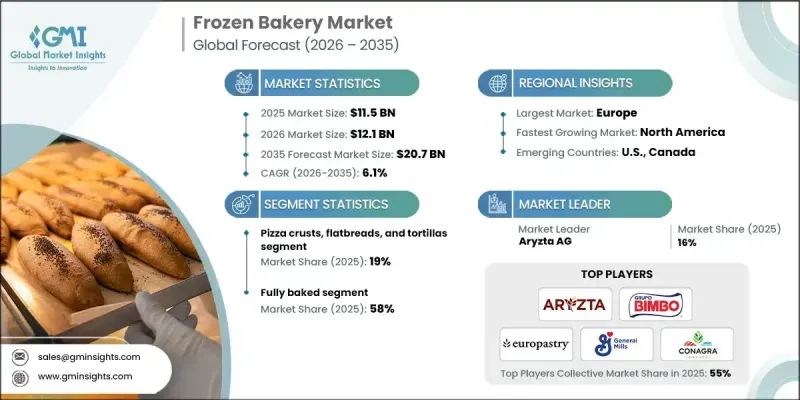
The Global Frozen Bakery Market was valued at USD 11.5 billion in 2025 and is estimated to grow at a CAGR of 6.1% to reach USD 20.7 billion by 2035.
The market expansion is driven by extended shelf life, which enables longer distribution and reduces waste compared to fresh bakery products, as well as labor savings for foodservice operators who require consistent quality without increasing skilled baking staff. As cold chain infrastructure and last-mile delivery networks improve, frozen bakery products become easier to distribute, store, and list, particularly in regions adopting modern retail formats. New freezing technologies preserve dough structure and post-thaw quality, narrowing the gap between frozen and fresh products. E-commerce platforms benefit from frozen bakery due to product stability during transit and consistent quality upon delivery. Sustainable cold chains help reduce food loss, estimated at 12% due to insufficient refrigeration, and lower emissions, especially as countries phase down high-GWP refrigerants under global agreements. Manufacturers are increasingly using whole grains, natural colors, and fewer additives while investing in energy-efficient refrigeration and renewable power. European production dynamics significantly influence the market, with the EU food and drink processing sector generating EUR 1,093 billion in turnover, bakery products representing the largest employment share at around 34%, providing both domestic consumption and export-scale production.
| Market Scope | |
|---|---|
| Start Year | 2025 |
| Forecast Year | 2026-2035 |
| Start Value | $11.5 Billion |
| Forecast Value | $20.7 Billion |
| CAGR | 6.1% |
The fully baked products segment held 58% share in 2024, valued for their "heat-and-serve" convenience across retail freezers, quick-service restaurants, and institutional settings. These products include bread, rolls, and pastries, which are increasingly popular among consumers seeking time-saving options.
The Pizza crusts, flatbreads, and tortillas segment accounted for a 19% share in 2025. Their growth is supported by widespread consumer preference, versatility across retail and foodservice channels, and the ability to serve as bases for various cuisines. The segment continues to expand as innovative flavors, portion sizes, and clean-label ingredients meet evolving consumer demands. Other segments, such as Danish pastries, croissants, and specialty artisan baked goods, are gaining traction due to premiumization trends, health-focused ingredients, and growing adoption in e-commerce and foodservice channels.
U.S. Frozen Bakery Market was valued at USD 2.5 billion in 2025 and is projected to reach USD 20.7 billion by 2035. North America accounted for approximately 27% of the global market in 2025. Growth in the region is supported by rising demand for convenient, ready-to-use products and off-premises dining. The U.S. market benefits from a well-established manufacturing base, with over 160 bakeries reporting significant sales, demonstrating the region's production capacity. Canada's market is expanding alongside modern retail and cross-border brands, though logistics challenges such as truck driver shortages and cold chain equipment losses remain.
Key players operating in the Global Frozen Bakery Market include Grupo Bimbo, Europastry, Pan Pa Ya, General Mills, Rich Products Corporation, Comapan, Don Maiz SAS, Vandemoortele, Patagonia Artisan Bakers, and Aryzta AG. Companies in the Global Frozen Bakery Market are employing diverse strategies to strengthen their presence and market position. They are investing in state-of-the-art freezing and packaging technologies to extend shelf life while preserving taste and texture. Product innovation, including clean-label ingredients, whole grains, and natural flavors, caters to health-conscious consumers and premium segments. Strategic partnerships with foodservice providers and retail chains help expand distribution channels, while cross-border expansions tap into emerging markets. Firms are also enhancing e-commerce logistics, cold chain capacity, and last-mile delivery capabilities to meet growing online demand.
Table of Contents
Chapter 1 Methodology & Scope
- 1.1 Market scope and definition
- 1.2 Research design
- 1.2.1 Research approach
- 1.2.2 Data collection methods
- 1.3 Data mining sources
- 1.3.1 Global
- 1.3.2 Regional/Country
- 1.4 Base estimates and calculations
- 1.4.1 Base year calculation
- 1.4.2 Key trends for market estimation
- 1.5 Primary research and validation
- 1.5.1 Primary sources
- 1.6 Forecast model
- 1.7 Research assumptions and limitations
Chapter 2 Executive Summary
- 2.1 Industry 360° synopsis
- 2.2 Key market trends
- 2.2.1 Product type
- 2.2.2 Product form
- 2.2.3 End use
- 2.3 TAM analysis, 2025-2034
- 2.4 CXO perspectives: Strategic imperatives
- 2.4.1 Executive decision points
- 2.4.2 Critical success factors
- 2.5 Outlook and strategic recommendations
Chapter 3 Industry Insights
- 3.1 Industry ecosystem analysis
- 3.1.1 Supplier landscape
- 3.1.2 Profit margin
- 3.1.3 Value addition at each stage
- 3.1.4 Factor affecting the value chain
- 3.1.5 Disruptions
- 3.2 Industry impact forces
- 3.2.1 Growth drivers
- 3.2.2 Industry pitfalls and challenges
- 3.2.3 Market opportunities
- 3.3 Growth potential analysis
- 3.4 Regulatory landscape
- 3.4.1 North America
- 3.4.2 Europe
- 3.4.3 Asia Pacific
- 3.4.4 Latin America
- 3.4.5 Middle East & Africa
- 3.5 Porter's analysis
- 3.6 PESTEL analysis
- 3.7 Price trends
- 3.7.1 By region
- 3.8 Future market trends
- 3.9 Technology and innovation landscape
- 3.9.1 Current technological trends
- 3.9.2 Emerging technologies
- 3.10 Patent landscape
- 3.11 Trade statistics (HS code) (Note: the trade statistics will be provided for key countries only)
- 3.11.1 Major importing countries
- 3.11.2 Major exporting countries
- 3.12 Sustainability and environmental aspects
- 3.12.1 Sustainable practices
- 3.12.2 Waste reduction strategies
- 3.12.3 Energy efficiency in production
- 3.12.4 Eco-friendly initiatives
- 3.13 Carbon footprint considerations
Chapter 4 Competitive Landscape, 2025
- 4.1 Introduction
- 4.2 Company market share analysis
- 4.2.1 By region
- 4.2.1.1 North America
- 4.2.1.2 Europe
- 4.2.1.3 Asia Pacific
- 4.2.1.4 Latin America
- 4.2.1.5 Middle East & Africa
- 4.2.1 By region
- 4.3 Company matrix analysis
- 4.4 Competitive analysis of major market players
- 4.5 Competitive positioning matrix
- 4.6 Key developments
- 4.6.1 Mergers & acquisitions
- 4.6.2 Partnerships & collaborations
- 4.6.3 New product launches
- 4.6.4 Expansion plans
Chapter 5 Market Size and Forecast, By Product Type, 2022-2035 (USD Billion, Kilo Tons)
- 5.1 Key trends
- 5.2 Bread & rolls
- 5.2.1 White bread & rolls
- 5.2.2 Whole wheat
- 5.2.3 Multigrain & seeded bread
- 5.2.4 Others
- 5.3 Viennoiserie & sweet laminated pastries
- 5.3.1 Croissants
- 5.3.2 Danish pastries
- 5.3.3 Sweet dough rolls
- 5.3.4 Others
- 5.4 Cakes, muffins & sweet goods
- 5.4.1 Cakes
- 5.4.2 Muffins
- 5.4.3 Brownies & bars
- 5.4.4 Others
- 5.5 Pies, tarts & filled pastries
- 5.6 Doughnuts & fried sweet goods
- 5.6.1 Yeast-raised doughnuts
- 5.6.2 Cake doughnuts
- 5.6.3 Filled doughnuts
- 5.6.4 Others
- 5.7 Waffles, pancakes & griddle products
- 5.8 Savory baked goods & appetizers
- 5.9 Pizza crusts, flatbreads & tortillas
- 5.10 Cookies, biscuits
- 5.11 Others
Chapter 6 Market Size and Forecast, By Product Form, 2022-2035 (USD Billion, Kilo Tons)
- 6.1 Key trends
- 6.2 Ready-to-Prove
- 6.3 Ready-to-Bake
- 6.4 Fully Baked
Chapter 7 Market Size and Forecast, By End use, 2022-2035 (USD Billion, Kilo Tons)
- 7.1 Key trends
- 7.2 Retail/consumer
- 7.2.1 Supermarkets & hypermarkets
- 7.2.2 Convenience stores
- 7.2.3 Specialty food stores
- 7.2.4 Online channels/e-commerce
- 7.3 Foodservice
- 7.3.1 Hotels, restaurants, and catering (HORECA)
- 7.3.2 Quick-service restaurants (QSR)
- 7.3.3 Cafeterias & institutional dining
- 7.4 Artisan bakeries & in-store bakeries
- 7.5 Bakery chains
- 7.6 Institutional/school nutrition programs
- 7.7 Others
Chapter 8 Market Size and Forecast, By Region, 2022-2035 (USD Billion, Kilo Tons)
- 8.1 Key trends
- 8.2 North America
- 8.2.1 U.S.
- 8.2.2 Canada
- 8.3 Europe
- 8.3.1 UK
- 8.3.2 Germany
- 8.3.3 France
- 8.3.4 Italy
- 8.3.5 Spain
- 8.3.6 Rest of Europe
- 8.4 Asia Pacific
- 8.4.1 China
- 8.4.2 India
- 8.4.3 Japan
- 8.4.4 South Korea
- 8.4.5 Australia
- 8.4.6 Rest of Asia Pacific
- 8.5 Latin America
- 8.5.1 Brazil
- 8.5.2 Mexico
- 8.5.3 Argentina
- 8.5.4 Rest of Latin America
- 8.6 Middle East & Africa
- 8.6.1 South Africa
- 8.6.2 Saudi Arabia
- 8.6.3 UAE
- 8.6.4 Rest of Middle East & Africa
Chapter 9 Company Profiles
- 9.1 Grupo Bimbo
- 9.2 Europastry
- 9.3 Pan Pa Ya
- 9.4 General Mills
- 9.5 Rich Products Corporation
- 9.6 Comapan
- 9.7 Don Maiz
- 9.8 Vandemoortele
- 9.9 Patagonia Artisan Bakers
- 9.10 Aryzta AG
- 9.11 Canada Bread Company
- 9.12 Kellogg Company
- 9.13 BredenMaster
- 9.14 Conagra Brands
- 9.15 Associated British Foods
- 9.16 CSM Bakery Solutions
- 9.17 Delifrance
- 9.18 Weston Foods
- 9.19 Custom Foods