
|
시장보고서
상품코드
1892853
로봇 페인트 부스 시장 기회, 성장요인, 업계 동향 분석 및 예측(2026-2035년)Robotic Paint Booth Market Opportunity, Growth Drivers, Industry Trend Analysis, and Forecast 2026 - 2035 |
||||||

세계의 로봇 페인트 부스 시장은 2025년에 7억 3,750만 달러로 평가되었고, 2035년까지 연평균 복합 성장률(CAGR) 3.6%로 성장하여 10억 3,000만 달러에 이를 것으로 예측됩니다.
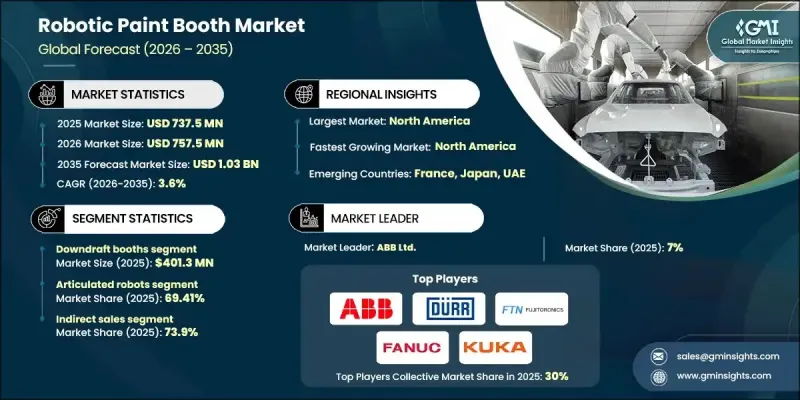
맞춤형 제품에 대한 수요 증가와 고처리량 및 유연한 제조로의 전환으로 인해 생산 시설에서는 정확성, 일관된 도장 품질 및 사이클 타임 최적화가 우선순위가 되고 있습니다. 제조업체가 더 넓은 색상 팔레트, 특수 마감재, 짧은 생산 리드 타임을 충족시키기 위해 운영을 계속 확장하고 업그레이드함에 따라 자동 도장 시스템의 필요성이 빠르게 증가하고 있습니다. 로봇 도장 부스는 균일한 도장 성능의 유지와 증가하는 생산의 복잡성을 관리하는데 필수적인 요소로 자리 잡고 있습니다. 도장 환경의 자동화는 지능형 컨베이어 시스템, 통합 비전 기술, 고급 피드백 제어의 활용으로 가속화되고 있습니다. 이러한 기술은 도장 파라미터를 실시간으로 모니터링하고 조정하여 기업의 운반 효율을 높이고, 재료 폐기물을 줄이며, 휘발성 유기 화합물에 대한 직접적인 노출을 제한하여 작업자의 안전성을 높입니다. 스마트 제조에 대한 지속적인 추진은 반복성, 정확성, 환경 요구 사항에 대한 적합성을 보장하는 로봇 플랫폼의 도입을 강화하고 있습니다.
| 시장 범위 | |
|---|---|
| 개시 연도 | 2025년 |
| 예측 연도 | 2026-2035년 |
| 개시 연도 시장 규모 | 7억 3,750만 달러 |
| 예측 금액 | 10억 3,000만 달러 |
| CAGR | 3.6% |
하향식 부스 부문은 2025년 4억 1,300만 달러 시장 규모를 창출했으며, 오버 스프레이와 오염을 최소화하는 수직 기류 설계로 인해 주요 구성 요소로 자리매김했습니다. 제어된 공기 흐름은 필터링된 천장 및 전용 배기 시스템과 결합하여 전체 도장 사이클 동안 안정적인 공기 흐름 패턴을 유지하여 일관된 마감 품질을 유지합니다.
관절형 로봇 부문은 2025년 69.41%의 점유율을 차지하며 주요 로봇 유형으로 자리를 지켰습니다. 이 로봇들은 여러 개의 이동축을 통해 높은 유연성을 제공하며, 복잡하고 불규칙한 표면에서 정밀하고 반복적인 작업을 목적으로 설계되었습니다. 서보 구동 메커니즘과 전용 컨트롤러를 통해 장시간 동안 까다로운 도장 작업을 최적의 성능으로 지속적으로 수행할 수 있습니다.
미국 로봇 도장 부스 시장은 2025년 83%의 점유율을 차지하며 2억 2,580만 달러 규모에 달할 것으로 예측됩니다. 자동차, 항공우주, 일반 제조업 등의 분야에서 첨단 도장 기술에 대한 수요와 함께 마감 능력 향상에 대한 강한 관심은 성장을 가속화하고 있습니다. 엄격한 VOC 규제에 따른 자재 절감, ESG 대응, 배출량 감소를 우선시하는 조직에서 다축 로봇 도장 시스템 도입이 확대되고 있습니다.
자주 묻는 질문
목차
제1장 조사 방법과 범위
제2장 주요 요약
제3장 업계 인사이트
- 생태계 분석
- 공급업체 상황
- 이익률
- 각 단계별 부가가치
- 밸류체인에 영향을 미치는 요인
- 업계에 대한 영향요인
- 성장 촉진요인
- 업계의 잠재적 리스크&과제
- 기회
- 향후 시장 동향
- 기술과 혁신 동향
- 현재 기술 동향
- 신기술
- 가격 동향
- 지역별
- 유형별
- 규제 상황
- 규격 및 컴플라이언스 요건
- 지역별 규제 구조
- 인증 기준
- Porter's Five Forces 분석
- PESTEL 분석
제4장 경쟁 구도
- 서론
- 기업의 시장 점유율 분석
- 지역별
- 기업 매트릭스 분석
- 주요 시장 기업의 경쟁 분석
- 경쟁 포지셔닝 매트릭스
- 주요 발전
- 인수합병(M&A)
- 제휴 및 협업
- 신제품 발매
- 확대 계획
제5장 시장 추산 및 예측 : 제품별, 2022-2035
- 주요 동향
- 다운 드래프트 부스
- 사이드 드래프트 부스
- 크로스 드래프트 부스
- 기타
제6장 시장 추산 및 예측 : 로봇 유형별, 2022-2035
- 주요 동향
- 관절식 로봇
- 직교 로봇
제7장 시장 추산 및 예측 : 조작별, 2022-2035
- 주요 동향
- 자동 페인트 부스
- 반자동 페인트 부스
제8장 시장 추산 및 예측 : 용도별, 2022-2035
- 주요 동향
- 자동차
- 항공우주 및 방위
- 가구
- 전자기기
- 기타
제9장 시장 추산 및 예측 : 유통 채널별, 2022-2035
- 주요 동향
- 직접 판매
- 간접 판매
제10장 시장 추산 및 예측 : 지역별, 2022-2035
- 주요 동향
- 북미
- 미국
- 캐나다
- 유럽
- 독일
- 영국
- 프랑스
- 이탈리아
- 스페인
- 아시아태평양
- 중국
- 일본
- 인도
- 호주
- 한국
- 라틴아메리카
- 브라질
- 멕시코
- 아르헨티나
- 중동 및 아프리카
- 남아프리카공화국
- 사우디아라비아
- 아랍에미리트(UAE)
제11장 기업 개요
- ABB Ltd.
- Blowtherm
- Durr Group
- Effort Intelligence Equipment Co. Ltd.
- Eisenmann SE
- Fanuc Corporation
- Fujitoronics-RSA
- GIFFIN
- Kawasaki Heavy Industry Co. Ltd.
- KUKA AG
- Robotic Paint Group Ltd.
- SAIMA Meccanica S.p.A.
- Staubli International AG
- TKS Industrial Company
- Yaskawa Electric Corporation
The Global Robotic Paint Booth Market was valued at USD 737.5 million in 2025 and is estimated to grow at a CAGR of 3.6% to reach USD 1.03 billion by 2035.
Rising demand for customized products and the shift toward high-throughput, flexible manufacturing have pushed production facilities to prioritize accuracy, consistent coating quality, and cycle-time optimization. As manufacturers continue expanding and upgrading their operations to handle broader color palettes, specialized finishes, and shorter production timelines, the need for automated painting systems is rapidly increasing. Robotic paint booths are becoming essential for maintaining uniform coating performance and managing growing production complexity. Automation in painting environments is accelerating with the use of intelligent conveyor systems, integrated vision technology, and advanced feedback controls to monitor and adjust coating parameters in real time. These innovations help companies improve transfer efficiency, reduce material waste, and enhance worker safety by limiting direct exposure to volatile organic compounds. The ongoing push toward smart manufacturing is reinforcing the adoption of robotic platforms that ensure repeatability, precision, and compliance with environmental requirements.
| Market Scope | |
|---|---|
| Start Year | 2025 |
| Forecast Year | 2026-2035 |
| Start Value | $737.5 Million |
| Forecast Value | $1.03 Billion |
| CAGR | 3.6% |
The downdraft booths segment generated USD 401.3 million in 2025, remaining the leading configuration due to their vertical airflow design that minimizes overspray and contamination. Their controlled air movement, combined with filtered ceilings and specialized exhaust systems, supports consistent finish quality by maintaining stable airflow patterns throughout the coating cycle.
The articulated robots segment accounted for 69.41% share in 2025, maintaining its position as the dominant robotic type. These robots offer high flexibility with multiple axes of movement and are engineered for precise, repeatable tasks across detailed and irregular surfaces. Their servo-driven mechanisms and specialized controllers allow them to perform demanding coating operations for extended periods while sustaining optimal performance.
U.S. Robotic Paint Booth Market held 83% share in 2025, generating USD 225.8 million. Strong interest in enhanced finishing capabilities, combined with demand for sophisticated coating technologies in sectors such as automotive, aerospace, and general manufacturing, continues to accelerate growth. Adoption of multi-axis robotic painting systems is expanding as organizations prioritize material savings, ESG compliance, and reduced emissions linked to strict VOC regulations.
Key participants in the Global Robotic Paint Booth Market include ABB Ltd., Durr Group, Eisenmann SE, KUKA AG, Kawasaki Heavy Industry Co. Ltd., Fanuc Corporation, Yaskawa Electric Corporation, GIFFIN, Staubli International AG, TKS Industrial Company, Blowtherm, SAIMA Meccanica S.p.A., Effort Intelligence Equipment Co. Ltd., Robotic Paint Group Ltd., and Fujitoronics-RSA. Companies in the Robotic Paint Booth Market rely on a mix of innovation, partnerships, and customer-focused strategies to expand their competitive presence. Many firms are advancing their robotic platforms with smarter control systems, energy-efficient components, and enhanced integration capabilities to support next-generation automated plants. Collaboration with coating material suppliers, automation integrators, and OEM manufacturers helps streamline system compatibility and accelerate deployment. Businesses are also expanding global service networks to provide rapid maintenance, training, and lifecycle support, ensuring reliable long-term performance for end users. Additionally, companies are strengthening their portfolios with customizable booth designs and modular robotic systems that address varied production needs. Investments in R&D, along with digital tools for predictive monitoring and process optimization, further reinforce their market foothold.
Table of Contents
Chapter 1 Methodology and Scope
- 1.1 Market scope and definition
- 1.2 Research design
- 1.2.1 Research approach
- 1.2.2 Data collection methods
- 1.3 Data mining sources
- 1.3.1 Global
- 1.3.2 Regional/Country
- 1.4 Base estimates and calculations
- 1.4.1 Base year calculation
- 1.4.2 Key trends for market estimation
- 1.5 Primary research and validation
- 1.5.1 Primary sources
- 1.6 Forecast model
- 1.7 Research assumptions and limitations
Chapter 2 Executive Summary
- 2.1 Industry 3600 synopsis
- 2.2 Key market trends
- 2.2.1 Regional
- 2.2.2 Product
- 2.2.3 Robot type
- 2.2.4 Operation
- 2.2.5 Application
- 2.2.6 Distribution channel
- 2.2.7 CXO perspectives: Strategic imperatives
- 2.2.8 Key decision points for industry executives
- 2.2.9 Critical success factors for market players
- 2.3 Future outlook and strategic recommendations
Chapter 3 Industry Insights
- 3.1 Industry ecosystem analysis
- 3.1.1 Supplier landscape
- 3.1.2 Profit margin
- 3.1.3 Value addition at each stage
- 3.1.4 Factor affecting the value chain
- 3.2 Industry impact forces
- 3.2.1 Growth drivers
- 3.2.1.1 Expansion of customization & EV manufacturing
- 3.2.1.2 Adoption of Industry 4.0 & digital twins
- 3.2.1.3 Global push for VOC reduction & ESG compliance
- 3.2.2 Industry pitfalls & challenges
- 3.2.2.1 High upfront capital investment
- 3.2.2.2 Complexity of system integration & programming
- 3.2.3 Opportunities
- 3.2.3.1 High-efficiency & sustainable application technology
- 3.2.3.2 AI-driven path planning & vision systems growth potential analysis
- 3.2.1 Growth drivers
- 3.3 Future market trends
- 3.4 Technology and innovation landscape
- 3.4.1 Current technological trends
- 3.4.2 Emerging technologies
- 3.5 Price trends
- 3.5.1 By region
- 3.5.2 By type
- 3.6 Regulatory landscape
- 3.6.1 Standards and compliance requirements
- 3.6.2 Regional regulatory frameworks
- 3.6.3 Certification standards
- 3.7 Porter's analysis
- 3.8 PESTEL analysis
Chapter 4 Competitive Landscape, 2024
- 4.1 Introduction
- 4.2 Company market share analysis
- 4.2.1 By region
- 4.2.1.1 North America
- 4.2.1.2 Europe
- 4.2.1.3 Asia Pacific
- 4.2.1.4 Latin America
- 4.2.1.5 Middle East and Africa
- 4.2.1 By region
- 4.3 Company matrix analysis
- 4.4 Competitive analysis of major market players
- 4.5 Competitive positioning matrix
- 4.6 Key developments
- 4.6.1 Mergers & acquisitions
- 4.6.2 Partnerships & collaborations
- 4.6.3 New product launches
- 4.6.4 Expansion plans
Chapter 5 Market Estimates and Forecast, By Product, 2022 - 2035 (USD Million) (Thousand Units)
- 5.1 Key trends
- 5.2 Downdraft booth
- 5.3 Sidedraft booth
- 5.4 Crossdraft booth
- 5.5 Others
Chapter 6 Market Estimates and Forecast, By Robot Type, 2022 - 2035 (USD Million) (Thousand Units)
- 6.1 Key trends
- 6.2 Articulated robots
- 6.3 Cartesian robots
Chapter 7 Market Estimates and Forecast, By Operation, 2022 - 2035 (USD Million) (Thousand Units)
- 7.1 Key trends
- 7.2 Automatic paint booth
- 7.3 Semi-automatic paint booth
Chapter 8 Market Estimates and Forecast, By Application, 2022 - 2035 (USD Million) (Thousand Units)
- 8.1 Key trends
- 8.2 Automotive
- 8.3 Aerospace & defense
- 8.4 Furniture
- 8.5 Electronics
- 8.6 Others
Chapter 9 Market Estimates and Forecast, By Distribution Channel, 2022 - 2035 (USD Million) (Thousand Units)
- 9.1 Key trends
- 9.2 Direct sales
- 9.3 Indirect sales
Chapter 10 Market Estimates and Forecast, By Region, 2022 - 2035 (USD Million) (Thousand Units)
- 10.1 Key trends
- 10.2 North America
- 10.2.1 U.S.
- 10.2.2 Canada
- 10.3 Europe
- 10.3.1 Germany
- 10.3.2 UK
- 10.3.3 France
- 10.3.4 Italy
- 10.3.5 Spain
- 10.4 Asia Pacific
- 10.4.1 China
- 10.4.2 Japan
- 10.4.3 India
- 10.4.4 Australia
- 10.4.5 South Korea
- 10.5 Latin America
- 10.5.1 Brazil
- 10.5.2 Mexico
- 10.5.3 Argentina
- 10.6 Middle East and Africa
- 10.6.1 South Africa
- 10.6.2 Saudi Arabia
- 10.6.3 UAE
Chapter 11 Company Profiles
- 11.1 ABB Ltd.
- 11.2 Blowtherm
- 11.3 Durr Group
- 11.4 Effort Intelligence Equipment Co. Ltd.
- 11.5 Eisenmann SE
- 11.6 Fanuc Corporation
- 11.7 Fujitoronics-RSA
- 11.8 GIFFIN
- 11.9 Kawasaki Heavy Industry Co. Ltd.
- 11.10 KUKA AG
- 11.11 Robotic Paint Group Ltd.
- 11.12 SAIMA Meccanica S.p.A.
- 11.13 Staubli International AG
- 11.14 TKS Industrial Company
- 11.15 Yaskawa Electric Corporation