|
시장보고서
상품코드
1892885
농업 장비 시장 기회, 성장 촉진요인, 업계 동향 분석 및 예측(2026-2035년)Farm Equipment Market Opportunity, Growth Drivers, Industry Trend Analysis, and Forecast 2026 - 2035 |
||||||

세계의 농업 장비 시장은 2025년에 1,869억 달러로 평가되었으며, 2035년까지 연평균 복합 성장률(CAGR) 6.5%를 나타내 3,509억 달러에 이를 것으로 예측됩니다.
이 꾸준한 성장은 기계화, 식량 수요 증가, 기술 혁신에 의해 형성되는 현대 농업의 급속한 진화를 반영합니다. 본 시장은 농작물의 재배, 축산 관리, 원예 분야에서의 농업 생산성의 향상, 노동력에 대한 의존도 저감, 업무 효율화를 목적으로 설계된 다양한 공구·기계를 망라하고 있습니다. 설비는 기존의 트랙터와 콤바인에서 센서, 인공지능, 자동 유도 시스템을 탑재한 차세대 자동화 시스템에 이르기까지 다양합니다. GPS 탑재 기계, 고급 센서, 무인 항공기를 포함한 정밀 농업 솔루션은 투입 자재의 효율성과 데이터 기반 의사 결정을 가능하게 함으로써 현장 관리의 방식을 변화시키고 있습니다. 이러한 기술은 가변율 시비, 실시간 모니터링, 최적화된 자원 배분을 지원하여 농가의 수확량 향상과 투입 비용의 15-20% 삭감에 공헌합니다. 지속가능한 농업에 대한 관심 증가와 개발도상지역에서의 기계화의 진전이 업계의 확대를 더욱 촉진하고 있습니다.
| 시장 범위 | |
|---|---|
| 시작 연도 | 2025년 |
| 예측 연도 | 2026-2035년 |
| 시작 가치 | 1,869억 달러 |
| 예측 금액 | 3,509억 달러 |
| CAGR | 6.5% |
농업용 트랙터 부문은 2024년에 543억 달러 시장 규모를 기록했으며, 2025년부터 2034년까지 연평균 복합 성장률(CAGR) 5.3%를 나타낼 것으로 예측됩니다. 소형 트랙터 및 유틸리티 트랙터에 대한 수요는 특히 중소규모의 농장에서 계속 견조합니다. 농업의 근대화를 촉진하기 위한 재정적 인센티브와 보조금 제도가 이 카테고리의 도입률을 더욱 밀어 올리고 있습니다.
디젤 전력 장비 부문은 2035년까지 연평균 복합 성장률(CAGR) 6.7%를 나타낼 것으로 예상됩니다. 디젤 기계는 내구성, 고부하 작업 하에서의 내성 및 광범위한 가용성을 통해 계속 선호되고 있습니다. 하지만 연료가격 상승과 배출가스 규제 강화로 제조업체는 효율성 향상과 보다 깨끗한 대체기술 개발을 촉구하고 있습니다.
미국의 농업 장비 시장은 2025년에 80%의 점유율을 차지했고, 206억 달러 규모에 이르렀습니다. 미국 시장은 기술의 급속한 진보, 정밀 농업의 보급, 다양한 농업 작업에 대응 가능한 고성능 기계에 대한 수요 증가 등의 이점을 누리고 있습니다. 수확 후 손실 감소 및 작업 속도 향상에 대한 인식이 높아짐에 따라 수확 기계의 성장을 지원하고 지속 가능한 물 관리에 대한 관심이 높아짐에 따라 고급 관개 시스템에 대한 수요가 높아지고 있습니다.
자주 묻는 질문
목차
제1장 조사 방법과 범위
제2장 주요 요약
제3장 업계 인사이트
- 생태계 분석
- 공급업체 현황
- 이익률
- 각 단계별 부가가치
- 밸류체인에 영향을 주는 요인
- 업계에 미치는 영향요인
- 성장 촉진요인
- 업계의 잠재적 위험 및 과제
- 기회
- 성장 가능성 분석
- 향후 시장 동향
- 기술 및 혁신 현황
- 현재 기술 동향
- 신흥 기술
- 가격 동향
- 지역별
- 기기별
- 규제 상황
- 규격 및 컴플라이언스 요건
- 지역별 규제 프레임워크
- 인증기준
- 무역 통계
- 주요 수입국
- 주요 수출국
- Porter's Five Forces 분석
- PESTEL 분석
제4장 경쟁 구도
- 서론
- 기업의 시장 점유율 분석
- 지역별
- 기업 매트릭스 분석
- 주요 시장 기업의 경쟁 분석
- 경쟁 포지셔닝 매트릭스
- 주요 발전
- 인수합병
- 파트너십 및 협력
- 신제품 출시
- 확대 계획
제5장 시장 추계·예측 : 기기 유형별(2022-2035년)
- 농업용 트랙터
- 사륜구동(4WD) 트랙터
- 조경 트랙터
- 다목적 트랙터
- 소형 다목적 트랙터
- 수확 기계
- 콤바인 수확기
- 낫/스웨더
- 사료 수확기
- 건초 수확 기계
- 건초 낫
- 건초 뒤집기 기계
- 파종 및 비료 살포
- 경운 및 재배
- 기타(관개 장비 등)
제6장 시장 추계·예측 : 작동 방식별(2022-2035년)
- 수동 장비
- 반자동 설비
- 완전 자동화 설비
제7장 시장 추계·예측 : 전원별(2022-2035년)
- 디젤 동력 장비
- 전기식 및 하이브리드식 장비
- 대체 연료
제8장 시장 추계·예측 : 용도별(2022-2035년)
- 작물 생산 용도
- 경작 및 토양 건강 관리
- 파종 및 씨 뿌리기 작업
- 작물 보호
- 수확 및 탈곡
- 정밀 농업
- GPS 유도 자동 조향
- 가변 속도 기술
- 수율 모니터링 및 매핑
- 섹션 제어 시스템
- 보전 및 지속가능성
- 보전 경작 관행
- 정밀 관개
- 표적 농약 살포
- 축산 운영
- 낙농
- 소/돼지 사육 운영
제9장 시장 추계·예측 : 최종 용도별(2022-2035년)
- 상업적 운영
- 중소규모 농가
제10장 시장 추계·예측 : 유통 채널별(2022-2035년)
- 직접 판매
- 간접 판매
제11장 시장 추계·예측 : 지역별(2022-2035년)
- 북미
- 미국
- 캐나다
- 유럽
- 독일
- 영국
- 프랑스
- 스페인
- 이탈리아
- 네덜란드
- 아시아태평양
- 중국
- 일본
- 인도
- 호주
- 한국
- 라틴아메리카
- 브라질
- 멕시코
- 아르헨티나
- 중동 및 아프리카
- 남아프리카
- 사우디아라비아
- 아랍에미리트(UAE)
제12장 기업 프로파일
- AGCO Corporation
- Bomet
- CLAAS
- CNH Industrial
- Deutz-Fahr
- FMWORLD Agricultural Machinery
- JCB
- John Deere
- Kubota Corporation
- KUHN
- Mahindra & Mahindra
- SDF Group
- Vermeer Corporation
- Yanmar
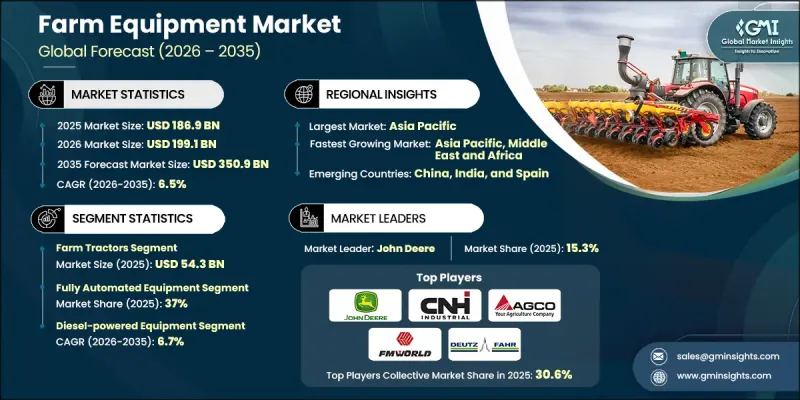
The Global Farm Equipment Market was valued at USD 186.9 billion in 2025 and is estimated to grow at a CAGR of 6.5% to reach USD 350.9 billion by 2035.
This steady momentum reflects the rapid evolution of modern agriculture, which is being shaped by mechanization, rising food demand, and technological breakthroughs. The market spans a broad spectrum of tools and machinery engineered to increase farm productivity, reduce reliance on labor, and streamline operations across crop cultivation, livestock management, and horticulture. Equipment ranges from traditional tractors and combine harvesters to next-generation automated systems powered by sensors, artificial intelligence, and guided navigation. Precision farming solutions, including GPS-enabled machinery, advanced sensors, and drones, are reshaping field management by improving input utilization and enabling data-driven decisions. These technologies support variable-rate applications, real-time monitoring, and optimized resource allocation, helping farmers improve yields while reducing input costs by 15-20%. Growing emphasis on sustainable farming and increased mechanization across developing regions continues to reinforce industry expansion.
| Market Scope | |
|---|---|
| Start Year | 2025 |
| Forecast Year | 2026-2035 |
| Start Value | $186.9 Billion |
| Forecast Value | $350.9 Billion |
| CAGR | 6.5% |
The farm tractors segment generated USD 54.3 billion in 2024 and is projected to grow at a CAGR of 5.3% during 2025-2034. Demand for compact and utility tractors remains strong, particularly among small and medium-sized farms. Financial incentives and subsidies designed to promote agricultural modernization are further elevating adoption rates in this category.
The diesel-powered equipment segment is anticipated to grow at a CAGR of 6.7% through 2035. Diesel machinery continues to be preferred for its durability, resilience under heavy workloads, and widespread availability. However, rising fuel prices and stricter emissions regulations are prompting manufacturers to enhance efficiency and develop cleaner alternatives.
United States Farm Equipment Market held an 80% share and generated USD 20.6 billion in 2025. The U.S. market benefits from rapid advancements in technology, strong uptake of precision agriculture, and increasing demand for high-performance machinery capable of handling diverse farm operations. Enhanced awareness regarding reducing post-harvest losses and improving operational speed is supporting growth in harvesting machinery, while heightened attention on sustainable water management is boosting demand for advanced irrigation systems.
Key players in the Global Farm Equipment Market include John Deere, SDF Group, CLAAS, AGCO Corporation, Yanmar, KUHN, CNH Industrial, Mahindra & Mahindra, Deutz-Fahr, JCB, Vermeer Corporation, Kubota Corporation, Bomet, and FMWORLD Agricultural Machinery. Companies competing in the Farm Equipment Market are adopting multiple strategies to strengthen their market position. Leading manufacturers are heavily investing in precision farming solutions, automation, and smart machinery to improve productivity and sustainability. Expanding product lines across various horsepower segments and machinery categories allows brands to serve diverse farm sizes and operational needs. Collaborations with technology partners, digital platform development, and integration of telematics enhance equipment monitoring and performance analytics for customers. Companies are also focusing on regional expansion through distribution networks, localized manufacturing, and after-sales service programs.
Table of Contents
Chapter 1 Methodology and scope
- 1.1 Market scope and definition
- 1.2 Research design
- 1.2.1 Research approach
- 1.2.2 Data collection methods
- 1.3 Data mining sources
- 1.3.1 Global
- 1.3.2 Regional/country
- 1.4 Base estimates and calculations
- 1.4.1 Base year calculation
- 1.4.2 Key trends for market estimation
- 1.5 Primary research and validation
- 1.5.1 Primary sources
- 1.6 Forecast model
- 1.7 Research assumptions and limitations
Chapter 2 Executive summary
- 2.1 Industry 3600 synopsis
- 2.2 Key market trends
- 2.2.1 Regional
- 2.2.2 Equipment type
- 2.2.3 Mode of operation
- 2.2.4 Power source
- 2.2.5 Application
- 2.2.6 End use
- 2.2.7 Distribution channel
- 2.3 CXO perspectives: strategic imperatives
- 2.3.1 Key decision points for industry executives
- 2.3.2 Critical success factors for market players
- 2.4 Future outlook and strategic recommendations
Chapter 3 Industry insights
- 3.1 Industry ecosystem analysis
- 3.1.1 Supplier landscape
- 3.1.2 Profit margin
- 3.1.3 Value addition at each stage
- 3.1.4 Factor affecting the value chain
- 3.2 Industry impact forces
- 3.2.1 Growth drivers
- 3.2.2 Industry pitfalls & challenges
- 3.2.3 Opportunities
- 3.3 Growth potential analysis
- 3.4 Future market trends
- 3.5 Technology and innovation landscape
- 3.5.1 Current technological trends
- 3.5.2 Emerging technologies
- 3.6 Price trends
- 3.6.1 By region
- 3.6.2 By equipment type
- 3.7 Regulatory landscape
- 3.7.1 Standards and compliance requirements
- 3.7.2 Regional regulatory frameworks
- 3.7.3 Certification standards
- 3.8 Trade statistics
- 3.8.1 Major importing countries
- 3.8.2 Major exporting countries
- 3.9 Porter's analysis
- 3.10 PESTEL analysis
Chapter 4 Competitive landscape, 2024
- 4.1 Introduction
- 4.2 Company market share analysis
- 4.2.1 By region
- 4.2.1.1 North America
- 4.2.1.2 Europe
- 4.2.1.3 Asia Pacific
- 4.2.1.4 Latin America
- 4.2.1.5 MEA
- 4.2.1 By region
- 4.3 Company matrix analysis
- 4.4 Competitive analysis of major market players
- 4.5 Competitive positioning matrix
- 4.6 Key developments
- 4.6.1 Mergers & acquisitions
- 4.6.2 Partnerships & collaborations
- 4.6.3 New product launches
- 4.6.4 Expansion plans
Chapter 5 Market Estimates & Forecast, By Equipment Type, 2022 - 2035 ($Billion, Thousand Units)
- 5.1 Key trends
- 5.2 Farm tractors
- 5.2.1 4-wheel drive (4wd) tractors
- 5.2.2 Row crop tractors
- 5.2.3 Utility tractors
- 5.2.4 Compact utility tractors
- 5.3 Harvesting machinery
- 5.3.1 Combine harvester
- 5.3.2 Mower/swather
- 5.3.3 Forage harvester
- 5.4 Haying machinery
- 5.4.1 Hay mowers
- 5.4.2 Hay tedders
- 5.5 Planting & fertilizing
- 5.6 Plowing & cultivation
- 5.7 Others (Irrigation equipment etc.)
Chapter 6 Market Estimates & Forecast, By Mode of Operation, 2022 - 2035 ($Billion, Thousand Units)
- 6.1 Key trends
- 6.2 Manual equipment
- 6.3 Semi-automated equipment
- 6.4 Fully automated equipment
Chapter 7 Market Estimates & Forecast, By Power Source, 2022 - 2035 ($Billion, Thousand Units)
- 7.1 Key trends
- 7.2 Diesel-powered equipment
- 7.3 Electric & hybrid equipment
- 7.4 Alternative fuels
Chapter 8 Market Estimates & Forecast, By Application, 2022 - 2035 ($Billion, Thousand Units)
- 8.1 Key trends
- 8.2 Crop production applications
- 8.2.1 Tillage & soil health management
- 8.2.2 Planting & seeding operations
- 8.2.3 Crop protection
- 8.2.4 Harvesting & threshing
- 8.3 Precision agriculture
- 8.3.1 GPS-guided auto-steering
- 8.3.2 Variable rate technology
- 8.3.3 Yield monitoring & mapping
- 8.3.4 Section control systems
- 8.4 Conservation & sustainability
- 8.4.1 Conservation tillage practices
- 8.4.2 Precision irrigation
- 8.4.3 Targeted pesticide application
- 8.5 Livestock operations
- 8.5.1 Dairy farming
- 8.5.2 Cattle/hog feeding operations
Chapter 9 Market Estimates & Forecast, By End Use, 2022 - 2035 ($Billion, Thousand Units)
- 9.1 Key trends
- 9.2 Commercial operations
- 9.3 Small & medium farmers
Chapter 10 Market Estimates & Forecast, By Distribution Channel, 2022 - 2035 ($Billion, Thousand Units)
- 10.1 Key trends
- 10.2 Direct sales
- 10.3 Indirect sales
Chapter 11 Market Estimates & Forecast, By Region, 2022 - 2035 ($Billion, Thousand Units)
- 11.1 Key trends
- 11.2 North America
- 11.2.1 U.S.
- 11.2.2 Canada
- 11.3 Europe
- 11.3.1 Germany
- 11.3.2 UK
- 11.3.3 France
- 11.3.4 Spain
- 11.3.5 Italy
- 11.3.6 Netherlands
- 11.4 Asia Pacific
- 11.4.1 China
- 11.4.2 Japan
- 11.4.3 India
- 11.4.4 Australia
- 11.4.5 South Korea
- 11.5 Latin America
- 11.5.1 Brazil
- 11.5.2 Mexico
- 11.5.3 Argentina
- 11.6 MEA
- 11.6.1 South Africa
- 11.6.2 Saudi Arabia
- 11.6.3 UAE
Chapter 12 Company Profiles
- 12.1 AGCO Corporation
- 12.2 Bomet
- 12.3 CLAAS
- 12.4 CNH Industrial
- 12.5 Deutz-Fahr
- 12.6 FMWORLD Agricultural Machinery
- 12.7 JCB
- 12.8 John Deere
- 12.9 Kubota Corporation
- 12.10 KUHN
- 12.11 Mahindra & Mahindra
- 12.12 SDF Group
- 12.13 Vermeer Corporation
- 12.14 Yanmar