|
시장보고서
상품코드
1913317
리미티드 슬립 디퍼렌셜(LSD) 시장 : 시장 기회, 성장 요인, 산업 동향 분석 및 예측(2026-2035년)Limited Slip Differential Market Opportunity, Growth Drivers, Industry Trend Analysis, and Forecast 2026 - 2035 |
||||||

세계의 리미티드 슬립 디퍼렌셜 시장은 2025년에 51억 달러로 평가되었고, 2035년까지 연평균 복합 성장률(CAGR) 11.1%로 성장할 전망이며, 142억 달러에 이를 것으로 예측됩니다.

차량의 안정성, 트랙션 관리, 일관된 핸들링 성능에 대한 기대가 높아짐에 따라, 리미티드 슬립 디퍼렌셜는 구동계의 핵심 부품으로서의 지위를 확립하고 있습니다. 이러한 시스템은 광범위한 차종 카테고리에서 종합적인 주행 성능 및 안전성을 향상시키기 위해 전자식 안정성 제어 시스템과 함께 사용되는 경우가 증가하고 있습니다. 또한, 전문 용도를 넘어 폭넓은 소비자 기호에 영향을 주고 있는 성능 지향의 주행 특성에 대한 관심의 고조도 수요를 지지하고 있습니다. 설계 공학, 재료 과학 및 정밀 제조의 지속적인 발전으로 보다 컴팩트하고 효율적이며 높은 토크 관리 능력을 갖춘 차동 장치 시스템을 실현할 수 있습니다. 전동 파워트레인으로의 이행이 진행되는 중, 전자 제어식 리미티드 슬립 디퍼렌셜의 채용이 가속하고 있습니다. 이러한 시스템은 최적화된 토크 배분, 에너지 이용 효율 향상, 차량 역학 강화를 실현하기 위한 것입니다. 동시에 실용성에 중점을 둔 차량에 대한 세계 수요 증가는 트랙션의 일관성 및 안정성을 지원하는 첨단 드라이브 라인 솔루션의 필요성을 강화하고 있습니다. 이러한 복합 요인은 세계의 일반 및 고급 자동차 부문 모두에서 지속적인 성장을 이어가고 있습니다.
| 시장 범위 | |
|---|---|
| 시작 연도 | 2025년 |
| 예측 연도 | 2026-2035년 |
| 시작 시 가치 | 51억 달러 |
| 예측 금액 | 142억 달러 |
| CAGR | 11.1% |
기계식 리미티드 슬립 디퍼렌셜 부문은 2025년 68%의 점유율을 차지했으며, 2035년까지 91억 달러에 달할 것으로 예측되고 있습니다. 이러한 시스템은 내구성, 비용 효율성 및 전자 부품에 의존하지 않는 신뢰성 있는 성능으로 널리 채택되고 있습니다. 내부 설계 및 마찰재의 지속적인 개선으로 토크 전달 효율이 향상되고 수명이 연장되고 여러 차량 카테고리 및 지역 시장에서 견조한 수요가 예상됩니다.
고성능 자동차 부문은 2026-2035년 연평균 복합 성장률(CAGR) 13.4%를 보일 것으로 예측됩니다. 자동차 제조업체는 핸들링 성능, 가속 성능 및 동적 제어의 향상을 지원하기 위해 전자식과 기계식의 리미티드 슬립 디퍼렌셜를 통합하는 경향이 커지고 있습니다. 토크 관리 기술의 진보로 고부가가치 차량 및 특수 차량 플랫폼에서의 채용이 확대되고 있으며, 이 부문에서 장기적인 수요를 강화하고 있습니다.
미국의 리미티드 슬립 디퍼렌셜 시장은 2025년 7억 9,160만 달러에 달했습니다. 대형 차량 플랫폼의 지속적인 생산과 다양한 운전 조건 하에서 성능, 안정성 및 트랙션을 향상시키는 드라이브 트레인 시스템에 OEM 제조업체의 지속적인 주력으로 국내 수요가 견조하게 추진하고 있습니다.
자주 묻는 질문
목차
제1장 조사 방법
제2장 주요 요약
제3장 업계 인사이트
- 생태계 분석
- 공급자의 상황
- 이익률 분석
- 비용 구조
- 각 단계에서의 부가가치
- 밸류체인에 영향을 주는 요인
- 혁신
- 업계에 미치는 영향요인
- 성장 촉진요인
- 차량의 안전성 및 트랙션에 대한 수요 증가
- SUV 및 크로스오버 부문의 급속한 성장
- 전기자동차 및 하이브리드 자동차의 확대
- 고성능차 및 모터스포츠 차량의 성장
- 드라이브 라인 및 재료 기술의 진보
- 업계의 잠재적 위험 및 과제
- 높은 시스템 및 통합 비용
- 대체 구동 기술로부터 경쟁 구도
- 시장 기회
- 신흥 시장에서의 AWD 채용 증가
- 전자식 LSD 플랫폼으로의 OEM의 이행
- 애프터마켓용 성능 향상 및 오프로드용 업그레이드
- 상용차 및 특수 차량에의 응용
- 성장 가능성 분석
- 규제 상황
- 북미
- SAE J328 액슬 및 드라이브 라인 부품 성능 요건
- 캐나다-SAE J328 액슬 및 드라이브 라인 부품 성능 요건
- 유럽
- 영국-UNECE 규칙 제13호 차량 제동 및 안정성 시스템
- 독일-ISO 26262 도로 차량의 전기 및 전자 시스템의 기능 안전
- 프랑스-UNECE 규칙 제79호 조타 및 차량 제어 시스템
- 이탈리아-차동 장치 제조용 ISO 9001 품질 경영 시스템
- 스페인-ISO 14001 환경 경영 시스템(디퍼렌셜 생산용)
- 아시아태평양
- 중국-GB/T 자동차용 차동 장치의 구동계 및 차축 성능 기준
- 일본-ISO 26262 도로 차량의 전기 전자 시스템의 기능 안전
- 인도-AIS 자동차 산업 규격(차축 및 차동 장치용)
- 라틴아메리카
- 브라질-ABNT NBR 자동차 구동계 성능 기준
- 멕시코-NOM 자동차 부품 성능 및 안전 기준
- 아르헨티나-자동차 부품용 ISO 9001 품질 경영 시스템
- 중동 및 아프리카
- 아랍에미리트-UNECE 규칙 제13호 차량 제동 및 안정성 시스템
- 남아프리카-ISO 26262 도로 차량의 전기 및 전자 시스템 기능 안전
- 사우디아라비아-SASO 자동차 기술 규제(구동계 시스템)
- 북미
- Porter's Five Forces 분석
- PESTEL 분석
- 기술 및 혁신 전망
- 현재의 기술 동향
- 신흥 기술
- 생산 통계
- 생산 거점
- 소비 허브
- 수출 및 수입
- 비용 내역 분석
- 개발 비용 구조
- 연구개발 비용 분석
- 마케팅 및 판매 비용
- 특허 분석
- 지속가능성 및 환경면
- 지속가능한 대처
- 폐기물 감축 전략
- 생산에서의 에너지 효율
- 환경 배려형 이니셔티브
- 장래 시장 전망 및 기회
- 경쟁 벤치마킹 : LSD 및 대체 기술
- LSD와 오픈 데프 성능 비교
- LSD와 전자식 트랙션 컨트롤 시스템(ETC) 비교
- LSD와 토크 벡터링 시스템 비교
- OEM 의사결정에서 트레이드오프 : 비용, 복잡성, 성능
- 차량 동태 제어 시스템과 LSD 통합
- 전기자동차(EV) 및 e-액슬 호환성 분석
- 전기자동차 아키텍처에서 기계식 LSD의 의미
- e-LSD 및 e-액슬 및 전동 구동 유닛의 통합
- 전기자동차의 LSD와 모터 기반 토크 벡터링의 비교
- BEV, HEV, PHEV의 미래 수요 전망
제4장 경쟁 구도
- 서문
- 기업의 시장 점유율 분석
- 북미
- 유럽
- 아시아태평양
- 라틴아메리카
- 중동 및 아프리카
- 주요 시장 기업의 경쟁 분석
- 경쟁 포지셔닝 매트릭스
- 전략적 전망 매트릭스
- 주요 발전
- 합병 및 인수
- 제휴 및 협업
- 신제품 발매
- 사업 확대 계획 및 자금 조달
제5장 시장 추계 및 예측 : 제품별(2022-2035년)
- 기계식 LSD
- 전자 LSD
- 토르센식 LSD
제6장 시장 추계 및 예측 : 차량별(2022-2035년)
- 승용차
- SUV
- 세단
- 해치백
- 상용차
- 경상용차(LCV)
- MCV
- 대형 상용차(HCV)
제7장 시장 추계 및 예측 : 구동 방식별(2022-2035년)
- 전륜 구동(FWD)
- 후륜구동(RWD)
- 전륜 구동 및 사륜 구동(AWD/4WD)
제8장 시장 추계 및 예측 : 용도별(2022-2035년)
- 고성능 차량
- 오프로드 자동차
- 승용차
- 기타
제9장 시장 추계 및 예측 : 판매 채널별(2022-2035년)
- OEM
- 애프터마켓
제10장 시장 추계 및 예측 : 지역별(2022-2035년)
- 북미
- 미국
- 캐나다
- 유럽
- 독일
- 영국
- 프랑스
- 이탈리아
- 스페인
- 러시아
- 북유럽 국가
- 포르투갈
- 크로아티아
- 베네룩스
- 아시아태평양
- 중국
- 인도
- 일본
- 호주
- 한국
- 싱가포르
- 태국
- 인도네시아
- 베트남
- 라틴아메리카
- 브라질
- 멕시코
- 아르헨티나
- 콜롬비아
- 중동 및 아프리카
- 남아프리카
- 사우디아라비아
- 아랍에미리트(UAE)
- 튀르키예
제11장 기업 프로파일
- 세계 기업
- Aisin Seiki
- American Axle & Manufacturing
- BorgWarner
- Dana
- Eaton
- GKN Automotive
- JTEKT
- Linamar
- Schaeffler
- ZF Friedrichshafen
- 지역 기업
- Auburn Gear
- Drexler Automotive
- Kaaz
- OS Giken
- RT Quaife Engineering
- Truetrac Limited Slip
- Yukon Gear & Axle
- ARB
- Torsen
- 신흥 기업 및 디스럽터 기업
- Carrosser
- CUSCO Japan
- Powertrax
- Wavetrac Differentials
- OS Giken Motorsport Division
- Xtrac
- MFactory
- Motive Gear
The Global Limited Slip Differential Market was valued at USD 5.1 billion in 2025 and is estimated to grow at a CAGR of 11.1% to reach USD 14.2 billion by 2035.
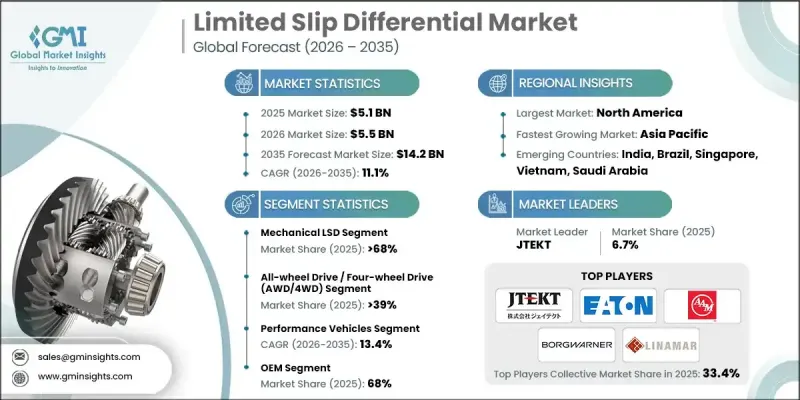
Rising expectations for vehicle stability, traction management, and consistent handling performance are positioning limited slip differentials as a core drivetrain component. These systems are increasingly used alongside electronic stability solutions to improve overall drivability and safety across a wide range of vehicle categories. Demand is also supported by growing interest in performance-oriented driving characteristics, which has influenced broader consumer preferences beyond specialized applications. Ongoing advancements in design engineering, materials science, and precision manufacturing are enabling more compact and efficient differential systems with higher torque management capability. The growing shift toward electrified powertrains is accelerating the adoption of electronically controlled limited slip differentials, as these systems support optimized torque delivery, improved energy utilization, and enhanced vehicle dynamics. In parallel, rising global demand for utility-focused vehicles is strengthening the need for advanced driveline solutions that support traction consistency and stability. These combined factors continue to drive sustained growth across both mainstream and premium automotive segments worldwide.
| Market Scope | |
|---|---|
| Start Year | 2025 |
| Forecast Year | 2026-2035 |
| Start Value | $5.1 Billion |
| Forecast Value | $14.2 Billion |
| CAGR | 11.1% |
In 2025, the mechanical limited slip differentials segment accounted for 68% share and is projected to reach USD 9.1 billion by 2035. These systems remain widely adopted due to their durability, cost efficiency, and reliable performance without reliance on electronic components. Continuous improvements in internal design and friction materials are enhancing torque transfer efficiency and extending service life, ensuring strong demand across multiple vehicle categories and regional markets.
The performance vehicle segment is expected to grow at a CAGR of 13.4% during 2026-2035. Automakers are increasingly integrating both electronic and mechanical limited slip differentials to support enhanced handling, acceleration, and dynamic control. Advances in torque management technologies are expanding adoption across high-value and specialized vehicle platforms, reinforcing long-term demand within this segment.
US Limited Slip Differential Market reached USD 791.6 million in 2025. Strong domestic demand is driven by sustained production of larger vehicle platforms and continued OEM focus on driveline systems that enhance capability, stability, and traction across diverse operating conditions.
Key companies active in the Global Limited Slip Differential Market include ZF Friedrichshafen, Dana, BorgWarner, Eaton, GKN Automotive, Aisin Seiki, JTEKT, American Axle & Manufacturing, Linamar, and Auburn Gear. Companies operating in the Global Limited Slip Differential Market are reinforcing their competitive position through continuous product innovation and investment in advanced driveline technologies. Manufacturers are focusing on lightweight materials, compact designs, and improved torque management to meet evolving OEM requirements. Strategic collaborations with vehicle manufacturers are enabling early integration of next-generation differential systems into new platforms. Many players are expanding electronic and hybrid LSD offerings to align with the growing electrification trend. Global footprint expansion through localized manufacturing and supply chain optimization is improving responsiveness to regional demand.
Table of Contents
Chapter 1 Methodology
- 1.1 Research approach
- 1.2 Quality commitments
- 1.2.1 GMI AI policy & data integrity commitment
- 1.3 Research trail & confidence scoring
- 1.3.1 Research trail components
- 1.3.2 Scoring components
- 1.4 Data collection
- 1.4.1 Partial list of primary sources
- 1.5 Data mining sources
- 1.5.1 Paid sources
- 1.6 Base estimates and calculations
- 1.6.1 Base year calculation
- 1.7 Forecast
- 1.8 Research transparency addendum
Chapter 2 Executive Summary
- 2.1 Industry 360° synopsis, 2022 - 2035
- 2.2 Key market trends
- 2.2.1 Regional
- 2.2.2 Product
- 2.2.3 Drive
- 2.2.4 Vehicle
- 2.2.5 Application
- 2.2.6 Sales channel
- 2.3 TAM Analysis, 2026-2035
- 2.4 CXO perspectives: Strategic imperatives
- 2.4.1 Executive decision points
- 2.4.2 Critical success factors
- 2.5 Future outlook & strategic recommendations
Chapter 3 Industry Insights
- 3.1 Industry ecosystem analysis
- 3.1.1 Supplier landscape
- 3.1.2 Profit margin analysis
- 3.1.3 Cost structure
- 3.1.4 Value addition at each stage
- 3.1.5 Factor affecting the value chain
- 3.1.6 Disruptions
- 3.2 Industry impact forces
- 3.2.1.1 Growth drivers
- 3.2.1.2 Rising demand for vehicle safety and traction
- 3.2.1.3 Rapid growth of SUV and crossover segments
- 3.2.1.4 Expansion of electric and hybrid vehicles
- 3.2.1.5 Growth of performance and motorsports vehicles
- 3.2.1.6 Advancements in driveline and materials technology
- 3.2.2 Industry pitfalls and challenges
- 3.2.2.1 High system and integration costs
- 3.2.2.2 Competition from alternative traction technologies
- 3.2.3 Market opportunities
- 3.2.3.1 Rising AWD adoption in emerging markets
- 3.2.3.2 OEM shift toward electronic LSD platforms
- 3.2.3.3 Aftermarket performance and off-road upgrades
- 3.2.3.4 Commercial and specialty vehicle applications
- 3.3 Growth potential analysis
- 3.4 Regulatory landscape
- 3.4.1 North America
- 3.4.1.1 United States - SAE J328 Axle and Driveline Component Performance Requirements
- 3.4.1.2 Canada - SAE J328 Axle and Driveline Component Performance Requirements
- 3.4.2 Europe
- 3.4.2.1 United Kingdom - UNECE Regulation No. 13 Vehicle Braking and Stability Systems
- 3.4.2.2 Germany - ISO 26262 Functional Safety of Electrical and Electronic Systems in Road Vehicles
- 3.4.2.3 France - UNECE Regulation No. 79 Steering and Vehicle Control Systems
- 3.4.2.4 Italy - ISO 9001 Quality Management Systems for Differential Manufacturing
- 3.4.2.5 Spain - ISO 14001 Environmental Management Systems for Differential Production
- 3.4.3 Asia Pacific
- 3.4.3.1 China - GB/T Driveline and Axle Performance Standards for Automotive Differentials
- 3.4.3.2 Japan - ISO 26262 Functional Safety of Electrical and Electronic Systems in Road Vehicles
- 3.4.3.3 India - AIS Automotive Industry Standards for Axles and Differentials
- 3.4.4 Latin America
- 3.4.4.1 Brazil - ABNT NBR Automotive Driveline Performance Standards
- 3.4.4.2 Mexico - NOM Automotive Component Performance and Safety Standards
- 3.4.4.3 Argentina - ISO 9001 Quality Management Systems for Automotive Components
- 3.4.5 Middle East & Africa
- 3.4.5.1 United Arab Emirates - UNECE Regulation No. 13 Vehicle Braking and Stability Systems
- 3.4.5.2 South Africa - ISO 26262 Functional Safety of Electrical and Electronic Systems in Road Vehicles
- 3.4.5.3 Saudi Arabia - SASO Automotive Technical Regulations for Driveline Systems
- 3.4.1 North America
- 3.5 Porter's analysis
- 3.6 PESTEL analysis
- 3.7 Technology and innovation landscape
- 3.7.1 Current technological trends
- 3.7.2 Emerging technologies
- 3.8 Production statistics
- 3.8.1 Production hubs
- 3.8.2 Consumption hubs
- 3.8.3 Export and import
- 3.9 Cost breakdown analysis
- 3.9.1 Development cost structure
- 3.9.2 R&D cost analysis
- 3.9.3 Marketing & sales costs
- 3.10 Patent analysis
- 3.11 Sustainability and environmental aspects
- 3.11.1 Sustainable practices
- 3.11.2 Waste reduction strategies
- 3.11.3 Energy efficiency in production
- 3.11.4 Eco-friendly Initiatives
- 3.12 Future market outlook & opportunities
- 3.13 Competitive technology benchmarking: LSD vs alternatives
- 3.13.1 LSD vs open differential performance comparison
- 3.13.2 LSD vs electronic traction control systems (ETC)
- 3.13.3 LSD vs torque vectoring systems
- 3.13.4 OEM decision trade-offs: cost, complexity, performance
- 3.14 LSD integration with vehicle dynamics systems
- 3.15 Electric Vehicle & e-Axle Compatibility Analysis
- 3.15.1 Mechanical LSD relevance in EV architectures
- 3.15.2 e-LSD integration with e-axles and electric drive units
- 3.15.3 LSD vs motor-based torque vectoring in EVs
- 3.15.4 Future demand outlook across BEV, HEV, PHEV
Chapter 4 Competitive Landscape, 2025
- 4.1 Introduction
- 4.2 Company market share analysis
- 4.2.1 North America
- 4.2.2 Europe
- 4.2.3 Asia Pacific
- 4.2.4 LATAM
- 4.2.5 MEA
- 4.3 Competitive analysis of major market players
- 4.4 Competitive positioning matrix
- 4.5 Strategic outlook matrix
- 4.6 Key developments
- 4.6.1 Mergers & acquisitions
- 4.6.2 Partnerships & collaborations
- 4.6.3 New Product Launches
- 4.6.4 Expansion Plans and funding
Chapter 5 Market Estimates & Forecast, By Product, 2022 - 2035 ($Bn, units)
- 5.1 Key trends
- 5.2 Mechanical LSD
- 5.3 Electronic LSD
- 5.4 Torsen LSD
Chapter 6 Market Estimates & Forecast, By Vehicle, 2022 - 2035 ($Bn, units)
- 6.1 Key trends
- 6.2 Passenger vehicle
- 6.2.1 SUV
- 6.2.2 Sedan
- 6.2.3 Hatchback
- 6.3 Commercial vehicle
- 6.3.1 LCV
- 6.3.2 MCV
- 6.3.3 HCV
Chapter 7 Market Estimates & Forecast, By Drive, 2022 - 2035 ($Bn, units)
- 7.1 Key trends
- 7.2 Front-Wheel Drive (FWD)
- 7.3 Rear-Wheel Drive (RWD)
- 7.4 All-Wheel Drive / Four-Wheel Drive (AWD/4WD)
Chapter 8 Market Estimates & Forecast, By Application, 2022 - 2035 ($Bn, units)
- 8.1 Key trends
- 8.2 Performance vehicles
- 8.3 Off-road vehicles
- 8.4 Passenger vehicles
- 8.5 Others
Chapter 9 Market Estimates & Forecast, By Sales Channel, 2022 - 2035 ($Bn, units)
- 9.1 Key trends
- 9.2 OEM
- 9.3 Aftermarket
Chapter 10 Market Estimates & Forecast, By Region, 2022 - 2035 ($Bn, units)
- 10.1 Key trends
- 10.2 North America
- 10.2.1 US
- 10.2.2 Canada
- 10.3 Europe
- 10.3.1 Germany
- 10.3.2 UK
- 10.3.3 France
- 10.3.4 Italy
- 10.3.5 Spain
- 10.3.6 Russia
- 10.3.7 Nordics
- 10.3.8 Portugal
- 10.3.9 Croatia
- 10.3.10 Benelux
- 10.4 Asia Pacific
- 10.4.1 China
- 10.4.2 India
- 10.4.3 Japan
- 10.4.4 Australia
- 10.4.5 South Korea
- 10.4.6 Singapore
- 10.4.7 Thailand
- 10.4.8 Indonesia
- 10.4.9 Vietnam
- 10.5 Latin America
- 10.5.1 Brazil
- 10.5.2 Mexico
- 10.5.3 Argentina
- 10.5.4 Colombia
- 10.6 MEA
- 10.6.1 South Africa
- 10.6.2 Saudi Arabia
- 10.6.3 UAE
- 10.6.4 Turkey
Chapter 11 Company Profiles
- 11.1 Global Players
- 11.1.1 Aisin Seiki
- 11.1.2 American Axle & Manufacturing
- 11.1.3 BorgWarner
- 11.1.4 Dana
- 11.1.5 Eaton
- 11.1.6 GKN Automotive
- 11.1.7 JTEKT
- 11.1.8 Linamar
- 11.1.9 Schaeffler
- 11.1.10 ZF Friedrichshafen
- 11.2 Regional Players
- 11.2.1 Auburn Gear
- 11.2.2 Drexler Automotive
- 11.2.3 Kaaz
- 11.2.4 OS Giken
- 11.2.5 RT Quaife Engineering
- 11.2.6 Truetrac Limited Slip
- 11.2.7 Yukon Gear & Axle
- 11.2.8 ARB
- 11.2.9 Torsen
- 11.3 Emerging / Disruptor Players
- 11.3.1 Carrosser
- 11.3.2 CUSCO Japan
- 11.3.3 Powertrax
- 11.3.4 Wavetrac Differentials
- 11.3.5 OS Giken Motorsport Division
- 11.3.6 Xtrac
- 11.3.7 MFactory
- 11.3.8 Motive Gear