|
시장보고서
상품코드
1913342
이소프로필 알코올 시장 : 시장 기회, 성장 요인, 산업 동향 분석 및 예측(2026-2035년)Isopropyl Alcohol Market Opportunity, Growth Drivers, Industry Trend Analysis, and Forecast 2026 - 2035 |
||||||

세계의 이소프로필 알코올 시장은 2025년에 73억 달러로 평가되었고, 2035년까지 연평균 복합 성장률(CAGR) 6.4%로 성장할 전망이며, 137억 달러에 이를 것으로 예측됩니다.

시장 성장은 세계 위생 기준에 중점을 두고 의약품 생산 능력을 확대하며 기술 주도형 산업에서 정밀 등급 세정액의 사용 증가에 의해 지원되고 있습니다. 이소프로필 알코올은 소독 능력 및 의약품 제조에서 신뢰할 수 있는 용매로서의 역할로부터 널리 평가되고 있습니다. 위생 관리 및 감염 예방에 대한 장기적인 의식이 높아짐에 따라 이전 수요 급증을 훨씬 넘어 수요를 지속시켜 여러 산업에서 필수 화학물질로서의 지위를 강화하고 있습니다. 동시에, 규제 압력과 환경 우선순위는 바이오 생산 경로와 보다 친환경적인 용매 시스템으로의 전환을 가속화하고 있습니다. 지속가능한 화학제조 및 공급망 최적화에 대한 투자는 생산 모델을 재구성하여 공급업체가 환경 성능을 향상시키면서 특수 용도 및 고순도 용도를 타겟팅할 수 있도록 합니다. 이러한 구조적 진전은 시장의 탄력성 및 장기적인 성장 가능성을 지속적으로 향상시키고 있습니다.
| 시장 범위 | |
|---|---|
| 시작 연도 | 2025년 |
| 예측 연도 | 2026-2035년 |
| 시작 시 가치 | 73억 달러 |
| 예측 금액 | 137억 달러 |
| CAGR | 6.4% |
산업용 등급의 이소프로필 알코올 부문은 2025년에 46.9%의 점유율을 차지하였고, 2035년까지 연평균 복합 성장률(CAGR) 6.4%로 성장할 것으로 예측됩니다. 그 이점은 비용 효율성 및 광범위한 기능적 적용 가능성에 의해 지원됩니다. 정화 요건이 낮기 때문에 생산 에너지 강도가 줄어들고 경쟁력 있는 가격 설정이 가능해 산업 운영 전체에서의 대규모 사용을 지원하고 있습니다.
의료 및 의약품 부문은 2025년에 34.1%의 점유율을 차지하였으며, 2026-2035년 CAGR 6.5%로 확대될 것으로 예측되고 있습니다. 소독 및 살균 용도나 의약품 급료 용제로서의 중요한 역할이, 강한 수요를 지지하고 있습니다.
북미의 이소프로필 알코올 시장은 2025년에 24.3%의 점유율을 차지했습니다. 이 지역의 성장은 의료, 화학 제조 및 전문 청소 분야에서 소비량이 증가함에 따라 견인되고 있으며, 견고한 산업 인프라와 일관된 규제 체제에 의해 지원됩니다.
자주 묻는 질문
목차
제1장 조사 방법 및 범위
제2장 주요 요약
제3장 업계 인사이트
- 생태계 분석
- 공급자의 상황
- 이익률
- 각 단계에서의 부가가치
- 밸류체인에 영향을 주는 요인
- 혁신
- 업계에 미치는 영향요인
- 성장 촉진요인
- 업계의 잠재적 위험 및 과제
- 시장 기회
- 성장 가능성 분석
- 규제 상황
- 북미
- 유럽
- 아시아태평양
- 라틴아메리카
- 중동 및 아프리카
- Porter's Five Forces 분석
- PESTEL 분석
- 가격 동향
- 지역별
- 등급별
- 장래 시장 동향
- 기술 및 혁신 동향
- 현재 기술 동향
- 신흥 기술
- 특허 상황
- 무역 통계(HS코드)(참고 : 무역 통계는 주요 국가에서만 제공됨)
- 주요 수입국
- 주요 수출국
- 지속가능성 및 환경면
- 지속가능한 대처
- 폐기물 감축 전략
- 생산에 있어서 에너지 효율
- 환경에 배려한 대처
- 탄소발자국 고려
제4장 경쟁 구도
- 서문
- 기업의 시장 점유율 분석
- 지역별
- 북미
- 유럽
- 아시아태평양
- 라틴아메리카
- 중동 및 아프리카
- 지역별
- 기업 매트릭스 분석
- 주요 시장 기업의 경쟁 분석
- 경쟁 포지셔닝 매트릭스
- 주요 발전
- 합병 및 인수
- 제휴 및 협업
- 신제품 발매
- 사업 확대 계획
제5장 시장 추계 및 예측 : 등급별(2022-2035년)
- 산업용 등급
- 의약품 등급
- 화장품 등급
- 식품 등급
- 전자 등급
제6장 시장 추계 및 예측 : 용도별(2022-2035년)
- 용제
- 산업용 용제
- 추출 용제
- 제조 공정용 용제
- 도료 및 잉크용 용제
- 세정제
- 표면 세정제
- 전자부품 세정제
- 유리 및 경질 표면용 세제
- 금속 세정 및 탈지
- 화학 중간체
- 아세톤 제조
- 아세트산 이소프로필 제조
- 수지 및 폴리머 중간체
- 기타 유기 합성
- 향료
- 식품용 향료 추출
- 천연 향료용 용제
- 소독제
- 손가락 소독제
- 표면 소독제
- 의료용 소독제
- 가정용 소독제
- 기타
- 도료용 신나
- 연료 첨가제
- 부동액 성분
- 실험실용 시약
제7장 시장 추계 및 예측 : 최종 이용 산업별(2022-2035년)
- 식품 및 음료
- 의료 및 의약품
- 화장품 및 퍼스널케어
- 페인트 및 코팅
- 화학제품
- 일렉트로닉스
- 자동차
- 기타
제8장 시장 추계 및 예측 : 지역별(2022-2035년)
- 북미
- 미국
- 캐나다
- 유럽
- 독일
- 영국
- 프랑스
- 스페인
- 이탈리아
- 기타 유럽
- 아시아태평양
- 중국
- 인도
- 일본
- 호주
- 한국
- 기타 아시아태평양
- 라틴아메리카
- 브라질
- 멕시코
- 아르헨티나
- 기타 라틴아메리카
- 중동 및 아프리카
- 사우디아라비아
- 남아프리카
- 아랍에미리트(UAE)
- 기타 중동 및 아프리카
제9장 기업 프로파일
- Deepak Fertilisers and Petrochemicals Corporation Ltd.(DFPCL)
- Dow
- ExxonMobil
- INEOS
- ISU Chemical
- Jiangsu Denoir Specialty Chemicals
- Kukdo Chemical
- LCY
- LG Chem
- LyondellBasell
- Mitsubishi Chemical Group
- Mitsui Chemicals
- PetroChina
- SABIC
- Sasol
- Shandong Dadi Supu Chemical Co., Ltd.
- Shell Chemicals
- SK Geo Centric
- Solvay
- Tokuyama Corporation
- Others
The Global Isopropyl Alcohol Market was valued at USD 7.3 billion in 2025 and is estimated to grow at a CAGR of 6.4% to reach USD 13.7 billion by 2035.
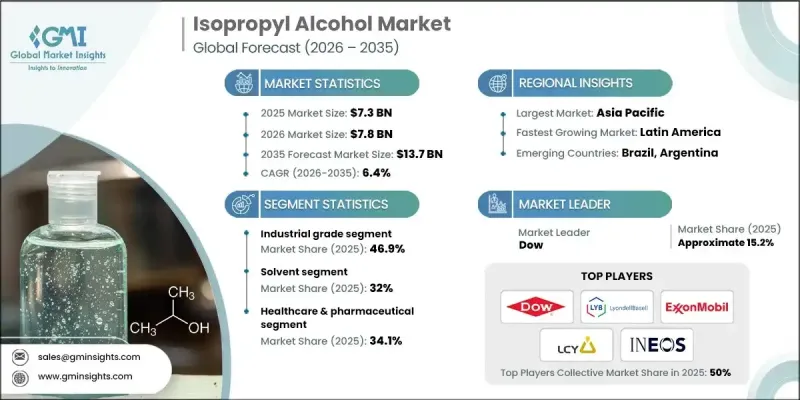
Market growth is supported by rising global emphasis on hygiene standards, expanding pharmaceutical production capacity, and increasing use of precision-grade cleaning solutions across technology-driven industries. Isopropyl alcohol remains widely valued for its disinfecting capability and its role as a reliable solvent in pharmaceutical manufacturing. Heightened long-term awareness around sanitation and infection prevention has sustained demand well beyond earlier surges, reinforcing its position as an essential chemical across multiple industries. In parallel, regulatory pressure and environmental priorities are accelerating the shift toward bio-based production pathways and greener solvent systems. Investments in sustainable chemical manufacturing and supply chain optimization are reshaping production models, enabling suppliers to target specialty and high-purity applications while improving environmental performance. These structural developments continue to enhance market resilience and long-term growth potential.
| Market Scope | |
|---|---|
| Start Year | 2025 |
| Forecast Year | 2026-2035 |
| Start Value | $7.3 Billion |
| Forecast Value | $13.7 Billion |
| CAGR | 6.4% |
The industrial-grade isopropyl alcohol segment held 46.9% share in 2025 and is expected to grow at a CAGR of 6.4% through 2035. Its dominance is driven by cost efficiency and broad functional applicability. Lower purification requirements reduce production energy intensity, allowing competitive pricing and supporting large-scale usage across industrial operations.
The healthcare and pharmaceutical segment held 34.1% share in 2025 and is forecast to expand at a CAGR of 6.5% from 2026 to 2035. Strong demand is supported by the critical role of isopropyl alcohol in sanitation, antiseptic use, and pharmaceutical-grade solvent applications.
North America Isopropyl Alcohol Market represented 24.3% share in 2025. Regional growth is driven by rising consumption across healthcare, chemical manufacturing, and professional cleaning sectors, supported by strong industrial infrastructure and consistent regulatory frameworks.
Key companies operating in the Global Isopropyl Alcohol Market include Dow, LyondellBasell, SABIC, Shell Chemicals, LG Chem, Mitsubishi Chemical Group, ExxonMobil, INEOS, Solvay, Sasol, PetroChina, Mitsui Chemicals, Deepak Fertilisers and Petrochemicals Corporation Ltd., Tokuyama Corporation, ISU Chemical, SK Geo Centric, LCY, Kukdo Chemical, Jiangsu Denoir Specialty Chemicals, and Shandong Dadi Supu Chemical Co., Ltd.
Companies in the isopropyl alcohol market are strengthening their competitive position through capacity expansion, sustainability-focused innovation, and portfolio optimization. Many producers are investing in bio-based and low-emission production technologies to meet regulatory and customer expectations. Strategic geographic expansion and localized manufacturing are helping reduce supply risks and improve responsiveness. Firms are also emphasizing high-purity and specialty-grade offerings to capture value-added segments. Long-term supply agreements with pharmaceutical and industrial customers are being used to stabilize demand, while operational efficiency initiatives and digitalized production systems support cost competitiveness and consistent product quality.
Table of Contents
Chapter 1 Methodology & Scope
- 1.1 Market scope and definition
- 1.2 Research design
- 1.2.1 Research approach
- 1.2.2 Data collection methods
- 1.3 Data mining sources
- 1.3.1 Global
- 1.3.2 Regional/Country
- 1.4 Base estimates and calculations
- 1.4.1 Base year calculation
- 1.4.2 Key trends for market estimation
- 1.5 Primary research and validation
- 1.5.1 Primary sources
- 1.6 Forecast model
- 1.7 Research assumptions and limitations
Chapter 2 Executive Summary
- 2.1 Industry 3600 synopsis
- 2.2 Key market trends
- 2.2.1 Regional
- 2.2.2 Grade
- 2.2.3 Application
- 2.2.4 End use industry
- 2.3 TAM Analysis, 2026-2035
- 2.4 CXO perspectives: Strategic imperatives
- 2.4.1 Executive decision points
- 2.4.2 Critical success factors
- 2.5 Future Outlook and Strategic Recommendations
Chapter 3 Industry Insights
- 3.1 Industry ecosystem analysis
- 3.1.1 Supplier landscape
- 3.1.2 Profit margin
- 3.1.3 Value addition at each stage
- 3.1.4 Factor affecting the value chain
- 3.1.5 Disruptions
- 3.2 Industry impact forces
- 3.2.1 Growth drivers
- 3.2.2 Industry pitfalls and challenges
- 3.2.3 Market opportunities
- 3.3 Growth potential analysis
- 3.4 Regulatory landscape
- 3.4.1 North America
- 3.4.2 Europe
- 3.4.3 Asia Pacific
- 3.4.4 Latin America
- 3.4.5 Middle East & Africa
- 3.5 Porter's analysis
- 3.6 PESTEL analysis
- 3.7 Price trends
- 3.7.1 By region
- 3.7.2 By grade
- 3.8 Future market trends
- 3.9 Technology and Innovation landscape
- 3.9.1 Current technological trends
- 3.9.2 Emerging technologies
- 3.10 Patent Landscape
- 3.11 Trade statistics (HS code) ( Note: the trade statistics will be provided for key countries only)
- 3.11.1 Major importing countries
- 3.11.2 Major exporting countries
- 3.12 Sustainability and environmental aspects
- 3.12.1 Sustainable practices
- 3.12.2 Waste reduction strategies
- 3.12.3 Energy efficiency in production
- 3.12.4 Eco-friendly initiatives
- 3.13 Carbon footprint consideration
Chapter 4 Competitive Landscape, 2025
- 4.1 Introduction
- 4.2 Company market share analysis
- 4.2.1 By region
- 4.2.1.1 North America
- 4.2.1.2 Europe
- 4.2.1.3 Asia Pacific
- 4.2.1.4 LATAM
- 4.2.1.5 MEA
- 4.2.1 By region
- 4.3 Company matrix analysis
- 4.4 Competitive analysis of major market players
- 4.5 Competitive positioning matrix
- 4.6 Key developments
- 4.6.1 Mergers & acquisitions
- 4.6.2 Partnerships & collaborations
- 4.6.3 New Product Launches
- 4.6.4 Expansion Plans
Chapter 5 Market Estimates and Forecast, By Grade, 2022-2035 (USD Billion) (Kilo Tons)
- 5.1 Key trends
- 5.2 Industrial Grade
- 5.3 Pharmaceutical Grade
- 5.4 Cosmetic Grade
- 5.5 Food Grade
- 5.6 Electronic Grade
Chapter 6 Market Estimates and Forecast, By Application, 2022-2035 (USD Billion) (Kilo Tons)
- 6.1 Key trends
- 6.2 Solvent
- 6.2.1 Industrial Solvent
- 6.2.2 Extraction Solvent
- 6.2.3 Process Solvent in Manufacturing
- 6.2.4 Coating & Ink Solvent
- 6.3 Cleaning Agent
- 6.3.1 Surface Cleaners
- 6.3.2 Electronic Component Cleaners
- 6.3.3 Glass & Hard Surface Cleaners
- 6.3.4 Metal Cleaning & Degreasing
- 6.4 Chemical Intermediate
- 6.4.1 Acetone Manufacturing
- 6.4.2 Production of Isopropyl Acetate
- 6.4.3 Resin & Polymer Intermediate
- 6.4.4 Other Organic Synthesis
- 6.5 Flavouring Agent
- 6.5.1 Food Flavor Extraction
- 6.5.2 Solvent in Natural Flavors
- 6.6 Disinfectant
- 6.6.1 Hand Sanitizers
- 6.6.2 Surface Disinfectants
- 6.6.3 Medical Disinfectants
- 6.6.4 Household Disinfectants
- 6.7 Others
- 6.7.1 Paint Thinner
- 6.7.2 Fuel Additive
- 6.7.3 Anti-freeze Component
- 6.7.4 Laboratory Reagent
Chapter 7 Market Estimates and Forecast, By End Use Industry, 2022-2035 (USD Billion) (Kilo Tons)
- 7.1 Key trends
- 7.2 Food & Beverages
- 7.3 Healthcare & Pharmaceutical
- 7.4 Cosmetic & Personal Care
- 7.5 Paints & Coatings
- 7.6 Chemicals
- 7.7 Electronics
- 7.8 Automotive
- 7.9 Others
Chapter 8 Market Estimates and Forecast, By Region, 2022-2035 (USD Billion) (Kilo Tons)
- 8.1 Key trends
- 8.2 North America
- 8.2.1 U.S.
- 8.2.2 Canada
- 8.3 Europe
- 8.3.1 Germany
- 8.3.2 UK
- 8.3.3 France
- 8.3.4 Spain
- 8.3.5 Italy
- 8.3.6 Rest of Europe
- 8.4 Asia Pacific
- 8.4.1 China
- 8.4.2 India
- 8.4.3 Japan
- 8.4.4 Australia
- 8.4.5 South Korea
- 8.4.6 Rest of Asia Pacific
- 8.5 Latin America
- 8.5.1 Brazil
- 8.5.2 Mexico
- 8.5.3 Argentina
- 8.5.4 Rest of Latin America
- 8.6 Middle East and Africa
- 8.6.1 Saudi Arabia
- 8.6.2 South Africa
- 8.6.3 UAE
- 8.6.4 Rest of Middle East and Africa
Chapter 9 Company Profiles
- 9.1 Deepak Fertilisers and Petrochemicals Corporation Ltd. (DFPCL)
- 9.2 Dow
- 9.3 ExxonMobil
- 9.4 INEOS
- 9.5 ISU Chemical
- 9.6 Jiangsu Denoir Specialty Chemicals
- 9.7 Kukdo Chemical
- 9.8 LCY
- 9.9 LG Chem
- 9.10 LyondellBasell
- 9.11 Mitsubishi Chemical Group
- 9.12 Mitsui Chemicals
- 9.13 PetroChina
- 9.14 SABIC
- 9.15 Sasol
- 9.16 Shandong Dadi Supu Chemical Co., Ltd.
- 9.17 Shell Chemicals
- 9.18 SK Geo Centric
- 9.19 Solvay
- 9.20 Tokuyama Corporation
- 9.21 Others