
|
시장보고서
상품코드
1913373
완두콩 전분 시장 : 시장 기회, 성장 촉진요인, 산업 동향 분석, 예측(2026-2035년)Pea Starch Market Opportunity, Growth Drivers, Industry Trend Analysis, and Forecast 2026 - 2035 |
||||||

세계의 완두콩 전분 시장은 2025년에 6억 5,300만 달러로 평가되었고, 2035년까지 연평균 복합 성장률(CAGR) 14%로 성장할 전망이며, 28억 달러에 이를 것으로 예측되고 있습니다.
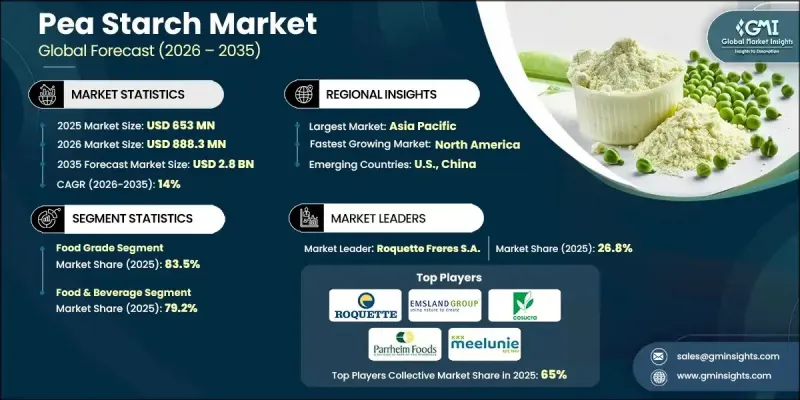
시장 확대의 배경에는 세계의 식품 및 음료 업계에 구조적 변화가 있어, 제조업체는 기능성, 식감, 영양면의 우위성을 높이기 위해, 식물 유래 원료에 대한 의존도를 높이고 있습니다. 완두콩 전분은 뛰어난 성능 특성과 클린 라벨 동향의 적합성으로부터 다양한 가공 식품 및 포장 식품의 배합에 활용되는 범용 원료로서 강한 주목을 받고 있습니다. 특히 선진국에서는 소비자의 식습관이 편의성과 건강 지향 식품으로 이행하고 있는 것이 수요의 꾸준한 성장을 지지하고 있습니다. 동시에 신흥 시장의 급속한 도시화, 가처분소득 증가, 라이프스타일의 변화가 포장 식품의 소비를 가속화하여 시장 기세를 더욱 강화하고 있습니다. 유럽의 식품업계도 투명성과 지속가능성에 관한 규제 기준과 소비자 기대의 변화에 대응하기 위해 제조업체가 식물성 유래 원료를 우선적으로 채용하고 있기 때문에 성장에 기여하고 있습니다. 이러한 동향이 함께, 완두콩 전분은 세계의 전분 및 특수 탄수화물 시장에서 고성장 원료로서의 지위를 확립하고 있습니다.
| 시장 범위 | |
|---|---|
| 시작 연도 | 2025년 |
| 예측 연도 | 2026-2035년 |
| 시작 시 가치 | 6억 5,300만 달러 |
| 예측 금액 | 28억 달러 |
| CAGR | 14% |
식품 등급 제품 부문은 뛰어난 품질 기준과 인간 소비 용도 분야에서 광범위한 사용을 지원했으며 2025년 83.5%의 점유율을 차지했습니다. 인증 및 컴플라이언스 요구 사항은 이 부문에서 제품 채택을 계속 형성하고 있습니다.
식품 및 음료 부문은 2025년에 79.2%의 점유율을 차지했습니다. 이것은 완두콩 전분이 대체 전분 소스에 제공하는 기능적 이점, 특히 성능의 일관성과 배합 효율의 높이에 의해 견인된 것입니다.
북미의 완두콩 전분 시장은 2025년에 17%의 점유율을 차지했으며, 그 성장은 주로 미국 식품 산업의 꾸준한 확대와 편리하고 가공된 식품 제품에 대한 수요 증가에 의해 지원되고 있습니다.
자주 묻는 질문
목차
제1장 분석 방법 및 범위
제2장 주요 요약
제3장 업계 인사이트
- 업계의 생태계 분석
- 공급자의 상황
- 이익률
- 각 단계에서의 부가가치
- 밸류체인에 영향을 주는 요인
- 혁신
- 업계에 미치는 영향요인
- 성장 촉진요인
- 업계의 잠재적 위험 및 과제
- 시장 기회
- 성장 가능성 분석
- 규제 상황
- 북미
- 유럽
- 아시아태평양
- 라틴아메리카
- 중동 및 아프리카
- Porter's Five Forces 분석
- PESTEL 분석
- 가격 동향
- 지역별
- 형상별
- 향후 시장 동향
- 기술 및 혁신 동향
- 현재 기술 동향
- 신흥 기술
- 특허 상황
- 무역 통계(HS코드)
(참고: 무역 통계는 주요 국가에서만 제공됩니다)
- 주요 수입국
- 주요 수출국
제4장 경쟁 구도
- 서문
- 기업별 시장 점유율 분석
- 지역별
- 북미
- 유럽
- 아시아태평양
- 라틴아메리카
- 중동 및 아프리카
- 지역별
- 기업 매트릭스 분석
- 주요 기업의 경쟁 분석
- 경쟁 포지셔닝 매트릭스
- 주요 동향
- 기업 합병 및 인수(M&A)
- 제휴 및 협업
- 신제품 발매
- 사업 확대 계획
제5장 시장의 추정 및 예측 : 제품별(2022-2035년)
- 식품 등급
- 산업용 등급
- 사료용 등급
제6장 시장의 추정 및 예측 : 용도별(2022-2035년)
- 의약품
- 식품 및 음료
- 제빵 및 과자류
- 유제품
- 수프, 소스, 드레싱
- 스낵 및 즉석 식품
- 사료
- 종이 및 섬유
- 기타
- 접착제
- 바이오플라스틱
제7장 시장의 추정 및 예측 : 기능별(2022-2035년)
- 증점제
- 결합제
- 겔화제
- 피막 형성제
- 텍스처링제
제8장 시장의 추정 및 예측 : 유통 채널별(2022-2035년)
- 직접 판매(B2B)
- 소매
- 슈퍼마켓
- 전문점
- 기타
- 온라인 채널
제9장 시장의 추정 및 예측 : 지역별(2022-2035년)
- 북미
- 미국
- 캐나다
- 유럽
- 독일
- 영국
- 프랑스
- 스페인
- 이탈리아
- 기타 유럽
- 아시아태평양
- 중국
- 인도
- 일본
- 호주
- 한국
- 기타 아시아태평양
- 라틴아메리카
- 브라질
- 멕시코
- 아르헨티나
- 기타 라틴아메리카
- 중동 및 아프리카
- 사우디아라비아
- 남아프리카
- 아랍에미리트(UAE)
- 기타 중동 및 아프리카
제10장 기업 프로파일
- Roquette Freres SA
- Yantai Oriental Protein Tech Co. Ltd.
- Cosucra-Groupe Warcoing
- Emsland-Starke GmbH
- Shandong Jianyuan Bioengineering Co., Ltd.
- Vestkorn Milling AS
- Dakota Dry Bean Inc.
- Yantai T.Full Biotech Co Ltd.
- Parrheim Foods
- Meelunie BV
- American Key Products Inc.
- AGT Food and Ingredients Inc.
- The Scoular Company
- Qingdao CBH Co., Ltd.
The Global Pea Starch Market was valued at USD 653 million in 2025 and is estimated to grow at a CAGR of 14% to reach USD 2.8 billion by 2035.
Market expansion is driven by structural changes within the global food and beverage sector, where manufacturers increasingly rely on plant-based ingredients to improve functionality, texture, and nutritional positioning. Pea starch is gaining strong traction as a versatile ingredient used across a wide range of processed and packaged food formulations due to its favorable performance characteristics and compatibility with clean-label trends. Shifts in consumer eating patterns toward convenience-oriented and health-conscious food options are supporting steady demand growth, particularly in developed economies. At the same time, rapid urbanization, rising disposable incomes, and lifestyle changes across emerging markets are accelerating the consumption of packaged foods, further strengthening market momentum. The European food industry is also contributing to growth as manufacturers prioritize plant-derived ingredients to meet evolving regulatory standards and consumer expectations related to transparency and sustainability. Together, these dynamics are positioning pea starch as a high-growth ingredient within the global starch and specialty carbohydrate landscape.
| Market Scope | |
|---|---|
| Start Year | 2025 |
| Forecast Year | 2026-2035 |
| Start Value | $653 Million |
| Forecast Value | $2.8 Billion |
| CAGR | 14% |
The food-grade products segment accounted for 83.5% share in 2025, supported by its superior quality standards and widespread use in human consumption applications. Certification and compliance requirements continue to shape product adoption within this segment.
The food & beverage segment held 79.2% share in 2025, driven by the functional advantages pea starch offers over alternative starch sources, including performance consistency and formulation efficiency.
North America Pea Starch Market held 17% share in 2025, with growth primarily supported by steady expansion in the U.S. food industry and increasing demand for convenient and processed food products.
Key companies operating in the Global Pea Starch Market include Roquette Freres S.A., Cosucra-Groupe Warcoing, Emsland-Starke GmbH, Vestkorn Milling AS, AGT Food and Ingredients Inc., Meelunie B.V., Dakota Dry Bean Inc., The Scoular Company, American Key Products Inc., Parrheim Foods, Yantai Oriental Protein Tech Co. Ltd., Qingdao CBH Co., Ltd., Shandong Jianyuan Bioengineering Co., Ltd., and Yantai T.Full Biotech Co Ltd. Companies in the Global Pea Starch Market are strengthening their competitive position by expanding processing capacities and securing long-term raw material sourcing agreements to ensure supply stability. Continuous investment in product innovation allows manufacturers to improve functional performance and tailor starch solutions for specific application needs. Strategic collaborations with food processors support the co-development of customized formulations and accelerate market penetration. Firms are also focusing on certifications, clean-label compliance, and sustainability messaging to align with evolving consumer and regulatory expectations.
Table of Contents
Chapter 1 Methodology & Scope
- 1.1 Market scope and definition
- 1.2 Research design
- 1.2.1 Research approach
- 1.2.2 Data collection methods
- 1.3 Data mining sources
- 1.3.1 Global
- 1.3.2 Regional/Country
- 1.4 Base estimates and calculations
- 1.4.1 Base year calculation
- 1.4.2 Key trends for market estimation
- 1.5 Primary research and validation
- 1.5.1 Primary sources
- 1.6 Forecast model
- 1.7 Research assumptions and limitations
Chapter 2 Executive Summary
- 2.1 Industry 360° synopsis
- 2.2 Key market trends
- 2.2.1 Regional
- 2.2.2 Product
- 2.2.3 End Use
- 2.3 TAM Analysis, 2026-2035
- 2.4 CXO perspectives: Strategic imperatives
- 2.4.1 Executive decision points
- 2.4.2 Critical success factors
- 2.5 Future Outlook and Strategic Recommendations
Chapter 3 Industry Insights
- 3.1 Industry ecosystem analysis
- 3.1.1 Supplier landscape
- 3.1.2 Profit margin
- 3.1.3 Value addition at each stage
- 3.1.4 Factor affecting the value chain
- 3.1.5 Disruptions
- 3.2 Industry impact forces
- 3.2.1 Growth drivers
- 3.2.2 Industry pitfalls and challenges
- 3.2.3 Market opportunities
- 3.3 Growth potential analysis
- 3.4 Regulatory landscape
- 3.4.1 North America
- 3.4.2 Europe
- 3.4.3 Asia Pacific
- 3.4.4 Latin America
- 3.4.5 Middle East & Africa
- 3.5 Porter's analysis
- 3.6 PESTEL analysis
- 3.7 Price trends
- 3.7.1 By region
- 3.7.2 By form
- 3.8 Future market trends
- 3.9 Technology and Innovation landscape
- 3.9.1 Current technological trends
- 3.9.2 Emerging technologies
- 3.10 Patent Landscape
- 3.11 Trade statistics (HS code)
( Note: The trade statistics will be provided for key countries only)
- 3.11.1 Major importing countries
- 3.11.2 Major exporting countries
Chapter 4 Competitive Landscape, 2025
- 4.1 Introduction
- 4.2 Company market share analysis
- 4.2.1 By region
- 4.2.1.1 North America
- 4.2.1.2 Europe
- 4.2.1.3 Asia Pacific
- 4.2.1.4 LATAM
- 4.2.1.5 MEA
- 4.2.1 By region
- 4.3 Company matrix analysis
- 4.4 Competitive analysis of major market players
- 4.5 Competitive positioning matrix
- 4.6 Key developments
- 4.6.1 Mergers & acquisitions
- 4.6.2 Partnerships & collaborations
- 4.6.3 New Product Launches
- 4.6.4 Expansion Plans
Chapter 5 Market Estimates and Forecast, By Product, 2022-2035 (USD Billion & Tons)
- 5.1 Key trends
- 5.2 Food grade
- 5.3 Industrial grade
- 5.4 Feed grade
Chapter 6 Market Estimates and Forecast, By Application, 2022-2035 (USD Billion & Tons)
- 6.1 Key trends
- 6.2 Pharmaceutical
- 6.3 Food & beverage
- 6.3.1 Bakery & Confectionery
- 6.3.2 Dairy Products
- 6.3.3 Soups, Sauces & Dressings
- 6.3.4 Snacks & Convenience Foods
- 6.4 Animal feed
- 6.5 Paper & textiles
- 6.6 Others
- 6.6.1 Adhesives
- 6.6.2 Bioplastics
Chapter 7 Market Estimates and Forecast, By Functionality, 2022-2035 (USD Billion & Tons)
- 7.1 Key trends
- 7.2 Thickening Agent
- 7.3 Binding Agent
- 7.4 Gelling Agent
- 7.5 Film-forming Agent
- 7.6 Texturizing Agent
Chapter 8 Market Estimates and Forecast, By Distribution Channel, 2022-2035 (USD Billion & Tons)
- 8.1 Key trends
- 8.2 Direct Sales (B2B)
- 8.3 Retail
- 8.3.1 Supermarkets
- 8.3.2 Specialty Stores
- 8.3.3 Others
- 8.4 Online Channels
Chapter 9 Market Estimates and Forecast, By Region, 2022-2035 (USD Billion & Tons)
- 9.1 Key trends
- 9.2 North America
- 9.2.1 U.S.
- 9.2.2 Canada
- 9.3 Europe
- 9.3.1 Germany
- 9.3.2 UK
- 9.3.3 France
- 9.3.4 Spain
- 9.3.5 Italy
- 9.3.6 Rest of Europe
- 9.4 Asia Pacific
- 9.4.1 China
- 9.4.2 India
- 9.4.3 Japan
- 9.4.4 Australia
- 9.4.5 South Korea
- 9.4.6 Rest of Asia Pacific
- 9.5 Latin America
- 9.5.1 Brazil
- 9.5.2 Mexico
- 9.5.3 Argentina
- 9.5.4 Rest of Latin America
- 9.6 Middle East and Africa
- 9.6.1 Saudi Arabia
- 9.6.2 South Africa
- 9.6.3 UAE
- 9.6.4 Rest of Middle East and Africa
Chapter 10 Company Profiles
- 10.1 Roquette Freres S.A.
- 10.2 Yantai Oriental Protein Tech Co. Ltd.
- 10.3 Cosucra-Groupe Warcoing
- 10.4 Emsland-Starke GmbH
- 10.5 Shandong Jianyuan Bioengineering Co., Ltd.
- 10.6 Vestkorn Milling AS
- 10.7 Dakota Dry Bean Inc.
- 10.8 Yantai T.Full Biotech Co Ltd.
- 10.9 Parrheim Foods
- 10.10 Meelunie B.V.
- 10.11 American Key Products Inc.
- 10.12 AGT Food and Ingredients Inc.
- 10.13 The Scoular Company
- 10.14 Qingdao CBH Co., Ltd.