

|
시장보고서
상품코드
1913385
염소화 폴리염화비닐(CPVC) 시장 : 기회, 성장 요인, 산업 동향 분석 및 예측(2026-2035년)Chlorinated Polyvinyl Chloride (CPVC) Market Opportunity, Growth Drivers, Industry Trend Analysis, and Forecast 2026 - 2035 |
||||||

세계의 염소화 폴리염화비닐(CPVC) 시장은 2025년 24억 달러로 평가되었으며, 2035년까지 연평균 복합 성장률(CAGR) 8.4%로 성장해 54억 달러에 이를 것으로 예측되고 있습니다.

시장 성장은 뛰어난 성능 특성과 긴 수명으로 인한 주택 및 상업 및 산업 건설 분야에서의 CPVC 채용 확대를 반영하고 있습니다. 고온, 내압 및 화학적으로 가혹한 환경에 견디는 내구성 파이프 솔루션에 대한 수요 증가가 보급을 지속적으로 추진하고 있습니다. CPVC는 안전성과 성능 기준을 유지하면서 재료의 다양성을 줄임으로써 건설 계획을 단순화하는 통합 재료 솔루션으로 점점 더 선정되고 있습니다. 엔지니어와 계약자는 시공 효율, 신뢰성 및 수명 주기 비용 우위를 바탕으로 CPVC를 높이 평가합니다. 지속적인 인프라 개발, 시스템 업데이트 및 현대화 프로젝트가 장기적인 수요를 강화하고 있습니다. 재료 배합 기술의 발전으로 성능의 일관성과 용도의 유연성이 더욱 향상되었습니다. 건축 기준이 진화하고 내구성 요건이 엄격화되는 가운데, CPVC는 세계의 건설 및 인프라 시장에서 선호되는 열가소성 재료로서 지위를 확고하게 하고 있습니다.
| 시장 범위 | |
|---|---|
| 시작 연도 | 2025년 |
| 예측 기간 | 2026-2035년 |
| 시작 규모 | 24억 달러 |
| 시장 규모 예측 | 54억 달러 |
| CAGR | 8.4% |
압출 성형 기반 제조 부문은 2025년에 17억 달러의 수익을 창출했고, 균일한 치수, 높은 생산 효율 및 비용 관리를 실현할 수 있는 능력을 통해 시장을 선도하고 있습니다. 이 프로세스는 일관된 품질과 대량 생산이 필요한 대규모 프로젝트를 지원합니다.
파이프 부문은 2025년에 55.6%의 점유율을 차지했으며, 2034년까지 연평균 복합 성장률(CAGR) 8.1%를 보일 것으로 예측됩니다. 대체 재료에 비해 내구성, 열 안정성, 장기 성능의 우위성으로 강한 수요가 견인되고 있습니다.
북미의 염소화 폴리염화비닐(CPVC) 시장은 2025년 8억 6,520만 달러에 달했습니다. 미국 및 캐나다 전역의 인프라 갱신, 안전 기준의 엄격화, 노후화 시스템의 갱신이 지역 성장을 지원하고 있습니다. CPVC 제형의 지속적인 개선은 시장의 신뢰성을 더욱 강화하고 있습니다.
자주 묻는 질문
목차
제1장 분석 방법과 범위
제2장 주요 요약
제3장 업계 인사이트
- 업계의 생태계 분석
- 공급자의 상황
- 이익률
- 각 단계에서의 부가가치
- 밸류체인에 영향을 주는 요인
- 혁신
- 업계에 미치는 영향요인
- 성장 요인
- 내구성과 내식성이 뛰어난 배관 재료에 대한 수요 증가
- 주택 및 상업 인프라의 건설 활동 증가
- 고온 환경 하에서도 화학적으로 안정된 플라스틱 재료에 대한 수요 증가
- 업계의 잠재적 위험과 과제
- 원재료 공급 상황과 가격 구조의 변동성
- 대체 배관 재료 및 기술에 의한 경쟁
- 시장 기회
- 신흥 경제국의 급속한 도시화와 인프라 정비
- CPVC의 성능 특성을 향상시키는 기술적 개선
- 성장 요인
- 성장 가능성 분석
- 규제 상황
- 북미
- 유럽
- 아시아태평양
- 라틴아메리카
- 중동 및 아프리카
- Porter's Five Forces 분석
- PESTEL 분석
- 가격 동향
- 지역별
- 제품 유형별
- 미래 시장 동향
- 기술과 혁신 동향
- 현재의 기술 동향
- 신흥기술
- 특허 상황
- 무역 통계(HS코드)(참고 : 무역 통계는 주요 국가에서만 제공됨)
- 주요 수입국
- 주요 수출국
- 지속가능성과 환경면
- 지속가능한 대처
- 폐기물 감축 전략
- 생산에서의 에너지 효율
- 환경에 배려한 대처
- 탄소발자국 고려
제4장 경쟁 구도
- 소개
- 기업별 시장 점유율 분석
- 지역별
- 북미
- 유럽
- 아시아태평양
- 라틴아메리카
- 중동 및 아프리카
- 지역별
- 기업 매트릭스 분석
- 주요 기업의 경쟁 분석
- 경쟁 포지셔닝 매트릭스
- 주요 동향
- 기업 인수합병(M&A)
- 제휴 및 협업
- 신제품 발매
- 사업 확대 계획
제5장 시장의 추정 및 예측 : 제조 공정별(2022-2035년)
- 압출 성형 기반 CPVC
- 사출 성형 기반 CPVC
제6장 시장의 추정 및 예측 : 제품 형상별(2022-2035년)
- 수지 및 화합물
- 파이프
- 피팅 및 밸브
- 커플링 어댑터
- 엘보 및 티
- 유니온 및 리듀서
- 밸브(볼, 게이트, 체크)
- 시트, 패널 및 프로파일
제7장 시장의 추정 및 예측 : 용도별(2022-2035년)
- 배관 및 배수
- 온수 시스템
- 냉수 시스템
- 순환 시스템
- 방화 시스템
- 주택용 스프링클러 설비(NFPA 13D)
- 상업용 스프링클러 설비(NFPA 13)
- 집합 주택용 스프링클러 설비(NFPA 13R)
- 공업 프로세스 배관
- 화학 처리 및 취급
- 상수 및 하수 처리
- 해수 담수화 플랜트
- 발전
- 석유 및 가스 사업
- 광물 처리
- 공조 및 냉수 시스템
- 온수난방
- 냉수배관
- 냉각탑
제8장 시장의 추정 및 예측 : 지역별(2022-2035년)
- 북미
- 미국
- 캐나다
- 유럽
- 독일
- 영국
- 프랑스
- 스페인
- 이탈리아
- 기타 유럽
- 아시아태평양
- 중국
- 인도
- 일본
- 호주
- 한국
- 기타 아시아태평양
- 라틴아메리카
- 브라질
- 멕시코
- 아르헨티나
- 기타 라틴아메리카
- 중동 및 아프리카
- 사우디아라비아
- 남아프리카
- 아랍에미리트(UAE)
- 기타 중동 및 아프리카
제9장 기업 프로파일
- Aliaxis Group SA
- Astral Limited
- Charlotte Pipe and Foundry
- Georg Fischer Ltd.
- IPEX Inc.
- Kaneka Corporation
- Lubrizol Corporation
- Prince Pipes and Fittings
- Sekisui Chemical Co., Ltd.
- Supreme Industries Limited
The Global Chlorinated Polyvinyl Chloride (CPVC) Market was valued at USD 2.4 billion in 2025 and is estimated to grow at a CAGR of 8.4% to reach USD 5.4 billion by 2035.
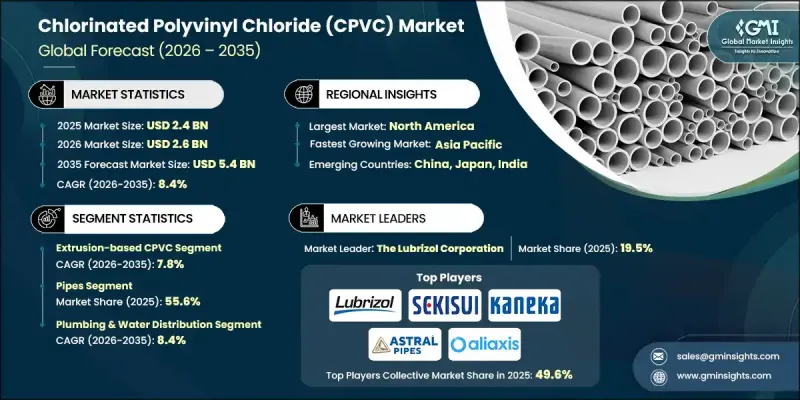
Market growth reflects rising adoption of CPVC across residential, commercial, and industrial construction due to its strong performance characteristics and long service life. Increasing demand for durable piping solutions that can withstand elevated temperatures, internal pressure, and chemically aggressive environments continues to support widespread acceptance. CPVC is increasingly selected as a unified material solution that simplifies construction planning by reducing material variation while maintaining safety and performance standards. Engineers and contractors value CPVC for its installation efficiency, reliability, and lifecycle cost advantages. Ongoing infrastructure development, system upgrades, and modernization projects are reinforcing long-term demand. Advances in material formulation are further improving performance consistency and application flexibility. As building codes evolve and durability requirements become more stringent, CPVC remains well-positioned as a preferred thermoplastic material across global construction and infrastructure markets.
| Market Scope | |
|---|---|
| Start Year | 2025 |
| Forecast Year | 2026-2035 |
| Start Value | $2.4 Billion |
| Forecast Value | $5.4 Billion |
| CAGR | 8.4% |
The extrusion-based manufacturing segment generated USD 1.7 billion in 2025 and continues to lead the market due to its ability to deliver uniform dimensions, high production efficiency, and cost control. This process supports large-scale projects that require consistent quality and volume output.
The pipes segment accounted for 55.6% share in 2025 and is expected to grow at a CAGR of 8.1% through 2034. Strong demand is driven by durability, thermal stability, and long-term performance advantages compared to alternative materials.
North America Chlorinated Polyvinyl Chloride (CPVC) Market reached USD 865.2 million in 2025. Regional growth is supported by infrastructure renewal, stricter safety standards, and replacement of aging systems across the U.S. and Canada. Continuous improvements in CPVC formulations are further strengthening market confidence.
Key companies operating in the Global Chlorinated Polyvinyl Chloride (CPVC) Market include Lubrizol Corporation, Aliaxis Group S.A., Kaneka Corporation, Georg Fischer Ltd., IPEX Inc., Astral Limited, Sekisui Chemical Co., Ltd., Prince Pipes and Fittings, Supreme Industries Limited, and Charlotte Pipe and Foundry. Companies in the Global Chlorinated Polyvinyl Chloride (CPVC) Market are strengthening their market position through capacity expansion, formulation innovation, and strategic partnerships. Manufacturers are investing in research to enhance thermal performance, pressure resistance, and long-term durability. Geographic expansion into high-growth construction markets is improving revenue diversification. Collaboration with contractors and system designers supports early-stage specification and repeat demand. Companies are also focusing on compliance with evolving safety and building regulations to reinforce product acceptance.
Table of Contents
Chapter 1 Methodology & Scope
- 1.1 Market scope and definition
- 1.2 Research design
- 1.2.1 Research approach
- 1.2.2 Data collection methods
- 1.3 Data mining sources
- 1.3.1 Global
- 1.3.2 Regional/Country
- 1.4 Base estimates and calculations
- 1.4.1 Base year calculation
- 1.4.2 Key trends for market estimation
- 1.5 Primary research and validation
- 1.5.1 Primary sources
- 1.6 Forecast model
- 1.7 Research assumptions and limitations
Chapter 2 Executive Summary
- 2.1 Industry 360° synopsis
- 2.2 Key market trends
- 2.2.1 Regional
- 2.2.2 Manufacturing Process
- 2.2.3 Product Form
- 2.2.4 Application
- 2.3 TAM Analysis, 2025-2034
- 2.4 CXO perspectives: Strategic imperatives
- 2.4.1 Executive decision points
- 2.4.2 Critical success factors
- 2.5 Future Outlook and Strategic Recommendations
Chapter 3 Industry Insights
- 3.1 Industry ecosystem analysis
- 3.1.1 Supplier landscape
- 3.1.2 Profit margin
- 3.1.3 Value addition at each stage
- 3.1.4 Factor affecting the value chain
- 3.1.5 Disruptions
- 3.2 Industry impact forces
- 3.2.1 Growth drivers
- 3.2.1.1 Increasing demand for durable and corrosion-resistant piping materials
- 3.2.1.2 Rising construction activity across residential and commercial infrastructure
- 3.2.1.3 Preference for high-temperature and chemically stable plastic materials
- 3.2.2 Industry pitfalls and challenges
- 3.2.2.1 Volatility in raw material availability and pricing structures
- 3.2.2.2 Competition from alternative piping materials and technologies
- 3.2.3 Market opportunities
- 3.2.3.1 Rapid urbanization and infrastructure development in emerging economies
- 3.2.3.2 Technological improvements enhancing CPVC performance characteristics
- 3.2.1 Growth drivers
- 3.3 Growth potential analysis
- 3.4 Regulatory landscape
- 3.4.1 North America
- 3.4.2 Europe
- 3.4.3 Asia Pacific
- 3.4.4 Latin America
- 3.4.5 Middle East & Africa
- 3.5 Porter's analysis
- 3.6 PESTEL analysis
- 3.7 Price trends
- 3.7.1 By region
- 3.7.2 By product type
- 3.8 Future market trends
- 3.9 Technology and Innovation landscape
- 3.9.1 Current technological trends
- 3.9.2 Emerging technologies
- 3.10 Patent Landscape
- 3.11 Trade statistics (HS code)( Note: the trade statistics will be provided for key countries only)
- 3.11.1 Major importing countries
- 3.11.2 Major exporting countries
- 3.12 Sustainability and environmental aspects
- 3.12.1 Sustainable practices
- 3.12.2 Waste reduction strategies
- 3.12.3 Energy efficiency in production
- 3.12.4 Eco-friendly initiatives
- 3.13 Carbon footprint consideration
Chapter 4 Competitive Landscape, 2025
- 4.1 Introduction
- 4.2 Company market share analysis
- 4.2.1 By region
- 4.2.1.1 North America
- 4.2.1.2 Europe
- 4.2.1.3 Asia Pacific
- 4.2.1.4 LATAM
- 4.2.1.5 MEA
- 4.2.1 By region
- 4.3 Company matrix analysis
- 4.4 Competitive analysis of major market players
- 4.5 Competitive positioning matrix
- 4.6 Key developments
- 4.6.1 Mergers & acquisitions
- 4.6.2 Partnerships & collaborations
- 4.6.3 New Product Launches
- 4.6.4 Expansion Plans
Chapter 5 Market Estimates and Forecast, By Manufacturing Process, 2022-2035 (USD Billion) (Kilo Tons)
- 5.1 Key trends
- 5.2 Extrusion-Based CPVC
- 5.3 Injection Molding-Based CPVC
Chapter 6 Market Estimates and Forecast, By Product Form, 2022-2035 (USD Billion) (Kilo Tons)
- 6.1 Key trends
- 6.2 Resin & Compound
- 6.3 Pipes
- 6.4 Fittings & Valves
- 6.4.1 Couplings & Adapters
- 6.4.2 Elbows & Tees
- 6.4.3 Unions & Reducers
- 6.4.4 Valves (Ball, Gate, Check)
- 6.5 Sheets, Panels & Profiles
Chapter 7 Market Estimates and Forecast, By Application, 2022-2035 (USD Billion) (Kilo Tons)
- 7.1 Key trends
- 7.2 Plumbing & Water Distribution
- 7.2.1 Hot Water Systems
- 7.2.2 Cold Water Systems
- 7.2.3 Recirculation Systems
- 7.3 Fire Protection Systems
- 7.3.1 Residential Fire Sprinklers (NFPA 13D)
- 7.3.2 Commercial Fire Sprinklers (NFPA 13)
- 7.3.3 Multifamily Fire Sprinklers (NFPA 13R)
- 7.4 Industrial Process Piping
- 7.4.1 Chemical Processing & Handling
- 7.4.2 Water & Wastewater Treatment
- 7.4.3 Desalination Plants
- 7.4.4 Power Generation
- 7.4.5 Oil & Gas Operations
- 7.4.6 Mineral Processing
- 7.5 HVAC & Chilled Water Systems
- 7.5.1 Hydronic Heating
- 7.5.2 Chilled Water Distribution
- 7.5.3 Cooling Towers
Chapter 8 Market Estimates and Forecast, By Region, 2022-2035 (USD Billion) (Kilo Tons)
- 8.1 Key trends
- 8.2 North America
- 8.2.1 U.S.
- 8.2.2 Canada
- 8.3 Europe
- 8.3.1 Germany
- 8.3.2 UK
- 8.3.3 France
- 8.3.4 Spain
- 8.3.5 Italy
- 8.3.6 Rest of Europe
- 8.4 Asia Pacific
- 8.4.1 China
- 8.4.2 India
- 8.4.3 Japan
- 8.4.4 Australia
- 8.4.5 South Korea
- 8.4.6 Rest of Asia Pacific
- 8.5 Latin America
- 8.5.1 Brazil
- 8.5.2 Mexico
- 8.5.3 Argentina
- 8.5.4 Rest of Latin America
- 8.6 Middle East and Africa
- 8.6.1 Saudi Arabia
- 8.6.2 South Africa
- 8.6.3 UAE
- 8.6.4 Rest of Middle East and Africa
Chapter 9 Company Profiles
- 9.1 Aliaxis Group S.A.
- 9.2 Astral Limited
- 9.3 Charlotte Pipe and Foundry
- 9.4 Georg Fischer Ltd.
- 9.5 IPEX Inc.
- 9.6 Kaneka Corporation
- 9.7 Lubrizol Corporation
- 9.8 Prince Pipes and Fittings
- 9.9 Sekisui Chemical Co., Ltd.
- 9.10 Supreme Industries Limited


