

|
시장보고서
상품코드
1913460
스마트 의료기기 시장 : 기회, 성장 요인, 산업 동향 분석 및 예측(2026-2035년)Smart Medical Devices Market Opportunity, Growth Drivers, Industry Trend Analysis, and Forecast 2026 - 2035 |
||||||

세계의 스마트 의료기기 시장은 2025년 616억 달러로 평가되었으며, 2035년까지 연평균 복합 성장률(CAGR) 11.8%로 성장해 1,952억 달러에 이를 것으로 예측됩니다.
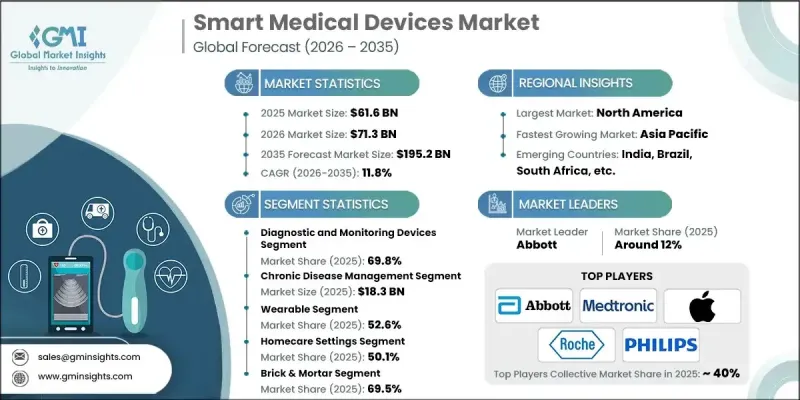
이 성장은 당뇨병, 천식과 같은 만성 질환의 유병률이 증가하고 가정 의료 솔루션 및 원격 환자 모니터링(RPM) 장치에 대한 수요가 증가함에 따라 촉진되고 있습니다. 원격 의료 및 디지털 건강 플랫폼의 확장과 IoT, AI, 클라우드 기반 통합의 기술 발전이 스마트 의료기기 채택을 추진하고 있습니다. 웨어러블 디바이스나 소형 디바이스, 예방 의료, 재택치료 모델 등의 동향도 시장 수요를 더욱 밀어 올리고 있습니다. Abbott, Apple, Medtronic, Roche, Philips 등 대기업은 시장에서의 존재감을 강화하기 위해 지리적 확대, 제품 혁신, 저렴한 가격, 의료 제공업체와의 제휴에 주력하고 있습니다. 건강 의식 증가와 개별화된 실시간 환자 모니터링으로의 전환이 업계 성장에 크게 기여하고 있습니다.
| 시장 범위 | |
|---|---|
| 시작 연도 | 2025년 |
| 예측연도 | 2026-2035년 |
| 시작 규모 | 616억 달러 |
| 예측 금액 | 1,952억 달러 |
| CAGR | 11.8% |
진단 및 모니터링 장비 부문은 2025년 69.8%의 점유율을 차지했습니다. 이 부문에는 지속 혈당 측정 장치(CGM), 착용가능한 심전도 패치, 스마트 혈압계, 산소포화도 측정기가 포함됩니다. 이러한 장비는 생리 데이터를 실시간으로 지속적으로 수집하고 연결된 플랫폼으로 전송하여 분석합니다. 기술 제공업체와 의료기관간의 제휴는 환자 모니터링의 접근성과 효율성을 향상시키고 이 범주의 추가 성장을 기대합니다.
만성 질환 관리 부문은 2025년 183억 달러에 달했습니다. 만성 질환 관리를 위한 스마트 장치는 웨어러블 센서, 재택 모니터링 장비, 복약 준수 시스템을 통합하여 생체 사인, 증상 및 치료법 사용을 추적합니다. 실시간 데이터 수집을 통해 임상의와 환자는 위험 점수를 평가하고 여러 질병을 효과적으로 관리할 수 있어 장기 치료를 지원하고 환자의 치료 결과를 향상시킬 수 있습니다.
북미의 스마트 의료기기 시장은 2025년 34.8%의 점유율을 차지했습니다. 지역 성장은 확립된 의료 시스템, 만성 질환의 높은 이환율, 디지털 건강 기술의 보급, 유리한 상환 정책에 의해 추진되고 있습니다. 건강 보험의 보급과 첨단 원격 의료 인프라가 이 지역의 스마트 기기 도입을 더욱 강화하고 있으며, 북미는 스마트 헬스케어 솔루션의 혁신과 성장을 위한 주요 시장으로 자리잡고 있습니다.
자주 묻는 질문
목차
제1장 조사 방법과 범위
제2장 주요 요약
제3장 업계 인사이트
- 생태계 분석
- 업계에 미치는 영향요인
- 성장 요인
- 당뇨병, 천식 및 기타 질환 증가 경향
- 급성장하는 의료기기 산업
- 인터넷 보급률 증가와 빅데이터 채용
- 진단 및 치료에서 실시간 데이터 기반 방식의 중요성 상승
- 업계의 잠재적 위험 및 과제
- 프라이버시에 대한 우려
- 저소득 및 중소득 국가에 적절한 인프라 부족
- 성장 요인
- 성장 가능성 분석
- 규제 상황
- 상환 시나리오
- 기술적 상황
- 가격 분석
- 미래 시장 동향
- 공급자의 상황
- M&A활동
- Porter's Five Forces 분석
- PESTEL 분석
- 갭 분석
제4장 경쟁 구도
- 소개
- 기업 매트릭스 분석
- 기업의 시장 점유율 분석
- 경쟁 포지셔닝 매트릭스
- 전략 대시보드
제5장 시장 추계 및 예측 : 제품 유형별, 2021-2032년
- 진단 및 모니터링 기기
- 혈당 측정기
- 심박수 모니터
- 산소포화도 측정기
- 혈압계
- 알코올 검출기
- 기타 진단 및 모니터링 기기
- 치료용 기기
- 휴대형 산소 농축기 및 인공호흡기
- 인슐린 펌프
- 보청기
- 기타 치료용 기기
- 기타 제품 유형
제6장 시장 추계 및 예측 : 최종 용도별, 2021-2032년
- 병원
- 재택치료 환경
- 기타 용도
제7장 시장 추계 및 예측 : 유통 채널별, 2021-2032년
- 실제 점포
- 전자상거래
제8장 시장 추계 및 예측 : 지역별, 2021-2032년
- 북미
- 미국
- 캐나다
- 유럽
- 독일
- 영국
- 프랑스
- 스페인
- 이탈리아
- 네덜란드
- 아시아태평양
- 중국
- 일본
- 인도
- 호주
- 한국
- 라틴아메리카
- 브라질
- 멕시코
- 아르헨티나
- 중동 및 아프리카
- 남아프리카
- 사우디아라비아
- 아랍에미리트(UAE)
제9장 기업 프로파일
- Abbott
- Apple
- Biobeat
- Boston Scientific Corporation
- Dexcom
- F Hoffmann-La Roche
- Fitbit
- Medtronic
- NeuroMetrix
- Novo Nordisk
- Omron Corporation
- SAMSUNG
- VitalConnect
- West Pharmaceutical Services
The Global Smart Medical Devices Market was valued at USD 61.6 billion in 2025 and is estimated to grow at a CAGR of 11.8% to reach USD 195.2 billion by 2035.
The growth is fueled by the rising prevalence of chronic conditions such as diabetes and asthma, coupled with the increasing demand for home healthcare solutions and remote patient monitoring (RPM) devices. Expansion of telemedicine and digital health platforms, alongside technological advancements in IoT, AI, and cloud-based integrations, are driving the adoption of smart medical devices. Trends such as wearable and miniaturized devices, preventive care, and hospital-at-home models are further boosting market demand. Leading players such as Abbott, Apple, Medtronic, Roche, and Philips are focusing on geographic expansion, product innovation, affordability, and collaboration with healthcare providers to strengthen market presence. Rising health awareness and the shift toward personalized, real-time patient monitoring are significantly contributing to industry growth.
| Market Scope | |
|---|---|
| Start Year | 2025 |
| Forecast Year | 2026-2035 |
| Start Value | $61.6 Billion |
| Forecast Value | $195.2 Billion |
| CAGR | 11.8% |
The diagnostic and monitoring devices segment held 69.8% share in 2025. This segment includes continuous glucose monitors (CGMs), wearable ECG patches, smart blood pressure monitors, and pulse oximeters. These devices continuously collect physiological data in real time and transmit it to connected platforms for analysis. Partnerships between technology providers and healthcare organizations are expected to drive further growth in this category by enhancing the accessibility and efficiency of patient monitoring.
The chronic disease management segment reached USD 18.3 billion in 2025. Smart devices for chronic disease management integrate wearable sensors, home monitoring equipment, and medication adherence systems to track vital signs, symptoms, and therapy usage. Real-time data collection allows clinicians and patients to assess risk scores and manage multiple conditions effectively, supporting long-term treatment and improving patient outcomes.
North America Smart Medical Devices Market held a 34.8% share in 2025. Regional growth is driven by a well-established healthcare system, high incidence of chronic diseases, widespread use of digital health technologies, and favorable reimbursement policies. The availability of health insurance and advanced telehealth infrastructure further supports the adoption of smart devices in the region, positioning North America as a leading market for innovation and growth in smart healthcare solutions.
Key players operating in the Global Smart Medical Devices Market include Abbott, Apple, Biobeat Medical, Boston Scientific, Dexcom, Fitbit, Masimo, Medtronic, NeuroMetrix, Novo Nordisk, OMRON Healthcare, Philips, Roche, SAMSUNG, Shenzhen Ztsense Hi Tech, SmartCardia, VitalConnect, Vital Health Ring, West Pharmaceutical Services, and WS Audiology. Companies in the Global Smart Medical Devices Market are focusing on multiple strategies to strengthen their market position. They invest heavily in research and development to launch innovative, miniaturized, and wearable solutions that integrate AI, IoT, and cloud platforms. Geographic expansion allows access to emerging markets with rising healthcare demands. Strategic collaborations with hospitals, clinics, and telemedicine providers enhance device adoption and distribution. Companies are also prioritizing affordability, regulatory compliance, and real-time data capabilities to improve patient engagement.
Table of Contents
Chapter 1 Methodology & Scope
- 1.1 Market scope & definition
- 1.2 Research design
- 1.2.1 Research approach
- 1.2.2 Data collection methods
- 1.3 Base estimates & calculations
- 1.3.1 Base year calculation
- 1.3.2 Key trends for market estimation
- 1.4 Forecast model
- 1.5 Primary research and validation
- 1.5.1 Primary sources
- 1.5.2 Data mining sources
Chapter 2 Executive Summary
- 2.1 Industry 3600 synopsis
Chapter 3 Industry Insights
- 3.1 Industry ecosystem analysis
- 3.2 Industry impact forces
- 3.2.1 Growth drivers
- 3.2.1.1 Increasing prevalence of diabetes, asthma and other diseases
- 3.2.1.2 Booming medical device industry
- 3.2.1.3 Increasing internet penetration rate and adoption of big data
- 3.2.1.4 Rising importance of real time data driven approach for diagnostics and treatment
- 3.2.2 Industry pitfalls & challenges
- 3.2.2.1 Privacy concerns
- 3.2.2.2 Lack of suitable infrastructure in low- and middle-income countries
- 3.2.1 Growth drivers
- 3.3 Growth potential analysis
- 3.4 Regulatory landscape
- 3.5 Reimbursement scenario
- 3.6 Technological landscape
- 3.7 Pricing analysis
- 3.8 Future market trends
- 3.9 Supplier landscape
- 3.10 M&A activities
- 3.11 Porter's analysis
- 3.12 PESTEL analysis
- 3.13 Gap analysis
Chapter 4 Competitive Landscape, 2023
- 4.1 Introduction
- 4.2 Company matrix analysis
- 4.3 Company market share analysis
- 4.4 Competitive positioning matrix
- 4.5 Strategy dashboard
Chapter 5 Market Estimates and Forecast, By Product Type, 2021 - 2032 ($ Mn)
- 5.1 Key trends
- 5.2 Diagnostic and monitoring devices
- 5.2.1 Blood glucose monitors
- 5.2.2 Heart rate monitors
- 5.2.3 Pulse oximeters
- 5.2.4 Blood pressure monitors
- 5.2.5 Breathalyzers
- 5.2.6 Other diagnostic and monitoring devices
- 5.3 Therapeutic devices
- 5.3.1 Portable oxygen concentrators and ventilators
- 5.3.2 Insulin pumps
- 5.3.3 Hearing aid
- 5.3.4 Other therapeutic devices
- 5.4 Other product types
Chapter 6 Market Estimates and Forecast, By End Use, 2021 - 2032 ($ Mn)
- 6.1 Key trends
- 6.2 Hospitals
- 6.3 Homecare settings
- 6.4 Other End Use
Chapter 7 Market Estimates and Forecast, By Distribution Channel, 2021 - 2032 ($ Mn)
- 7.1 Key trends
- 7.2 Brick & mortar
- 7.3 E-commerce
Chapter 8 Market Estimates and Forecast, By Region, 2021 - 2032 ($ Mn)
- 8.1 Key trends
- 8.2 North America
- 8.2.1 U.S.
- 8.2.2 Canada
- 8.3 Europe
- 8.3.1 Germany
- 8.3.2 UK
- 8.3.3 France
- 8.3.4 Spain
- 8.3.5 Italy
- 8.3.6 Netherlands
- 8.4 Asia Pacific
- 8.4.1 China
- 8.4.2 Japan
- 8.4.3 India
- 8.4.4 Australia
- 8.4.5 South Korea
- 8.5 Latin America
- 8.5.1 Brazil
- 8.5.2 Mexico
- 8.5.3 Argentina
- 8.6 Middle East and Africa
- 8.6.1 South Africa
- 8.6.2 Saudi Arabia
- 8.6.3 UAE
Chapter 9 Company Profiles
- 9.1 Abbott
- 9.2 Apple
- 9.3 Biobeat
- 9.4 Boston Scientific Corporation
- 9.5 Dexcom
- 9.6 F Hoffmann-La Roche
- 9.7 Fitbit
- 9.8 Medtronic
- 9.9 NeuroMetrix
- 9.10 Novo Nordisk
- 9.11 Omron Corporation
- 9.12 SAMSUNG
- 9.13 VitalConnect
- 9.14 West Pharmaceutical Services


