

|
시장보고서
상품코드
1913470
상용차 시트 시장 예측 : 기회, 성장 요인, 업계 동향 분석(2026-2035년)Commercial Vehicle Seat Market Opportunity, Growth Drivers, Industry Trend Analysis, and Forecast 2026 - 2035 |
||||||

세계 상용차 시트 시장은 2025년에 135억 달러로 평가되었으며, 2035년까지 연평균 복합 성장률(CAGR) 4.5%로 성장하고, 207억 달러에 이를 것으로 예측됩니다.
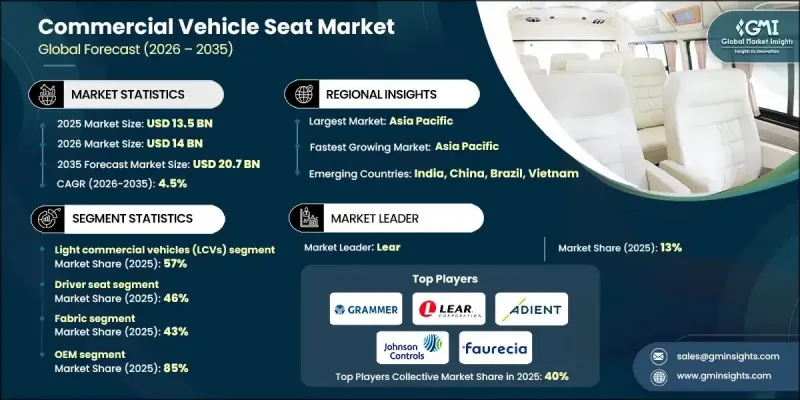
시장의 발전은 차량 사업자가 운전자의 건강, 효율성, 장기적인 비용 관리를 우선시하는 동안 인체 공학적 쾌적성을 강조하는 좌석 솔루션으로의 전환에 의해 점점 영향을 받고 있습니다. 부적절한 시트 설계는 신체적 불쾌감과 생산성 저하의 요인으로 널리 인식되고 있으며, 자세 지원 기능, 피로 경감, 일상적인 운전 환경 개선을 실현하는 시트에 대한 수요를 가속화하고 있습니다. 상용차 시트는 기본적인 쾌적성을 넘어 차량 전자기기나 드라이버 감시 플랫폼과 통합된 기술 탑재 시스템으로 진화하고 있습니다. 전동 조절 기능, 온도 조절 시트, 메모리 설정, 마사지 기능 등의 특징은 상용차의 고부가가치 인테리어로의 광범위한 전환을 반영합니다. 또한 시트 성능, 탑승자 보호 및 재료 기준을 다루는 세계 안전 기준의 강화도 시장에 긍정적인 영향을 미치고 있으며 제조업체는 보다 선진적인 설계로 향하고 있습니다. 병행하여 물류, 화물 운송 및 배송 서비스의 확대가 세계적으로 상용차 수요를 계속 자극하고 있으며, 신차 생산 및 교환 사이클 전체에서 시트 설치의 꾸준한 성장을 추진하고 있습니다.
| 시장 범위 | |
|---|---|
| 시작 연도 | 2025년 |
| 예측 연도 | 2026-2035년 |
| 시작 금액 | 135억 달러 |
| 예측 금액 | 207억 달러 |
| CAGR | 4.5% |
경상용 차량 부문은 2025년에 57%의 점유율을 차지했으며, 2026년부터 2035년까지 연평균 복합 성장률(CAGR)은 3.9%를 보일 것으로 예측됩니다. 이 주도적인 지위는 배송 서비스, 서비스업, 지자체 업무 등 폭넓은 분야에서의 이용을 반영하고 있습니다. 총 중량 6,000Kg(1만 3,228 파운드) 미만의 이 범주의 차량은 내구성과 내마모성을 결합하여 조정 메커니즘을 간소화하고 비용 효율적인 좌석을 요구합니다. 이를 통해 사용 빈도가 높고 예산 중심의 운영자의 기대에 부응할 수 있습니다.
운전석 부문은 2025년에 46%의 점유율을 차지했으며, 2026년부터 2035년까지 연평균 복합 성장률(CAGR) 4.8%로 가장 빠른 성장을 기록할 것으로 예측됩니다. 운전석은 안전성, 쾌적성, 직원 정착에 있어서 중요한 역할로부터 보다 높은 가치를 가지고 있습니다. 첨단 인체공학 설계, 전동기능, 에어컨 기능, 고급 소재는 운영자의 건강과 지속적인 생산성을 지원하면서 가격 설정 강화에 기여하고 있습니다.
아시아태평양의 상용차 시트 시장은 2025년 39%의 점유율을 차지했습니다. 이 지역의 우위성은 대규모 차량 제조, 신흥 경제국의 인프라 개발, 확립된 자동차 생산 거점, 상용 운송 및 모빌리티 서비스에 대한 수요를 증가시키고 있는 인구동태의 동향에 의해 지지되고 있습니다. 도시 지역의 인구 증가는 대중교통의 차량군과 상용차에 대한 투자 확대를 촉진하고 있으며, 이는 지역 전체에서 시트 시스템 수요를 지속적으로 증가 시키고 있습니다.
자주 묻는 질문
목차
제1장 조사 방법
제2장 주요 요약
제3장 업계 인사이트
- 생태계 분석
- 공급업체 현황
- 수익률 분석
- 비용 구조
- 단계별 부가가치
- 밸류체인에 영향을 주는 요인
- 혁신
- 업계에 미치는 영향요인
- 성장 촉진요인
- 경량화 및 인체공학적 수요
- 엄격한 안전기준 및 배출가스 규제
- 전자상거래와 물류 성장
- 지속 가능한 소재의 진보
- 대중교통기관의 확충과 플릿 현대화
- 업계의 잠재적 위험 및 과제
- 첨단 시트 기술의 고비용
- 공급망의 혼란
- 시장 기회
- 인체 공학과 편안함에 중점을 둔 운전석 시트에 대한 수요 증가
- 전기자동차 및 자동 운전 상용차의 보급 확대
- 대중교통 및 버스 플릿의 확대
- 모듈식 및 접이식 시트 설계 증가
- 애프터마켓에서의 교환 수요 증가
- 성장 가능성 분석
- 규제 상황
- 북미
- 미국 : FMVSS No. 207-시트 시스템
- 캐나다 : CMVSS 208 - 정면 충돌 시 탑승자 보호
- 유럽
- 독일 : ECE R17-시트, 시트 앵커, 헤드레스트
- 영국 : ECE R25-차량용 시트의 헤드레스트
- 프랑스 : ECE R129-어린이 카시트 시스템(i-Size)
- 이탈리아 : ECE R17-시트, 시트 앵커, 헤드레스트
- 아시아태평양
- 중국 : GB 15083-자동차 시트의 강도 요구 및 시험
- 인도 : AIS-023-상용차 시트, 고정장치 및 헤드레스트
- 일본 : JASO D 601-상용차 시트
- 라틴아메리카
- 브라질 : CONTRAN 결의 780-상용차 안전 기준
- 중동 및 아프리카
- 아랍에미리트(UAE) : GSO 2014 - 자동차 안전 요구사항
- 북미
- Porter's Five Forces 분석
- PESTEL 분석
- 기술과 혁신의 전망
- 현재의 기술 동향
- 신규 기술
- 생산 통계
- 생산 거점
- 소비 거점
- 수출과 수입
- 가격 분석
- 코스트 내역 분석
- 특허 분석
- 지속가능성과 환경면
- 지속가능한 실천
- 폐기물 감축 전략
- 생산에 있어서의 에너지 효율화
- 친환경 이니셔티브
- 탄소발자국에 관한 고려 사항
- 전망과 투자 기회
- 스마트 커넥티비티와 차량 시스템 통합
- 피로 및 부주의 감지 시스템 통합
- 텔레매틱스 대응 시트 센서 에코시스템
- ADAS 연계 : 승차 감지 및 에어백 최적화
- 운전자의 건강 상태 분석과 예측적 건강 모니터링
- 클라우드 기반 플릿 인텔리전스 플랫폼 및 시트 데이터 분석
- 차량의 전동화가 시트 시스템에 미치는 영향
제4장 경쟁 구도
- 소개
- 기업의 시장 점유율 분석
- 북미
- 유럽
- 아시아태평양
- 라틴아메리카
- 중동 및 아프리카
- 주요 시장 기업의 경쟁 분석
- 경쟁 포지셔닝 매트릭스
- 전략적 전망 매트릭스
- 주요 발전
- 합병 및 인수
- 제휴 및 협업
- 신제품 발매
- 사업 확대 계획과 자금 조달
제5장 시장 추정 및 예측 : 좌석수별, 2022-2035
- 운전석
- 조수석
- 뒷좌석
- 접이식 좌석
제6장 시장 추정 및 예측 : 재료별, 2022-2035
- 직물
- 비닐
- 가죽
- 합성 소재
제7장 시장 추정 및 예측 : 차량별, 2022-2035
- 소형 상용차(LCV)
- 대형 상용차(HCV)
- 버스 및 장거리 버스
제8장 시장 추정 및 예측 : 기술별, 2022-2035
- 표준/기존 좌석
- 전동 시트
- 히터 부착 및 환기 부착 시트
- 메모리 시트
- 마사지 시트
제9장 시장 추정 및 예측 : 판매채널별, 2022-2035
- OEM
- 애프터마켓
제10장 시장 추정 및 예측 : 지역별, 2022-2035
- 북미
- 미국
- 캐나다
- 유럽
- 독일
- 영국
- 프랑스
- 이탈리아
- 스페인
- 러시아
- 북유럽 국가
- 베네룩스
- 아시아태평양
- 중국
- 인도
- 일본
- 호주
- 한국
- 싱가포르
- 태국
- 인도네시아
- 베트남
- 라틴아메리카
- 브라질
- 멕시코
- 아르헨티나
- 콜롬비아
- 중동 및 아프리카
- 남아프리카
- 사우디아라비아
- 아랍에미리트(UAE)
제11장 기업 프로파일
- 세계 기업
- Adient
- Brose Fahrzeugteile
- Faurecia
- GRAMMER
- Hyundai Dymos
- Johnson Controls
- Lear
- Magna International
- RECARO Automotive Seating
- TS TECH
- Daimler
- Iveco
- 지역별 주요 제조업체
- Dongfeng Auto Seating
- GRM Seating Solutions
- Kongsberg Automotive
- Seoyon E-Hwa
- Sogefi
- Sumitomo Riko
- Sundaram Clayton
- Tachi-S
- Toyota Boshoku
- Zhejiang Panyu-Jeep Vehicle
- 신규 제조업체
- Autofurn International
- Blitz
- Bostrom Seating Systems
- Firth Seating Technologies
- King Long Commercial Vehicle Seating
The Global Commercial Vehicle Seat Market was valued at USD 13.5 billion in 2025 and is estimated to grow at a CAGR of 4.5% to reach USD 20.7 billion by 2035.
Market development is increasingly influenced by the shift toward ergonomic, comfort-oriented seating solutions, as fleet operators prioritize driver well-being, efficiency, and long-term cost control. Poor seating design is widely recognized as a contributor to physical discomfort and reduced productivity, which has accelerated demand for seats that support posture, reduce fatigue, and improve daily driving conditions. Commercial vehicle seating has evolved beyond basic comfort to become a technology-enabled system integrated with vehicle electronics and driver monitoring platforms. Features such as powered adjustments, temperature-controlled seating, memory settings, and massage functions reflect a broader move toward higher-value interiors in commercial vehicles. The market is also benefiting from tighter global safety requirements covering seating performance, occupant protection, and material standards, which are pushing manufacturers toward more advanced designs. In parallel, the expansion of logistics, freight movement, and delivery services continues to stimulate demand for commercial vehicles worldwide, reinforcing steady growth in seating installations across new vehicle production and replacement cycles.
| Market Scope | |
|---|---|
| Start Year | 2025 |
| Forecast Year | 2026-2035 |
| Start Value | $13.5 Billion |
| Forecast Value | $20.7 Billion |
| CAGR | 4.5% |
The light commercial vehicles segment held a 57% share in 2025 and is expected to grow at a CAGR of 3.9% from 2026 to 2035. This leadership reflects their widespread use across delivery services, service-oriented businesses, and municipal operations. Vehicles in this category, with gross vehicle weights below 6,000 kilograms or 13,228 pounds, require seating that balances durability, resistance to wear, simplified adjustment mechanisms, and cost efficiency to meet the expectations of high-usage and budget-conscious operators.
The driver seat segment accounted for 46% share in 2025 and is forecast to register the fastest growth, with a CAGR of 4.8% from 2026 to 2035. Driver seats command a higher value due to their critical role in safety, comfort, and workforce retention. Advanced ergonomics, powered functionality, climate features, and premium materials contribute to stronger pricing while supporting operator health and sustained productivity.
Asia Pacific Commercial Vehicle Seat Market held a 39% share in 2025. The region's dominance is supported by large-scale vehicle manufacturing, infrastructure development across emerging economies, established automotive production bases, and demographic trends that are increasing demand for commercial transportation and mobility services. Rising urban populations are driving greater investment in public transport fleets and commercial vehicles, which continues to boost demand for seating systems across the region.
Key participants in the Global Commercial Vehicle Seat Market include Lear, Adient, GRAMMER, Faurecia, TS TECH, RECARO Automotive Seating, Hyundai Dymos, Johnson Controls, Daimler, and Iveco. Companies operating in the Global Commercial Vehicle Seat Market are reinforcing their market position through a combination of innovation, strategic partnerships, and global expansion. Manufacturers are investing heavily in research and development to enhance ergonomic performance, integrate smart features, and improve material durability while meeting evolving safety standards. Many players are aligning closely with vehicle OEMs to secure long-term supply agreements and participate early in platform development cycles. Expansion into high-growth regions and localization of production are being used to reduce costs and improve responsiveness to regional demand.
Table of Contents
Chapter 1 Methodology
- 1.1 Market scope and definition
- 1.2 Research design
- 1.2.1 Research approach
- 1.2.2 Data collection methods
- 1.3 Data mining sources
- 1.3.1 Global
- 1.3.2 Regional/Country
- 1.4 Base estimates and calculations
- 1.4.1 Base year calculation
- 1.4.2 Key trends for market estimation
- 1.5 Primary research and validation
- 1.5.1 Primary sources
- 1.6 Forecast model
- 1.7 Research assumptions and limitations
Chapter 2 Executive Summary
- 2.1 Industry 3600 synopsis, 2022 - 2035
- 2.2 Key market trends
- 2.2.1 Regional
- 2.2.2 Vehicle
- 2.2.3 Seat
- 2.2.4 Material
- 2.2.5 Technology
- 2.2.6 Sales Channel
- 2.3 TAM Analysis, 2026-2035
- 2.4 CXO perspectives: Strategic imperatives
- 2.4.1 Executive decision points
- 2.4.2 Critical success factors
- 2.5 Future outlook and strategic recommendations
Chapter 3 Industry Insights
- 3.1 Industry ecosystem analysis
- 3.1.1 Supplier landscape
- 3.1.2 Profit margin analysis
- 3.1.3 Cost structure
- 3.1.4 Value addition at each stage
- 3.1.5 Factor affecting the value chain
- 3.1.6 Disruptions
- 3.2 Industry impact forces
- 3.2.1.1 Growth drivers
- 3.2.1.2 Rising demand for lightweight and ergonomic seating
- 3.2.1.3 Stringent safety and emission regulations
- 3.2.1.4 Growth in e-commerce and logistics
- 3.2.1.5 Advancements in sustainable materials
- 3.2.1.6 Expansion of public transportation and fleet modernization
- 3.2.2 Industry pitfalls and challenges
- 3.2.2.1 High cost of advanced seating technologies
- 3.2.2.2 Supply chain disruptions
- 3.2.3 Market opportunities
- 3.2.3.1 Growing demand for ergonomic and comfort-focused driver seats
- 3.2.3.2 Rising adoption of electric and autonomous commercial vehicles
- 3.2.3.3 Expansion of public transport and bus fleets
- 3.2.3.4 Increasing use of modular and folding seating designs
- 3.2.3.5 Strong aftermarket replacement demand
- 3.3 Growth potential analysis
- 3.4 Regulatory landscape
- 3.4.1 North America
- 3.4.1.1 US: FMVSS No. 207 - seating systems
- 3.4.1.2 Canada: CMVSS 208 - occupant protection in frontal impacts
- 3.4.2 Europe
- 3.4.2.1 Germany: ECE R17 - seats, seat anchorages and head restraints
- 3.4.2.2 UK: ECE R25 - head restraints for vehicle seats
- 3.4.2.3 France: ECE R129 - Child Restraint Systems (i-Size)
- 3.4.2.4 Italy: ECE R17 - seats, seat anchorages and head restraints
- 3.4.3 Asia Pacific
- 3.4.3.1 China: GB 15083 - strength requirement and test of motor vehicle seats
- 3.4.3.2 India: AIS-023 - seats, their anchorages and head restraints for commercial vehicles
- 3.4.3.3 Japan: JASO D 601 - commercial vehicle seats
- 3.4.4 Latin America
- 3.4.4.1 Brazil: CONTRAN Resolution 780 - commercial vehicle safety standards
- 3.4.5 MEA
- 3.4.5.1 UAE: GSO 2014 - motor vehicle safety requirements
- 3.4.1 North America
- 3.5 Porter's analysis
- 3.6 PESTEL analysis
- 3.7 Technology and innovation landscape
- 3.7.1 Current technological trends
- 3.7.2 Emerging technologies
- 3.8 Production statistics
- 3.8.1 Production hubs
- 3.8.2 Consumption hubs
- 3.8.3 Export and import
- 3.9 Pricing analysis
- 3.10 Cost breakdown analysis
- 3.11 Patent analysis
- 3.12 Sustainability and environmental aspects
- 3.12.1 Sustainable practices
- 3.12.2 Waste reduction strategies
- 3.12.3 Energy efficiency in production
- 3.12.4 Eco-friendly Initiatives
- 3.12.5 Carbon footprint considerations
- 3.13 Future outlook & investment opportunities
- 3.14 Smart Connectivity & Vehicle System Integration
- 3.14.1 Fatigue & distraction detection systems ( integration)
- 3.14.2 Telematics-enabled seat sensor ecosystems
- 3.14.3 ADAS Co-Integration: occupancy sensing & airbag optimization
- 3.14.4 Driver wellness analytics & predictive health monitoring
- 3.14.5 Cloud-based fleet intelligence platforms & seat data analytics
- 3.15 Vehicle electrification impact on seating systems
Chapter 4 Competitive Landscape, 2025
- 4.1 Introduction
- 4.2 Company market share analysis
- 4.2.1 North America
- 4.2.2 Europe
- 4.2.3 Asia Pacific
- 4.2.4 LATAM
- 4.2.5 MEA
- 4.3 Competitive analysis of major market players
- 4.4 Competitive positioning matrix
- 4.5 Strategic outlook matrix
- 4.6 Key developments
- 4.6.1 Mergers & acquisitions
- 4.6.2 Partnerships & collaborations
- 4.6.3 New product launches
- 4.6.4 Expansion Plans and funding
Chapter 5 Market Estimates & Forecast, By Seat, 2022 - 2035 ($Bn, Units)
- 5.1 Key trends
- 5.2 Driver seat
- 5.3 Passenger seat
- 5.4 Rear seat
- 5.5 Folding seat
Chapter 6 Market Estimates & Forecast, By Material, 2022 - 2035 ($Bn, Units)
- 6.1 Key trends
- 6.2 Fabric
- 6.3 Vinyl
- 6.4 Leather
- 6.5 Synthetic materials
Chapter 7 Market Estimates & Forecast, By Vehicle, 2022 - 2035 ($Bn, Units)
- 7.1 Key trends
- 7.2 Light commercial vehicles (LCV)
- 7.3 Heavy commercial vehicles (HCV)
- 7.4 Buses & coaches
Chapter 8 Market Estimates & Forecast, By Technology, 2022 - 2035 ($Bn, Units)
- 8.1 Key trends
- 8.2 Standard/conventional seats
- 8.3 Powered/electric seats
- 8.4 Heated & ventilated seats
- 8.5 Memory seats
- 8.6 Massage seats
Chapter 9 Market Estimates & Forecast, By Sales Channel, 2022 - 2035 ($Bn, Units)
- 9.1 Key trends
- 9.2 OEM
- 9.3 Aftermarket
Chapter 10 Market Estimates & Forecast, By Region, 2022 - 2035 ($Bn, Units)
- 10.1 Key trends
- 10.2 North America
- 10.2.1 US
- 10.2.2 Canada
- 10.3 Europe
- 10.3.1 Germany
- 10.3.2 UK
- 10.3.3 France
- 10.3.4 Italy
- 10.3.5 Spain
- 10.3.6 Russia
- 10.3.7 Nordics
- 10.3.8 Benelux
- 10.4 Asia Pacific
- 10.4.1 China
- 10.4.2 India
- 10.4.3 Japan
- 10.4.4 Australia
- 10.4.5 South Korea
- 10.4.6 Singapore
- 10.4.7 Thailand
- 10.4.8 Indonesia
- 10.4.9 Vietnam
- 10.5 Latin America
- 10.5.1 Brazil
- 10.5.2 Mexico
- 10.5.3 Argentina
- 10.5.4 Colombia
- 10.6 MEA
- 10.6.1 South Africa
- 10.6.2 Saudi Arabia
- 10.6.3 UAE
Chapter 11 Company Profiles
- 11.1 Global Players
- 11.1.1 Adient
- 11.1.2 Brose Fahrzeugteile
- 11.1.3 Faurecia
- 11.1.4 GRAMMER
- 11.1.5 Hyundai Dymos
- 11.1.6 Johnson Controls
- 11.1.7 Lear
- 11.1.8 Magna International
- 11.1.9 RECARO Automotive Seating
- 11.1.10 TS TECH
- 11.1.11 Daimler
- 11.1.12 Iveco
- 11.2 Regional Players
- 11.2.1 Dongfeng Auto Seating
- 11.2.2 GRM Seating Solutions
- 11.2.3 Kongsberg Automotive
- 11.2.4 Seoyon E-Hwa
- 11.2.5 Sogefi
- 11.2.6 Sumitomo Riko
- 11.2.7 Sundaram Clayton
- 11.2.8 Tachi-S
- 11.2.9 Toyota Boshoku
- 11.2.10 Zhejiang Panyu-Jeep Vehicle
- 11.3 Emerging Players
- 11.3.1 Autofurn International
- 11.3.2 Blitz
- 11.3.3 Bostrom Seating Systems
- 11.3.4 Firth Seating Technologies
- 11.3.5 King Long Commercial Vehicle Seating


