
|
시장보고서
상품코드
1928899
고급차 시장 기회, 성장 동인, 업계 동향 분석 및 예측(2026-2035년)Luxury Car Market Opportunity, Growth Drivers, Industry Trend Analysis, and Forecast 2026 - 2035 |
||||||

세계의 고급차 시장은 2025년에 5,938억 달러로 평가되었고, 2035년까지 연평균 복합 성장률(CAGR) 6.3%로 성장하여 1조 900억 달러에 달할 것으로 예측됩니다.
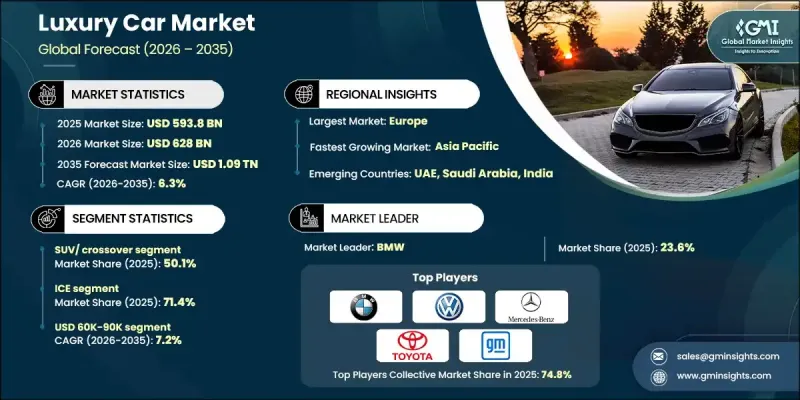
이러한 성장은 전 세계 부유층 증가와 가처분 소득 증가로 인해 더 많은 소비자들이 고급 자동차 제품에 접근할 수 있게 됨에 따라 성장세를 보이고 있습니다. 또한, 초부유층 인구 증가와 편안함, 성능, 브랜드 독점성에 대한 소비자 기대치의 변화도 수요를 견인하고 있습니다. 고급 자동차는 첨단 기술, 뛰어난 장인정신, 개인화를 겸비한 라이프스타일 자산으로 자리매김하고 있습니다. 자동차 제조업체들은 시장 접근성 향상과 비용 장벽을 낮추기 위해 여러 지역에서 생산 능력을 확장하고 있으며, 이는 판매 가능성을 더욱 강화하고 있습니다. 전동화 전략도 경쟁 구도를 재편하고 있으며, 고급 브랜드들은 지속가능성 목표에 부합하는 동시에 성능 기준을 유지하는 프리미엄 전기 모델 개발에 박차를 가하고 있습니다. 고급 파워트레인과 디지털 기능의 조기 도입은 지위와 혁신을 추구하는 부유층 구매자를 계속 끌어들이고 있습니다. 세계 모빌리티 선호도가 변화하는 가운데, 고급차 제조업체들은 다양한 제품 포트폴리오와 강화된 소유 경험을 통해 장기적인 수요를 확보할 수 있는 유리한 입지를 유지하고 있습니다.
| 시장 범위 | |
|---|---|
| 개시 연도 | 2025년 |
| 예측 연도 | 2026-2035년 |
| 개시 연도 시장 규모 | 5,938억 달러 |
| 예측 금액 | 1조 900억 달러 |
| CAGR | 6.3% |
2025년 고급 SUV 및 크로스오버 부문은 50.1%의 점유율을 차지할 것으로 예측됩니다. 이 부문은 고급스러운 인테리어와 다목적성, 높은 시트 포지션, 그리고 강한 존재감을 갖춘 차량을 점점 더 선호하는 경향이 있어 시장을 선도하고 있습니다. 넓은 캐빈 레이아웃과 유연한 수납공간은 부유층 소비자들에게 더욱 매력적으로 다가갈 수 있습니다.
내연기관차 부문은 2025년 71.4%의 점유율을 차지하며 2035년까지 7,508억 달러에 달할 것으로 예측됩니다. 전동화로의 전환이 진행 중이지만, 많은 고급차 구매자들은 여전히 ICE 플랫폼에 요구되는 주행 성능, 음향 성능, 기계적 정교함을 우선시하고 있습니다. 이러한 파워트레인과 관련된 다양한 커스터마이징 옵션도 지속적인 수요를 뒷받침하고 있습니다.
미국 고급차 시장은 2025년 1,623억 달러 규모에 달할 것으로 예측됩니다. 중국은 구매력, 높은 브랜드 인지도, 프리미엄 모빌리티에 대한 지속적인 관심으로 인해 여전히 세계 최대 시장입니다. 소유형태의 변화와 고객 경험 향상에 대한 수요는 계속해서 확장의 기회를 창출하고 있습니다.
자주 묻는 질문
목차
제1장 조사 방법
제2장 주요 요약
제3장 업계 인사이트
제4장 경쟁 구도
제5장 시장 추산 및 예측 : 차량별, 2022-2035년
제6장 시장 추산 및 예측 : 클래스별, 2022-2035년
제7장 시장 추산 및 예측 : 파워트레인별, 2022-2035년
제8장 시장 추산 및 예측 : 가격별, 2022-2035년
제9장 시장 추산 및 예측 : 판매채널별, 2022-2035년
제10장 시장 추산 및 예측 : 지역별, 2022-2035년
제11장 기업 개요
LSH 26.02.27The Global Luxury Car Market was valued at USD 593.8 billion in 2025 and is estimated to grow at a CAGR of 6.3% to reach USD 1.09 trillion by 2035.
Growth is supported by rising global wealth levels and increasing disposable incomes, which are enabling more consumers to access premium automotive offerings. Demand is also fueled by the growing population of ultra-high-net-worth individuals and evolving consumer expectations around comfort, performance, and brand exclusivity. Luxury vehicles are increasingly positioned as lifestyle assets that combine advanced technology, superior craftsmanship, and personalization. Automakers are expanding manufacturing capabilities across multiple regions to improve market access and reduce cost barriers, which further strengthens sales potential. Electrification strategies are also reshaping the competitive landscape, as luxury brands accelerate the development of premium electric models to align with sustainability goals while preserving performance standards. Early adoption of advanced powertrains and digital features continues to attract affluent buyers seeking innovation alongside status. As global mobility preferences evolve, luxury car manufacturers remain well-positioned to capture long-term demand through diversified product portfolios and enhanced ownership experiences.
| Market Scope | |
|---|---|
| Start Year | 2025 |
| Forecast Year | 2026-2035 |
| Start Value | $593.8 Billion |
| Forecast Value | $1.09 Trillion |
| CAGR | 6.3% |
The luxury SUVs and crossovers segment accounted for 50.1% share in 2025. This segment leads the market as buyers increasingly favor vehicles that combine upscale interiors with versatility, elevated seating positions, and strong visual presence. Spacious cabin layouts and adaptable storage configurations further enhance appeal among affluent consumers.
The internal combustion engine vehicles segment held 71.4% share in 2025 and is forecast to reach USD 750.8 billion by 2035. Despite the shift toward electrification, many luxury buyers continue to prioritize driving dynamics, acoustic performance, and mechanical refinement traditionally associated with ICE platforms. Extensive customization options linked to these powertrains also support sustained demand.
United States Luxury Car Market reached USD 162.3 billion in 2025. The country remains the largest global market due to strong purchasing power, high brand awareness, and sustained interest in premium mobility. Changing ownership models and demand for enhanced customer experiences continue to create expansion opportunities.
Key companies operating in the Global Luxury Car Market include Mercedes-Benz, BMW, Volkswagen, Toyota Motor (Lexus), General Motors, Ferrari, Tata Motors, Volvo, Aston Martin, and McLaren. Companies in the Global Luxury Car Market strengthen their market position through continuous innovation and strategic expansion. Manufacturers invest heavily in advanced powertrain technologies, digital connectivity, and autonomous features to enhance vehicle differentiation. Expanding electric and hybrid portfolios allows brands to address sustainability expectations without compromising performance. Strategic localization of production facilities improves cost efficiency and market responsiveness. Personalized design options and exclusive ownership programs help deepen customer loyalty. Strong branding, immersive retail experiences, and premium after-sales services further elevate value perception.
Table of Contents
Chapter 1 Methodology
- 1.1 Research approach
- 1.2 Quality commitments
- 1.2.1 GMI AI policy & data integrity commitment
- 1.3 Research trail & confidence scoring
- 1.3.1 Research trail components
- 1.3.2 Scoring components
- 1.4 Data collection
- 1.4.1 Partial list of primary sources
- 1.5 Data mining sources
- 1.5.1 Paid sources
- 1.6 Base estimates and calculations
- 1.6.1 Base year calculation
- 1.7 Forecast model
- 1.8 Research transparency addendum
Chapter 2 Executive Summary
- 2.1 Industry 360° synopsis
- 2.2 Key market trends
- 2.2.1 Regional
- 2.2.2 Vehicle
- 2.2.3 Class
- 2.2.4 Powertrain
- 2.2.5 Price
- 2.2.6 Sales Channel
- 2.3 TAM analysis, 2026-2035
- 2.4 CXO perspectives: Strategic imperatives
- 2.4.1 Executive decision points
- 2.4.2 Critical success factors
- 2.5 Future outlook and recommendations
Chapter 3 Industry Insights
- 3.1 Industry ecosystem analysis
- 3.1.1 Supplier landscape
- 3.1.2 Profit margin
- 3.1.3 Cost structure
- 3.1.4 Value addition at each stage
- 3.1.5 Factor affecting the value chain
- 3.1.6 Disruptions
- 3.2 Industry impact forces
- 3.2.1 Growth drivers
- 3.2.1.1 Rising high-net-worth individual (HNWI) population
- 3.2.1.2 Increasing consumer preference for premium comfort and features
- 3.2.1.3 Electrification and expansion of luxury electric vehicles (EVs)
- 3.2.1.4 Strong influence of social status and lifestyle branding
- 3.2.2 Industry pitfalls and challenges
- 3.2.2.1 High vehicle acquisition and ownership costs
- 3.2.2.2 Limited penetration in price-sensitive emerging markets
- 3.2.3 Market opportunities
- 3.2.3.1 Expansion of luxury electric and hybrid vehicle portfolios
- 3.2.3.2 Growing demand in emerging markets such as Asia and Middle East
- 3.2.3.3 Integration of autonomous and semi-autonomous driving features
- 3.2.3.4 Entry into tier-2 and tier-3 cities with compact luxury models
- 3.2.1 Growth drivers
- 3.3 Growth potential analysis
- 3.4 Regulatory landscape
- 3.4.1 North America
- 3.4.1.1 Federal Motor Vehicle Safety Standards (FMVSS)
- 3.4.1.2 EPA Emission Standards (Tier 3)
- 3.4.1.3 CAFE (Corporate Average Fuel Economy)
- 3.4.1.4 U.S. Clean Air Act
- 3.4.2 Europe
- 3.4.2.1 UN/ECE Regulations (ECE R)
- 3.4.2.2 Euro NCAP (European New Car Assessment Programme)
- 3.4.2.3 General Safety Regulation (EU )
- 3.4.3 Asia Pacific
- 3.4.3.1 ASEAN NCAP
- 3.4.3.2 Japan Safety & Emission Standards (JAMA / MLIT)
- 3.4.3.3 China 6 Emission Standard (CN6)
- 3.4.4 Latin America
- 3.4.4.1 Mercosur Regulations
- 3.4.4.2 Mexico NOM Standards
- 3.4.4.3 Brazil PROCONVE
- 3.4.5 Middle East & Africa
- 3.4.5.1 GSO / GCC Technical Regulations
- 3.4.5.2 GCC NCAP
- 3.4.5.3 UAE Vehicle Standards (ESMA)
- 3.4.1 North America
- 3.5 Porter';s analysis
- 3.6 PESTEL analysis
- 3.7 Technology and innovation landscape
- 3.7.1 Current technological trends
- 3.7.2 Emerging technologies
- 3.8 Price trends
- 3.8.1 By region
- 3.8.2 By product
- 3.9 Production statistics
- 3.9.1 Production hubs
- 3.9.2 Consumption hubs
- 3.9.3 Export and import
- 3.10 Cost breakdown analysis
- 3.11 Sustainability and environmental impact
- 3.11.1 Environmental impact assessment
- 3.11.2 Social impact & community benefits
- 3.11.3 Governance & corporate responsibility
- 3.11.4 Sustainable finance & investment trends
- 3.12 Dealer network & distribution infrastructure
- 3.12.1 Franchise vs. Independent dealer economics
- 3.12.2 Luxury showroom design and customer experience
- 3.12.3 Geographic coverage and dealership density by market
- 3.12.4 After-sales service network and certified service centers
- 3.13 Electrification transition & charging infrastructure
- 3.13.1 Consumer adoption barriers for luxury EVs
- 3.13.2 Private and public charging infrastructure development
- 3.13.3 Home charging solutions and smart grid integration
- 3.13.4 Battery technology advancements specific to luxury segment
- 3.14 Case studies
- 3.15 Future outlook & opportunities
Chapter 4 Competitive Landscape, 2025
- 4.1 Introduction
- 4.2 Company market share analysis
- 4.2.1 North America
- 4.2.2 Europe
- 4.2.3 Asia Pacific
- 4.2.4 LATAM
- 4.2.5 MEA
- 4.3 Competitive analysis of major market players
- 4.4 Competitive positioning matrix
- 4.5 Strategic outlook matrix
- 4.6 Key developments
- 4.6.1 Mergers & acquisitions
- 4.6.2 Partnerships & collaborations
- 4.6.3 New product launches
- 4.6.4 Expansion plans and funding
Chapter 5 Market Estimates & Forecast, By Vehicle, 2022 - 2035 ($Bn, Units)
- 5.1 Key trends
- 5.2 Hatchback
- 5.3 Sedan
- 5.4 SUV/ Crossover
- 5.5 Coupe
- 5.6 Wagon / Estate
- 5.7 Convertible
- 5.8 Others
Chapter 6 Market Estimates & Forecast, By Class, 2022 - 2035 ($Bn, Units)
- 6.1 Key trends
- 6.2 Entry-Level Luxury
- 6.3 Mid-Level Luxury
- 6.4 Ultra Luxury
Chapter 7 Market Estimates & Forecast, By Powertrain, 2022 - 2035 ($Bn, Units)
- 7.1 Key trends
- 7.2 ICE
- 7.2.1 Gasoline
- 7.2.2 Diesel
- 7.3 Electric/Hybrid
- 7.3.1 BEV
- 7.3.2 HEV
- 7.3.3 PHEV
Chapter 8 Market Estimates & Forecast, By Price, 2022 - 2035 ($Bn, Units)
- 8.1 Key trends
- 8.2 USD 40K-60K
- 8.3 USD 60K-90K
- 8.4 USD 90K-120K
- 8.5 Over USD 120K
Chapter 9 Market Estimates & Forecast, By Sales Channel, 2022 - 2035 ($Bn, Units)
- 9.1 Key trends
- 9.2 Franchised dealer
- 9.3 Independent dealer
Chapter 10 Market Estimates & Forecast, By Region, 2022 - 2035 ($Bn, Units)
- 10.1 Key trends
- 10.2 North America
- 10.2.1 US
- 10.2.2 Canada
- 10.3 Europe
- 10.3.1 Germany
- 10.3.2 UK
- 10.3.3 France
- 10.3.4 Italy
- 10.3.5 Spain
- 10.3.6 Russia
- 10.3.7 Nordics
- 10.3.8 Benelux
- 10.4 Asia Pacific
- 10.4.1 China
- 10.4.2 India
- 10.4.3 Japan
- 10.4.4 South Korea
- 10.4.5 ANZ
- 10.4.6 Singapore
- 10.4.7 Malaysia
- 10.4.8 Indonesia
- 10.4.9 Vietnam
- 10.4.10 Thailand
- 10.5 Latin America
- 10.5.1 Brazil
- 10.5.2 Mexico
- 10.5.3 Argentina
- 10.5.4 Colombia
- 10.6 MEA
- 10.6.1 South Africa
- 10.6.2 Saudi Arabia
- 10.6.3 UAE
Chapter 11 Company Profiles
- 11.1 Global companies
- 11.1.1 BMW
- 11.1.2 Volkswagen
- 11.1.3 Mercedes-Benz
- 11.1.4 Toyota Motor (Lexus)
- 11.1.5 General Motors
- 11.1.6 Tata Motors
- 11.1.7 Ferrari
- 11.1.8 Volvo
- 11.1.9 Aston Martin
- 11.1.10 Ford Motor
- 11.1.11 Tesla
- 11.1.12 Stellantis
- 11.1.13 Pagani Automobili
- 11.1.14 Koenigsegg Automotive
- 11.2 Regional companies
- 11.2.1 Hyundai Motor
- 11.2.2 McLaren Automotive
- 11.2.3 Geely
- 11.2.4 FAW
- 11.2.5 BYD Auto
- 11.2.6 SAIC Motor
- 11.3 Emerging companies
- 11.3.1 VinFast
- 11.3.2 Lucid
- 11.3.3 Rivian Automotive
- 11.3.4 Xpeng Motors