|
시장보고서
상품코드
1928967
건식 선박용 스크러버 시스템 시장 기회, 성장요인, 업계 동향 분석 및 예측(2026-2035년)Dry Marine Scrubber Systems Market Opportunity, Growth Drivers, Industry Trend Analysis, and Forecast 2026 - 2035 |
||||||

세계의 건식 선박용 스크러버 시스템 시장은 2025년에 12억 달러로 평가되었고, 2035년까지 연평균 복합 성장률(CAGR) 8.7%로 성장하여 29억 달러에 이를 것으로 예측됩니다.
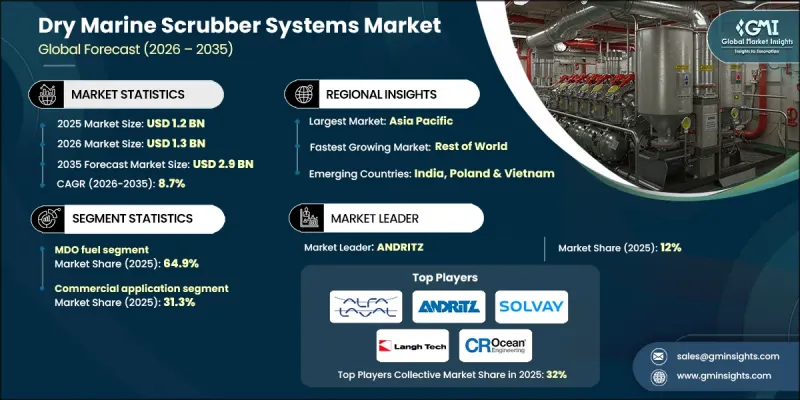
이러한 성장은 해운업계 전반의 컴플라이언스 전략을 재구성하고 있는 점점 더 엄격해지는 배출 규제에 의해 촉진되고 있습니다. 선박 운영자들은 황 및 질소산화물 배출 제한을 충족시키면서 운영 비용을 관리하고 규제상의 처벌을 피하기 위해 드라이 스크러버 시스템을 채택하고 있습니다. 이러한 시스템은 대규모 엔진 개조 없이도 규정을 준수할 수 있기 때문에 효율적이고 상업적으로 실현 가능한 선택이 될 수 있습니다. 드라이 머신 스크러버는 유해한 배기가스 성분을 대기 중으로 배출되기 전에 포집하여 대기오염물질 저감에 중요한 역할을 합니다. 그 사용은 더 깨끗한 해운 업무를 지원하고, 항만 주변의 대기질을 개선하며, 지속가능성에 대한 기대치를 높이는 데 도움이 됩니다. 기술 개발에 대한 지속적인 투자를 통해 모든 선박 카테고리에서 시스템의 효율성, 신뢰성, 적응성을 향상시키고 있습니다. 라이프사이클 비용 절감과 운영 간소화에 초점을 맞춘 개선이 점점 더 많이 채택되고 있습니다. 사업자들이 환경적 의무와 수익성의 균형을 맞추기 위해 노력하고 있는 가운데, 드라이 스크러버 시스템은 현대의 선대 전략에서 필수적인 솔루션이 되고 있습니다.
| 시장 범위 | |
|---|---|
| 개시 연도 | 2025년 |
| 예측 연도 | 2026-2035년 |
| 개시 연도 가치 | 12억 달러 |
| 예측 금액 | 29억 달러 |
| CAGR | 8.7% |
선박용 경유 부문은 2025년 64.9%의 점유율을 차지할 것으로 예상되며, 2035년까지 연평균 8.5%의 성장률을 보일 것으로 전망됩니다. 수요는 황 규제 강화와 연료가 드라이 스크러버 기술과의 호환성이 높아지면서 큰 기술적 변화 없이도 규제를 준수할 수 있게 됨에 따라 뒷받침되고 있습니다.
레크리에이션 선박 부문은 2035년까지 연평균 8.5%의 성장률을 보일 것으로 예측됩니다. 선주들이 규제 기준을 충족하면서도 공간 효율성과 선박 설계를 유지할 수 있는 소형 배출가스 제어 솔루션에 대한 투자가 증가함에 따라, 이 솔루션의 채택이 증가하고 있습니다.
미국 드라이 마린 스크러버 시스템 시장은 2025년 71.9%의 점유율을 차지하며 2035년까지 4억 7,000만 달러 이상의 수익을 창출할 것으로 예측됩니다. 강력한 규제 집행과 무배출 요구사항으로 인해 드라이 스크러버가 우선적인 컴플라이언스 솔루션으로 자리매김하고 있습니다.
자주 묻는 질문
목차
제1장 조사 방법과 범위
제2장 주요 요약
제3장 업계 인사이트
- 업계 에코시스템
- 원재료 가용성과 조달 분석
- 제조능력 평가
- 공급망 회복력과 리스크 요인
- 유통 네트워크 분석
- 규제 상황
- 업계에 대한 영향요인
- 성장 촉진요인
- 업계의 잠재적 리스크&과제
- 성장 가능성 분석
- 비용 구조 분석
- Porter의 Five Forces 분석
- 공급 기업의 교섭력
- 바이어의 교섭력
- 신규 진출업체의 위협
- 대체품의 위협
- PESTEL 분석
- 새로운 기회와 동향
- 디지털화와 IoT 통합
- 신흥 시장에의 진출
- 투자 분석과 전망
제4장 경쟁 구도
- 서론
- 기업의 시장 점유율 분석 : 지역별
- 북미
- 유럽
- 아시아태평양
- 세계 기타 지역
- 전략적 대시보드
- 전략적 이니셔티브
- 기업 벤치마킹
- 혁신과 기술 동향
제5장 시장 규모와 예측 : 연료별, 2022-2035
- MDO
- MGO
- 하이브리드
- 기타
제6장 시장 규모와 예측 : 용도별, 2022-2035
- 상업용
- 오프쇼어
- 레크리에이션
- 해군
- 기타
제7장 시장 규모와 예측 : 지역별, 2022-2035
- 북미
- 미국
- 캐나다
- 유럽
- 그리스
- 노르웨이
- 독일
- 영국
- 프랑스
- 네덜란드
- 이탈리아
- 아시아태평양
- 중국
- 한국
- 일본
- 베트남
- 인도
- 호주
- 세계 기타 지역
제8장 기업 개요
- ANDRITZ
- Aarco Engineering Projects Pvt. Ltd.
- Albion Marine Solutions
- Alfa Laval
- 브렌타그·아시아태평양 주식회사
- Clean Marine
- CR Ocean Engineering
- DuPont Clean Technologies
- Ecospray Technologies
- Fuji Electric
- Langh Tech
- ME Production
- Nicro
- SAACKE
- Solvay
- VDL AEC Maritime
- Yara Marine Technologies
The Global Dry Marine Scrubber Systems Market was valued at USD 1.2 billion in 2025 and is estimated to grow at a CAGR of 8.7% to reach USD 2.9 billion by 2035.
Growth is driven by increasingly strict emission regulations that are reshaping compliance strategies across the maritime industry. Ship operators are adopting dry scrubber systems to meet sulfur and nitrogen oxide limits while managing operating costs and avoiding regulatory penalties. These systems enable compliance without extensive engine modifications, making them an efficient and commercially viable option. Dry marine scrubbers play a vital role in lowering atmospheric pollutants by capturing harmful exhaust components before release. Their use supports cleaner maritime operations, improves air quality around ports, and aligns with rising sustainability expectations. Continuous investment in technology development is enhancing system efficiency, reliability, and adaptability across vessel categories. Improvements focused on lowering lifecycle costs and simplifying operations are increasingly adopted. As operators balance environmental obligations with profitability, dry scrubber systems are becoming an essential solution within modern fleet strategies.
| Market Scope | |
|---|---|
| Start Year | 2025 |
| Forecast Year | 2026-2035 |
| Start Value | $1.2 Billion |
| Forecast Value | $2.9 Billion |
| CAGR | 8.7% |
The marine diesel oil segment accounted for 64.9% share in 2025 and is expected to grow at a CAGR of 8.5% through 2035. Demand is supported by tighter sulfur regulations and the fuel's compatibility with dry scrubber technology, allowing compliance without major technical changes.
The recreational vessel segment is projected to grow at a CAGR of 8.5% by 2035. Adoption is rising as owners invest in compact emission control solutions that meet regulatory standards while preserving space efficiency and vessel design.
U.S. Dry Marine Scrubber Systems Market held 71.9% share in 2025 and is expected to generate more than USD 470 million in revenue by 2035. Strong regulatory enforcement and zero-discharge requirements are accelerating adoption, positioning dry scrubbers as a preferred compliance solution.
Key companies operating in the Global Dry Marine Scrubber Systems Market include Alfa Laval, ANDRITZ, Yara Marine Technologies, Ecospray Technologies, DuPont Clean Technologies, Solvay, Fuji Electric, Langh Tech, Clean Marine, SAACKE, VDL AEC Maritime, Nicro, CR Ocean Engineering, ME Production, Brenntag Asia Pacific Pte Ltd, Albion Marine Solutions, and Aarco Engineering Projects Pvt. Ltd. Companies in the Global Dry Marine Scrubber Systems Market are strengthening their positions through technological innovation, strategic partnerships, and global service expansion. Manufacturers are investing in compact, high-efficiency designs that reduce installation complexity and operating costs. Many players are focusing on modular systems to support retrofitting across diverse vessel types. Expanding after-sales services, including maintenance and performance optimization, is helping improve long-term customer retention. Firms are also enhancing compliance support by aligning product offerings with evolving environmental regulations.
Table of Contents
Chapter 1 Methodology & Scope
- 1.1 Research design
- 1.1.1 Research approach
- 1.1.2 Data collection methods
- 1.2 Base estimates and calculations
- 1.2.1 Base year calculation
- 1.2.2 Market estimates & forecast parameters
- 1.3 Forecast
- 1.3.1 Key trends for market estimates
- 1.3.1.1 Quantified market impact analysis
- 1.3.2 Mathematical impact of growth parameters on forecast
- 1.3.3 Scenario analysis framework
- 1.3.1 Key trends for market estimates
- 1.4 Primary research and validation
- 1.4.1 Some of the primary sources (but not limited to)
- 1.5 Data mining sources
- 1.5.1 Paid Sources
- 1.5.2 Sources, by region
- 1.6 Research trail & scoring components
- 1.6.1 Research trail components
- 1.6.2 Scoring components
- 1.7 Research transparency addendum
- 1.7.1 Source attribution framework
- 1.7.2 Quality assurance metrics
- 1.7.3 Our commitment to trust
- 1.8 Market definitions
Chapter 2 Executive Summary
- 2.1 Industry synopsis, 2022 - 2035
- 2.2 Business trends
- 2.3 Fuel trends
- 2.4 Application trends
- 2.5 Regional trends
Chapter 3 Industry Insights
- 3.1 Industry ecosystem
- 3.1.1 Raw material availability & sourcing analysis
- 3.1.2 Manufacturing capacity assessment
- 3.1.3 Supply chain resilience & risk factors
- 3.1.4 Distribution network analysis
- 3.2 Regulatory landscape
- 3.3 Industry impact forces
- 3.3.1 Growth drivers
- 3.3.2 Industry pitfalls & challenges
- 3.4 Growth potential analysis
- 3.5 Cost structure analysis
- 3.6 Porter';s analysis
- 3.6.1 Bargaining power of suppliers
- 3.6.2 Bargaining power of buyers
- 3.6.3 Threat of new entrants
- 3.6.4 Threat of substitutes
- 3.7 PESTEL analysis
- 3.7.1 Political factors
- 3.7.2 Economic factors
- 3.7.3 Social factors
- 3.7.4 Technological factors
- 3.7.5 Legal factors
- 3.7.6 Environmental factors
- 3.8 Emerging opportunities & trends
- 3.8.1 Digitalization & IoT integration
- 3.8.2 Emerging market penetration
- 3.9 Investment analysis and future outlook
Chapter 4 Competitive landscape, 2025
- 4.1 Introduction
- 4.2 Company market share analysis, by region, 2025
- 4.2.1 North America
- 4.2.2 Europe
- 4.2.3 Asia Pacific
- 4.2.4 Rest of World
- 4.3 Strategic dashboard
- 4.4 Strategic initiatives
- 4.5 Company benchmarking
- 4.6 Innovation & technology landscape
Chapter 5 Market Size and Forecast, By Fuel, 2022 - 2035 (USD Million & Units)
- 5.1 Key trends
- 5.2 MDO
- 5.3 MGO
- 5.4 Hybrid
- 5.5 Others
Chapter 6 Market Size and Forecast, By Application, 2022 - 2035 (USD Million & Units)
- 6.1 Key trends
- 6.2 Commercial
- 6.3 Offshore
- 6.4 Recreational
- 6.5 Navy
- 6.6 Others
Chapter 7 Market Size and Forecast, By Region, 2022 - 2035 (USD Million & Units)
- 7.1 Key trends
- 7.2 North America
- 7.2.1 U.S.
- 7.2.2 Canada
- 7.3 Europe
- 7.3.1 Greece
- 7.3.2 Norway
- 7.3.3 Germany
- 7.3.4 UK
- 7.3.5 France
- 7.3.6 Netherlands
- 7.3.7 Italy
- 7.4 Asia Pacific
- 7.4.1 China
- 7.4.2 South Korea
- 7.4.3 Japan
- 7.4.4 Vietnam
- 7.4.5 India
- 7.4.6 Australia
- 7.5 Rest of World
Chapter 8 Company Profiles
- 8.1 ANDRITZ
- 8.2 Aarco Engineering Projects Pvt. Ltd.
- 8.3 Albion Marine Solutions
- 8.4 Alfa Laval
- 8.5 Brenntag Asia Pacific Pte Ltd
- 8.6 Clean Marine
- 8.7 CR Ocean Engineering
- 8.8 DuPont Clean Technologies
- 8.9 Ecospray Technologies
- 8.10 Fuji Electric
- 8.11 Langh Tech
- 8.12 ME Production
- 8.13 Nicro
- 8.14 SAACKE
- 8.15 Solvay
- 8.16 VDL AEC Maritime
- 8.17 Yara Marine Technologies