|
시장보고서
상품코드
1936622
레크리에이션용 선박 스크러버 시스템 시장 기회, 성장 촉진요인, 업계 동향 분석, 예측(2026-2035년)Recreational Marine Scrubber Systems Market Opportunity, Growth Drivers, Industry Trend Analysis, and Forecast 2026 - 2035 |
||||||

세계의 레크리에이션용 선박 스크러버 시스템 시장은 2025년에 17억 달러로 평가되었으며, 2035년까지 CAGR 8.9%로 성장하여 42억 달러에 달할 것으로 예측됩니다.

시장 성장은 환경적 지속가능성에 대한 전 세계적인 관심 증가와 선박 배출 기준 강화로 인해 주도되고 있습니다. 레크리에이션 선박 소유자는 배출 규제를 준수하면서 고황 연료를 계속 사용할 수 있도록 스크러버 시스템을 채택하여 연료 관리의 유연성과 비용 효율성을 실현하고 있습니다. 이러한 시스템은 연료 품질 요구사항이 다른 지역에서 특히 가치가 높으며, 사업자에게 비용 효율적이고 운영 효율성이 높은 솔루션을 제공합니다. 선대의 개조 및 개조와 친환경 해양 관행에 대한 투자 증가가 수요를 더욱 촉진하고 있습니다. 스크러버 도입은 레크리에이션 보트 분야의 성장에도 영향을 미치고 있습니다. 선주들은 환경적 책임과 성능 및 유지보수 효율성의 균형을 맞추는 친환경 기술을 우선시하고 있습니다. 라틴아메리카, 아프리카, 오세아니아 등의 지역에서는 각국이 연안 수역의 정화를 추진하면서 급속한 보급이 진행되고 있습니다.
| 시장 범위 | |
|---|---|
| 시작 연도 | 2025년 |
| 예측 연도 | 2026-2035년 |
| 개시 금액 | 17억 달러 |
| 예측 금액 | 42억 달러 |
| CAGR | 8.9% |
선박용 디젤유(MDO) 부문은 2025년 64.3%의 점유율을 차지했으며, 2035년까지 연평균 9.2%의 성장률을 기록할 것으로 전망됩니다. MDO는 청정 연소, 연료 효율 향상, 스크러버 시스템과의 원활한 통합을 통해 엄격한 환경 규제에 대응하고 운영 비용 효율을 유지하는 데 있어 점점 더 많은 지지를 받고 있습니다. 이러한 다용도성으로 인해 선박 소유자는 성능 저하 없이 고황 연료와 저황 연료를 전환할 수 있어 레저용 해상 운항에서 실용적이고 유연한 대안이 될 수 있습니다.
습식 스크러버 기술 부문은 2025년 86.2%의 점유율을 차지했으며, 2026-2035년 연평균 9.2%의 성장률을 보일 것으로 예상됩니다. 습식 스크러버는 황산화물, 질소산화물, 미립자 물질 제거 능력이 뛰어나 국제 배출기준을 준수할 수 있다는 점에서 선호되고 있습니다. 다양한 선박 크기와 운항 조건에 대한 적응성으로 인해 신조선 및 개조 프로젝트 모두에 적합합니다. 엄격한 환경 규제를 충족시키면서 연료의 유연성을 높일 수 있는 다중 오염 물질 제어 시스템에 대한 수요가 증가하면서 습식 스크러버의 도입이 촉진되고 있습니다.
미국의 레크리에이션용 선박 스크러버 시스템 시장은 2025년 71.1%의 점유율을 차지하며 2035년까지 7억 3,500만 달러 규모로 성장할 것으로 예상됩니다. EPA와 같은 규제 기관의 압력과 더불어 대규모 레크리에이션 보트 애호가 커뮤니티와 지속가능한 보트 활동에 대한 관심이 높아지면서 스크러버 도입이 촉진되고 있습니다. 강화된 규제 준수 요건과 친환경 선박에 대한 소비자의 선호도가 설치 대수를 더욱 증가시키고 있습니다.
자주 묻는 질문
목차
제1장 조사 방법과 범위
제2장 주요 요약
제3장 업계 인사이트
제4장 경쟁 구도
제5장 시장 규모 및 예측 : 연료별, 2022-2035년
제6장 시장 규모 및 예측 : 용도별, 2022-2035년
제7장 시장 규모 및 예측 : 지역별, 2022-2035년
제8장 기업 개요
KSM 26.03.12The Global Recreational Marine Scrubber Systems Market was valued at USD 1.7 billion in 2025 and is estimated to grow at a CAGR of 8.9% to reach USD 4.2 billion by 2035.
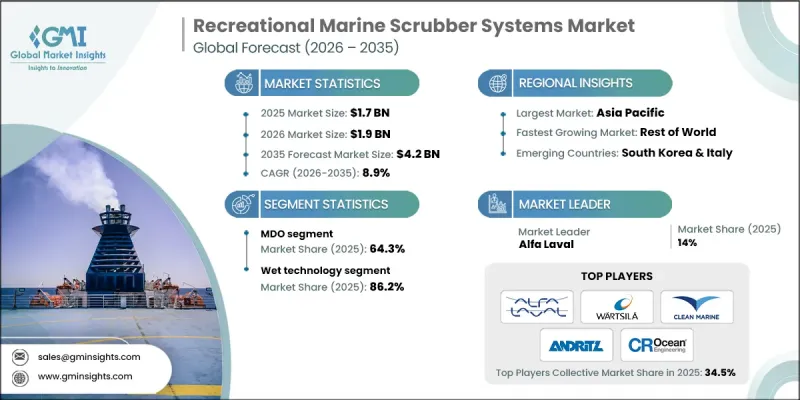
Market growth is driven by increasing global emphasis on environmental sustainability and stricter maritime emission standards. Recreational vessel owners are adopting scrubber systems to continue using high-sulfur fuels while remaining compliant with emission regulations, offering flexibility in fuel management and cost efficiency. These systems are especially valuable in regions with varying fuel quality requirements, providing operators with a cost-effective and operationally efficient solution. Rising investment in fleet retrofitting, refurbishment, and green maritime practices is further fueling demand. Scrubber adoption is also influenced by the growing recreational boating sector, where vessel owners prioritize eco-friendly technologies that balance environmental responsibility with performance and maintenance efficiency. Regions including Latin America, Africa, and Oceania are witnessing rapid uptake as nations push for cleaner coastal waters.
| Market Scope | |
|---|---|
| Start Year | 2025 |
| Forecast Year | 2026-2035 |
| Start Value | $1.7 Billion |
| Forecast Value | $4.2 Billion |
| CAGR | 8.9% |
The marine diesel oil (MDO) segment held a 64.3% share in 2025 and is projected to grow at a CAGR of 9.2% through 2035. MDO is increasingly favored due to its ability to deliver cleaner combustion, improved fuel efficiency, and seamless integration with scrubber systems, helping operators meet strict environmental regulations while maintaining operational cost-effectiveness. Its versatility allows vessel owners to switch between high- and low-sulfur fuels without compromising performance, making it a practical and flexible choice for recreational maritime operations.
The wet scrubber technology segment accounted for an 86.2% share in 2025 and is expected to grow at a CAGR of 9.2% from 2026 to 2035. Wet scrubbers are preferred for their superior ability to remove sulfur oxides, nitrogen oxides, and particulate matter, ensuring compliance with international emission standards. Their adaptability to various vessel sizes and operational conditions makes them suitable for both new builds and retrofitting projects. Increasing demand for multi-pollutant control systems, capable of meeting stringent environmental regulations while enhancing fuel flexibility, is boosting the uptake of wet scrubbers.
U.S. Recreational Marine Scrubber Systems Market held a 71.1% share in 2025 and is expected to generate USD 735 million by 2035. Regulatory pressure from agencies like the EPA, along with a large recreational boating community and growing interest in sustainable boating, is driving scrubber adoption. Increasing compliance requirements and consumer preference for eco-friendly vessels are further boosting installations.
Key players in the Global Recreational Marine Scrubber Systems Market include: Andritz, Alfa Laval, CR Ocean Engineering, Clean Marine AS, Damen Shipyards Group, EnviroCare, Ecospray Technologies S.r.l., Fuji Electric, Hitachi Energy, KwangSung, Keppel, LiqTech, ME Production, Mitsubishi Heavy Industries, Nicro, SAACKE, Valmet, VDL AEC Maritime, Wartsila, Yara. Companies in the recreational marine scrubber systems market are employing strategies to strengthen their market foothold by investing in R&D for more compact, efficient, and multi-pollutant scrubbing solutions. Manufacturers are expanding global service networks, forming partnerships with shipyards, and targeting regions with emerging environmental regulations. Additionally, companies focus on retrofitting existing fleets, providing customized solutions for different vessel types, and promoting cost-effective, fuel-flexible technologies to enhance customer adoption. Strategic marketing campaigns emphasizing environmental compliance and operational efficiency also reinforce brand positioning and long-term growth.
Table of Contents
Chapter 1 Methodology & Scope
- 1.1 Research design
- 1.1.1 Research approach
- 1.1.2 Data collection methods
- 1.2 Base estimates and calculations
- 1.2.1 Base year calculation
- 1.2.2 Market estimates & forecast parameters
- 1.3 Forecast
- 1.3.1 Key trends for market estimates
- 1.3.1.1 Quantified market impact analysis
- 1.3.2 Mathematical impact of growth parameters on forecast
- 1.3.3 Scenario analysis framework
- 1.3.1 Key trends for market estimates
- 1.4 Primary research and validation
- 1.4.1 Some of the primary sources (but not limited to)
- 1.5 Data mining sources
- 1.5.1 Paid Sources
- 1.5.2 Sources, by region
- 1.6 Research trail & scoring components
- 1.6.1 Research trail components
- 1.6.2 Scoring components
- 1.7 Research transparency addendum
- 1.7.1 Source attribution framework
- 1.7.2 Quality assurance metrics
- 1.7.3 Our commitment to trust
- 1.8 Market definitions
Chapter 2 Executive Summary
- 2.1 Industry synopsis, 2022 - 2035
- 2.2 Business trends
- 2.3 Fuel trends
- 2.4 Technology trends
- 2.5 Regional trends
Chapter 3 Industry Insights
- 3.1 Industry ecosystem
- 3.1.1 Raw material availability & sourcing analysis
- 3.1.2 Manufacturing capacity assessment
- 3.1.3 Supply chain resilience & risk factors
- 3.1.4 Distribution network analysis
- 3.2 Regulatory landscape
- 3.3 Industry impact forces
- 3.3.1 Growth drivers
- 3.3.2 Industry pitfalls & challenges
- 3.4 Growth potential analysis
- 3.5 Cost structure analysis
- 3.6 Porter's analysis
- 3.6.1 Bargaining power of suppliers
- 3.6.2 Bargaining power of buyers
- 3.6.3 Threat of new entrants
- 3.6.4 Threat of substitutes
- 3.7 PESTEL analysis
- 3.7.1 Political factors
- 3.7.2 Economic factors
- 3.7.3 Social factors
- 3.7.4 Technological factors
- 3.7.5 Legal factors
- 3.7.6 Environmental factors
- 3.8 Emerging opportunities & trends
- 3.8.1 Digitalization & IoT integration
- 3.8.2 Emerging market penetration
- 3.9 Investment analysis and future outlook
Chapter 4 Competitive landscape, 2025
- 4.1 Introduction
- 4.2 Company market share analysis, by region, 2025
- 4.2.1 North America
- 4.2.2 Europe
- 4.2.3 Asia Pacific
- 4.2.4 Rest of World
- 4.3 Strategic dashboard
- 4.4 Strategic initiatives
- 4.5 Company benchmarking
- 4.6 Innovation & technology landscape
Chapter 5 Market Size and Forecast, By Fuel, 2022 - 2035 (USD Million & Units)
- 5.1 Key trends
- 5.2 MDO
- 5.3 MGO
- 5.4 Hybrid
- 5.5 Others
Chapter 6 Market Size and Forecast, By Application, 2022 - 2035 (USD Million & Units)
- 6.1 Key trends
- 6.2 Wet technology
- 6.3 Dry technology
Chapter 7 Market Size and Forecast, By Region, 2022 - 2035 (USD Million & Units)
- 7.1 Key trends
- 7.2 North America
- 7.2.1 U.S.
- 7.2.2 Canada
- 7.3 Europe
- 7.3.1 Germany
- 7.3.2 France
- 7.3.3 UK
- 7.3.4 Italy
- 7.3.5 Greece
- 7.4 Asia Pacific
- 7.4.1 China
- 7.4.2 Japan
- 7.4.3 South Korea
- 7.4.4 Malaysia
- 7.4.5 Indonesia
- 7.5 Rest of World
Chapter 8 Company Profiles
- 8.1 ANDRITZ
- 8.2 Aarco Engineering Projects Pvt. Ltd.
- 8.3 Albion Marine Solutions
- 8.4 Alfa Laval
- 8.5 Brenntag Asia Pacific Pte Ltd
- 8.6 Clean Marine
- 8.7 CR Ocean Engineering
- 8.8 DuPont Clean Technologies
- 8.9 Ecospray Technologies
- 8.10 Fuji Electric
- 8.11 Langh Tech
- 8.12 ME Production
- 8.13 Nicro
- 8.14 SAACKE
- 8.15 Solvay
- 8.16 VDL AEC Maritime
- 8.17 Yara Marine Technologies