
|
시장보고서
상품코드
1936488
어류용 구충제 시장 : 시장 기회, 성장 요인, 산업 동향 분석 및 예측(2026-2035년)Fish Anthelmintics Drugs Market Opportunity, Growth Drivers, Industry Trend Analysis, and Forecast 2026 - 2035 |
||||||

세계의 어류용 구충제 시장은 2025년에 2억 5,600만 달러로 평가되었고, 2035년까지 연평균 복합 성장률(CAGR) 5.3%로 성장할 전망이며, 4억 3,050만 달러에 이를 것으로 예측됩니다.

시장 성장은 양식업의 급속한 확대, 양식어에서 기생충 감염 증가, 고품질 수산물에 대한 수요 증가로 인한 것입니다. 구충제는 생선의 건강 상태, 성장률, 생존율에 악영향을 미치는 선충, 조충, 흡충 등의 내부 기생충을 제어하는 데 중요한 역할을합니다. 세계의 단백질 수요를 충족시키기 위해 양식업이 강화되는 가운데 경제적 손실을 최소화하고 지속 가능한 양식 실천을 확보하기 위해서는 효과적인 기생충 관리가 필수적입니다. 어류의 건강 관리와 바이오 시큐리티에 대한 중시가 높아짐에 따라, 상업 양식 시설에서 어류용 구충제의 도입이 대폭 증가하고 있습니다. 기생충 감염은 사료 효율과 체중 증가를 감소시킬 뿐만 아니라 사망률을 증가시키고 양식장의 수익성에 직접적인 영향을 미칩니다. 결과적으로 양식 생산자는 스톡의 건강 유지를 위해 예방 및 치료제 솔루션에 대한 투자를 확대하고 있습니다. 여러 국가의 규제 기관들은 식품 안전기준을 개선하기 위한 수의약품의 관리된 사용을 권장하고 있으며, 이는 시장 성장을 더욱 강화하고 있습니다. 또한, 제제 기술의 진보에 의해 보다 표적을 좁혀, 잔류 관리되고, 환경적으로 안전한 구충약이 개발되어, 치료 효과의 향상 및 규제 기준에 대한 준수를 실현하고 있습니다.
| 시장 범위 | |
|---|---|
| 시작 연도 | 2025년 |
| 예측 연도 | 2026-2035년 |
| 시작 시 가치 | 2억 5,600만 달러 |
| 예측 금액 | 4억 3,050만 달러 |
| CAGR | 5.3% |
의약품 등급별 시장 세분화에서는 벤즈이미다졸계, 대환상 락톤계, 프라디칸텔 등으로 구분되어 있으며, 벤즈이미다졸계 부문은 2025년에 6,550만 달러의 매출로 평가되었습니다. 벤즈이미다졸계 약제는 위장관선충류 및 흡충류에 대한 광범위한 효능, 비용 효율성, 약용 사료에 의한 투여 용이성으로부터 널리 선호되고 있습니다. 이러한 약물은 기생충의 대사와 에너지 생산을 억제하고 어류에 대한 허용 가능한 안전 영역을 유지하면서 효과적인 기생충 치료를 실현합니다. 담수 및 해양 양식 시스템 모두에서 널리 사용되는 것은 시장에서 주도적인 지위를 확고히 합니다.
B2B 부문은 2025년에 49.6%의 점유율을 차지했으며, 상업 양식장, 부화장, 통합 양식 생산자, 대규모 수산물 수출업체로부터의 강한 수요에 견인되었습니다. 이러한 구매자는 감염 위험이 증가하는 고밀도 양식 환경에서 기생충 발생을 관리하기 때문에 신뢰성이 높고 효과적인 구충제 솔루션을 선호합니다. B2B 고객은 일반적으로 수의 용품 공급업체, 양식 자재 유통 업체 또는 제조업체와 직접 계약을 통해 어류용 구충제를 대량 조달하여 안정적인 공급 및 비용 효율성을 보장합니다.
아시아태평양의 어류용 구충제 시장은 이 지역의 대규모 양식 생산, 수산물 소비 증가, 상업 양식 사업 확대에 힘입어 2025년에는 1억 9,300만 달러에 달했습니다. 중국, 인도, 베트남, 인도네시아 등의 국가들은 광범위한 내륙 및 연안 양식 활동을 통해 주요 공헌국이 되었습니다. 현대적인 어류 건강 관리 기술의 도입 증가와 양식 생산성 및 질병 관리 개선을 위한 정부의 이니셔티브이 함께 이 지역에서 동물용 의약품의 사용은 크게 증가하고 있습니다.
자주 묻는 질문
목차
제1장 조사 방법 및 범위
제2장 주요 요약
제3장 업계 인사이트
- 생태계 분석
- 업계에 미치는 영향요인
- 성장 촉진요인
- 수산 양식 생산량 증가
- 기생충 질환의 급증
- 지속성 제제 및 병용 요법의 개발
- 엄격한 식품 안전규제
- 업계의 잠재적 위험 및 과제
- 신규 동물용 의약품에 대한 엄격한 승인 프로세스
- 수역에서의 잔류 약물에 대한 우려
- 기회
- 신흥 시장에서 수산 양식의 급속한 성장
- 기생충 검출 및 표적 약물 사용을 위한 스마트 모니터링 시스템 통합
- 성장 촉진요인
- 성장 가능성 분석
- 규제 상황
- 북미
- 미국
- 캐나다
- 유럽
- 아시아태평양
- 북미
- 기술적 상황
- 현재 기술 동향
- 신흥 기술
- 투자 환경
- 특허 분석
- 가격 분석
- 공급망 분석
- Porter's Five Forces 분석
- PESTEL 분석
- 장래 시장 동향
제4장 경쟁 구도
- 서문
- 기업 매트릭스 분석
- 기업의 시장 점유율 분석
- 주요 시장 기업의 경쟁 분석
- 경쟁 포지셔닝 매트릭스
- 주요 발전
- 합병 및 인수
- 제휴 및 협업
- 신제품 발매
- 확대 계획
제5장 시장 추계 및 예측 : 약제 클래스별(2022-2035년)
- 피라지노이소퀴놀론계
- 벤즈이미다졸계
- 대환상 락톤
- 기타 약제 분류
제6장 시장 추계 및 예측 : 대상 기생충별(2022-2035년)
- 선충류
- 흡충류
- 혼합 감염
- 조충류
제7장 시장 추계 및 예측 : 제제별(2022-2035년)
- 경구제
- 침지
- 주사제
제8장 시장 추계 및 예측 : 유통 채널별(2022-2035년)
- B2B
- 동물 병원 부속 약국
- 소매점
- 전자상거래
제9장 시장 추계 및 예측 : 지역별(2022-2035년)
- 북미
- 미국
- 캐나다
- 유럽
- 노르웨이
- 튀르키예
- 독일
- 영국
- 프랑스
- 스페인
- 이탈리아
- 네덜란드
- 아시아태평양
- 중국
- 인도
- 인도네시아
- 베트남
- 일본
- 한국
- 호주
- 라틴아메리카
- 브라질
- 멕시코
- 아르헨티나
- 중동 및 아프리카
- 이집트
- 남아프리카
- 사우디아라비아
- 아랍에미리트(UAE)
제10장 기업 프로파일
- API
- Aquarium Products India
- Aquatic Remedies
- Centurion HEALTHCARE
- Hikari
- KOI PHARMA
- Kyoritsu Seiyaku Corporation
- Merck & Co., Inc.
- NATIONAL FISH PHARMACEUTICALS USA
- Syndel
The Global Fish Anthelmintics Drugs Market was valued at USD 256 million in 2025 and is estimated to grow at a CAGR of 5.3% to reach USD 430.5 million by 2035.
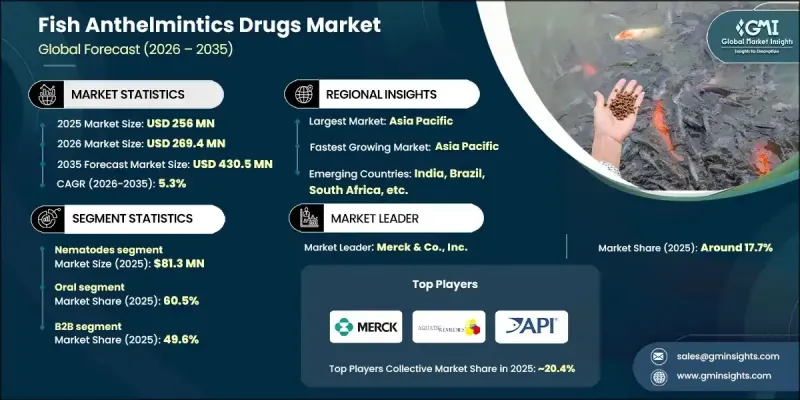
Market growth is driven by the rapid expansion of aquaculture, the increasing prevalence of parasitic infestations in farmed fish, and rising demand for high-quality seafood. Anthelmintic drugs play a critical role in controlling internal parasitic worms such as nematodes, cestodes, and trematodes that negatively impact fish health, growth rates, and survival. As aquaculture operations intensify to meet global protein demand, effective parasite management has become essential to minimize economic losses and ensure sustainable fish farming practices. The growing emphasis on fish health management and biosecurity has significantly increased the adoption of fish anthelmintics across commercial aquaculture facilities. Parasitic infections not only reduce feed efficiency and weight gain but also increase mortality rates, directly affecting farm profitability. As a result, aquaculture producers are increasingly investing in preventive and therapeutic drug solutions to maintain stock health. Regulatory bodies in several countries are also encouraging the controlled use of veterinary pharmaceuticals to improve food safety standards, further supporting market growth. Additionally, advancements in formulation technologies have led to more targeted, residue-controlled, and environmentally safer anthelmintic drugs, improving treatment outcomes and compliance with regulatory norms.
| Market Scope | |
|---|---|
| Start Year | 2025 |
| Forecast Year | 2026-2035 |
| Start Value | $256 Million |
| Forecast Value | $430.5 Million |
| CAGR | 5.3% |
Based on drug class, the market is segmented into benzimidazoles, macrocyclic lactones, praziquantel, and others, with the benzimidazoles segment generating USD 65.5 million in 2025. Benzimidazoles are widely preferred due to their broad-spectrum efficacy against gastrointestinal nematodes and trematodes, cost-effectiveness, and ease of administration through medicated feed. These drugs interfere with parasite metabolism and energy production, leading to effective parasite elimination while maintaining acceptable safety margins for fish. Their extensive use in both freshwater and marine aquaculture systems has solidified their leading market position.
The B2B segment held 49.6% share in 2025, driven by strong demand from commercial aquaculture farms, hatcheries, integrated fish producers, and large-scale seafood exporters. These buyers prioritize reliable, high-efficacy anthelmintic solutions to manage parasite outbreaks in high-density farming environments where infection risks are elevated. B2B customers typically procure fish anthelmintics in bulk through veterinary suppliers, aquaculture input distributors, and direct manufacturer contracts, ensuring consistent supply and cost efficiency
Asia Pacific Fish Anthelmintics Drugs Market reached USD 193 million in 2025, supported by the region's large-scale aquaculture production, growing seafood consumption, and expanding commercial fish farming operations. Countries such as China, India, Vietnam, and Indonesia are major contributors, owing to their extensive inland and coastal aquaculture activities. The increasing adoption of modern fish health management practices, combined with government initiatives to improve aquaculture productivity and disease control, has significantly boosted the use of veterinary drugs in the region.
Key players operating in the Global Fish Anthelmintics Drugs Market include Zoetis Inc., Elanco Animal Health, Merck & Co. (MSD Animal Health), Virbac, Vetoquinol, Ceva Sante Animale, Huvepharma, and Phibro Animal Health Corporation. Companies operating in the Fish Anthelmintics Drugs Market are focusing on product innovation, strategic partnerships, and geographic expansion to strengthen their market presence. Leading players are investing heavily in research and development to introduce advanced formulations with improved efficacy, reduced environmental impact, and lower drug residue levels to meet stringent regulatory standards. Collaborations with aquaculture farms, feed manufacturers, and veterinary networks enable companies to expand distribution and improve farmer awareness. Many firms are also targeting emerging aquaculture markets in Asia Pacific and Latin America through localized manufacturing and pricing strategies. Additionally, companies are emphasizing sustainable parasite management solutions, including integrated health management programs, to build long-term customer relationships and reinforce their competitive positioning.
Table of Contents
Chapter 1 Methodology and Scope
- 1.1 Market scope and definition
- 1.2 Research design
- 1.2.1 Research approach
- 1.2.2 Data collection methods
- 1.3 Data mining sources
- 1.3.1 Global
- 1.3.2 Regional/Country
- 1.4 Base estimates and calculations
- 1.4.1 Base year calculation
- 1.4.2 Key trends for market estimation
- 1.5 Primary research and validation
- 1.5.1 Primary sources
- 1.6 Forecast model
- 1.7 Research assumptions and limitations
Chapter 2 Executive Summary
- 2.1 Industry 3600 synopsis
- 2.2 Key market trends
- 2.2.1 Regional trends
- 2.2.2 Drug class trends
- 2.2.3 Target parasite trends
- 2.2.4 Formulation trends
- 2.2.5 Distribution channel trends
- 2.3 CXO perspectives: Strategic imperatives
- 2.3.1 Key decision points for industry executives
- 2.3.2 Critical success factors for market players
- 2.4 Future outlook and strategic recommendations
Chapter 3 Industry Insights
- 3.1 Industry ecosystem analysis
- 3.2 Industry impact forces
- 3.2.1 Growth drivers
- 3.2.1.1 Rising production of aquaculture
- 3.2.1.2 Surging prevalence of parasitic diseases
- 3.2.1.3 Development of long-acting formulations and combination therapies
- 3.2.1.4 Stringent food safety regulations
- 3.2.2 Industry pitfalls and challenges
- 3.2.2.1 Strict approval processes for new veterinary drugs
- 3.2.2.2 Concerns regarding residual drugs in water bodies
- 3.2.3 Opportunities
- 3.2.3.1 Rapid aquaculture growth in emerging markets
- 3.2.3.2 Integration of smart monitoring systems for parasite detection and targeted drug use
- 3.2.1 Growth drivers
- 3.3 Growth potential analysis
- 3.4 Regulatory landscape
- 3.4.1 North America
- 3.4.1.1 U.S.
- 3.4.1.2 Canada
- 3.4.2 Europe
- 3.4.3 Asia Pacific
- 3.4.1 North America
- 3.5 Technological landscape
- 3.5.1 Current technological trends
- 3.5.2 Emerging technologies
- 3.6 Investment landscape
- 3.7 Patent analysis
- 3.8 Pricing analysis
- 3.9 Supply chain analysis
- 3.10 Porter's analysis
- 3.11 PESTEL analysis
- 3.12 Future market trends
Chapter 4 Competitive Landscape, 2025
- 4.1 Introduction
- 4.2 Company matrix analysis
- 4.3 Company market share analysis
- 4.4 Competitive analysis of major market players
- 4.5 Competitive positioning matrix
- 4.6 Key developments
- 4.6.1 Mergers & acquisitions
- 4.6.2 Partnerships & collaborations
- 4.6.3 New product launches
- 4.6.4 Expansion plans
Chapter 5 Market Estimates and Forecast, By Drug Class, 2022 - 2035 ($ Mn)
- 5.1 Key trends
- 5.2 Pyrazinoisoquinolones
- 5.3 Benzimidazoles
- 5.4 Macrocyclic lactones
- 5.5 Other drug classes
Chapter 6 Market Estimates and Forecast, By Target Parasite, 2022 - 2035 ($ Mn)
- 6.1 Key trends
- 6.2 Nematodes
- 6.3 Trematodes
- 6.4 Mixed infections
- 6.5 Cestodes
Chapter 7 Market Estimates and Forecast, By Formulation, 2022 - 2035 ($ Mn)
- 7.1 Key trends
- 7.2 Oral
- 7.3 Immersion
- 7.4 Injectable
Chapter 8 Market Estimates and Forecast, By Distribution Channel, 2022 - 2035 ($ Mn)
- 8.1 Key trends
- 8.2 B2B
- 8.3 Veterinary pharmacy
- 8.4 Retail stores
- 8.5 E-commerce
Chapter 9 Market Estimates and Forecast, By Region, 2022 - 2035 ($ Mn)
- 9.1 Key trends
- 9.2 North America
- 9.2.1 U.S.
- 9.2.2 Canada
- 9.3 Europe
- 9.3.1 Norway
- 9.3.2 Turkey
- 9.3.3 Germany
- 9.3.4 UK
- 9.3.5 France
- 9.3.6 Spain
- 9.3.7 Italy
- 9.3.8 Netherlands
- 9.4 Asia Pacific
- 9.4.1 China
- 9.4.2 India
- 9.4.3 Indonesia
- 9.4.4 Vietnam
- 9.4.5 Japan
- 9.4.6 South Korea
- 9.4.7 Australia
- 9.5 Latin America
- 9.5.1 Brazil
- 9.5.2 Mexico
- 9.5.3 Argentina
- 9.6 MEA
- 9.6.1 Egypt
- 9.6.2 South Africa
- 9.6.3 Saudi Arabia
- 9.6.4 UAE
Chapter 10 Company Profiles
- 10.1 API
- 10.2 Aquarium Products India
- 10.3 Aquatic Remedies
- 10.4 Centurion HEALTHCARE
- 10.5 Hikari
- 10.6 KOI PHARMA
- 10.7 Kyoritsu Seiyaku Corporation
- 10.8 Merck & Co., Inc.
- 10.9 NATIONAL FISH PHARMACEUTICALS U.S.A.
- 10.10 Syndel