

|
시장보고서
상품코드
1936562
기계 안전 시장 기회, 성장 촉진요인, 업계 동향 분석 및 예측(2026-2035년)Machine Safety Market Opportunity, Growth Drivers, Industry Trend Analysis, and Forecast 2026 - 2035 |
||||||

세계의 기계 안전 시장은 2025년에 64억 달러로 평가되었으며, 2035년까지 CAGR 6.6%로 성장하여 119억 달러에 달할 것으로 예측됩니다.

규제 강화 압력, 투자자의 기대, 보다 안전하고 지속가능한 산업 운영에 대한 사회적 요구가 높아짐에 따라 업계에서는 도입이 가속화되고 있습니다. 기업들은 환경 부하 최소화, 폐기물 감소, 자원 이용 최적화, 설비 전기화를 실현하는 기술 도입을 확대하는 한편, 재생에너지와 물 재활용 시스템 통합을 추진하고 있습니다. 최신 기계 안전 솔루션은 실시간 모니터링, 저영향 운영 모니터링, 책임감 있는 공급업체 추적을 지원하여 운영 투명성과 규정 준수를 보장합니다. 이러한 발전은 자동화 및 고위험 기계에 강력한 안전 시스템이 필요한 산업 환경에서 특히 중요합니다. 지속가능성, 운영 효율성, 근로자 보호에 대한 노력은 전 세계 산업 분야에서 첨단 안전 컨트롤러, 센서, 인터록 시스템에 대한 투자를 촉진하고 있습니다.
| 시장 범위 | |
|---|---|
| 시작 연도 | 2025년 |
| 예측 연도 | 2026-2035 |
| 개시 금액 | 64억 달러 |
| 예측 금액 | 119억 달러 |
| CAGR | 6.6% |
존재 감지 안전 센서 부문은 2025년 23억 달러를 차지할 것으로 예상됩니다. 이 센서는 직원이나 물체가 위험 구역에 진입한 것을 감지하고 즉시 기계 작동을 중지시켜 작업장 내 부상을 줄일 수 있습니다. 비접촉식 기능을 갖추고 있어 물리적 장벽이 작업 흐름을 방해하거나 접근을 제한할 수 있는 용도에 적합합니다.
개별 부품 부문은 2025년 61.3%의 점유율을 차지할 것으로 예상됩니다. 독립적인 안전 구성요소는 기계에 개별적으로 설치되기 때문에 새롭고 오래된 기계와 안전 요구 사항이 다른 장비에 대한 맞춤형 보호 기능을 제공합니다. 이러한 접근 방식을 통해 비용 효율적인 업그레이드는 물론, 타겟팅된 안전 솔루션을 확보할 수 있습니다.
미국 기계 안전 시장은 2025년 55.3%의 점유율을 차지하며 10억 달러 규모에 달할 것으로 예상됩니다. 성장세는 강력한 규제 집행, 높은 산업 자동화 도입률, 성숙한 제조 기반에 의해 뒷받침되고 있습니다. 자동차, 전자, 식품가공, 물류 등의 산업에서 생산라인의 현대화가 진행되면서 예지보전, 인간과 기계의 협업, 운영 가시화를 가능하게 하는 첨단 안전기술에 대한 수요가 증가하고 있습니다.
자주 묻는 질문
목차
제1장 조사 방법과 범위
제2장 주요 요약
제3장 업계 인사이트
제4장 경쟁 구도
제5장 시장 추정 및 예측 : 구성요소별, 2022-2035
제6장 시장 추정 및 예측 : 구현 유형별, 2022-2035
제7장 시장 추정 및 예측 : 용도별, 2022-2035
제8장 시장 추정 및 예측 : 최종 이용 산업별, 2022-2035
제9장 시장 추정 및 예측 : 지역별, 2022-2035
제10장 기업 개요
KSM 26.03.05The Global Machine Safety Market was valued at USD 6.4 billion in 2025 and is estimated to grow at a CAGR of 6.6% to reach USD 11.9 billion by 2035.
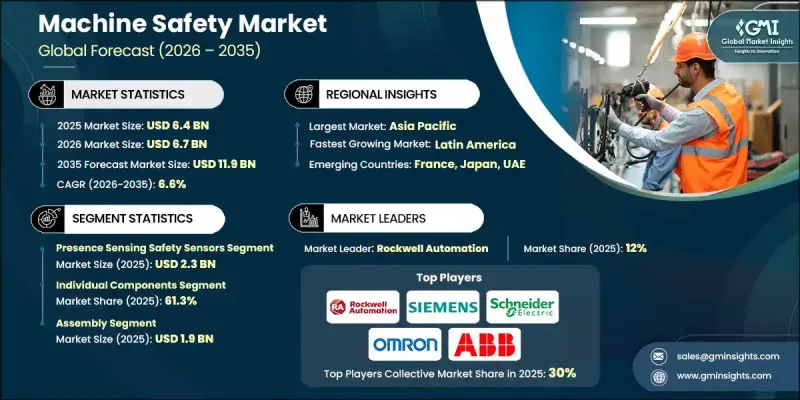
The industry is witnessing accelerated adoption due to rising regulatory pressures, investor expectations, and community demands for safer and more sustainable industrial operations. Companies are increasingly implementing technologies that minimize environmental impact, reduce waste, optimize resource use, and electrify equipment, while integrating renewable energy and water recycling systems. Modern machine safety solutions also support real-time monitoring, low-impact operational oversight, and responsible supplier tracking, ensuring operational transparency and compliance. These developments are particularly critical in industrial environments where automation and high-risk machinery necessitate robust safety systems. The push toward sustainability, operational efficiency, and worker protection is driving investments in advanced safety controllers, sensors, and interlock systems across industries worldwide.
| Market Scope | |
|---|---|
| Start Year | 2025 |
| Forecast Year | 2026-2035 |
| Start Value | $6.4 Billion |
| Forecast Value | $11.9 Billion |
| CAGR | 6.6% |
The presence-sensing safety sensors segment accounted for USD 2.3 billion in 2025. These sensors detect employees or objects entering hazardous zones and immediately halt machine operations, reducing workplace injuries. Their non-contact functionality makes them ideal for applications where physical barriers may hinder workflow or restrict access.
The individual components segment held a 61.3% share in 2025. Independent safety components are installed separately on machinery, allowing tailored protection for older and newer machines, or for equipment with varying safety requirements. This approach ensures targeted safety solutions while enabling cost-effective upgrades.
U.S. Machine Safety Market held a 55.3% share, generating USD 1 billion in 2025. Growth is supported by strong regulatory enforcement, high industrial automation adoption, and a mature manufacturing base. Industries across automotive, electronics, food processing, and logistics are modernizing production lines, driving demand for advanced safety technologies that enable predictive maintenance, human-machine collaboration, and operational visibility.
Key players in the Global Machine Safety Market include ABB, Banner Engineering, Emerson Electric, Honeywell International, IDEC, ISE Controls, KEYENCE, Mitsubishi Electric, OMRON, Pepperl+Fuchs, Pilz GmbH, Rockwell Automation, Schneider Electric, SICK, and Siemens. Companies in the machine safety market focus on innovation and R&D to enhance product reliability, accuracy, and integration capabilities. They expand their global footprint through strategic partnerships, acquisitions, and local manufacturing setups. Firms emphasize modular and scalable solutions to address diverse machinery requirements, enabling cost-effective retrofits and upgrades. Investment in IoT-enabled devices, predictive analytics, and real-time monitoring strengthens operational efficiency and compliance. Additionally, companies pursue certifications and regulatory adherence to reinforce trust and market credibility, while offering training and support services to build long-term client relationships and maintain a competitive advantage.
Table of Contents
Chapter 1 Methodology and Scope
- 1.1 Market scope and definition
- 1.2 Research design
- 1.2.1 Research approach
- 1.2.2 Data collection methods
- 1.3 Data mining sources
- 1.3.1 Global
- 1.3.2 Regional/Country
- 1.4 Base estimates and calculations
- 1.4.1 Base year calculation
- 1.4.2 Key trends for market estimation
- 1.5 Primary research and validation
- 1.5.1 Primary sources
- 1.6 Forecast model
- 1.7 Research assumptions and limitations
Chapter 2 Executive Summary
- 2.1 Industry 360° synopsis
- 2.2 Key market trends
- 2.2.1 Regional
- 2.2.2 Component
- 2.2.3 Implementation type
- 2.2.4 Application
- 2.2.5 End use industry
- 2.3 CXO perspectives: Strategic imperatives
- 2.3.1 Key decision points for industry executives
- 2.3.2 Critical success factors for market players
- 2.4 Future outlook and strategic recommendations
Chapter 3 Industry Insights
- 3.1 Industry ecosystem analysis
- 3.1.1 Supplier landscape
- 3.1.2 Profit margin
- 3.1.3 Value addition at each stage
- 3.1.4 Factor affecting the value chain
- 3.2 Industry impact forces
- 3.2.1 Growth drivers
- 3.2.1.1 Increased focus on sustainable and environmentally friendly mining practices
- 3.2.1.2 Increasing automation in industries
- 3.2.1.3 Growing awareness about workplace safety
- 3.2.2 Industry pitfalls & challenges
- 3.2.2.1 High initial investment costs
- 3.2.2.2 Lack of skilled workforce
- 3.2.3 Opportunities
- 3.2.3.1 Expansion of industry 4.0 & smart factories
- 3.2.3.2 Growth of collaborative robotics (Cobots)
- 3.2.1 Growth drivers
- 3.3 Growth potential analysis
- 3.4 Future market trends
- 3.5 Technology and innovation landscape
- 3.5.1 Current technological trends
- 3.5.2 Emerging technologies
- 3.6 Price trends
- 3.6.1 By region
- 3.6.2 By component
- 3.7 Regulatory landscape
- 3.7.1 Standards and compliance requirements
- 3.7.2 Regional regulatory frameworks
- 3.7.3 Certification standards
- 3.8 Porter's analysis
- 3.9 PESTEL analysis
Chapter 4 Competitive Landscape, 2025
- 4.1 Introduction
- 4.2 Company market share analysis
- 4.2.1 By region
- 4.2.1.1 North America
- 4.2.1.2 Europe
- 4.2.1.3 Asia Pacific
- 4.2.1.4 Latin America
- 4.2.1.5 Middle East and Africa
- 4.2.1 By region
- 4.3 Company matrix analysis
- 4.4 Competitive analysis of major market players
- 4.5 Competitive positioning matrix
- 4.6 Key developments
- 4.6.1 Mergers & acquisitions
- 4.6.2 Partnerships & collaborations
- 4.6.3 New product launches
- 4.6.4 Expansion plans
Chapter 5 Market Estimates and Forecast, By Component, 2022 - 2035 (USD Billion) (Thousand Units)
- 5.1 Key trends
- 5.2 Presence sensing safety sensors
- 5.2.1 Safety edges
- 5.2.2 Laser scanners
- 5.2.3 Safety light curtains
- 5.2.4 Safety mats
- 5.2.5 Safety camera systems
- 5.2.6 Other devices (single & multi-beam devices)
- 5.3 Safety interlock switches
- 5.3.1 Electromechanical
- 5.3.2 Hinge pins
- 5.3.3 Limit switches
- 5.3.4 Non-contact interlock switches
- 5.3.5 Tongue interlock switches
- 5.3.6 Trapped key interlock switches
- 5.4 Safety controllers/modules/relays
- 5.5 Programmable safety applications
- 5.6 Emergency stop controls
- 5.7 Two-hand safety controls
Chapter 6 Market Estimates and Forecast, By Implementation Type, 2022 - 2035 (USD Billion) (Thousand Units)
- 6.1 Key trends
- 6.2 Individual components
- 6.3 Embedded components
Chapter 7 Market Estimates and Forecast, By Application, 2022 - 2035 (USD Billion) (Thousand Units)
- 7.1 Key trends
- 7.2 Assembly
- 7.3 Robotics
- 7.4 Packaging
- 7.5 Material handling
- 7.6 Metal working
Chapter 8 Market Estimates and Forecast, By End Use Industry, 2022 - 2035 (USD Billion) (Thousand Units)
- 8.1 Key trends
- 8.2 Oil & gas
- 8.3 Aerospace
- 8.4 Semiconductor & electronics
- 8.5 Food & beverages
- 8.6 Automotive
- 8.7 Healthcare
- 8.8 Others
Chapter 9 Market Estimates and Forecast, By Region, 2022 - 2035 (USD Billion) (Thousand Units)
- 9.1 Key trends
- 9.2 North America
- 9.2.1 U.S.
- 9.2.2 Canada
- 9.3 Europe
- 9.3.1 Germany
- 9.3.2 UK
- 9.3.3 France
- 9.3.4 Italy
- 9.3.5 Spain
- 9.4 Asia Pacific
- 9.4.1 China
- 9.4.2 Japan
- 9.4.3 India
- 9.4.4 Australia
- 9.4.5 South Korea
- 9.5 Latin America
- 9.5.1 Brazil
- 9.5.2 Mexico
- 9.5.3 Argentina
- 9.6 Middle East and Africa
- 9.6.1 South Africa
- 9.6.2 Saudi Arabia
- 9.6.3 UAE
Chapter 10 Company Profiles
- 10.1 ABB
- 10.2 Banner Engineering
- 10.3 Emerson Electric
- 10.4 Honeywell International
- 10.5 IDEC
- 10.6 ISE Controls
- 10.7 KEYENCE
- 10.8 Mitsubishi Electric
- 10.9 OMRON
- 10.10 Pepperl+Fuchs
- 10.11 Pilz GmbH
- 10.12 Rockwell Automation
- 10.13 Schneider Electric
- 10.14 SICK
- 10.15 Siemens


