
|
시장보고서
상품코드
1936596
가정용 부스터 펌프 시장 기회, 성장 촉진요인, 업계 동향 분석, 예측(2026-2035년)Domestic Booster Pump Market Opportunity, Growth Drivers, Industry Trend Analysis, and Forecast 2026 - 2035 |
||||||

세계의 가정용 부스터 펌프 시장은 2025년에 35억 달러로 평가되었으며, 2035년까지 CAGR 6.1%로 성장하여 62억 달러에 달할 것으로 예측됩니다.
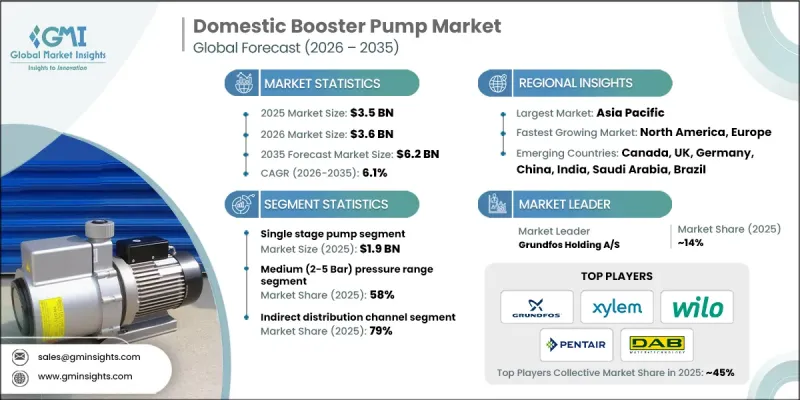
세계 도시화의 진전과 도시 지역의 인구 밀도 증가는 가정용 부스터 펌프에 대한 수요를 주도하고 있습니다. 다층 주택, 게이트형 커뮤니티, 고층 아파트의 확장은 지자체 상수도 시스템에 부하를 주어 안정적인 물 공급을 어렵게 하고 있습니다. 현대의 주택은 여러 명의 거주자를 수용할 수 있도록 설계되어 있고, 여러 개의 욕실과 물을 많이 소비하는 가전제품을 갖추고 있기 때문에 모든 설비에서 일정한 수압이 요구됩니다. 주택 소유자는 현재 샤워, 수도꼭지, 세탁기, 식기세척기를 동시에 사용할 때 중압 급수를 기대하고 있으며, 이로 인해 가정용 부스터 펌프는 선택적 업그레이드에서 필수 시스템으로 전환되고 있습니다. 이러한 추세는 쾌적성, 신뢰성, 에너지 효율을 보장하기 위한 신축 주택 및 도시형 주택단지 건설 증가와 물 절약 기술 채택으로 더욱 강화되고 있습니다.
| 시장 범위 | |
|---|---|
| 시작 연도 | 2025년 |
| 예측 연도 | 2026-2035년 |
| 개시 금액 | 35억 달러 |
| 예측 금액 | 62억 달러 |
| CAGR | 6.1% |
단단 펌프 부문은 2025년 19억 달러의 시장 규모를 기록했으며, 2035년까지 CAGR 6%로 성장할 것으로 예상됩니다. 단단 부스터 펌프는 비용 효율적이고 설치가 용이하며, 저압에서 중압의 주거용 애플리케이션에 적합합니다. 단일 임펠러로 필요한 양정과 유량을 효율적으로 충족시키기 때문에 단독주택, 저층건물, 별장, 소규모 공동주택 등에서 널리 채택되고 있습니다.
중압 범위(2-5Bar)는 2025년 58%의 점유율을 차지했으며, 2035년까지 CAGR 6%로 성장할 것으로 예상됩니다. 이 시스템은 여러 개의 욕실을 가진 주택, 저층-중층 아파트, 주택 단지에서 여러 개의 급수구를 통해 안정적인 수류를 공급하면서 과도한 에너지 사용을 피하는 효율적인 서비스를 제공합니다. 2-5Bar의 범위는 현대 배관 표준에 부합하고, 배관의 부담을 줄이고, 누수를 최소화하며, 유지보수 비용을 절감할 수 있어 도시 주거 환경에서 이상적인 선택이 될 수 있습니다.
미국 가정용 부스터 펌프 시장은 2025년 8억 달러 규모에 달했으며, 2035년까지 연평균 5.9%의 성장률을 기록할 것으로 전망됩니다. 수요는 안정적인 수압을 필요로 하는 다층 주택, 고층 아파트, 대규모 단독주택에 의해 주도되고 있습니다. 노후화된 도시 인프라와 장거리 송수에 대한 과제는 부스터 펌프에 대한 의존도를 더욱 높이고 있습니다. 신규 주택 프로젝트, 스마트 빌딩 개발 및 리노베이션 프로젝트에서는 지속가능성과 비용 효율성이라는 목표에 따라 가변 속도 구동 장치(VFD)가 장착된 에너지 절약형 펌프를 채택하는 경향이 있습니다.
자주 묻는 질문
목차
제1장 조사 방법과 범위
제2장 주요 요약
제3장 업계 인사이트
제4장 경쟁 구도
제5장 시장 추정 및 예측 : 제품 유형별, 2022-2035년
제6장 시장 추정 및 예측 : 정격 출력별, 2022-2035년
제7장 시장 추정 및 예측 : 압력 범위별, 2022-2035년
제8장 시장 추정 및 예측 : 최종 용도별, 2022-2035년
제9장 시장 추정 및 예측 : 유통 채널별, 2022-2035년
제10장 시장 추정 및 예측 : 지역별, 2022-2035년
제11장 기업 개요
KSM 26.03.12The Global Domestic Booster Pump Market was valued at USD 3.5 billion in 2025 and is estimated to grow at a CAGR of 6.1% to reach USD 6.2 billion by 2035.
Increasing urbanization and rising population densities in cities worldwide are driving demand for domestic booster pumps. Expanding multi-story residential buildings, gated communities, and high-rise apartments are placing pressure on municipal water systems, making a consistent water supply a challenge. Modern homes are designed to accommodate multiple occupants with several bathrooms and water-intensive appliances, requiring constant water pressure across all fixtures. Homeowners now expect medium-pressure water delivery for showers, faucets, washing machines, and dishwashers simultaneously, shifting domestic booster pumps from optional upgrades to essential systems. This trend is further reinforced by the growing construction of new homes, urban residential complexes, and the adoption of water-efficient technologies to ensure comfort, reliability, and energy efficiency.
| Market Scope | |
|---|---|
| Start Year | 2025 |
| Forecast Year | 2026-2035 |
| Start Value | $3.5 Billion |
| Forecast Value | $6.2 Billion |
| CAGR | 6.1% |
The single-stage pump segment generated USD 1.9 billion in 2025 and is expected to grow at a CAGR of 6% through 2035. Single-stage booster pumps are cost-effective, easy to install, and well-suited for low- to medium-pressure residential applications. They are widely used in single-family homes, low-rise buildings, villas, and smaller apartment complexes where a single impeller meets the required head and flow efficiently.
The medium-pressure range (2-5 Bar) accounted for 58% share in 2025 and is forecasted to grow at a CAGR of 6% through 2035. These systems efficiently serve multi-bathroom homes, low- to mid-rise apartments, and residential complexes, providing consistent water flow across multiple outlets while avoiding excessive energy use. The 2-5 Bar range aligns with modern plumbing codes, prevents pipe stress, minimizes leakage, and reduces maintenance costs, making it ideal for urban residential setups.
U.S. Domestic Booster Pump Market reached USD 0.8 billion in 2025 and is projected to grow at a CAGR of 5.9% through 2035. The demand is driven by multi-story residential buildings, high-rise apartments, and large single-family homes that require stable water pressure. Aging municipal infrastructure and long-distance water transmission challenges are further increasing reliance on booster pumps. New housing projects, smart building developments, and retrofitting initiatives favor energy-efficient pumps with variable frequency drives (VFDs), aligning with sustainability and cost-efficiency goals.
Key players operating in the Global Domestic Booster Pump Market include Grundfos Holding A/S, Franklin Electric Co., Inc., Kirloskar Brothers Limited, Danfoss A/S, Pedrollo S.p.A., Xylem Inc., DAB Pumps S.p.A., and C.R.I. Pumps Private Limited, KSB SE & Co. KGaA, Wilo SE, Ebara Corporation, Pentair plc, Shimge Pump Industry Group Co., Ltd., Zhejiang Dayuan Pumps Industrial Co., Ltd., and Davey Water Products Pty Ltd. Companies in the domestic booster pump market are strengthening their foothold by investing in advanced energy-efficient and VFD-integrated pumps, targeting residential, commercial, and high-rise segments. Strategic partnerships with real estate developers and municipal authorities help expand distribution channels and gain large-scale project contracts. Firms are focusing on R&D to improve pump reliability, reduce noise, and enhance smart control systems for IoT-enabled monitoring. Product portfolio diversification, geographic expansion into urbanizing regions, and after-sales service enhancement allow companies to capture new customers and retain loyalty. Marketing initiatives emphasizing energy savings, sustainability, and compliance with water regulations are boosting market presence and brand reputation.
Table of Contents
Chapter 1 Methodology & Scope
- 1.1 Market scope and definition
- 1.2 Research design
- 1.2.1 Research approach
- 1.2.2 Data collection methods
- 1.3 Data mining sources
- 1.3.1 Global
- 1.3.2 Regional/Country
- 1.4 Base estimates and calculations
- 1.4.1 Base year calculation
- 1.4.2 Key trends for market estimation
- 1.5 Primary research and validation
- 1.5.1 Primary sources
- 1.6 Forecast model
- 1.7 Research assumptions and limitations
Chapter 2 Executive Summary
- 2.1 Industry 360° synopsis
- 2.2 Key market trends
- 2.2.1 Regional
- 2.2.2 Product type
- 2.2.3 Rated power
- 2.2.4 Pressure range
- 2.2.5 End use
- 2.2.6 Distribution channel
- 2.3 CXO perspectives: Strategic imperatives
- 2.3.1 Key decision points for industry executives
- 2.3.2 Critical success factors for market players
- 2.4 Future outlook and strategic recommendations
Chapter 3 Industry Insights
- 3.1 Industry ecosystem analysis
- 3.1.1 Supplier landscape
- 3.1.2 Profit margin
- 3.1.3 Value addition at each stage
- 3.1.4 Factor affecting the value chain
- 3.2 Industry impact forces
- 3.2.1 Growth drivers
- 3.2.1.1 Rapid urbanization and residential construction
- 3.2.1.2 Inadequate municipal water pressure and aging water supply infrastructure
- 3.2.1.3 Growth in multi-bathroom and modern housing designs
- 3.2.1.4 Expansion of smart homes and building automation
- 3.2.2 Industry pitfalls & challenges
- 3.2.2.1 High initial installation and replacement costs
- 3.2.2.2 Maintenance requirements and after-sales dependence
- 3.2.1 Growth drivers
- 3.3 Growth potential analysis
- 3.4 Future market trends
- 3.5 Technology and innovation landscape
- 3.5.1 Current technological trends
- 3.5.2 Emerging technologies
- 3.6 Price trends
- 3.6.1 By region
- 3.6.2 By product type
- 3.7 Regulatory landscape
- 3.7.1 Standards and compliance requirements
- 3.7.2 Regional regulatory frameworks
- 3.7.3 Certification standards
- 3.8 Trade statistics
- 3.8.1 Major importing countries
- 3.8.2 Major exporting countries
- 3.9 Porter's analysis
- 3.10 PESTEL analysis
Chapter 4 Competitive Landscape, 2025
- 4.1 Introduction
- 4.2 Company market share analysis
- 4.2.1 By Region
- 4.2.1.1 North America
- 4.2.1.2 Europe
- 4.2.1.3 Asia Pacific
- 4.2.1.4 Latin America
- 4.2.1.5 Middle East & Africa
- 4.2.1 By Region
- 4.3 Company matrix analysis
- 4.4 Competitive analysis of major market players
- 4.5 Competitive positioning matrix
- 4.6 Key developments
- 4.6.1 Mergers & acquisitions
- 4.6.2 Partnerships & collaborations
- 4.6.3 New product launches
- 4.6.4 Expansion plans
Chapter 5 Market Estimates & Forecast, By Product Type, 2022 - 2035, (USD Billion) (Million Units)
- 5.1 Key trends
- 5.2 Single stage pump
- 5.3 Multiple stage pump
Chapter 6 Market Estimates & Forecast, By Rated Power, 2022 - 2035, (USD Billion) (Million Units)
- 6.1 Key trends
- 6.2 10 - 50 W
- 6.3 50 - 150 W
- 6.4 150 - 300 W
- 6.5 Above 300 W
Chapter 7 Market Estimates & Forecast, By Pressure Range, 2022 - 2035, (USD Billion) (Million Units)
- 7.1 Key trends
- 7.2 Low (Up to 2 Bar)
- 7.3 Medium (2-5 Bar)
- 7.4 High (Above 5 Bar)
Chapter 8 Market Estimates & Forecast, By End Use, 2022 - 2035, (USD Billion) (Million Units)
- 8.1 Key trends
- 8.2 Residential
- 8.3 Commercial
- 8.3.1 Healthcare
- 8.3.2 HoReCa
- 8.3.3 Service centers
- 8.3.4 Mega retail space
- 8.3.5 others
- 8.4 Industrial
- 8.5 Others (Government, Etc.)
Chapter 9 Market Estimates & Forecast, By Distribution Channel, 2022 - 2035, (USD Billion) (Million Units)
- 9.1 Key trends
- 9.2 Direct sales
- 9.3 Indirect sales
Chapter 10 Market Estimates & Forecast, By Region, 2022 - 2035, (USD Billion) (Million Units)
- 10.1 Key trends
- 10.2 North America
- 10.2.1 U.S.
- 10.2.2 Canada
- 10.3 Europe
- 10.3.1 Germany
- 10.3.2 UK
- 10.3.3 France
- 10.3.4 Italy
- 10.3.5 Spain
- 10.4 Asia Pacific
- 10.4.1 China
- 10.4.2 India
- 10.4.3 Japan
- 10.4.4 South Korea
- 10.4.5 Australia
- 10.4.6 Indonesia
- 10.4.7 Malaysia
- 10.5 Latin America
- 10.5.1 Brazil
- 10.5.2 Mexico
- 10.5.3 Argentina
- 10.6 MEA
- 10.6.1 Saudi Arabia
- 10.6.2 UAE
- 10.6.3 South Africa
Chapter 11 Company Profiles
- 11.1 C.R.I. Pumps Private Limited
- 11.2 DAB Pumps S.p.A.
- 11.3 Danfoss A/S
- 11.4 Davey Water Products Pty Ltd.
- 11.5 Ebara Corporation
- 11.6 Franklin Electric Co., Inc.
- 11.7 Grundfos Holding A/S
- 11.8 Kirloskar Brothers Limited
- 11.9 KSB SE & Co. KGaA
- 11.10 Pedrollo S.p.A.
- 11.11 Pentair plc
- 11.12 Shimge Pump Industry Group Co., Ltd.
- 11.13 Wilo SE
- 11.14 Xylem Inc.
- 11.15 Zhejiang Dayuan Pumps Industrial Co., Ltd.