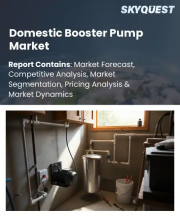
|
시장보고서
상품코드
2066000
가정용 부스터 펌프 시장 : 펌프 유형, 재료, 동력원, 정격 출력, 용도별 예측(2026-2032년)Domestic Booster Pump Market by Pump Type, Material, Power Source, Power Rating, Application - Global Forecast 2026-2032 |
||||||
 360iResearch
가정용 부스터 펌프 시장은 2032년까지 연평균 복합 성장률(CAGR) 8.85%로 74억 9,000만 달러 규모로 확대될 것으로 예측됩니다.
| 주요 시장 통계 | |
|---|---|
| 기준 연도 : 2025년 | 41억 3,000만 달러 |
| 추정 연도 : 2026년 | 44억 7,000만 달러 |
| 예측 연도 : 2032년 | 74억 9,000만 달러 |
| CAGR(%) | 8.85% |
가정용 부스터 펌프 시장 개요
가정용 부스터 펌프는 단독주택, 아파트, 별장, 개인 우물, 옥상 저수조, 빗물 이용 시스템 및 저압 공공 상수도 연결 시 수압을 높이고 안정시키는 역할을 합니다. 이 분야는 기본적인 가압 장치에서 펌프, 압력 센서, 컨트롤러, 팽창 탱크, 보호 기능을 통합한, 콤팩트하고 소음이 적으며 내식성이 뛰어나고 에너지 효율이 우수한 주택용 수압 시스템으로 점차 전환되고 있습니다.
가정용 수압을 재구축하는 혁신적인 변화
도시 지역의 고밀도화, 노후화된 상수도망, 간헐적인 상수도 공급, 그리고 절수형 주택의 보급으로 인해 가정용 부스터 펌프 시장 환경이 재편되고 있습니다. 아파트나 교외 주택에서는 과도한 소음, 잦은 가동 및 정지, 또는 과도한 에너지 소비 없이 변동하는 수요에 대응할 수 있는 증압 시스템에 대한 수요가 증가하고 있습니다.
스마트 가정용 부스터 펌프에 대한 AI의 누적 영향
인공지능(AI)은 가정용 부스터 펌프 시스템에 새로운 지능 계층을 더하고 있습니다. 센서가 장착된 펌프는 수압, 유량, 온도, 진동, 모터 전류, 가동 시간 등의 데이터를 수집할 수 있습니다. AI 모델은 이러한 데이터를 바탕으로 가정 내 소비 패턴을 파악하고, 수요 피크를 예측하여 기존 제어 시스템보다 더 정밀하게 펌프의 회전수를 조절할 수 있습니다.
아시아태평양, 북미, 라틴아메리카, 유럽, 중동 및 아프리카의 지역별 동향
아시아태평양은 도시 지역의 아파트 증가, 고층 빌딩 건설, 개인용 저수 탱크의 보급, 그리고 급성장하는 도시에서 나타나는 수압의 불균형으로 인해 가정용 부스터 펌프의 주요 수요 거점이 되고 있습니다. 유엔의 도시화 데이터와 해당 지역 각국의 주택 정책은 주택 인프라에 대한 지속적인 수요를 보여주고 있으며, 중국과 인도는 여전히 막대한 수요의 중심을 이루고 있습니다. 일본, 호주, 한국에서는 컴팩트한 설계, 저소음 운전, 에너지 효율, 식수 안전성, 그리고 디지털 제어를 통한 가정용 가압 시스템이 더욱 중요시되고 있습니다.
아세안(ASEAN), GCC, EU, 브릭스(BRICS), G7, 나토(NATO)에 대한 그룹 분석
아세안 지역 수요는 도시화, 아파트 건설, 빗물 저류, 그리고 인구 밀도가 높은 도시의 수압 불안정성에 의해 뒷받침되고 있으며, 소형 자동 증압 펌프는 아파트, 단독주택, 소규모 주택단지에서 중요한 역할을 하고 있습니다. GCC 시장은 고급 주택, 별장, 고층 빌딩 개발이 주도하고 있으며, 이러한 시설들은 탈염수 및 중앙 급수에 대해 신뢰성 높은 가압 시스템을 필요로 합니다. 또한, 고온 기후에서는 내식성, 내열성, 그리고 신뢰할 수 있는 사후 서비스가 특히 중요하게 여겨집니다. 유럽연합(EU)에서는 에너지 효율, 제품 안전성, 물과 접촉하는 재료의 적합성, 그리고 주거용 저소음 운전이 중시되고 있으며, 스마트 가변 속도 가정용 가압 펌프 시스템은 리모델링이나 에너지 효율을 중시하는 신축 주택에 특히 적합합니다.
주요 가정용 부스터 펌프 시장에 대한 국가별 분석
미국과 캐나다에서는 수요가 개인 우물, 교외 주택, 수압 관리, 노후된 배관, 관개 지원, 그리고 에너지 절약을 중시하는 설비 교체와 밀접한 관련이 있습니다. 미국 환경보호청(EPA)의 주거용 물 사용량 기준과 북미에서 사설 우물이 광범위하게 이용되고 있는 점은 신뢰할 수 있는 가정용 수압 시스템의 중요성을 여실히 보여주고 있습니다. 멕시코와 브라질에서는 도시 및 도시 주변 지역의 주택에서 옥상 탱크, 저수 시스템, 그리고 지자체에 의한 수압 불안정 현상이 흔히 발생하기 때문에 가정용 수압 증압에 대한 수요가 높습니다. 따라서 내구성이 뛰어난 자동 수압 펌프나 탱크 일체형 시스템이 매우 중요해지고 있습니다.
가정용 부스터 펌프 업계의 선두주자를 위한 실천적 제안
업계 선도 기업들은 가변 속도식 가정용 부스터 펌프, 통합형 수압 컨트롤러, 공회전 방지 기능, 과열 방지 기능, 사이클링 방지 로직, 그리고 저소음 운전을 우선시해야 합니다. 이러한 기능들은 수압 불안정, 에너지 소비, 소음, 펌프 고장 등 주택 소유자가 겪는 주요 문제를 해결하기 위한 것입니다. 제품 포트폴리오는 아파트, 단독주택, 개인 우물, 옥상 탱크, 빗물 활용, 관개 지원, 소형 개조 설치 등 용도별로 분류해야 합니다.
조사 방법 및 데이터 검증
본 조사의 조사 기법은 2차 정보를 통한 검증, 전문가의 해석, 그리고 구조화된 삼각측량법을 결합한 것입니다. 데이터에 기반한 정보 출처로는 유엔 및 세계은행의 도시화 지표, 미국 환경보호청(EPA) 등 기관이 제시한 주거용 물 사용량 벤치마크, 국제에너지기구(IEA) 및 각국 에너지 부처가 제공하는 에너지 효율 현황, 그리고 각 지역의 건축, 배관 및 제품 적합성 관련 기준 등이 포함됩니다.
결론: 성장의 기반이 되는 신뢰할 수 있는 주택용 수압
가정용 부스터 펌프 시장은 단순한 배관용 부속품에서 주택용 수압을 확보하기 위한 중요한 솔루션으로 진화하고 있습니다. 도시화, 고층 주택의 보급, 인프라 노후화, 가정용 물 저장, 간헐적인 수돗물 수압, 그리고 안정적인 물 흐름에 대한 소비자의 기대 등으로 인해, 선진국과 신흥국을 막론하고 가정용 부스터 펌프의 중요성이 커지고 있습니다.
자주 묻는 질문
목차
제1장 서문
제2장 조사 방법
제3장 주요 요약
제4장 시장 개요
제5장 시장 인사이트
제6장 AI의 누적 영향, 2026년
제7장 가정용 부스터 펌프 시장 : 펌프 유형별
제8장 가정용 부스터 펌프 시장 : 재료별
제9장 가정용 부스터 펌프 시장 : 동력원별
제10장 가정용 부스터 펌프 시장 : 정격 출력별
제11장 가정용 부스터 펌프 시장 : 용도별
제12장 가정용 부스터 펌프 시장 : 지역별
제13장 가정용 부스터 펌프 시장 : 그룹별
제14장 가정용 부스터 펌프 시장 : 국가별
제15장 경쟁 구도
제16장 기업 개요
JHS 26.06.29The Domestic Booster Pump Market is projected to grow by USD 7.49 billion at a CAGR of 8.85% by 2032.
| KEY MARKET STATISTICS | |
|---|---|
| Base Year [2025] | USD 4.13 billion |
| Estimated Year [2026] | USD 4.47 billion |
| Forecast Year [2032] | USD 7.49 billion |
| CAGR (%) | 8.85% |
Domestic Booster Pump Market Overview
Domestic booster pumps increase and stabilize water pressure for homes, apartments, villas, private wells, roof tanks, rainwater harvesting systems, and low-pressure municipal connections. The category is moving from basic pressure-boosting equipment toward compact, quiet, corrosion-resistant, and energy-efficient residential water pressure systems that integrate pumps, pressure sensors, controllers, expansion tanks, and protection features.
Demand is supported by measurable structural trends. The United Nations reports that the global urban population is expected to rise from about 56% of the world population in 2021 to 68% by 2050, increasing pressure on residential water infrastructure and high-rise housing. In the United States, the EPA WaterSense program notes that the average family uses more than 300 gallons of water per day at home, underscoring the need for reliable pressure across showers, appliances, irrigation, and fixtures. As households expect constant water pressure, quieter operation, and lower utility costs, domestic booster pumps are becoming an essential part of modern residential plumbing.
Transformative Shifts Reshaping Home Water Pressure
The domestic booster pump landscape is being reshaped by urban densification, aging water networks, intermittent municipal supply, and the adoption of water-efficient homes. Multifamily buildings and suburban residences increasingly require pressure-boosting systems that can manage variable demand without excessive noise, cycling, or energy consumption.
The most important technology shift is the transition from fixed-speed pumps to variable-speed booster pumps with intelligent controllers. Variable frequency drives align motor speed with actual water demand, improving comfort and reducing unnecessary power use. Materials are also changing, with stainless steel, engineered polymers, and corrosion-resistant components gaining preference for potable-water applications. At the same time, installers and homeowners are demanding easier commissioning, dry-run protection, thermal protection, compact footprints, and digital serviceability.
Regulation and sustainability are reinforcing these shifts. Building energy policies, plumbing standards, and consumer awareness are increasing the value of efficient pumps that maintain recommended household pressure ranges while helping avoid over-pressurization, leakage, water hammer, and premature equipment wear.
Cumulative Impact of AI on Smart Domestic Booster Pumps
Artificial intelligence is adding a new layer of intelligence to domestic booster pump systems. Sensor-enabled pumps can capture pressure, flow, temperature, vibration, motor current, and run-time data; AI models can then identify household consumption patterns, predict demand peaks, and adjust pump speed more precisely than conventional controls.
The impact is cumulative because AI improves performance across the pump life cycle. During operation, it can reduce short cycling, detect leaks, identify dry-run conditions, flag cavitation risk, and recommend maintenance before failure. For centrifugal pumps, affinity laws show that lower speed can significantly reduce power draw under suitable variable-flow conditions, making AI-assisted variable-speed control a practical path to energy optimization.
AI also supports manufacturers, distributors, and service providers through remote diagnostics, warranty analytics, product design feedback, and inventory planning. Industry leaders will need to pair these benefits with secure connectivity, transparent data governance, cyber-resilient firmware updates, and installer-friendly interfaces.
Regional Insights Across Asia-Pacific, North America, Latin America, Europe, Middle East & Africa
Asia-Pacific represents a major demand center for domestic booster pumps because of urban apartment growth, high-rise construction, private water storage, and uneven municipal pressure across fast-growing cities. United Nations urbanization data and national housing programs across the region point to sustained residential infrastructure needs, while China and India remain central to large-volume demand. Japan, Australia, and South Korea place greater emphasis on compact design, low-noise operation, energy efficiency, potable-water safety, and digitally controlled domestic pressure boosting systems.
North America is shaped by replacement demand, private wells, pressure regulation, irrigation, and aging water infrastructure. Public infrastructure assessments in the region continue to highlight water network renewal needs, while household reliance on well systems in rural and suburban areas supports demand for residential pressure booster pumps. Latin America shows strong relevance where households rely on storage tanks and pressure recovery because municipal supply can be intermittent. Brazil and Mexico are especially important due to large urban populations, vertical housing, and expanding residential construction in metropolitan and peri-urban areas.
Europe is driven by energy efficiency, compact housing, renovation, and regulatory attention to building performance, with demand favoring low-noise variable-speed booster pumps that fit modern residential retrofit requirements. The Middle East shows demand from villas, high-rise towers, desalinated-water distribution, and premium residential developments, particularly in water-scarce environments where stable indoor pressure is a key comfort requirement. Africa is an emerging long-term opportunity as urbanization, household water storage, borehole use, and the need for reliable residential pressure continue to expand across major cities and secondary urban centers.
Group Insights Across ASEAN, GCC, EU, BRICS, G7 & NATO
ASEAN demand is supported by urbanization, condominium construction, rainwater storage, and pressure inconsistencies in dense cities, making compact automatic booster pumps relevant for apartments, landed homes, and small residential complexes. The GCC market is led by premium housing, villas, and high-rise developments that require reliable boosting for desalinated and centrally supplied water, with corrosion resistance, thermal durability, and dependable aftersales service carrying particular importance in hot climates. The European Union emphasizes energy efficiency, product safety, water-contact material compliance, and low-noise residential operation, making smart variable-speed domestic booster pump systems especially relevant for renovations and new energy-conscious housing.
BRICS countries combine large populations, infrastructure gaps, high-density housing, and rapid residential expansion, creating broad demand for affordable, durable, and serviceable domestic booster pumps suited to varied municipal supply conditions. G7 markets are more replacement- and efficiency-led, with customers prioritizing reliability, certified potable-water components, connected maintenance, and low total cost of ownership. NATO countries overlap heavily with North American and European markets, where resilience, building modernization, cybersecurity for connected devices, and secure supply chains increasingly influence procurement decisions for smart residential pumping systems.
Country Insights for Major Domestic Booster Pump Markets
In the United States and Canada, demand is tied to private wells, suburban homes, pressure management, aging plumbing, irrigation support, and energy-conscious replacement. U.S. EPA residential water-use benchmarks and the widespread use of private wells in North America underscore the importance of reliable domestic water pressure systems. Mexico and Brazil show strong need for household pressure boosting where rooftop tanks, storage systems, and uneven municipal pressure are common in urban and peri-urban housing, making durable automatic pressure pumps and tank-integrated systems highly relevant.
The United Kingdom, Germany, France, Italy, and Spain are mature markets where renovation, compact pump design, quiet operation, efficiency, and product compliance are key purchase drivers. Energy performance requirements and higher consumer sensitivity to household noise support adoption of variable-speed and integrated domestic booster pump solutions. Russia presents demand from multifamily housing, cold-climate plumbing requirements, private homes, and replacement of residential water systems, although supply conditions can be affected by trade, logistics, and financing constraints.
China and India remain large-volume markets due to urbanization, apartment construction, household water storage, and variable municipal supply pressure across dense cities. Japan and South Korea favor premium, compact, low-noise systems with strong reliability expectations, reflecting high urban density, advanced residential building standards, and strong preference for low-maintenance equipment. Australia combines residential pressure boosting with rainwater harvesting, garden irrigation, water-efficiency priorities, and detached housing needs, making domestic booster pumps important for both mains-pressure improvement and stored-water applications.
Actionable Recommendations for Domestic Booster Pump Leaders
Industry leaders should prioritize variable-speed domestic booster pumps, integrated pressure controllers, dry-run protection, thermal protection, anti-cycling logic, and quiet operation because these features address the main homeowner pain points of inconsistent pressure, energy use, noise, and pump failure. Product portfolios should be segmented by application, including apartments, villas, private wells, rooftop tanks, rainwater harvesting, irrigation support, and compact retrofit installations.
Manufacturers should invest in installer training, simplified sizing tools, mobile commissioning, and clear total-cost-of-ownership messaging. Channel partners can improve conversion by pairing pumps with certified accessories, expansion tanks, filtration, pressure gauges, non-return valves, and service packages. For connected booster pumps, leaders should build secure firmware update processes, remote diagnostics, privacy-by-design data practices, and practical homeowner alerts while keeping user interfaces simple.
Competitive advantage will come from combining energy efficiency, reliability, serviceability, potable-water compliance, and regional application fit rather than competing only on pump price.
Research Methodology and Data Validation
The research methodology combines secondary-source validation, expert interpretation, and structured triangulation. Data-backed inputs include urbanization indicators from the United Nations and World Bank, residential water-use benchmarks from agencies such as the U.S. EPA, energy-efficiency context from the International Energy Agency and public energy departments, and regional building, plumbing, and product-compliance references.
Market conclusions are developed by mapping demand drivers across housing type, water-source reliability, pressure requirements, energy regulation, construction activity, replacement cycles, and technology adoption. Product-level assessment considers pump type, motor configuration, controller integration, materials, potable-water suitability, noise performance, installation complexity, distribution channels, and aftersales service.
Insights are validated through cross-comparison of public datasets, technical standards, manufacturer specifications, distributor behavior, regulatory trends, and application-specific use cases to avoid reliance on a single source or unverified market claims. The approach excludes unsupported sizing claims and focuses on verified drivers, technology shifts, regional demand conditions, and practical adoption barriers.
Conclusion: Reliable Residential Water Pressure as a Growth Platform
The domestic booster pump market is evolving from a simple plumbing accessory into a critical residential water-pressure solution. Urbanization, high-rise living, aging infrastructure, private water storage, intermittent municipal pressure, and consumer expectations for steady water flow are expanding the relevance of domestic booster pumps across developed and emerging economies.
The strongest opportunities sit at the intersection of energy efficiency, smart control, reliability, quiet operation, and easy installation. AI-enabled diagnostics, variable-speed operation, and connected service models will further differentiate premium offerings, while cost-effective durable systems will remain essential in high-volume emerging markets. Organizations that align products with regional water realities, installer needs, regulatory requirements, and household comfort expectations will be best positioned to lead the next phase of domestic booster pump adoption.
Table of Contents
1. Preface
- 1.1. Objectives of the Study
- 1.2. Market Definition
- 1.3. Market Segmentation & Coverage
- 1.4. Years Considered for the Study
- 1.5. Currency Considered for the Study
- 1.6. Language Considered for the Study
- 1.7. Key Stakeholders
2. Research Methodology
- 2.1. Introduction
- 2.2. Research Design
- 2.2.1. Primary Research
- 2.2.2. Secondary Research
- 2.3. Research Framework
- 2.3.1. Qualitative Analysis
- 2.3.2. Quantitative Analysis
- 2.4. Market Size Estimation
- 2.4.1. Top-Down Approach
- 2.4.2. Bottom-Up Approach
- 2.5. Data Triangulation
- 2.6. Research Outcomes
- 2.7. Research Assumptions
- 2.8. Research Limitations
3. Executive Summary
- 3.1. Introduction
- 3.2. CXO Perspective
- 3.3. Market Size & Growth Trends
- 3.4. Market Share Analysis, 2025
- 3.5. FPNV Positioning Matrix, 2025
- 3.6. New Revenue Opportunities
- 3.7. Next-Generation Business Models
- 3.8. Industry Roadmap
4. Market Overview
- 4.1. Introduction
- 4.2. Industry Ecosystem & Value Chain Analysis
- 4.2.1. Supply-Side Analysis
- 4.2.2. Demand-Side Analysis
- 4.2.3. Stakeholder Analysis
- 4.3. Market Dynamics
- 4.3.1. Key Drivers
- 4.3.2. Key Restraints
- 4.3.3. Key Opportunities
- 4.3.4. Key Challenges
- 4.4. Porter's Five Forces Analysis
- 4.5. PESTLE Analysis
- 4.6. Market Outlook
- 4.6.1. Near-Term Market Outlook (0-2 Years)
- 4.6.2. Medium-Term Market Outlook (3-5 Years)
- 4.6.3. Long-Term Market Outlook (5-10 Years)
- 4.7. Go-to-Market Strategy
5. Market Insights
- 5.1. Consumer Insights & End-User Perspective
- 5.2. Consumer Experience Benchmarking
- 5.3. Opportunity Mapping
- 5.4. Distribution Channel Analysis
- 5.5. Pricing Trend Analysis
- 5.6. Regulatory Compliance & Standards Framework
- 5.7. ESG & Sustainability Analysis
- 5.8. Disruption & Risk Scenarios
- 5.9. Return on Investment & Cost-Benefit Analysis
6. Cumulative Impact of Artificial Intelligence 2026
7. Domestic Booster Pump Market, by Pump Type
- 7.1. End Suction Pumps
- 7.2. In Line Pumps
- 7.3. Multistage Pumps
- 7.3.1. Single Stage
- 7.3.2. Three Stage And Above
- 7.3.3. Two Stage
8. Domestic Booster Pump Market, by Material
- 8.1. Bronze
- 8.2. Cast Iron
- 8.3. Stainless Steel
9. Domestic Booster Pump Market, by Power Source
- 9.1. Electric
- 9.2. Hydraulic
- 9.3. Gasoline / Fuel-Powered
- 9.4. Solar-Powered
10. Domestic Booster Pump Market, by Power Rating
- 10.1. 0.5 To 2 kW
- 10.2. Above 2 kW
- 10.3. Up To 0.5 kW
11. Domestic Booster Pump Market, by Application
- 11.1. Agricultural
- 11.1.1. Greenhouse
- 11.1.2. Irrigation
- 11.1.3. Livestock
- 11.2. Commercial
- 11.2.1. Hotels And Restaurants
- 11.2.2. Office Buildings
- 11.2.3. Retail Stores
- 11.3. Industrial
- 11.3.1. Chemical And Petrochemical
- 11.3.2. Manufacturing
- 11.3.3. Power Generation
- 11.4. Residential
- 11.4.1. Multi Family
- 11.4.2. Single Family
12. Domestic Booster Pump Market, by Region
- 12.1. Asia-Pacific
- 12.2. North America
- 12.3. Latin America
- 12.4. Europe
- 12.5. Middle East
- 12.6. Africa
13. Domestic Booster Pump Market, by Group
- 13.1. ASEAN
- 13.2. GCC
- 13.3. European Union
- 13.4. BRICS
- 13.5. G7
- 13.6. NATO
14. Domestic Booster Pump Market, by Country
- 14.1. United States
- 14.2. Canada
- 14.3. Mexico
- 14.4. Brazil
- 14.5. United Kingdom
- 14.6. Germany
- 14.7. France
- 14.8. Russia
- 14.9. Italy
- 14.10. Spain
- 14.11. China
- 14.12. India
- 14.13. Japan
- 14.14. Australia
- 14.15. South Korea
15. Competitive Landscape
- 15.1. Market Concentration Analysis, 2025
- 15.1.1. Concentration Ratio (CR)
- 15.1.2. Herfindahl Hirschman Index (HHI)
- 15.2. Recent Developments & Impact Analysis, 2025
- 15.3. Product Portfolio Analysis, 2025
- 15.4. Benchmarking Analysis, 2025
16. Company Profiles
- 16.1. A.Y. McDonald Manufacturing Company
- 16.2. Alfred Karcher SE & Co. KG
- 16.3. C.R.I. Pumps Private Limited
- 16.4. Crompton Greaves Consumer Electricals Limited
- 16.5. DAB Pumps S.p.A.
- 16.6. Davey Water Products Pty Ltd
- 16.7. Ebara Corporation
- 16.8. Franklin Electric Co., Inc.
- 16.9. Grundfos Holding A/S
- 16.10. Havells India Limited
- 16.11. Kirloskar Brothers Limited
- 16.12. KSB SE & Co. KGaA
- 16.13. Lubi Industries LLP
- 16.14. Oswal Pumps Limited
- 16.15. Pedrollo S.p.A.
- 16.16. Pentair plc
- 16.17. Shakti Pumps Limited
- 16.18. Torishima Pump Mfg. Co., Ltd.
- 16.19. Tsurumi Manufacturing Co., Ltd.
- 16.20. V-Guard Industries Ltd.
- 16.21. Wilo SE
- 16.22. Xylem Inc.
- 16.23. Zhejiang Dayuan Pumps Industrial Co., Ltd.
- 16.24. Zoeller Pump Company