

|
시장보고서
상품코드
1936608
해저 라이저 시장 기회, 성장 촉진요인, 업계 동향 분석 및 예측(2026-2035년)Subsea Risers Market Opportunity, Growth Drivers, Industry Trend Analysis, and Forecast 2026 - 2035 |
||||||

세계의 해저 라이저 시장은 2025년에 8억 4,540만 달러로 평가되었으며, 2035년까지 CAGR 8.7%로 성장하여 19억 달러에 달할 것으로 예측됩니다.
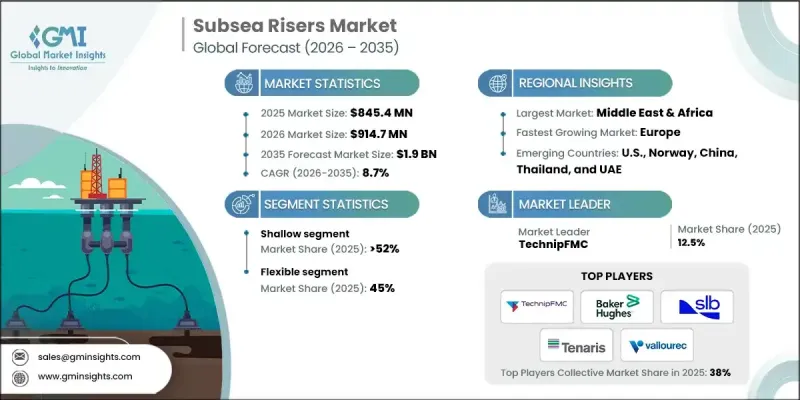
시장 확대는 해양 및 심해 에너지 개발에 대한 자본 배분 증가와 더불어 다양한 해저 지질 환경에서 탄화수소 추출에 따른 운영 및 기술적 복잡성에 대응하기 위한 전환이 이루어지고 있는 것에 힘입은 것입니다. 심해 및 초심해 매장량 개발에 대한 관심이 높아지면서 육상 및 얕은 바다에서의 생산량 감소를 보완하기 위해 기술적으로 고도의 자본 집약적인 프로젝트를 추구하는 사업자들이 해양 개발 전략을 재구성하고 있습니다. 부유식 생산 설비의 도입 증가와 해저 저류층에서 지상 시설로의 탄화수소 수송에 있어 신뢰할 수 있는 유량 보장 솔루션에 대한 수요 증가가 수요를 강화하고 있습니다. 또한, 전 세계 에너지 소비 증가, 쉽게 접근할 수 있는 매장량 감소, 고장률과 유지보수 빈도를 줄이는 첨단 재료 및 구조 설계를 촉진하는 정책 이니셔티브가 시장의 방향성에 영향을 미치고 있습니다. 제조업체들은 안전과 성능 기준을 유지하면서 해저 생산 시스템의 설계 및 제조 공정을 개선하여 비용 최적화에 점점 더 우선순위를 두고 있습니다. 재료 혁신, 내식성 향상, 디지털 모니터링 및 예지보전 도구의 통합을 포함한 지속적인 기술 발전은 해양 개발 전반에 걸쳐 채택을 더욱 가속화하고 있습니다.
| 시장 범위 | |
|---|---|
| 시작 연도 | 2025년 |
| 예측 연도 | 2026-2035 |
| 개시 금액 | 8억 4,540만 달러 |
| 예측 금액 | 19억 달러 |
| CAGR | 8.7% |
얕은 바다 부문은 2025년 52%의 점유율을 차지했으며, 2026년부터 2035년까지 CAGR 8%로 성장할 것으로 예상됩니다. 이 부문의 성장은 노후화된 해양 자산의 개발 활동 재개와 경제적으로 실행 가능한 탐사 프로그램에 대한 관심이 높아짐에 따라 성장세를 보이고 있습니다. 공급 안정성을 강화하기 위한 연안 에너지 블록에 대한 투자 증가, 조기 생산 솔루션 도입 확대, 단계적 유전 확장 등이 결합되어 이 부문의 실적과 장기적인 이용률을 지속적으로 뒷받침하고 있습니다.
철강 케이블 라이저 부문은 2035년까지 3억 3,500만 달러 규모에 달할 것으로 예상됩니다. 해양 석유 및 가스 채굴 활동 증가, 심부 탄화수소층에 대한 투자 확대, 다운스트림 수요 증가가 채용을 촉진하고 있습니다. 사업자들은 에너지 수요에 대응하기 위해 생산능력 확대에 주력하는 동시에 라이저 설계의 효율성과 내구성을 향상시키고 있으며, 이는 부문 확장을 지속적으로 뒷받침하고 있습니다.
북미 해저 라이저 시장은 2025년 75.3%의 점유율을 차지하며 9,000만 달러 규모에 달할 것으로 예상됩니다. 시장 성장은 해양 시추 작업의 자동화 및 디지털 통합의 발전, 유리한 규제 프레임워크, 지속적인 탐사 및 생산 활동으로 뒷받침되고 있습니다. 업계 관계자들은 첨단 해저 기술 도입, 해양 공정 최적화, 해양 개발을 광범위한 에너지 전환 전략과 일치시키기 위해 협력을 강화하고 있습니다.
자주 묻는 질문
목차
제1장 조사 방법과 범위
제2장 주요 요약
제3장 업계 인사이트
제4장 경쟁 구도
제5장 시장 규모 및 예측 : 심도별, 2022-2035
제6장 시장 규모 및 예측 : 제품별, 2022-2035
제7장 시장 규모 및 예측 : 지역별, 2022-2035
제8장 기업 개요
KSM 26.03.05The Global Subsea Risers Market was valued at USD 845.4 million in 2025 and is estimated to grow at a CAGR of 8.7% to reach USD 1.9 billion by 2035.
Market expansion is supported by rising capital allocation toward offshore and deepwater energy developments, alongside a growing shift toward addressing the operational and engineering complexities associated with hydrocarbon extraction across varied subsea geological environments. Increasing focus on unlocking deepwater and ultra-deepwater reserves is reshaping offshore development strategies, as operators pursue technically advanced and capital-intensive projects to offset declining onshore and shallow-water production. The rising deployment of floating production systems and the growing requirement for dependable flow assurance solutions to transport hydrocarbons from seabed reservoirs to surface facilities are strengthening demand. In addition, higher global energy consumption, reduced availability of easily accessible reserves, and policy initiatives promoting advanced materials and structural designs that lower failure rates and maintenance frequency are influencing market direction. Manufacturers are increasingly prioritizing cost optimization by refining designs and manufacturing processes for subsea production systems while maintaining safety and performance standards. Ongoing technological progress, including material innovation, improved corrosion resistance, and the integration of digital monitoring and predictive maintenance tools, is further accelerating adoption across offshore developments.
| Market Scope | |
|---|---|
| Start Year | 2025 |
| Forecast Year | 2026-2035 |
| Start Value | $845.4 Million |
| Forecast Value | $1.9 Billion |
| CAGR | 8.7% |
The shallow-water segment accounted for 52% share in 2025 and is forecast to grow at a CAGR of 8% from 2026 to 2035. Growth in this segment is driven by renewed development activity in aging offshore assets and a growing emphasis on economically viable exploration programs. Increased investments in nearshore energy blocks to enhance supply stability, combined with rising adoption of early-production solutions and incremental field expansions, continue to support segment performance and long-term utilization.
The steel catenary riser segment is expected to reach USD 335 million by 2035. Rising offshore oil and gas extraction activity, increasing investment in deeper hydrocarbon fields, and growing downstream demand are driving adoption. Operators are focusing on expanding production capacity to meet energy demand while advancing riser design efficiency and durability, which continues to support segment expansion.
North America Subsea Risers Market held 75.3% share in 2025 and generated USD 90 million. Market growth is supported by increased automation and digital integration across offshore drilling operations, favorable regulatory frameworks, and sustained exploration and production activity. Industry participants are increasingly collaborating to deploy advanced subsea technologies, optimize offshore processes, and align offshore developments with broader energy transition strategies.
Key companies active in the Global Subsea Risers Market include TechnipFMC plc, SLB, Subsea 7, Baker Hughes Company, NOV, OneSubsea, Vallourec, Tenaris, ArcelorMittal, John Wood Group PLC, Weatherford, Oil States, Hunting PLC, Alleima, Aquaterra Energy Limited, Balmoral Comtec Ltd, 2H Offshore Engineering Ltd., Worldwide Oilfield Machine (WOM), OCTALSTEEL, and HOHN GROUP. Companies operating in the Subsea Risers Market are strengthening their market position through continuous technology innovation, strategic partnerships, and expansion of engineering capabilities. Leading players are investing in advanced materials, digital monitoring systems, and predictive maintenance technologies to enhance reliability and lifecycle performance. Collaboration with offshore operators enables customized riser solutions for complex field conditions. Firms are also focusing on cost-efficient manufacturing, modular designs, and localized production to remain competitive.
Table of Contents
Chapter 1 Methodology & Scope
- 1.1 Research design
- 1.2 Quality commitment
- 1.2.1 GMI AI policy & data integrity commitment
- 1.2.1.1 Source consistency protocol
- 1.2.1 GMI AI policy & data integrity commitment
- 1.3 Research Trail & Confidence Scoring
- 1.3.1 Research Trail Components
- 1.3.2 Scoring components
- 1.4 Data Collection
- 1.4.1 Partial list of primary sources
- 1.5 Data mining sources
- 1.5.1 Paid Sources
- 1.5.1.1 Sources, by region
- 1.5.1 Paid Sources
- 1.6 Base estimates and calculations
- 1.6.1 Base year calculation for any one approach
- 1.7 Forecast model
- 1.8 Research transparency addendum
- 1.8.1 Source attribution framework
- 1.8.2 Quality assurance metrics
- 1.8.3 Our commitment to trust
- 1.9 Market definitions
Chapter 2 Executive Summary
- 2.1 Industry synopsis, 2022 - 2035
- 2.2 Business trends
- 2.3 Depth trends
- 2.4 Product trends
- 2.5 Regional trends
Chapter 3 Industry Insights
- 3.1 Industry ecosystem analysis
- 3.1.1 Raw material availability & sourcing analysis
- 3.1.2 Key factors affecting the value chain
- 3.1.3 Disruptions
- 3.2 Regulatory landscape
- 3.3 Industry impact forces
- 3.3.1 Growth drivers
- 3.3.2 Industry pitfalls & challenges
- 3.4 Growth potential analysis
- 3.5 Porter's analysis
- 3.5.1 Bargaining power of suppliers
- 3.5.2 Bargaining power of buyers
- 3.5.3 Threat of new entrants
- 3.5.4 Threat of substitutes
- 3.6 PESTEL analysis
- 3.6.1 Political factors
- 3.6.2 Economic factors
- 3.6.3 Social factors
- 3.6.4 Technological factors
- 3.6.5 Legal factors
- 3.6.6 Environmental factors
- 3.7 Cost structure analysis of subsea risers
- 3.8 Emerging opportunities & trends
- 3.8.1 Digital transformation with IoT technologies
- 3.8.2 Emerging market penetration
- 3.9 Investment analysis & future outlook
Chapter 4 Competitive Landscape, 2025
- 4.1 Introduction
- 4.2 Company market share analysis, by region, 2025
- 4.2.1 North America
- 4.2.2 Europe
- 4.2.3 Asia Pacific
- 4.2.4 Middle East & Africa
- 4.2.5 Latin America
- 4.3 Strategic initiatives
- 4.3.1 Key partnerships & collaborations
- 4.3.2 Major M&A activities
- 4.3.3 Product innovations & launches
- 4.3.4 Market expansion strategies
- 4.4 Competitive benchmarking
- 4.5 Strategic dashboard
- 4.6 Innovation & sustainability landscape
Chapter 5 Market Size and Forecast, By Depth, 2022 - 2035 (‘000 Feet & USD Million)
- 5.1 Key trends
- 5.2 Shallow
- 5.2.1 SCR
- 5.2.2 Flexible
- 5.2.3 Others
- 5.3 Deep
- 5.3.1 SCR
- 5.3.2 Flexible
- 5.3.3 Others
- 5.4 Ultra-Deep
- 5.4.1 SCR
- 5.4.2 Flexible
- 5.4.3 Others
Chapter 6 Market Size and Forecast, By Product, 2022 - 2035 (‘000 Feet & USD Million)
- 6.1 Key trends
- 6.2 SCR
- 6.3 Flexible
- 6.4 Others
Chapter 7 Market Size and Forecast, By Region, 2022 - 2035 (‘000 Feet & USD Million)
- 7.1 Key trends
- 7.2 North America
- 7.2.1 U.S.
- 7.2.2 Canada
- 7.2.3 Mexico
- 7.3 Europe
- 7.3.1 UK
- 7.3.2 Norway
- 7.3.3 Netherlands
- 7.3.4 Russia
- 7.4 Asia Pacific
- 7.4.1 China
- 7.4.2 India
- 7.4.3 Indonesia
- 7.4.4 Malaysia
- 7.4.5 Thailand
- 7.4.6 Australia
- 7.5 Middle East & Africa
- 7.5.1 Angola
- 7.5.2 Nigeria
- 7.5.3 Egypt
- 7.5.4 Qatar
- 7.5.5 Saudi Arabia
- 7.5.6 UAE
- 7.6 Latin America
- 7.6.1 Brazil
Chapter 8 Company Profiles
- 8.1 2H Offshore Engineering Ltd.
- 8.2 Alleima
- 8.3 Aquaterra Energy Limited
- 8.4 ArcelorMittal
- 8.5 Baker Hughes Company
- 8.6 Balmoral Comtec Ltd
- 8.7 HOHN GROUP
- 8.8 Hunting PLC
- 8.9 John Wood Group PLC
- 8.10 NOV
- 8.11 OCTALSTEEL
- 8.12 Oil States
- 8.13 OneSubsea
- 8.14 SLB
- 8.15 Subsea 7
- 8.16 TechnipFMC plc
- 8.17 Tenaris
- 8.18 Vallourec
- 8.19 Weatherford
- 8.20 Worldwide Oilfield Machine (WOM)


