|
시장보고서
상품코드
1936611
외상성 뇌손상 평가 시장 기회, 성장 촉진요인, 업계 동향 분석 및 예측(2026-2035년)Traumatic Brain Injuries Assessment Market Opportunity, Growth Drivers, Industry Trend Analysis, and Forecast 2026 - 2035 |
||||||

세계의 외상성 뇌손상 평가 시장은 2025년에 23억 달러로 평가되었으며, 2035년까지 CAGR 5.2%로 성장하여 40억 달러에 달할 것으로 예측됩니다.
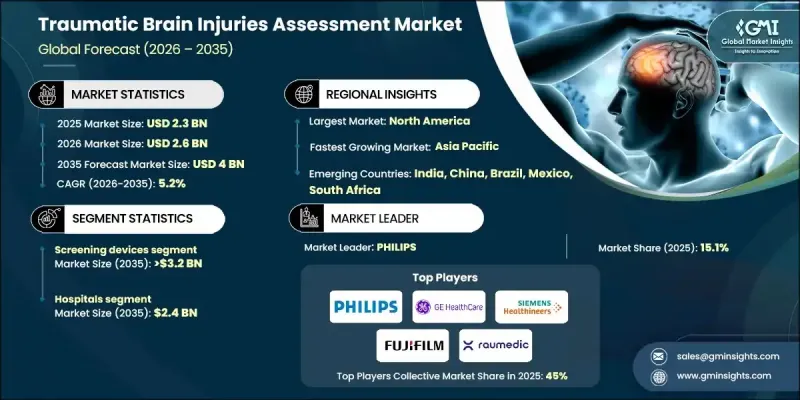
시장 확대의 배경에는 두부 외상 증가 추세, 스포츠 및 군사 관련 TBI 사례의 증가, 신경 영상 진단 기술 및 진단 기술의 지속적인 발전이 있습니다. 외상성 뇌손상 평가에는 뇌손상의 심각성, 기능적 영향 및 전반적인 예후를 판단하기 위한 종합적인 임상적, 인지적, 신경학적 평가가 포함됩니다. 신속한 진단, 치료 계획 수립, 예후 판단을 촉진하기 위해 신경학적 검사, 행동 평가, 영상 진단 기술, 바이오마커 분석이 통합되어 있습니다. 또한 CT, MRI, EEG, 바이오마커 기반 진단 기술의 혁신으로 그동안 간과되었던 경증 및 중등도 TBI를 보다 신속하고 정확하게 감지할 수 있게 되면서 시장은 더욱 활성화되고 있습니다. AI 기반 분석, 객관적 진단 도구, 혈액 기반 스크리닝 솔루션의 채택 확대도 업계의 변화를 촉진하고 있습니다.
| 시장 범위 | |
|---|---|
| 시작 연도 | 2025년 |
| 예측 기간 | 2026-2035 |
| 개시 금액 | 23억 달러 |
| 예측 금액 | 40억 달러 |
| CAGR | 5.2% |
스크리닝 장비 부문은 신속하고 비용 효율적이며 비침습적인 평가 능력을 갖춘 스크리닝 장비 부문이 2025년 80.1%의 점유율을 차지할 것으로 예상됩니다. 이 장비들은 응급실이나 진료 현장에서 뇌손상이 의심되는 환자를 조기에 발견하고 우선순위를 정하는 데 필수적이며, 그 보급을 촉진하고 있습니다.
병원 부문은 2025년 57.9%의 점유율을 차지했으며, 2026년부터 2035년까지 24억 달러에 달할 것으로 전망됩니다. 병원은 두부 외상 환자의 주요 치료 거점이며, 높은 환자 유입량으로 인해 고도의 평가 도구가 필요합니다. 교통사고와 노화에 따른 외상 증가는 병원 입원 환자 수 증가에 기여하는 주요 요인으로, 효율적인 TBI 평가 솔루션의 필요성을 더욱 강화하고 있습니다.
미국의 외상성 뇌손상 평가 시장은 2025년 8억 8,160만 달러로 평가되었습니다. 북미의 수요는 사고, 낙상 및 기타 원인으로 인한 두부 외상에 크게 좌우되며, 응급 의료 서비스 제공자에게 신속하고 정확한 진단 도구의 도입이 절실히 요구되고 있습니다. 병원 및 응급실 부문의 첨단 신경 진단 솔루션에 대한 의존도는 미국 시장의 성장을 지속적으로 견인하고 있습니다.
자주 묻는 질문
목차
제1장 조사 방법과 범위
제2장 주요 요약
제3장 업계 인사이트
제4장 경쟁 구도
제5장 시장 추정 및 예측 : 제품별, 2022-2035
제6장 시장 추정 및 예측 : 최종 용도별, 2022-2035
제7장 시장 추정 및 예측 : 지역별, 2022-2035
제8장 기업 개요
KSM 26.03.05The Global Traumatic Brain Injuries Assessment Market was valued at USD 2.3 billion in 2025 and is estimated to grow at a CAGR of 5.2% to reach USD 4 billion by 2035.
Market expansion is driven by the increasing prevalence of head injuries, the rising number of sports-related and military-associated TBIs, and ongoing advancements in neuroimaging and diagnostic technologies. Traumatic brain injury assessment involves a comprehensive clinical, cognitive, and neurological evaluation to determine the severity, functional impact, and overall outcome of brain injuries. It incorporates neurological tests, behavioral assessments, imaging techniques, and biomarker analysis to facilitate prompt diagnosis, treatment planning, and prognosis. The market is further fueled by innovations in CT, MRI, EEG, and biomarker-based diagnostics, enabling faster and more accurate detection of mild and moderate TBIs, which were often overlooked previously. Growing adoption of AI-driven analytics, objective diagnostic tools, and blood-based screening solutions is also reshaping the industry.
| Market Scope | |
|---|---|
| Start Year | 2025 |
| Forecast Year | 2026-2035 |
| Start Value | $2.3 Billion |
| Forecast Value | $4 Billion |
| CAGR | 5.2% |
The screening devices segment held an 80.1% share in 2025, due to their rapid, cost-effective, and non-invasive assessment capabilities. These devices are essential for early detection and prioritization of suspected brain injuries in emergency and point-of-care settings, driving their widespread adoption.
The hospitals segment held a 57.9% share in 2025, expected to reach USD 2.4 billion during 2026-2035. Hospitals remain the primary care centers for head injury patients, with high patient inflow demanding advanced assessment tools. Rising road traffic incidents and age-related injuries are key factors contributing to increased hospital admissions, reinforcing the need for efficient TBI evaluation solutions.
U.S. Traumatic Brain Injuries Assessment Market was valued at USD 881.6 million in 2025. North America's demand is largely fueled by head injuries stemming from accidents, falls, and other causes, creating significant pressure on emergency care providers to adopt rapid and accurate diagnostic tools. The reliance on advanced neurodiagnostic solutions in hospitals and emergency units continues to drive the U.S. market forward.
Key players in the Global Traumatic Brain Injury Assessment Market include Philips, BrainScope, INTEGRA, RAUMEDIC, Fujifilm, Natus Medical, GE Healthcare, BIOMERIEUX, Oculogica, NIHON KOHDEN, InfraScan, SIEMENS Healthineers, COMPUMEDICS, and ZOLL Medical. To strengthen their presence, companies are pursuing strategies such as launching advanced diagnostic tools with faster turnaround times, integrating AI and machine learning into imaging platforms, and developing non-invasive biomarker-based tests. Many firms are expanding geographically to access high-growth regions and forming partnerships with hospitals, research institutions, and emergency care providers. Investment in marketing campaigns, training programs for healthcare professionals, and after-sales support ensures broader adoption and improved clinical outcomes.
Table of Contents
Chapter 1 Methodology and Scope
- 1.1 Market scope and definitions
- 1.2 Research design
- 1.2.1 Research approach
- 1.2.2 Data collection methods
- 1.3 Data mining sources
- 1.3.1 Global
- 1.3.2 Regional/country
- 1.4 Base estimates and calculations
- 1.4.1 Base year calculation
- 1.4.2 Key trends for market estimation
- 1.5 Primary research and validation
- 1.5.1 Primary sources
- 1.6 Forecast model
- 1.7 Research assumptions and limitations
Chapter 2 Executive Summary
- 2.1 Industry 3600 synopsis
- 2.2 Key market trends
- 2.2.1 Regional trends
- 2.2.2 Product trends
- 2.2.3 End use trends
- 2.3 CXO perspectives: Strategic imperatives
- 2.3.1 Key decision points for industry executives
- 2.3.2 Critical success factors for market players
- 2.4 Future outlook and strategic recommendations
Chapter 3 Industry Insights
- 3.1 Industry ecosystem analysis
- 3.2 Industry impact forces
- 3.2.1 Growth drivers
- 3.2.1.1 Growing incidence of traumatic brain injuries
- 3.2.1.2 Technological advancements in traumatic brain injuries assessment
- 3.2.1.3 Increasing demand for non-invasive devices for TBI assessment
- 3.2.1.4 Rising awareness regarding traumatic brain injury
- 3.2.2 Industry pitfalls and challenges
- 3.2.2.1 Dearth of skilled professionals
- 3.2.2.2 High cost of assessment devices
- 3.2.3 Market opportunities
- 3.2.3.1 Development of portable and point-of-care assessment tools
- 3.2.3.2 Emerging markets with untapped demand
- 3.2.1 Growth drivers
- 3.3 Growth potential analysis
- 3.4 Regulatory landscape
- 3.4.1 North America
- 3.4.2 Europe
- 3.4.3 Asia Pacific
- 3.5 Technology landscape
- 3.5.1 Current technological trends
- 3.5.2 Emerging technologies
- 3.6 Consumer insights
- 3.7 Pricing analysis, 2024
- 3.8 Future market trends
- 3.9 Value chain analysis
- 3.10 Porter's analysis
- 3.11 PESTEL analysis
- 3.12 Gap analysis
Chapter 4 Competitive Landscape, 2025
- 4.1 Introduction
- 4.2 Company matrix analysis
- 4.3 Company market share analysis
- 4.3.1 Global
- 4.3.2 North America
- 4.3.3 Europe
- 4.3.4 Asia Pacific
- 4.4 Competitive positioning matrix
- 4.5 Competitive analysis of major market players
- 4.6 Key developments
- 4.6.1 Mergers & acquisitions
- 4.6.2 Partnerships & collaborations
- 4.6.3 New product launches
- 4.6.4 Expansion plans
Chapter 5 Market Estimates and Forecast, By Product, 2022 - 2035 ($ Mn)
- 5.1 Key trends
- 5.2 Screening devices
- 5.2.1 Computerized tomography (CT) scan
- 5.2.2 Magnetic resonance imaging (MRI)
- 5.2.3 Other screening devices
- 5.3 Monitoring devices
- 5.3.1 Intracranial pressure (ICP) monitoring
- 5.3.2 Partial pressure of oxygen in brain tissue (pBrO2)
Chapter 6 Market Estimates and Forecast, By End Use, 2022 - 2035 ($ Mn)
- 6.1 Key trends
- 6.2 Hospitals
- 6.3 Diagnostic centers
- 6.4 Other end use
Chapter 7 Market Estimates and Forecast, By Region, 2022 - 2035 ($ Mn)
- 7.1 Key trends
- 7.2 North America
- 7.2.1 U.S.
- 7.2.2 Canada
- 7.3 Europe
- 7.3.1 Germany
- 7.3.2 UK
- 7.3.3 France
- 7.3.4 Spain
- 7.3.5 Italy
- 7.3.6 Netherlands
- 7.4 Asia Pacific
- 7.4.1 China
- 7.4.2 Japan
- 7.4.3 India
- 7.4.4 Australia
- 7.4.5 South Korea
- 7.5 Latin America
- 7.5.1 Brazil
- 7.5.2 Mexico
- 7.5.3 Argentina
- 7.6 Middle East and Africa
- 7.6.1 South Africa
- 7.6.2 Saudi Arabia
- 7.6.3 UAE
Chapter 8 Company Profiles
- 8.1 BIOMERIEUX
- 8.2 BrainScope
- 8.3 COMPUMEDICS
- 8.4 FUJIFILM
- 8.5 GE Healthcare
- 8.6 InfraScan
- 8.7 INTEGRA
- 8.8 Natus Medical
- 8.9 NIHON KOHDEN
- 8.10 Oculogica
- 8.11 PHILIPS
- 8.12 RAUMEDIC
- 8.13 SIEMENS Healthineers
- 8.14 ZOLL Medical